
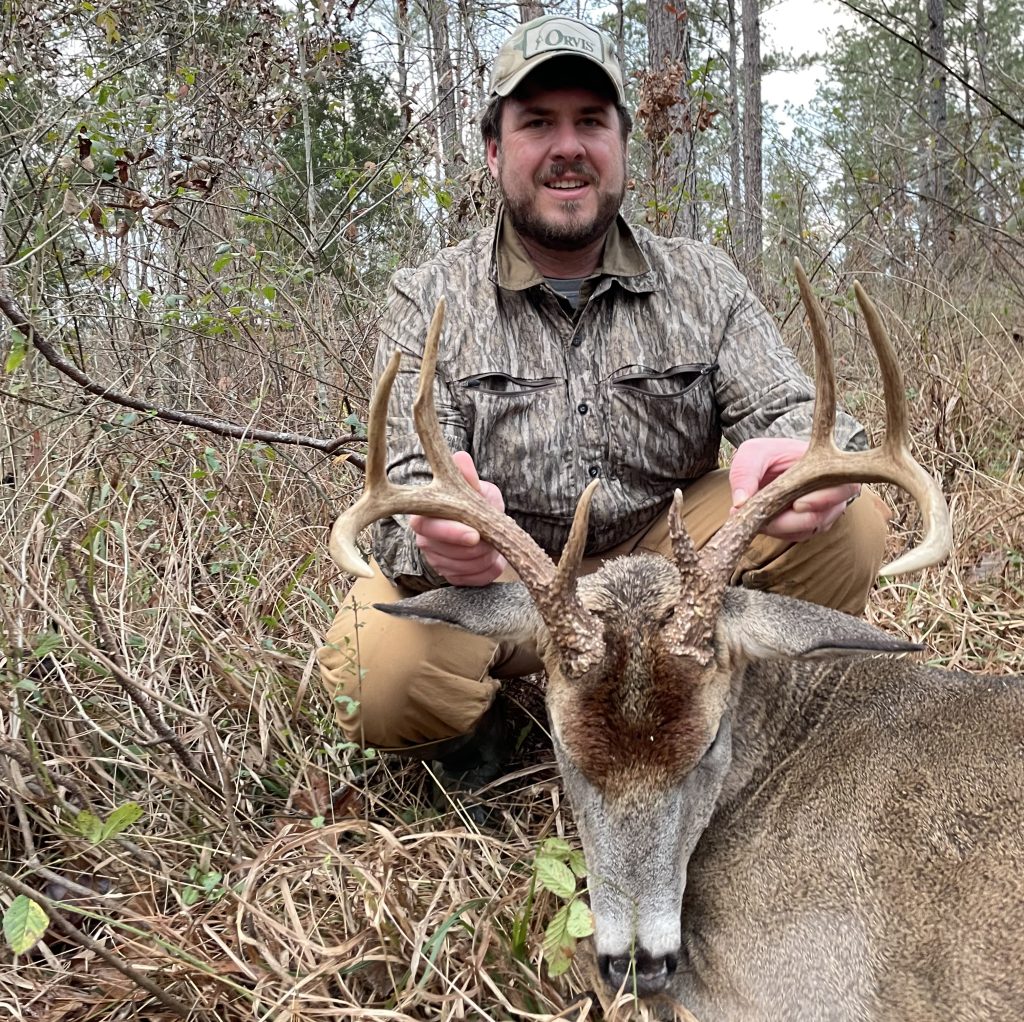
I do believe still hunting to be a lost form of art in the hunting world. Slipping around slowly, seeing new trails, tracks, signs, trees, or wildlife.
Slipping Through the Woods
As you park the cart, you see the steam of your breath and start to slip to your destination, one foot in front of the other, constantly scanning, looking for something that shouldn’t be there. THERE IT IS! A slight flicker of a tail; it’s two does easing up out of their bed. As I ease up against a tree, a third deer pops up. It’s a buck! His head and rack are behind a tree, and I can’t quite tell what he is. His body looks good. There he is—now that’s a fine rack. My heart starts beating faster. He stuck his head past the tree, and that was his last step. A beautiful Tombigbee River swamp 10-point.
Still hunting is slipping slowly and cautiously until you spot game before it spots you, or you reach a destination.
A Question of Names
Now why is it called still hunting when you stalk, and stalking when you’re still? For me, it is a question I have not put much thought into. I reckon it’s like why a parkway is called that when you drive on it and a driveway when you park on it. I would love for us readers to find out, and maybe the bigwigs at Great Days Outdoors can get clear and well-defined answers from our wildlife officials in Montgomery.
Learning the Craft
I’ve spent my whole life in the woods and had some great inspiration for my outdoor passion from people who are like second fathers and mentors (personally and professionally). I remember almost every story told by those men and every encounter I have had of my own.

Conditions, Strategy, and Style
The biggest difference between stalk and still hunting is stalk hunting is spotting the animal first, then making a move to get into range. That can be a challenge in most places in Alabama without having large tracts of land to roam. Still hunting is a more practical approach, especially in the swamp I get to frequent. This may be more challenging on the tree farm tracts but is doable.
I prefer to still hunt on cool mornings with some moisture on the ground. It helps cover your steps, and you can generally dress a little lighter to avoid building up too much body heat. A light rain makes wonderful stalking weather as your scent and sounds are masked by the rain. I am not a fan of frosty mornings or dry conditions. However, a frosty morning can turn into great conditions after it melts, and you may be cold or not seeing much activity and want to explore. I will normally sit in a stand until the frost starts to melt, then ease around after the sun starts to knock it down.
I will try to plan my route based on the area I am hunting and, of course, the wind. A benefit of the wind not being perfect for a stand is you can ease around and put it to your advantage and cover an area you may overlook due to a treestand or box blind not being there. I look at satellite maps all the time, looking for areas with timber or terrain change, and see what winds work best.
Techniques and Traditions
Two of the men I have learned a lot from both do things a little differently as far as techniques go, and I adapt both to what I am doing. My dad’s best friend is like a ninja slipping around the woods. He taught me and my brother the ways of the woods through campfire stories and tales. He loves to stay on the edge of a road, and if he sees something, will slip behind the tree and watch. He likes to wear soft-soled boots when he’s out and about. My best friend’s dad, who has let me hunt with them on their family land on the Tombigbee River for years, will walk and find a log or stump to sit on, then ease on. The river swamp makes soft sole boots a challenge to wear most of the time, so knee boots are almost a must.
I myself will slip on the edge of the road, find a log, stump, or nice tree to lean against, and take one step at a time planning my next step. I may walk 100 yards in 5-10 minutes and sit for 15-20, then ease further down and do the same until I’m ready to head back to camp and hunt the same way coming out of the woods. I will usually try to stay on roads and then slip towards water and walk parallel to that. When you know of some heavily used crossings, I always feel like it’s a good place to stop.
Being Present in the Moment
I like to hunt a spot that may have a few treestands to go between. It just gives you another option to have a great experience in the woods. I may not sit there, but most of the stands are there for a reason. It’s important to keep your eyes and ears open when you’re moving around. You may catch the flicker of a deer’s tail or ear, hear a pig snort or squeal, or hear some rustling of leaves or a twig snap as an animal moves about. One thing to look for is horizontal lines. All your trees are vertical, and the back of an animal is not. Sometimes you’ll see the back and it takes a second to realize it’s an animal. I’ve encountered this a lot when deer or hogs are feeding on acorns and have their faces to the ground. Even more fun is slipping up on some turkeys as they cluck and purr and have no clue you are there.

A Minimalist’s Approach
I am a minimalist hunter. I don’t take a whole lot with me when I’m still hunting. My gear is usually my binoculars, knife, gun, grunt call, and cushion that goes around my waist. I’m not a fan of having a wet bottom, so that is essential. Hunting the swamp gives me the opportunity to shoot fowl, deer, hogs, and small game. Because of this, I carry an obscure gun—a Sauer Drilling (three-barrel)—nine times out of ten. A Drilling is a double-barrel shotgun with a rifle barrel under those. I can shoot whatever I want with that. When it’s late season and waterfowl is closed, my tried-and-true Browning A-bolt goes with me. A lightweight rifle and scope are all you need. I like shorter-barreled rifles for weight savings and they are easier for me to swing if I am in some brush. You will encounter freehand shots, so if you are not comfortable with that, practice or use some shooting sticks if you like to lug those around.
Final Thoughts
A tip I picked up many moons ago was to wake up a little early and let the coffee work before heading out. This means carrying less and leaving less in the woods.
It may not be easy to still hunt your property or club, but it’s always worth a shot! You can pick a little area you may want to scout and take an hour or so to just slip around slowly and have that hunt of a lifetime. Don’t let the grown-up clear cuts shy you away from a still hunt either. The trails are usually easily defined, and easing along the road and sitting to watch one for a bit then easing past it to another is a great way to hunt them. When you’re on the ground, you can see under the canopy better in spots than being in a stand also.
I love to think of a still hunt as an expedition, not knowing what you’ll encounter or what you may find. It just adds to the adventure! I have had the pleasure of coming across all types of game while still hunting. Mallards, wood ducks, mergansers, turkey, owls, and gators, as well as small songbirds, are just some of the things that add to the beauty of being in the woods. Most of those were a stone’s throw away! Deer and pigs are what are most seen, but slipping up on a bobcat is one of the most exciting things to happen. Neither one of us knew what to think! Now, coming across a covey of quail is always the best, even if it may scare the last bit of that morning coffee out of you!