
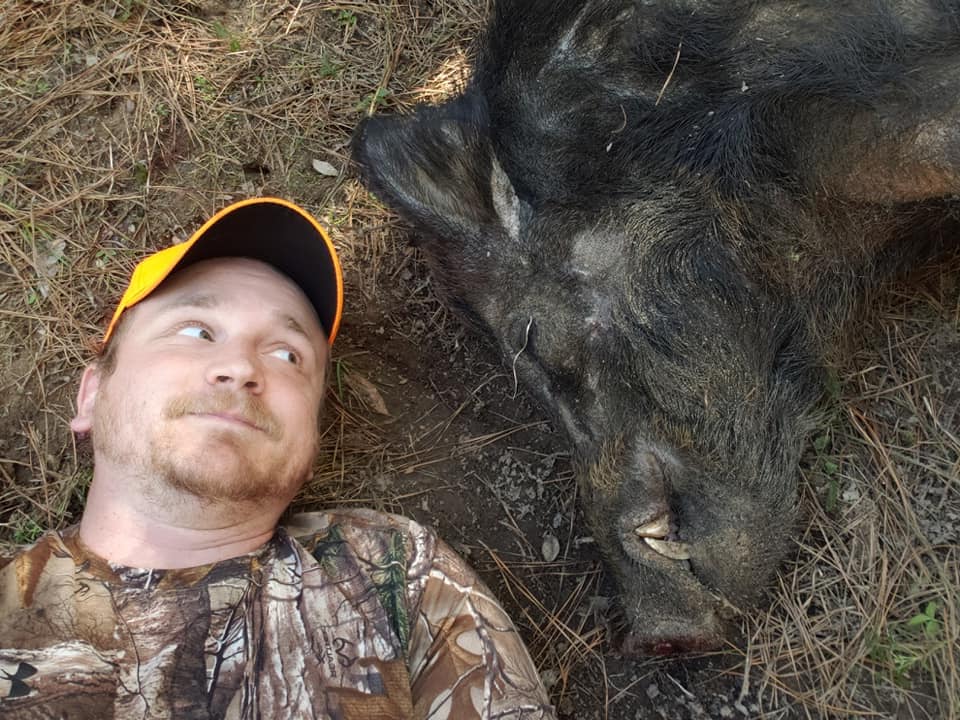
When I was a teenager, feral hogs on Alabama’s public lands seemed like the perfect target. They were big enough to fill a freezer, legal to hunt for months on end, and there were plenty of them around. On paper, it was a dream: meat in the freezer from September through April, a huntable animal that wasn’t as limited as deer or turkeys, and a species that, being invasive, I could feel good about removing from the landscape. Looking back, those early hunts were my first introduction to rimfire hog hunting, a practical and sustainable way to manage wild pig populations while putting quality meat on the table.
The reality, though, was more complicated. On Alabama’s WMAs, hogs can be hunted “incidentally” while pursuing other game, but that means you’re limited to whatever weapons are legal for that other species. For much of the season, that means rimfire rifles, small game shotguns, or archery tackle, not centerfire rifles, which are hands down the most effective tool for the job. If you want to use centerfire, you’re basically stuck hunting them during the few deer gun days, and those are crowded weekends when everyone’s in the woods.
Early Trials: Archery and Shotguns
Archery was my first go-to. I had visions of stalking through the palmettos, slipping an arrow into a feeding hog at close range. In practice, it was tough. Realistic bow range in the field is twenty or thirty yards, and when you’re closing that gap on a sounder of pigs, you’ve got a lot of eyes, ears, and noses to beat. The cover is thick, the vitals are small, and they never stop moving. Brush deflects arrows. Palmetto fronds open expandable broadheads, causing them to veer off course. Even with a crossbow, it’s bulky, awkward, and hard to carry in the dense, wet, and tangled country hogs love.
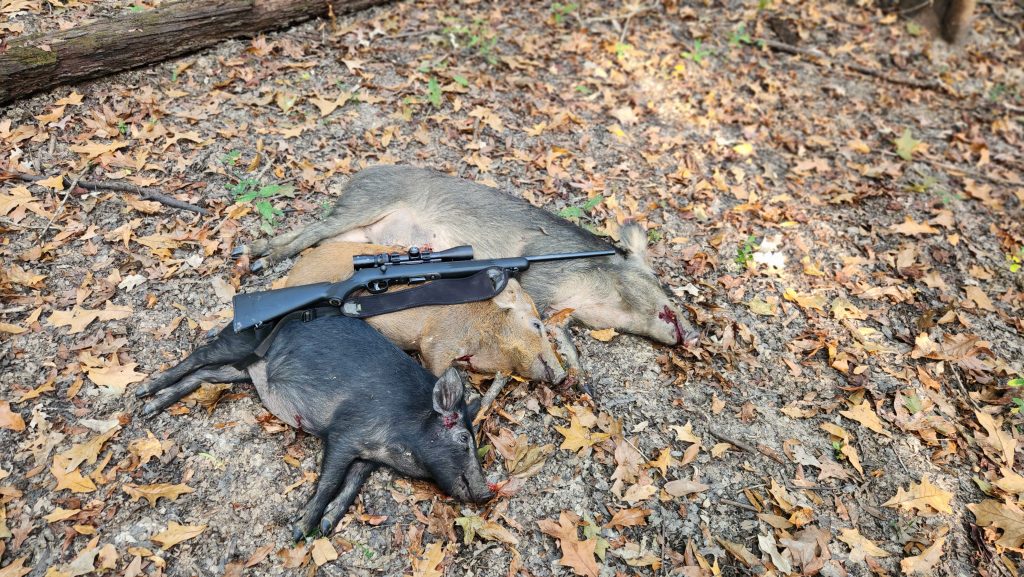
Shotguns are another legal option, and I’ve had some luck with tungsten waterfowl loads, but the range is still limited, and the meat damage is significant. That left rimfire rifles, something most people dismiss for hogs unless you’re making headshots. But headshots aren’t the magic answer they’re often made out to be. A hog’s brain is barely bigger than a golf ball, tucked in a spot most hunters can’t point to accurately. It’s constantly moving as the animal feeds and roots. I tried it and lost more hogs than I was comfortable with.
Learning from Glenn Solomon
That changed after I heard the late Glenn Solomon on the Southern Outdoorsman Podcast. Glenn was a well-known Georgia public-land hunter who worked under regulations similar to ours and, over his lifetime, killed a staggering number of hogs with a .22 WMR using 40- or 50-grain FMJ bullets. His approach to rimfire hog hunting was simple: he didn’t mess with headshots. He shot them low and tight behind the shoulder, just like you’d do on a deer, and swore you could kill any hog in the swamp that way. His posts on the Georgia Outdoor News forum, many of which are still there today, are full of proof, big hogs, little hogs, all taken with rimfire.
First Success with the .22 WMR
Glenn’s posts inspired me to purchase my own .22wmr. I bought my first “22 magnum”, a CZ 512 semi-auto with a 3x9x40 rimfire scope, and sighted it in at 30 yards. I figured that would keep me in the kill zone from twenty to sixty yards without having to think much about holdover. It felt light and quick in the hands, perfect for slipping through palmettos and briar thickets.
The first real rimfire hog hunting test came on an SOA hunt in Dallas County. The weather was cool, the air damp with that early-morning river-bottom smell, and the ground was soft enough that I could stalk quietly. Within minutes of arriving on the property, I spotted my first sounder feeding along the banks of a creek: two sows and a handful of shoats. I eased the rifle to my shoulder, settled the crosshairs low on the near shoulder of the biggest sow, and squeezed. The rifle gave a soft push and a sharp crack. She folded where she stood, and I picked off a shoat with a follow-up shot as it froze momentarily, confused by the scattering of its littermates.
That set the tone for the weekend. I killed eight or nine pigs over those couple of days, everything from a speckled piglet that still looked too young to be on its own to a boar so big I couldn’t move him. On the smaller hogs, the bullet often passed clean through, dropping them instantly. On the big boar, I broke the near shoulder, hit the vitals, and he still only made it about fifty yards before expiring in a tangle of young pines.
By the time I loaded the last hog of the hunt, I remember thinking that I couldn’t have been more effective with my .30-06. The little rimfire had done everything I asked of it, and it had done it in a package that was easy to carry, quick to point, and a pleasure to shoot.
Studying Bullet Performance
As I piled up more pigs with the .22 WMR during my rimfire hog hunting experiments, I started realizing that Glenn’s recommended round might be leaving some performance on the table. Around the same time, I got hooked on a long-running rokslide.com forum thread about hunters using .223 Remington for elk. That thread was fascinating to me because the guys advocating for the round in question were backing up their claims with hard data. Many posts were full of detailed necropsies: bullet weights before and after impact, expansion measurements, photos of wound channels, notes on bone damage, and recovery distances.
It made me realize that a lot of our assumptions about what constitutes an “effective” big game round were formed decades ago, before bullet technology and our understanding of terminal performance had caught up to the 2020s. If those guys could take down elk, a bigger, tougher animal than any hog I’d ever see in Alabama, by pairing the right bullet with the right shot placement, then surely there was room to think differently about rimfire.
That’s when I started treating my hog hunts as field experiments. Every pig got the same post-mortem treatment. I measured heart diameter and spine length to estimate live weight using a formula published by Oregon State University, logged the range and shot angle, and noted how far the animal traveled before expiring. Then I opened them up to see what the bullet had done, taking pictures at each step of the way. I photographed entry wounds, broken bones, internal organs, and exit wounds. It was gory, unpleasant work, but it gradually gave me a view of what was happening when my bullet went through an animal.
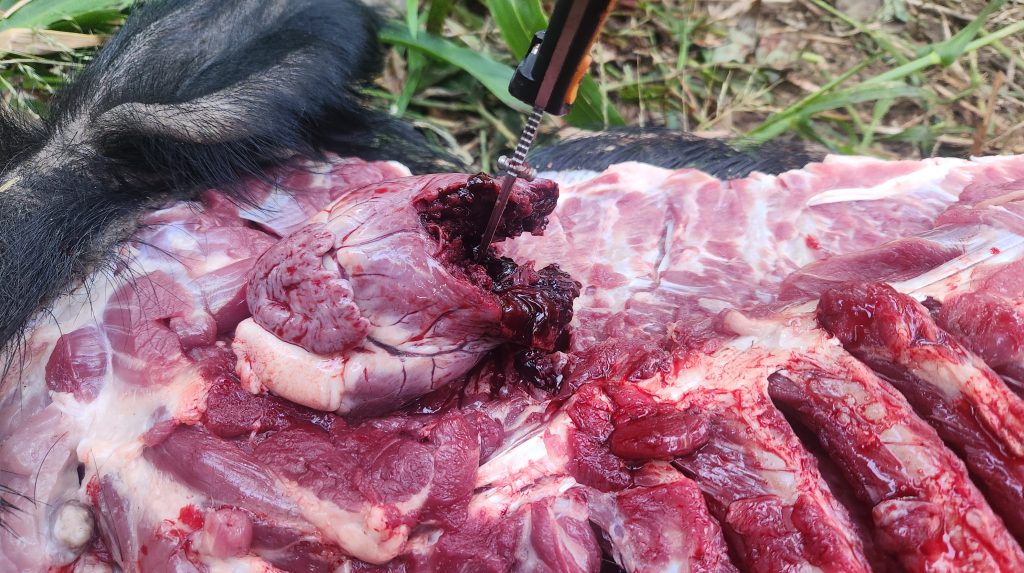
The FMJ’s penetration was impressive, no question. On small pigs it would consistently shatter shoulders without slowing down. On big boars, it usually broke the near-side shoulder at its thickest point and still punched through the vitals or even fractured the far-side shoulder. But those same traits that made it so good at getting deep could also work against it. On broadside shots through the ribs, I almost never recovered bullets, and there was very little soft tissue damage and often a non-existant blood trail. The bullet was just penciling through, and in the kind of dense cover hogs call home, that meant I sometimes lost pigs I knew were dead.
The more necropsies I did, the more I realized I wasn’t just looking for “enough” penetration. The mighty-mini-magnum had plenty of that! I was looking for the balance point where penetration and expansion worked together to anchor hogs quickly and leave a good trail when they didn’t drop on the spot. That realization sent me on a stretch of ammo experimentation that would eventually land me on my current favorite load.
Solving the Overpenetration Problem
I started my own informal test program for rimfire hog hunting, buying every .22 WMR load I could get my hands on. There really aren’t all that many on the market, but there’s enough variety to cover a range of designs, everything from lightweight, poly-tipped “varmint” rounds like the CCI V-Max, to heavy 50-grain solids, to specialty defensive loads like Hornady’s 45-grain Critical Defense.
I shot pigs with all of them, recording the same data I had for the FMJs. The poly-tipped bullets were spectacular on small hogs, creating massive soft tissue damage, but they were prone to fragmenting on bone, especially shoulders, which sometimes meant they didn’t make it to the vitals on bigger animals. The heavier solids penetrated excellently, but I was right back where I’d started, great pass-throughs with not enough disruption. Hollow points were hit or miss; some expanded too aggressively, others barely at all.
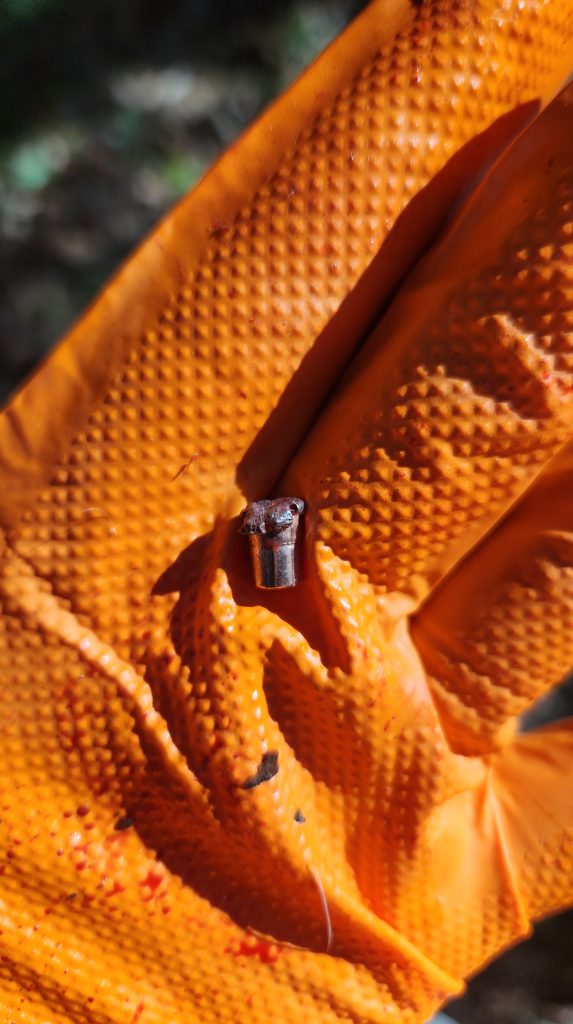
Ultimately, it was the jacketed soft points that hit the “Goldilocks Zone.” They didn’t blow apart like a varmint round, but they still expanded in a controlled way, dumping more energy into the pig instead of the dirt beyond it. Eventually, I settled on the easily obtainable and consistently reliable Winchester 40-grain Jacketed Soft Point. In necropsies, these bullets consistently showed ideal performance, mushrooming to about 150 percent of their original diameter, holding together with around 98 percent weight retention, and either stopping just under the far-side hide or exiting with a large, leaking hole.
I’ve got one recovered from an 80-pound hog where it passed through both shoulders, lodged just under the skin, and left a hole through the heart big enough to stick my thumb through. That pig dropped where it stood. On the average-size hogs I prefer to shoot, 60 to 100 pounds, the JSP became a bang-flop machine. The balance was finally there: enough penetration to handle a quartering-to shoulder shot; enough expansion to wreck the soft tissue of the lungs, heart, and liver; and no more penciling.
Switching to that bullet transformed the .22 WMR from a “good enough” compromise into what I honestly consider a best-in-class tool for public-land hogs under our weapon restrictions. It solved the overpenetration problem without giving up the advantages that drew me to the caliber in the first place.
The .22 WMR as a Public-Land Hog Rifle
That bullet has made the .22 WMR a public-land hog hammer. In the dense bottomland cover where most of my shots are inside 50 yards, I honestly consider it nearly as effective as a centerfire. The rifle is light, easy to carry, and quick to shoulder in the brush. The recoil is negligible, so you can shoot it accurately and quickly. Ammo is cheap enough to practice with regularly, which means confidence in the field. Last September alone, I killed seventeen hogs with that setup and lost only one.
Building Your Own Rimfire Hog Setup
If you want to try rimfire hog hunting it yourself, choose a short, handy rifle you can carry all day. Semi-autos like the CZ 512 or the Savage A22 Magnum are excellent, but bolt guns work just as well. Use a scope with a 50-yard parallax setting for sharp focus up close, and zero at thirty yards to keep your point of impact within an inch or so from twenty to sixty yards. Load it with a 40-grain Jacketed Soft Point, and don’t be afraid to aim for the shoulder. Hog anatomy isn’t the same as a deer’s; their vitals are farther forward, so what looks like a behind-the-shoulder shot on a deer is a gut shot on a hog.
Final Thoughts
Rimfire hog hunting may not be the obvious choice, but in the right conditions and with the right ammo, it’s not just a stopgap for public land restrictions. It’s an efficient, ethical, and incredibly satisfying way to hunt, with the bonus of a season that spans most of the year.