
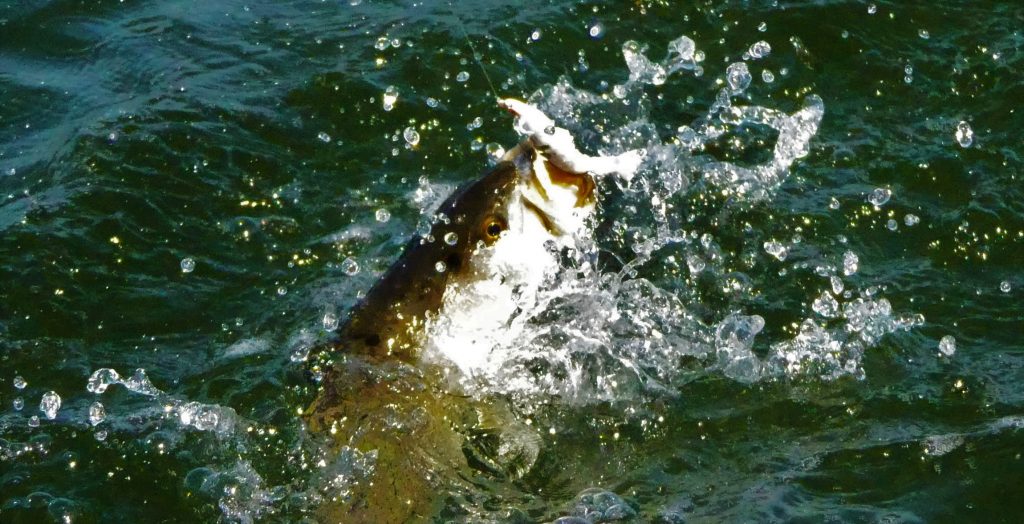
No matter the season, anglers who are serious about catching speckled trout in our coastal waters need to think about things that smell and we’re not talking now about unwashed anglers after a long day’s fishing. When it comes to the best speckled trout lures, action, color and scent can all play important roles in fooling big specks, and a lure that combines all three can give anglers an advantage, particularly when the fish are reluctant to bite.
And for day in and day out good trout lures that combine all three factors, it’s hard to beat the Fight Club series of scented soft plastics made by Fishbites, based out of St. Augustine, Florida. We reached out to Fishbites to find out what makes these lures so effective and how anglers can get the most out of them.
And Why Does Scent Matter to Speckled Trout?
“Our bait research was undertaken by Dr. William Carr who was the foremost authority on chemoreception in marine species. His research concluded that bait odors we humans smell in the air, gasses, have virtually nothing in common with the chemicals that fish detect in the water.

Fish can only detect substances that actually dissolve in water. As they swim, fish will detect these chemicals with their nose and mouth because they use both in tandem to detect and track down injured prey items,” Michael Carr of Fishbites explained.
“But the scent component is only part of what makes an effective bait. Once the fish bites, the mouthparts take over and if the anticipated flavor does not match the scent the fish tracked, the fish will often spit the bait out,” Carr explained. “Think of it this way: if you drive past a fast-food restaurant and smell french fries, and you pull in to get some, if these french fries taste like cardboard, you’re probably not going to get past the first few fries.
Fish are somewhat the same way and Fishbites’ unique flavor/scent formulation has taken this into account from day one of its introduction. Fish not only attack our lures aggressively, but they hold on longer because of the flavor we infuse into each bait.”
There are Scents, and There are Tough Scents
Scott Jones, who served as sales manager for Fishbites when this article was originally reported, is also an avid speckled trout angler. Jones pointed out that one of the major benefits of the Fight Club lures is their long “hook life” and the fact that they hold up to abuse.

“One thing that’s special about all of the Fishbites baits is their durability. Unlike other brands of scented lures, Fishbites are tough,” Jones said. “It’s common to catch over a dozen specks on a single Fight Club bait. This morning, I caught two redfish and seven specks on a single one.”
Captain Mike Wilson of Bama Slam Inshore Adventures in Gulf Shores fishes the Alabama Gulf Coast region for specks quite often and he agrees that Fishbites are some of the top speckled trout lures.
“Fishbites Fight Club saltwater baits are extremely durable and outlast other scented soft baits by far. They last cast after cast, fish after fish, making them a very cost-efficient alternative to other scented soft and live bait. But most importantly, they catch fish,” Wilson said.
With many soft plastic lures, anglers can go through several baits in a single fishing trip, and that can get expensive quickly. Fishbites Fight Club lures are designed with durability in mind, allowing anglers to catch multiple fish on the same bait while continuing to release scent into the water.

Still, there are lots of choices for anglers to use when throwing Fishbites Fight Club Series soft scented baits to the specks. A multitude of forms, each with different actions and different colors are offered.
The Fight Club series includes the 5-inch Dirty Boxer, a curly-tail grub with plenty of action, the 4-inch Butt Kicker, a paddle-tail bait with a pronounced swimming action, the 3.5-inch Fight’n Shrimp, a natural-looking shrimp imitation, and the 5-inch Brawler, a jerkbait that can be rigged weedless for fishing over grass beds.
The Fight Club lineup has also grown to include a larger 6-inch Grub, a 5-inch Mullet designed to imitate a substantial baitfish meal, and the Mini Mawler, a scented twitchbait that offers anglers another profile for working around inshore structure and other feeding areas. With several shapes and sizes to choose from, anglers can match their presentations to the forage trout are feeding on.
These baits don’t require a jar or other cumbersome vessel to store them. The resealable packaging makes them easy to keep in a tackle box, although anglers should keep the bags sealed when not in use and avoid leaving them exposed to excessive heat. Proper storage helps preserve the lures’ condition between fishing trips.
Fight Club baits come in different shapes and actions for different situations, and anglers have a variety of colors to choose from. The selection varies by lure, with the Dirty Boxer currently available in 10 colors, including natural baitfish patterns and brighter options for stained water.
How to Fish the Scented Soft Lures for Specks
“I like to use the Fight Club series of lures in clean, moving water around sharp bends in creeks and bayous, and if there’s a drop off, that’s even better. In deeper water, I may go to a 3/8 oz jig head. Around docks and oyster bars, the Fight Club lures can be deadly,” Jones said.
Also, the Fight Club series of scented soft lures are great under a popping cork for a “search” lure to help locate active specks.
The key is matching the lure’s action and depth to the conditions. When trout are actively feeding on shrimp and small baitfish around shallow flats or grass beds, a lighter jig head or popping cork can keep the lure in the strike zone. In deeper water, heavier jig heads help get the lure down to fish holding along channel edges, drop-offs and other structure. As water temperatures fall, slowing down the retrieve and allowing the bait to spend more time near the bottom can make a big difference.
“The Dirty Boxer in white or chartreuse color, specks will take even a motionless bait because of the scent which draws the fish,” Jones commented. “If the specks are on a hot bite and then the bite tapers off, try switching color or body style. A different color or a different action from the lure may trigger the bite again.”

Captain Mike Wilson from Bama Slam Inshore Adventures has found Fishbites baits, and the Fight Club Series in particular, to be some of the best winter speckled trout lures. When he originally shared his recommendations, the lineup consisted of four primary lure styles, all of which remain available today.
“I use a variety of Fishbites Fight Club lures, and if specks are present, one or more of the four selections will usually catch fish,” Wilson said.
When it comes to some of the specifics of fishing Fight Club baits in winter and early spring, Wilson has some advice.
“Whatever bait I select, I rig it on a FCC Lures ¼ oz. jig head. Most of the time I choose red, but occasionally I will try unpainted, white or yellow. I tie it on eight pound Vicious low-vis green mono. But when the water is really clear, I drop down to a six pound. test which will garner more strikes,” Wilson said. “I fish the bait ‘low and slow’, and I mean really slow.
The specks are slow and lethargic in the winter cold water, and they are on the bottom. Let the bait drop to the bottom before retrieving. Fish it like you are bass fishing with a plastic worm: slow retrieve, bump off bottom, let it sit, bump it again, slow retrieve. If you think you are going too slow, slow down a little more.”
Fishbites also offers jig heads specifically designed for the Fight Club lures, with 1/8-, 3/16-, 1/4- and 3/8-ounce options for fishing different depths and currents. The jig heads feature strong, wide-gap hooks and a keeper system designed to hold the soft plastic securely in place, giving anglers several options for matching their presentation to the conditions.
“Adding Fishbites Fight Club saltwater baits to your tackle arsenal will help to consistently catch more speckled trout,” Wilson concluded.
This slow, bottom-oriented approach can be especially effective when cold weather pushes speckled trout into deeper rivers, canals and protected channels. However, fish won’t always remain glued to the bottom. During warmer periods, especially on sunny afternoons, trout may move onto nearby shallow flats to feed. The best speckled trout lures are those that can be worked at the right depth and speed to match these changing conditions. Anglers should pay attention to water temperature and the location of baitfish rather than assuming the trout will always be holding deep.
Of course, scented soft plastics are only one option for catching speckled trout. Depending on the season, water clarity and what the fish are feeding on, topwater plugs, suspending twitchbaits and other soft plastics can also produce some impressive catches. For more ideas, check out our guide to speckled trout lures that work from Virginia to Texas and learn more about deep-water tactics for winter speckled trout.