

For anyone considering building or rebuilding a boat dock in coastal waters, one of the most important steps may come before construction even begins. Selecting the right pilings—the strong posts sunk into the bottom that support the entire structure—is crucial to the dock’s longevity and safety. Choosing the wrong pilings can lead to problems and even potential danger. The two most common options for dock construction are traditional wooden pilings and newer composite plastic-based pilings.
We asked Luke Walding of Martin Marine Construction in Orange Beach, Alabama, about the construction of wooden and plastic dock pilings. He explained, “Installation is about the same, lowering them down with an A-frame barge while jetting them into place.”
Let’s examine the key factors involved in choosing dock pilings.
Value: How It Is Determined
The upfront cost of wooden pilings for a new dock can vary significantly by location. For instance, wooden pilings may be much more expensive in Miami than on Dauphin Island. Composite plastic-based pilings also fluctuate in price, but their cost tends to be less affected by location.
When it comes to initial investment, wooden pilings are cheaper than plastic ones. The exact price difference depends on location, piling size, and even the time of year.
Luke Walding explains, “Plastic or composite pilings definitely have a larger upfront cost, but in the long run, they outlast wood pilings. A good quality wood piling might last 20 years, while composite can last more than 50 to 60 years. Looking at the life cycle cost, composite is actually cheaper over time.
“However, there’s also the hurricane factor. Say you invest in composite pilings for their longevity, but then a Category 5 hurricane comes along—your investment is still at risk of being washed away, no matter how strong you build it. We install pilings as deep and strong as possible to account for this, but there will always be a storm powerful enough to destroy even the best-built dock.
“What’s interesting, though, is that if you look at the technical data, composite pilings have significantly higher lateral and compressive load ratings than traditional wood, meaning they have a better chance of withstanding major storms. That’s definitely something to consider.”
Another advantage of composite pilings is sustainability. Unlike wooden pilings, which eventually end up in landfills, plastic composite pilings are fully recyclable. When a dock reaches the end of its lifespan, these pilings can be removed, recycled, and repurposed rather than taking up space in a landfill.
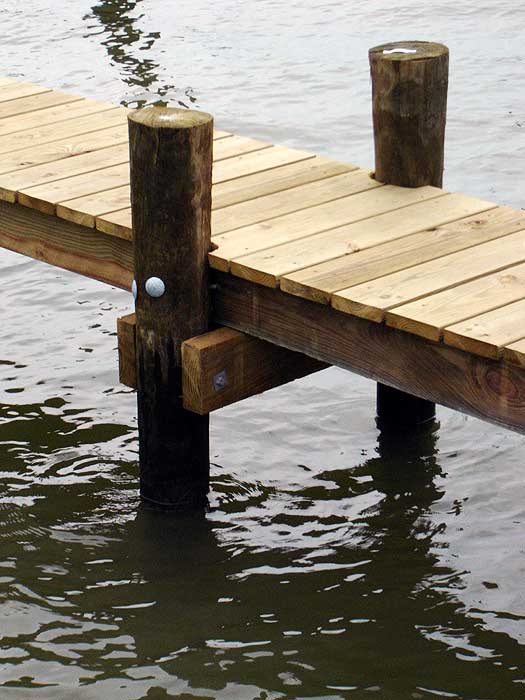
Longevity: A Key Consideration
Docks are a long-term investment. Building or rebuilding them is costly, so it’s important to extend the life of their pilings.
Wooden pilings once lasted 20 years or more. Now, due to restrictions on chemical treatments, they often last 10 years or less. Protective wraps and hard plastic coatings can help, but they increase costs. As a result, wooden pilings can be as expensive as, or even more expensive than, composite options.

Plastic composite pilings last much longer. EcoPile by Shoreline Plastics, a well-known brand, offers a 25-year guarantee. However, these pilings often last 50 years or more.
Conclusion
When choosing dock pilings, value depends on more than just the upfront cost. Wooden pilings are initially cheaper and widely available along the U.S. coastline, but they require maintenance to prevent marine borer damage and have a considerably shorter lifespan.
Plastic composite pilings, like the EcoPile system, have a higher initial cost but require no maintenance and will likely outlast the dock itself.
Luke Walding advises, “Upfront costs are definitely higher for EcoPile or other composite pilings, but when you analyze the life cycle cost, you’ll see that they are roughly 2.25 times more expensive than traditional pilings but last four times as long. That brings the lifetime cost well below that of replacing wood pilings every 10 to 15 years.
“My recommendation, having worked with both materials, is to go with EcoPile or similar composite pilings if it fits your budget. Be sure to review the technical specs before making your final decision to ensure it’s the right fit for your project.”