
Picking the right location for a new game food plot is much like choosing a location for a new business. Location is everything in both of these projects.
A food plot builder needs to look at possible sites for the food plot in terms of sunlight- good game food production needs adequate light for the planted food crops to grow. The presence of a water source is very important- combine good food and water close to the food plot and we have a winner. Of course, if game is already present in the vicinity of a new food plot, the task of attracting and growing game animals is much easier and much quicker to develop.
Choosing a Location
We asked Dave Edwards of Tall Tines Wildlife & Hunting Consultants, Inc. to tell us about choosing the best location for a new food plot. Edwards says, “When establishing a new food plot there are several factors that you should consider: What’s the goal of the food plot? Although all food plots “feed” deer, I typically categorize plots as “nutrition” plots, which are designed to provide deer with an abundance of high-quality forage throughout the year, or “hunting” plots, which are designed to attract deer, particularly mature bucks, for hunting opportunities. Nutrition plots are generally larger and more open fields that offer lots of acreage (5-10 acres in size) for planting summer crops, perennial crops, along with cool-season plots. I often refer to these fields as destination plots because this is where many deer end up after dark. Hunting plots are smaller plots with lots of edge habitat. Examples of hunting plots include rabbit ear designs, hub & spoke designs, bow tie designs that range from 1 acre to 3 acres in size.

What is the soil type? Soil type is an extremely important factor to consider when selecting a new food plot location. Although various species of crops are adapted to wet or dry soils, a well-drained loamy soil offers the best growing conditions for most food plot crops. That is, pick a location that is normally not too wet (e.g., bottomland) and not too dry (e.g., sandhill).”
Edwards adds, “Where are other food plots located? Food plots should be scattered across a property’s landscape to ensure quality food is available across the property. Land managers should avoid installing food plots in close proximity to each other, particularly if both plots will be planting fall-attractant crops. Doing so will result in fewer deer sightings because deer will be split among the two plots.”
Mistakes New Builders Make
Dave Edwards tells us, “ The biggest mistake I see hunters/landowners make when creating a new food plot is not considering how it will be hunted when designing it. They simply create a food plot because it looks like a great place to create one without thinking about how it could be hunted without disturbing deer. When picking the location and layout of a food plot one should consider where the stand should be located, how hunters will access the stand, and the wind direction the plot could be hunted. For example, if the access road comes into the field on the north end, it would be impossible for hunters to access a stand on the south end without impacting deer. Thus, this particular setup would require a stand on the north end of the field, which means that a south wind would be required to hunt the plot.
Poor Design
The second biggest mistake I see is poor design/layout when creating a hunting plot. Although large, open fields offer lots of acreage to plant more food, which means more deer will be using the plot, they are not ideal for seeing and harvesting mature bucks. In this situation, you are hoping a mature buck will do something that goes against everything in his body – step out into a wide-open area and expose himself to danger. Mature bucks certainly use large food plots, but most of this use occurs under the cover of darkness. Many mature bucks certainly get killed in large/open fields, but most of these harvests take place during the rut where the opportunity to breed overrides a buck’s instinct to avoid the field. Hunting plots should be more linear and/or have lots of edge. Mature bucks are much more comfortable entering smaller fields or fingers of food plots where they are a bounce or two from security cover if danger presents itself.”
Design of Food Plots
The best time a potential food plot creator can spend is before any actual work on the ground is done. Planning is crucial for best results. The plot builder will need to consider if the new plot is a food-only plot or a plot which is to be hunted. The size of the plot is important. Plots need to fit the available land, and they need to be neither too large nor too small, and this will be an individual case decision. Even the shape of the plot needs consideration.
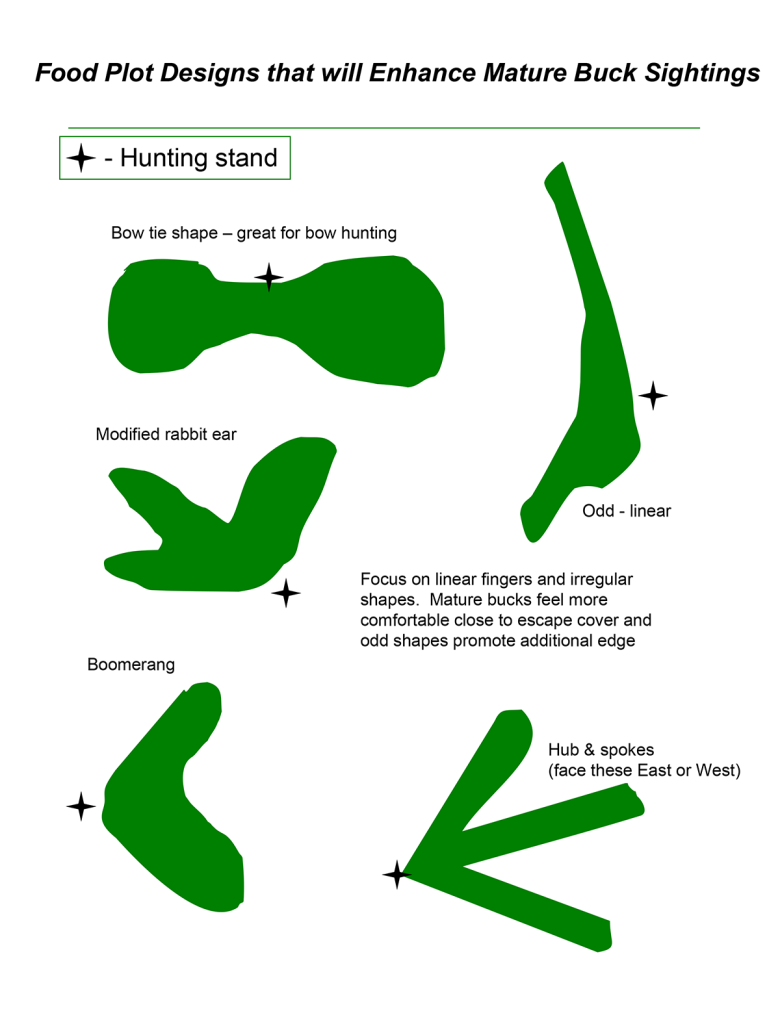
The plot builder will need to consider the seasonal rotations of crops. Not all wildlife forage grows at the same time and at the same rate. A crop rotation schedule is needed Edwards tells us,” Deer use of food plots will increase when located along ecotones – where two or more habitat types join. For example, a food plot that is located between a clearcut, mature hardwood bottom and a pine plantation will typically receive higher deer use than one that is in the middle of a pine plantation. Pick areas to create a food plot like you would pick areas to place a deer stand – areas with high habitat diversity or along the edge of two habitats. Deer are edge species, meaning they spend much of their time in edge habitat. Locating food plots where deer already want to be will translate to higher deer use.”
Plant Species to Include
When we asked Edwards to advise new plot builders on the selection of crops to plant to attract game, he says, “What should I plant is the number one question I get when hunters ask about food plots. My answer is always the same – have you already properly amended the soil to ensure desirable pH and fertility? Ensuring the soil is amended properly to promote optimal crop growth is more important than what you plant.
Once the soil is properly amended, the species to plant will be determined by many factors, including the type of plot, season, climate, soils, and goals. There are essentially three types of food plots: summer annual plots, fall plots, and perennial plots.
Summer annual plots typically include crops or blends of various varieties of soybeans, lab lab, peas, corn, or vetch. One of my favorite summer crops is forage soybeans.
Fall annual plots often include blends of small grains, annual clovers, and brassicas. Small grains include crops such as winter wheat, rye, and oats. There are many varieties of annuals. clovers, such as crimson clover, berseem clover, etc. Brassicas often include species such as rape, kale, and beets. This blend of species offers excellent attraction and nutrition over several months.
Perennial plots often include species such as white clover, chicory, and alfalfa. When properly managed, these crops offer wildlife a quality food source throughout the year for many years. My go-to perennial plot in the Deep South is a blend of durana white clover and forage chicory.”
Costs of Building a Food Plot
Of course, like everything else, making a new game food plot comes down to money. We asked Dave Edwards to advise us on this point. He says, “The costs of creating a new food plot vary depending on the situation and the work required to convert land into tillable ground. Of course, starting with a forested area will be more expensive than having a field to work with. Here are a few costs that are commonly associated with creating and establishing a new food plot.
Clearing
Every situation is unique, but this work often includes removing trees, stumps, cleaning up debris, and blading or forestry harrowing to smooth the area in preparation for farm tractor work. This work often requires the use of dozers, mulching machines, or excavators. Outside contractors are often hired to do this work, and the cost depends on the equipment being used. However, these costs cost around $125-$350 per hour but vary depending on your location and competition among contractors.
Harrowing
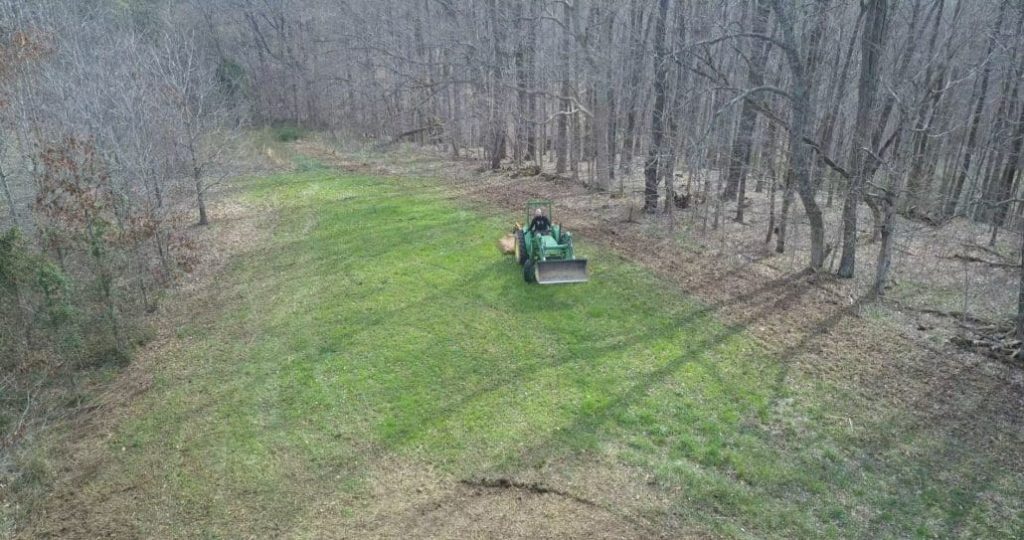
New food plots will require harrowing to break the ground and incorporate vegetation and debris into the soil. Several passes are needed. The first few passes are done with aggressive harrows that turn the ground, while the remainder of the passes are applied to smooth the ground and prepare a desirable seed bed. Costs for harrowing depend on whether you own a tractor and harrow or must pay someone to do this work. If you hire someone, costs are commonly $75-$200/hour.
Lime & Fertilizer
Once a new food plot has been harrowed, the soil should be tested and properly amended with lime and fertilizer. Lime itself is usually not overly costly. It is the delivery and spreading fees that add up. Lime and spreading fees vary but are typically $40-$75/ton. It is common for new food plots in pine country to require 4-5 tons of lime initially, with 1-2 tons required in future years. Fertilizer is commonly the most expensive component of planting a quality food plot. The cost varies depending on your location but is commonly in the $800-$1000 per acre range (including spreading fees).”
How to Reduce Start-Up Costs
And finally, we asked for advice on ways that a new food plot builder might save a little money while still getting a good food plot. Edwards advises us, “This depends on the situation and what is required to establish a new food plot. Clearing debris and stumping the area is expensive if timber must be removed to create a new food plot. If you have time, one cost-effective strategy is to allow the area to sit fallow for a couple years before initiating the site prep work. During this time, stumps deteriorate and rot which will significantly reduce the amount of effort needed to stump and smooth the area (stumps will bust up much easier).
“Once a plot is created and plant-able, some planting methods are more cost-effective than others. For example, no-till planting strategies remove the need to harrow the field several times, which saves time and money.
“If you are trying to save money, avoid buying expensive commercially marketed blends with big bucks on the bag. While many of these products are great, they are much more expensive than seeds you can buy from local feed & seed stores or farmers’ coops.
“Do not skip liming when trying to save money. Ensuring proper soil pH is essential to getting the most out of your food plots.”
How to Finance it All
It is possible that some landowners who want to build a productive food plot for wildlife on their land have the pocket money to do this construction on their own. However, many if not most landowners need to have some financial help when it comes to building food plots.
A reliable local lender who can help landowners who want to construct food plots as part of a larger land improvement project is First South Farm Credit. Taylor Hart, branch manager of the Auburn-Opelika branch of First South Farm Credit, says that if a landowner needs financing help with a major land improvement project, including food plots, First South can help. Small simple food plot construction will probably not be financed. Hart says, “If a project involves road construction, fencing, large scale de-stumping -anything that improves the value of the collateral land, we can work with that.”
Hart continues, “ If we’re doing land improvement loans, we can finance for as long as 30 years, and the loan rates will depend on the individual borrower and current interest rates. For more specific information about a land improvement load involving food plots, landowners should contact First South Farm Credit online at or call one of the many local branches.
Important Contact Information
DAVE EDWARDS
Certified Wildlife Biologist/President
Tall Tines Wildlife & Hunting Consultants, Inc.
dave@talltineswildlife.com