
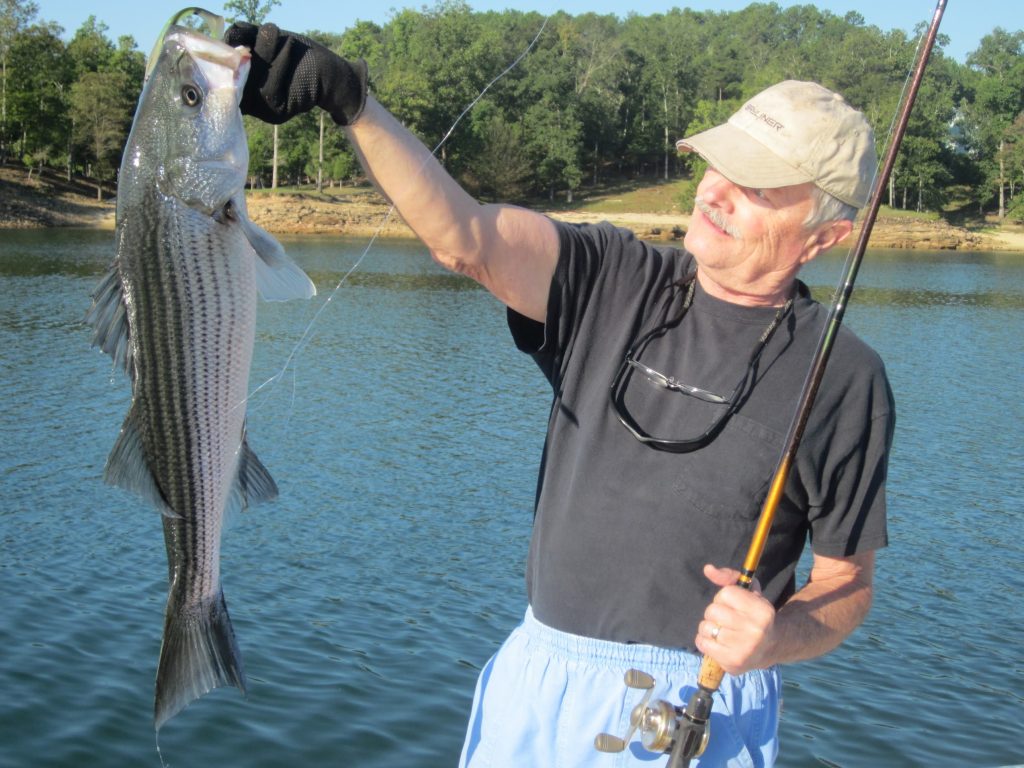
If you’ve ever been blasted on the end of a fly line by something that felt like a torpedo with gills, you might’ve already met one of Alabama’s most underrated native game fish: the Gulf strain striped bass. While they don’t get the same press as redfish or largemouth bass, these stripers are a local treasure—and a surprisingly ancient one at that.
Atlantic vs Gulf Strain Striped Bass
Striped bass in general come in two strains: Atlantic and Gulf. On the outside, they’re nearly identical. You’d need a DNA test to reliably tell them apart, but the story of how the Gulf strain came to call Alabama home is what makes them truly special. Their roots go all the way back to the last Ice Age, when colder water temperatures allowed Atlantic striped bass to migrate around the tip of Florida and push west along the Gulf Coast. Over time, a population settled into the river systems between the St. Johns River in Florida and the Mississippi River, particularly thriving in Alabama’s warm, spring-fed rivers.
Where Gulf Strain Striped Bass Live in Alabama
That long-term residency had a major effect. These stripers adapted to tolerate higher temperatures—up to 80 degrees in some cases—and developed behaviors and physiology suited specifically to life in Gulf Coast rivers. Before Alabama’s river systems were dammed in the 1970s, these fish were fully anadromous. That means they lived part of their lives in saltwater, typically the Gulf of Mexico, and ran up freshwater rivers to spawn. They’d fatten up for about half the year in the Gulf before heading back upstream to lay their eggs during spring’s magic window when water temperatures hit the mid-60s.
Historically, Alabama’s Coosa, Tallapoosa, and Cahaba Rivers were the epicenters of this activity. The fast-moving shoals in these rivers were essential for the eggs to tumble downstream in oxygen-rich water for two to three days—any longer in one place, and the eggs would suffocate under silt and sediment. Over time, Gulf strain striped bass adapted even further. Their eggs grew denser to handle the higher flows of Alabama’s rivers, and they developed behaviors that mirrored steelhead more than any Southern freshwater fish—migrating long distances, thriving in cold-water pockets, and responding heavily to seasonal flows.

But everything changed with the rise of dams. Once the rivers were blocked, stripers lost access to the historic shoals where they had successfully spawned for generations. Much like the Alabama sturgeon, whose numbers dropped dramatically, the Gulf strain striper began to vanish from its native range. Yet a few populations managed to hold on in impoundments like Lewis Smith Lake and Lake Weiss. In fact, the stripers in Weiss still make impressive runs up into Georgia’s Etowah and Oostanaula Rivers, showing a lingering spark of their migratory instinct.
The stripers that call Alabama’s coastal rivers home today—places like Fish River, Fowl River, and Dog River—are the product of years of hatchery efforts. According to Peter Jordan, a passionate angler and owner of Lost Angler Fly Shop in Mobile, the Alabama Department of Conservation and Natural Resources has quietly led a comeback story for these fish. About eight years ago, biologists started taking a hard look at bringing Gulf strain stripers back to their home waters. Stocking began in earnest, but because these fish don’t leave the rivers for their first three years of life, it took a while before anglers started catching them. When they did, the feedback was electric.
“People started getting smoked fishing for redfish or speckled trout,” Jordan says. “They’d hook into something on a popping cork and shrimp, and the next thing they know, a striper is peeling line like crazy. Pound for pound, these fish are unbelievably strong.”
Best Seasons and Water Temps for Catch and Release
It’s not just brute force that makes Gulf strain stripers special. It’s their story, their resilience, and their role in painting the bigger picture of what Alabama’s rivers once were—and could be again. While the fishery remains hatchery-supported and doesn’t have widespread natural reproduction in the Mobile-Tensaw system, the stocking program has expanded to more rivers each year. Still, Jordan urges anglers to be mindful. “There just aren’t that many fish. You might catch one or two in a day, and that’s a phenomenal day.”

He’s also quick to caution against targeting them in summer. Once water temps climb above 75 degrees, catch-and-release survival rates plummet. “This is a fall and winter fish,” he says. “Go easy on them in summer—if you catch one when it’s hot, keep it in the water the whole time and take extra care reviving it.”
Top Alabama Lakes and Rivers for Stripers
For folks upstate, the picture looks a little different. Stripers in Lake Martin, Weiss, Logan Martin, and Lewis Smith enjoy higher densities and even some limited natural reproduction. These impoundments also give anglers more consistent opportunities to target them. In spring and fall, when the baitfish move shallow, stripers follow—and that’s when the real fun begins.
“You’ll see them blitzing shad in open water just like they would in salt,” Jordan says. “It’s like a saltwater experience in the middle of an Alabama lake.” On the fly rod, it’s a game of matching the hatch. Stripers can be incredibly picky, dialing in on the exact size of shad they’re chasing. That means having multiple rods or lures rigged up in different sizes to match the bite.
They can also be maddeningly elusive. Stripers roam constantly, suspended in open water, refusing to stay pinned to any one structure. As Jordan puts it, “They live in that frustrating time of year when largemouth are in transition—but they live there year-round.”
Still, for those willing to put in the work, the payoff is worth it. “A great day might be one fish,” Jordan says. “But when that fish eats, you’ll never forget it.” Especially if it’s one of the bigger, older stripers—fish in the 20- to 30-pound range that often roam solo or in tiny schools of two or three.
And just like muskie or trophy brown trout, it’s not just the size but the rarity that makes them special. Year over year, each age class shrinks, whittled down by predation, heat, anglers, and other unknown factors. That’s why ethical handling and catch-and-release are so important. Jordan recommends using your trolling motor to hold the fish in current during revival. “They give everything they’ve got when they fight. Let them catch their breath before they swim off.”

While coastal striper fishing remains a low-odds, high-reward affair, Jordan encourages anglers to explore the rest of the state’s offerings. Lake Martin, Weiss, and Lewis Smith all provide more robust fisheries, often with multiple age classes and a much better chance of success. And since Alabama uses Smith Lake as the brood stock source for its stocking program, you can bet those fish are well-suited to thrive here.
Fly Fishing for Gulf Strain Stripers
For fly anglers or anyone interested in learning more, Jordan recommends checking in with Deep South Outfitters fly shop in Birmingham. “Tim Bar and those guys really know their stuff,” he says. “They’ve helped a lot of people get started chasing stripers on the fly.”
Georgia’s fishery is also worth looking into, especially the Etowah River. Outfits like Alpharetta Outfitters, Bowman Outdoors, and Fish Hawk have tapped into a deep well of experience with Gulf strain stripers, and they’re helping anglers make the most of a very special fish.
For those who want to dive deeper into the subject, Jordan suggests reading Sodium Free Stripers by Henry Cowen, a well-regarded guide and fly angler out of Georgia. “He really picked up on this whole fishery before most folks did,” Jordan says. “And he’s helped shine a light on what a cool opportunity we’ve got right here in the South.”
The truth is, Alabama anglers don’t have to travel to the coast or to the Rockies to experience a thrilling, migratory game fish. Gulf strain stripers are native, they’re tough, and they’re making a comeback in the very rivers they evolved in over thousands of years. Whether you chase them in the tailraces of Smith Lake, the lower Mobile Delta, or the deep green runs of the Coosa, there’s something undeniably special about tying into a fish that belongs here.
They’re not easy. They’re not abundant. But they’re worth every cast.