

To capitalize on the potential of tungsten shot, hunters need to pattern their shotgun to understand how it will perform at various distances. This testing ensures they have the knowledge and confidence to make ethical shots on gobblers, whether close or far. So, hunters need to pattern a shotgun in the age of TSS.
Turkey hunters have always been at the forefront of experimenting with powder loads, shot sizes, barrel lengths, and various chokes to create a more concentrated cloud of lethal pellets. However, when the first wave of tungsten shot was introduced to the shooting world about twenty years ago, it garnered a lot of curiosity and a little skepticism.
Most serious turkey hunters had patterned enough to know the limits of their lead turkey loads. However, it didn’t take long before they realized that this new metal’s increased density and hardness would eventually cause all shotgunners to reconsider their preferred shot size and lethal range.
According to a study by the National Wild Turkey Federation, the average shot taken at turkeys with lead is 35 yards. However, with TSS, the average is closer to 45 yards. TSS allows hunters to choose a much smaller shot size to increase pellet count and pattern density, which means more pellets are likely to land on target even at longer distances.
Ultimately, the best way to determine your maximum range is to pattern your shotgun with various load/choke combinations at different distances. Remember, a good choke and the right turkey load can make all the difference between a successful hunt and a good excuse.
What Is TSS Shot?
About 25 years ago, the search began for an alternative to lead for use in duck hunting. The USFWS began researching lead alternatives after studies indicated waterfowl were experiencing significant health issues after ingesting stray lead pellets during shallow water feeding.
Initially, steel seemed the only alternative; however, manufacturers began experimenting with materials like bismuth, iron alloys, and nickel. Finally, trials with a tungsten/nickel/iron mixture evolved into what became known as Tungsten Super Shot, or TSS.
The development of new manufacturing techniques in 2016 allowed Apex Ammunition to offer its first commercial shot shells containing TSS. Pellets made from this dense, harder-than-steel material are about 60% heavier than lead. Smaller pellets of TSS can achieve the same downrange performance as larger-sized lead shots. TSS is also more aerodynamic than lead shot, so it retains its velocity better and penetrates deeper into targets.
As a result of these properties, TSS is a highly effective shot material for hunting waterfowl, turkeys, and other upland game. It is also a non-toxic, environmentally friendly alternative to lead. It seems the only drawback to this new lead alternative is price so knowing how to pattern a shotgun is important. Extensive patterning can become a somewhat expensive proposition, though, at $5- $10.00 per shell and can reach close to $80.00 for a box of five specialty loads.
The Basics Of Turkey Patterning
Turkey patterning refers to testing the shot pattern of a shotgun fired from a specific gun/choke/shell combination to ensure its accuracy and effectiveness for turkey hunting.
Patterning involves shooting a 10-inch circle or a paper target with a picture or outline of a turkey’s head and neck from a specific distance to evaluate the density and spread of the pellets. The aim is to determine if the shotgun can consistently deliver a lethal shot to a turkey’s vital areas. This process helps hunters select the right combination of shotgun, choke, and ammunition for their hunting needs.
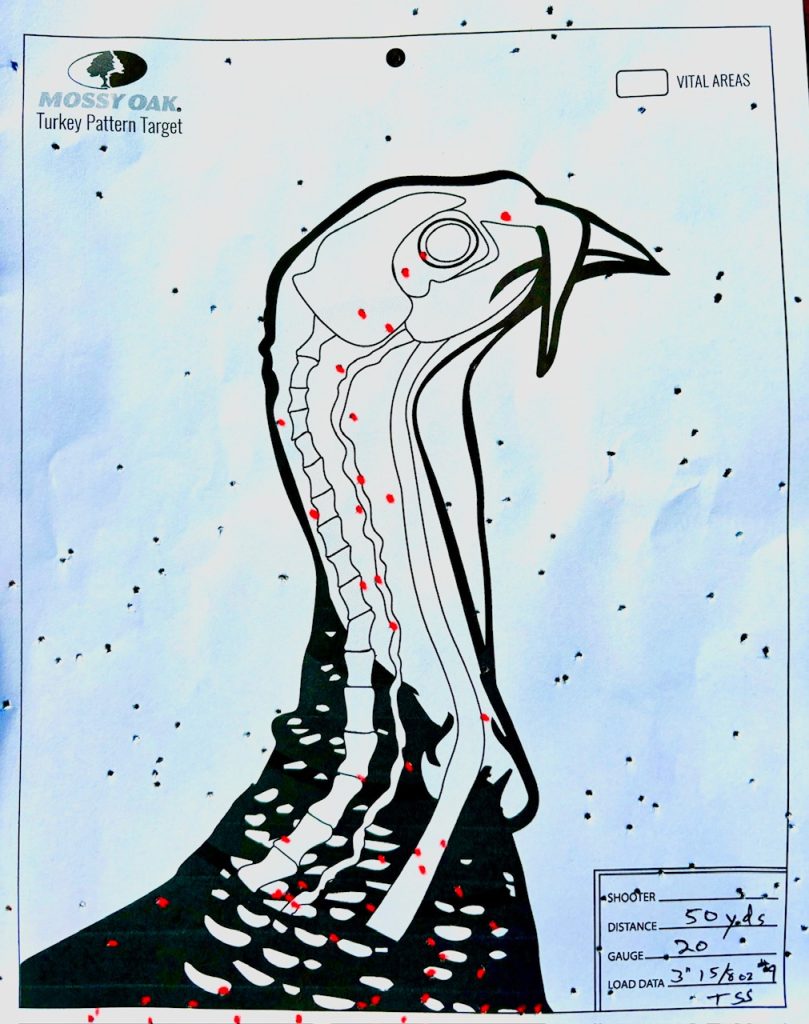
When using the 10″ circle for patterning, many draw a vertical and horizontal line within the perimeter to evaluate the shot count in each quadrant. Most use a fresh target at 20, 30, 40, 50, and sometimes 60 yards to assess their pattern.
The 20 gauge now seems the preferred choice of most turkey hunters, and younger hunters can avoid even more recoil by using a .410. Before the availability of TSS, most hunters opted for a heavy load of #4 or #5 or the mule kick of a ten gauge to extend their effective range
The Impact Of TSS On Turkey Patterning
The ability to drop down in shot size while retaining or increasing pellet penetration has been the primary result of TSS pellets.
One #9 TSS pellet has a mass similar to a #5 lead pellet. With equal velocities, the #9 pellet hits with as much energy as a #5 lead pellet and hits harder than a #4 steel pellet. Plus, a 1⅜-ounce load of #9 TSS contains almost 500 pellets. TSS shot through a .410 is now regarded as deadly up to 40 yards with the correct shell/choke combination.
Choke makers have integrated hardened steel to withstand the increased friction and have also developed special wadding that helps protect barrels.
Choosing The Best TSS Choke
A shotgun’s choke is defined as the difference between the diameter of the bore, measured nine inches from the breech, and muzzle, expressed in thousandths of an inch. So, a higher number means more constriction or tighter choke.
Patterning your shotgun with various aftermarket choke options is one way to develop the tightest, most consistent patterns. Specialty turkey choke tubes from companies like Indian Creek, Muller Chokes, Carlson’s, and Patternmaster offer a variety of constrictions to take advantage of the TSS shot. Expect to pay upwards of $100.00, but if they can tighten your pattern and extend your range, most will consider it money well spent.
Below are a few of the styles available. You’ll also find tubes that combine some or all of these options:
- Constriction Style Chokes – These use internal constriction, similar to standard chokes, but optimized for TSS loads.
- Wad Stripping Chokes – This type of choke slows and separates the plastic wad from the pellets before they exit the barrel.
- Ported Chokes – Cutouts or holes in the choke redirect gases to reduce recoil and help maintain accuracy for follow-up shots.
- Extended Chokes – Adding length is another way to control shot strings at longer ranges.
- Adjustable Chokes – Several are available that adjust the constriction from .550″ down to .700″ with a simple twist and are similar to the older-style poly-chokes of yesteryear.
Consider the range you expect to be shooting. TSS shot patterns well out to 40-50 yards and beyond with the right choke. Many hunters opt for red dot sights because, at closer ranges, some barrel/choke combinations have an ultra-tight pattern that can lead to a clean miss.
Barrel length can also impact your choice of an aftermarket choke. Longer barrels generally pair better with tighter chokes, while shorter barrels do better with more open chokes; however, an aftermarket extended choke tube can make a huge difference when threaded onto shorter barrels. Ensure any aftermarket choke tube you buy is designed for your specific barrel. Below is a summary of standard choke sizes:
Choke Sizes:
- Double Full – In addition to typical primary choke constrictions, specialty options designated double full (.570+) and other long-range style turkey chokes claim even tighter constrictions for extending your effective TSS shot range.
- Extra Full – These chokes have tight constrictions for a dense pattern at extended distances. Standard openings typically measure .550-.570 inches and are best for longer-range shots at turkeys.
- Full – Full chokes for TSS loads have constrictions around .550-.565 inches typically. They produce solid patterns at moderate ranges.
- Improved Modified – Improved modified chokes constrict shotshells less than full chokes, usually around .545-.550 inches. They can be a good compromise between closer and moderate distances.
- Modified – With constrictions of .535-.545 inches, modified chokes allow for more open patterns at closer range and are recommended for shots inside 30 yards with TSS.
Choosing The Best TSS Shot Size For Turkey
Many hunters opt for the maximum pellet count when using TSS loads, and most consider #9 shot the best choice for achieving the densest pattern.
I recently tested a turkey load by Apex with 1-5/8oz of #9 TSS in my grandson’s Franchi to see how it patterned through an Indian Creek Black Diamond .555 Turkey choke. It contains about 590 pellets, and I had no problem punching multiple holes through the printed kill zone.
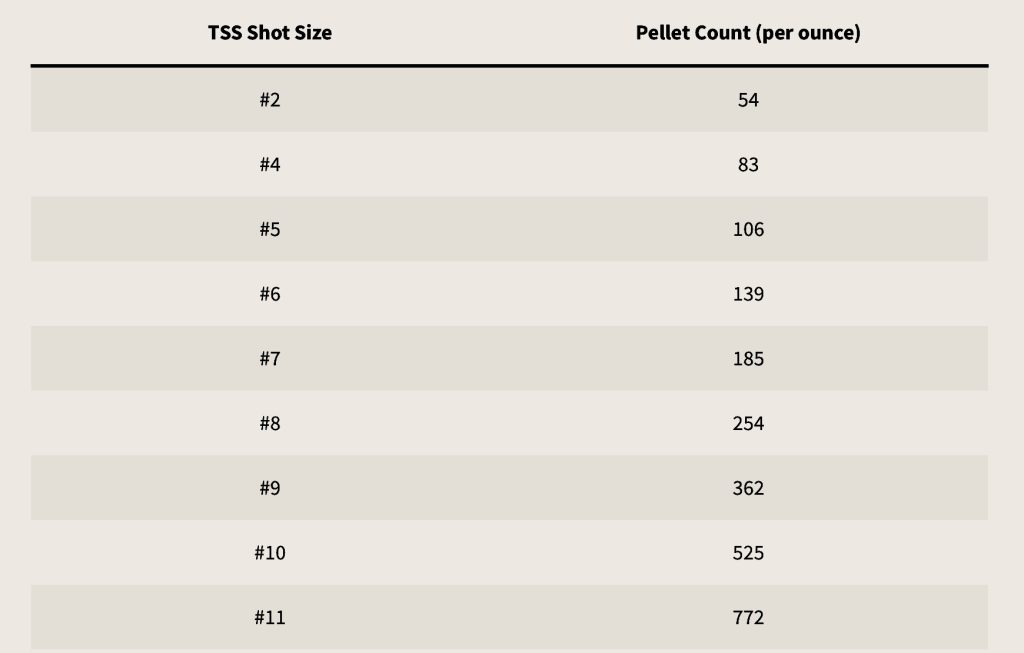
Factors such as gauge, barrel length, and choke, combined with experience and personal preferences, can also play a role in shot choice.
TSS’s most popular size pellets for turkey include 7, 8, and 9. However, several manufacturers now offer shells loaded with a combination of different-sized shots.
5 TSS Shotshells to Consider
Browning TSS
Federal TSS
HEVI-18 TSS
Remington TSS
Fiocchi TSS
Final Thoughts
There is no doubt that Tungsten Super Shot has allowed for tremendous change in what constitutes a good turkey gun. In years past, many hunters opted for a ten gauge to achieve maximum range when drawing a bead on a gobbler’s head. It’s now possible to closely match the performance of those mule-kickers with a 20 gauge.
However, one thing remains the same: one must possess a degree of luck or develop the skill set needed to get within range of those wily, red-necked, southern peacock wannabes.