
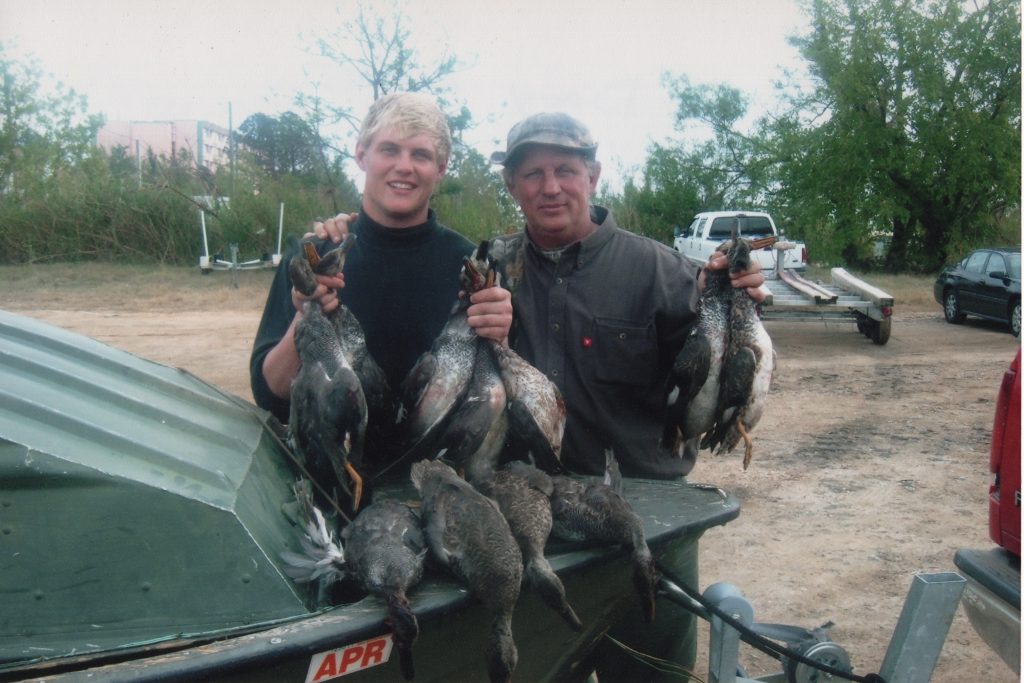
Joe Norton still remembers his first duck opener vividly. “We hunted out in the bay,” he said. “The guy I was with called in a big drake mallard that landed almost on top of my head, and I missed it twice before it flew off.” He laughed. “I’ll never forget that.” That marked the start of a lifetime of Mobile Delta duck hunting. “I’ve hunted every opening day since that time,” he said, pausing for a moment to do the math. “Fifty-five opening days in the Mobile Delta, excepting two while in college.”
“When I first started hunting, there were a lot of ducks,” he continued. “There were ducks throughout the delta—Bay Minette Basin, Choccolatta, Justin’s, Delvan, Polecat, Grand Bay, D’Olive, Big and Little Bateau. Every one of those bays would have ducks and anywhere from six to twelve blinds, and it was nothing unusual for people to be in every one of those blinds. The Chocolatta Flat adjacent to the causeway would have 10 blinds in it.”
Today, he said, it’s a fraction of that. “People talk about how many hunters there are now, but it’s nothing like it used to be. Back then, there weren’t that many deer around, so we did more small game and bird hunting. Today I believe there are fewer hunters because there are fewer ducks. All the ducks seem to congregate in one or two bays each year, and everybody piles into those bays with each other. You can go out and look for yourself. There will be entire bays that don’t have a blind in them.”
Sewer Boots and Cedar Boats
Joe chuckled when asked what Mobile Delta duck hunting gear looked like in the old days. “Most of the hunters shopped at Ward’s Army-Navy Store in Mobile,” he said. “We hunted out of a 14-foot Stauter-Built Cedar Point Special with high sides. Back then you could shoot lead shot. We didn’t have all of the nice hunting jackets like you have today with Goretex in them. Almost everybody wore an army field jacket, and you’d throw on an army surplus poncho if it rained. The old-timers called their hip boots ‘sewer boots’ because McGowin-Lyons Hardware sold them for Water Works employees. Most folks didn’t wear chest waders, because they were expensive, and they were prone to crack at the inseam. Once they cracked and leaked, you weren’t any better off than if you had hip boots anyways.”

There weren’t dozens of fancy duck calls, either. That came later, when Phil Robertson started the Duck Commander call company that would soon grow into a “dynasty.”
“Back then there were only a handful of calls available,” Joe said. “I still have the original call I bought in high school. It’s a Faulk’s, made down in Lake Charles, Louisiana. I still use that same call today.”
Modern gear, he admitted, makes things easier—but it’s also changed the way people treat the Delta. “The mud motor has become like a four-wheeler, you know. People say to their buddies, ‘Let’s go ridin’. They’re not just going from the boat ramp to their blind to hunt. They’re running through grass beds and small creeks, tearing things up and flushing birds. You can be out fishing and see the vegetation that’s been sheared by those motors floating in the bay.”
“So Thick it Bogged the Motor Down”
When Joe was in college, the Delta’s bays were thick with submerged grasses. “I can remember riding through Turtle Ditch on the Blakely Bar, and the ribbon grass was so thick it choked the motor down,” he said. “Now there are just scattered patches. Last year there were areas out on the Tensaw Bar that had no grass at all.”
While it frustrates him a bit to see mud motors tearing up what little grass is left, he doesn’t pin the decline on boat traffic. He suspects turbidity plays a role, but also blames invasive species. “When I first started hunting, there was no milfoil in the Delta,” he said. “It came from ships’ bilges coming into the port. The milfoil overtook a lot of the native grasses, and I don’t think it offers the food the waterfowl prefer. The native grasses supported snails and invertebrates that ducks fed on. You just don’t see those anymore.”
A Delta Full of Ducks
Asked when Mobile Delta duck hunting was at its best, Joe didn’t hesitate. “Probably in the mid-80s,” he said. “There were above-average populations to start with, and you had probably three or four very good nesting years. We had a lot of birds back then.”
He recalled one stretch that stood out. “I hunted the same blind ten days and had ten limit hunts,” he said. “The first three hunts that I made, it was nothing but mallards and pintails. Then the next four or five hunts were mostly gadwalls. And by the time we got towards the end, you weren’t being nearly as selective—you were shooting pretty much whatever came by: teal, scaup, whatever.”
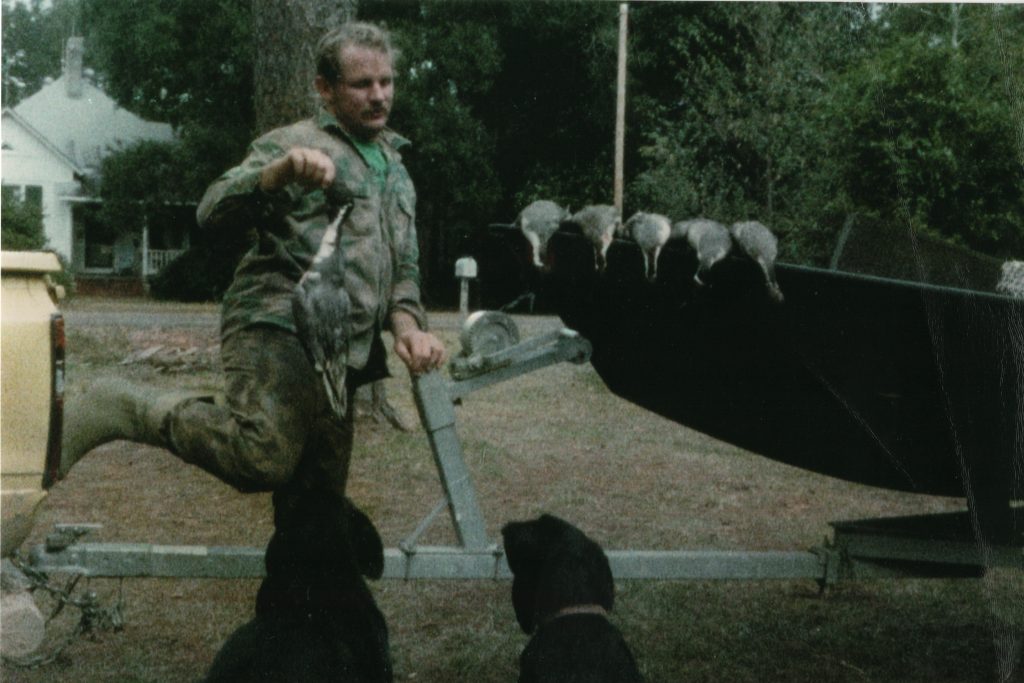
That was during what he calls “the good years.” “We just had ducks everywhere,” he said. “It was normal to see birds working all morning. You’d finish out a limit and still sit there watching them fly back and forth across the bay.”
He smiled as he remembered another day from around that same time. “I went by myself out in the bay,” he said. “I picked up six drake pintails. This was back during the point system.* I shot one hen, and I couldn’t find it. So the picture is me holding up six drake pintails.” He paused, then added with a grin, “It wasn’t like I was trying to pick drakes—I’m not that adept with a shotgun. I was just lucky to do that. But it was pretty neat. It wouldn’t have been all that uncommon to shoot six pintails, but it was special to shoot six drakes like that. A ‘rooster shoot.’”
Where Did the Birds Go?
I always enjoy getting to talk to “old school” hunters like Joe; it’s why I became an outdoor writer in the first place. But in between the chuckles and soft head shakes of wonder as Joe reminisced about “the good old days,” I couldn’t help but feel the occasional twinge of sadness.
“What happened?” I found myself wondering. It’s a question I’ve asked a lot in my meager twelve years on the delta. Joe’s stories put flesh on a skeleton I’d unearthed years ago. Once upon a time, harvest reports told stories of hunters shooting bigger and more diverse bag limits. Nowadays, for the most part, open water hunters shoot gadwall and a few redheads, and those who hunt the timber (my stomping grounds) are happy with their three wood ducks. Tales of the occasional mallard are spoken of in the same way that seafarers of yore spoke of monsters beyond the edges of the maps. As we talked, Joe confirmed that his experiences in recent years were similar to mine. He’s still shooting a few birds, but he’s not seeing as many, and not the same variety of species he once did.
When Joe and I talked, he told me that fly-over surveys in the 1950s revealed wintering duck populations that could be as high as 200,000 birds. Last year, when Joe checked the report, there were only around 3,000 birds wintering in the delta.
“Even the coot have gotten less plentiful,” he said. “Used to you would see thousands, and I mean thousands of coot out in places like Chocolatta. The water would be black with coots. You still see them, but there aren’t as many.”

Like most seasoned hunters, Joe has theories about why the birds no longer fill the sky. “Farming practices changed everything,” he said. “Farmers drained the prairie potholes to grow grain, and that’s where the ducks nested. Pintails especially—they nest in the grasslands adjacent to wetlands. When those were farmed, they lost their nesting grounds.”
He also believes the Delta’s small size, lack of food, and heavy hunter pressure in what’s left of the good habitat probably plays a role. “If you were a duck, would you rather sit in a farm pond and eat soybeans, or come down to the Mobile Delta and eat mud while people are shooting at you or running mud boats over you?”
“A Head Full of Snakes”
For Joe, Mobile Delta duck hunting has always been about more than killing. “You know, duck hunting is kind of a young man’s game, and I’ve seen a lot of people give it up. Everybody I know who used to duck hunt decades ago but quit, they all say, ‘It’s just too much work for what you get now.’ I guess the difference between people that look at hunting as work and me is that I enjoy the preparation as much as the hunt. The scouting, building blinds, just being out there—it’s mentally relaxing. I can have a head full of snakes from work, and when I get in my boat and ride around the Delta, I don’t think about the snakes anymore.”
He’s learned to measure success differently now. “As you get older, it becomes less about shooting the bird and more about the experience,” he said. “Don’t get me wrong, if one flies by, I’m going to try my best to kill him! But…it’s not nearly as important as the other aspects. I’d rather see my son or grandson shoot than me. It’s just nice to be out there.”
“I hope I’m wrong.”
When asked what advice he’d give to someone looking to get into Mobile Delta duck hunting, Joe didn’t mince words. “Don’t,” he said. The words hung in the air for a moment as I waited for a chuckle that never came. “It’s expensive, number one, with having to have a boat, decoys, guns, and a box of shells that costs thirty bucks. It’s hard, and there just aren’t many ducks anymore. Find some other pursuit.”
As much as it pains me to admit it, I can’t argue with his assessment. Delta hunting is tough and getting tougher. But Mobile Delta duck hunting, by his own admission, is a young man’s game, and I’m just still young enough to persist in my folly and press him for advice.
“Try to get people to take you that have been doing it longer,” he said after a little thought. “A lot comes with experience. You learn things like not to set up where the tide will fall out and leave you stuck in the mud while someone else is out there in deep water still hunting.”

The best education comes from time in the field—but he’s realistic about what newcomers will find. “As long as there’s a seed population, one or two good nesting years and the population will rebound,” he said. “But will the Mobile Delta ever be what it once was? I don’t think it will. We’re a small, isolated area compared to the marshes in Louisiana, and I don’t know that the birds will ever find their way back here. I hope I’m wrong.”
Me too.
What’s Left Beneath the Sunsets
Despite his skepticism, Joe’s love for the place runs deep. “The Delta is the lifeblood of the bay,” he said. “It’s the estuary for Mobile Bay. If it’s not there, you don’t have fish. The forage for the fish offshore is produced in the Delta. The shrimp are raised in the Delta. Everybody gets excited when the weather changes because it’ll move the shrimp and the fish, but if the estuary isn’t there, you don’t have anything.”
He’s quick to credit the organizations working to protect it. “Join groups like Mobile Baykeeper,” he said, “groups that are trying to enforce wise environmental stewardship in the bay and the Delta. Be proactive–not reactive. Don’t sit at the house and complain. Write to the Conservation Department and your representatives, and voice your concerns and opinions.”
I asked him what he thought the future of Mobile Delta duck hunting was likely to be. “Somebody once asked an older, wiser man what he thought the future of Mobile Bay was. And he said, ‘Beautiful sunsets.’”
Joe paused and looked out over the water. “I hope that underneath those sunsets, there’s still a fish to catch, still crabs, still shrimp, still ducks with long, pointy tails. I hope that’s still there for my grandchildren.”
* Duck hunters used to use a “point system” where each species and sex of duck was assigned a point value based on its abundance, and hunters could shoot as many birds as they wanted until they reached 100 points—a somewhat controversial system meant to protect vulnerable species while allowing more harvest of plentiful ones. It was eventually phased out in favor of today’s system of fixed daily bag limits for each species, largely due to problems with practical implementation for hunters and enforcement.