

Even though quail season has ended, we can still prepare frequent meals of delicious quail for the whole family to enjoy. We absolutely do not go out and poach bobwhites. That would be totally unacceptable, but we have discovered how to raise quail for meat at home. Also, we have found that raising Coturnix quail on small acreages or even in the suburbs is not hard and it’s lots of fun.
What Are Coturnix Quail?
First, these Coturnix quail are not the native bobwhites or any other wild quail we have in the United States. Coturnix quail are native to Asia, but they have been domesticated and transplanted all over the world.
Coturnix quail are small birds. When mature, they are about the size of a large robin or a blue jay. Their pen requirements are minimal, but they must be kept in pens. Coturnix quail can and will fly away and they do not come back when allowed to escape.
Coturnix quail come in a wide range of colors and feather patterns from very dark brown “scaled” feather patterns to mottled brown, to caramel, to all white. It is very common to get a mixture of feather patterns in a single hatching of Coturnix eggs.

One of the most amazing features of Coturnix quail is their extremely rapid growth and maturity. From the time of hatching, Coturnix grow and become adult birds in only about seven weeks. They will be fully feathered, fully grown, and laying eggs in less than three months. At eight weeks old, Coturnix quail are ready for processing for food.
Coturnix are great tasting little birds. Just about any recipe that works for chicken or other poultry will work just fine with Coturnix. The only modification that needs to be made when cooking Coturnix quail is that at least two birds should be prepared for each person eating. My sons need three or four birds to make a meal.
The eggs of Coturnix are tiny, but they are perfectly suited for cooking. It may take a couple of dozen or more Coturnix eggs to make an omelet, but they are delicious little eggs. Coturnix eggs are very popular for pickled egg recipes because they are small and easy to pack in jars.
How to Get Started Raising Coturnix
To raise Coturnix quail at home for meat, the first requirement is a good pen. It does not have to be a tall pen, but it needs to be solid enough so dogs and other pests can’t knock it over. The pens I build for our Coturnix are about four feet wide by eight feet long and perhaps four feet high. This allows plenty of room for 20 or 30 Coturnix.

The birds need to be in a dry space. Coturnix love to have contact with the ground. They will scratch and dust bathe just like tiny chickens. Hardware cloth or other close-mesh wire is best, since regular chicken wire won’t contain them, especially when they are immature. It is helpful to have a pen that can be moved from place to place as the birds eat all of the vegetation at one location.
A few notes on housing and space:
-
Plan on about 1–2 quail per square foot for small backyard flocks.
-
If you want to give them the best life, add dust bath pans and little hiding spots for enrichment.
-
In winter, make sure the pen is sheltered and water doesn’t freeze. In summer, shade and airflow are critical.
If adult birds can be located at chicken sales or on local farms, a couple of dozen birds will be plenty to start a flock. Coturnix are prolific little layers. The adult birds will not reliably set and hatch their eggs, so to increase a flock, owners need to have an inexpensive incubator.

Incubating and Brooding Coturnix
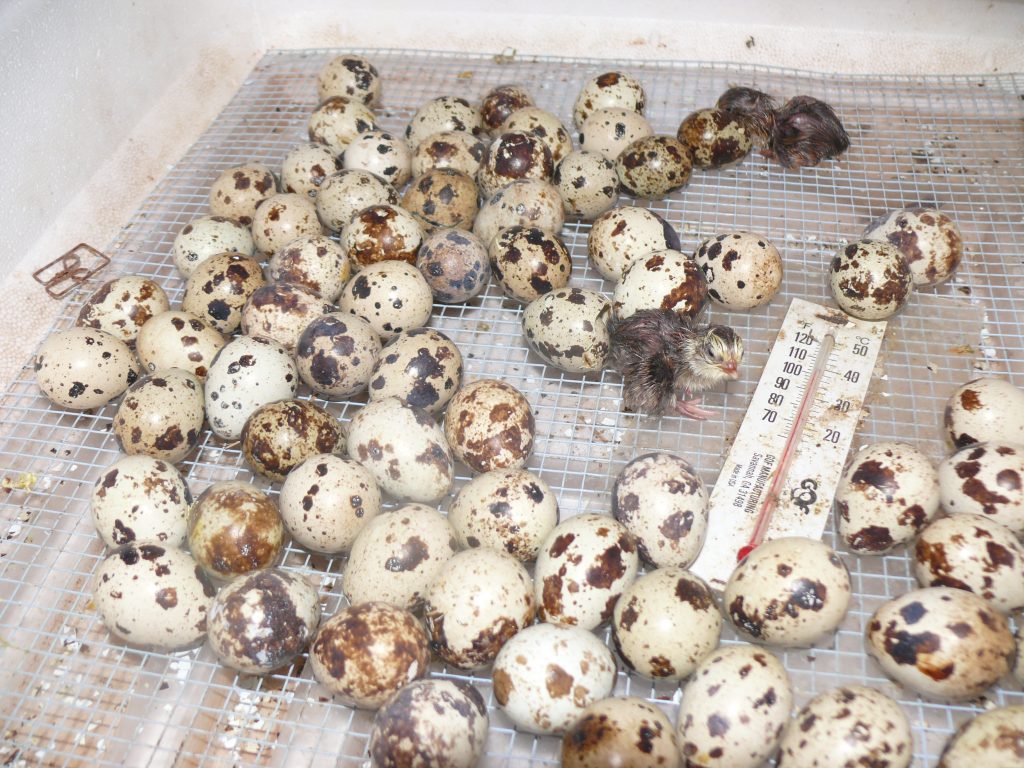
It is very possible to order Coturnix hatching eggs online and start a flock of quail in a home incubator. The hatching temperature should be about 99.5°F with humidity around 40%, raised to 50–60% for the final few days before hatch. The eggs hatch in only 16–18 days, almost always right on time.
When the eggs hatch, it happens fast—usually within 24 hours. If a Coturnix egg doesn’t pip by Day 18, it likely won’t hatch.
Once the chicks are dry, they need to be placed in a brooder with a warm heat source. Start them off at about 95°F the first week, then lower the temperature by 5°F each week until they are feathered out. Always make sure they have fresh air, dry bedding, and safe shallow waterers so they don’t drown.
When they dry off from hatching, Coturnix quail are just about the cutest things imaginable. They are tiny little birds, but they start running around, drinking, feeding, flapping, and acting like 2-week old chickens when they are an hour old. In fact, the baby quail are known officially as “buttons.” I suppose because they are as cute as buttons.
Feeding Coturnix Quail
Coturnix need high-protein feed. They don’t do well on standard poultry pellets or crumbles. This high-protein feed is usually sold as game bird feed.
-
Chicks (0–3 weeks): 27–30% protein, non-medicated starter.
-
Growers (4–6 weeks): about 20–22% protein.
-
Layers (7 weeks and up): 18–22% protein, with added calcium (oyster shell or cuttlebone).
They will drink almost immediately from shallow water containers, no deeper than a half inch. A little grit and the occasional treat like greens or mealworms are fine, but protein feed is the backbone of good growth.
What Do We Do With Them?
A good thing about raising Coturnix quail for meat is, as we noted earlier, that they mature very quickly. Even though they require more expensive high-protein feed, they are very efficient at converting the feed into an actual bird. This means we get more meat on the table for less feed and expense.
Processing Coturnix quail is just like killing and cleaning any other kind of poultry, but it’s easier. To remove the heads, a pair of kitchen shears does a quick and painless job. The shears will remove the feet, too.
Coturnix quail don’t have to be dipped in hot water for picking. They dry-pick perfectly well. The skin is tender, but with a little care, all the feathers, even the larger wing feathers, come out easily without messy, smelly dipping. We find that a Coturnix can be killed, plucked, and ready for cleaning in eight minutes or less.
When cleaning the birds, instead of splitting them down the breast as is done with chickens, we’ll want to use the kitchen shears to cut along the backbone and keep the breast in one piece. That’s where most of the meat is found.
So, Let’s Get on with the Coturnix Game!
Even though Coturnix quail are not as much a challenge and outdoor fun as hunting native bobwhite quail, these cute, delicious, easy to raise quail can be a rewarding part of every sportsman’s life. Whether we purchase adult birds and save their eggs for hatching or order the eggs online, raising Coturnix quail for meat is just too easy and too good to not give a try on the family property.