

For years, boaters have wrestled with the decision to stick with classic 2-stroke versus 4-stroke outboard engines or make the leap to a cleaner, quieter 4-stroke. Two-stroke engines are known for their punchy performance and lightweight design, while 4-strokes bring smoother operation, better fuel efficiency, and lower emissions. But can today’s 4-strokes truly match the power and feel of their predecessors? According to John Adams, General Manager of Tohatsu America Corporation, the answer is yes—and then some.
John has spent over a decade at Tohatsu North America, moving from the service department to General Manager. With a background in sales and service at marine dealerships before that, he’s seen every side of the industry. “I’ve been in the marine business a long time,” he says. “I’ve worked with just about every kind of boat and motor setup out there.”
Choosing Between 2-Stroke Versus 4-Stroke Outboard Engines
The turning point for the industry came in 1998, when the EPA implemented emissions regulations that eventually made it impractical for 2-stroke engines to comply. “It started with the first round of emissions standards, which 2-strokes could pass,” John recalls, “but as the levels became more technical, it just got harder for them to meet those requirements.”
4-stroke engines became the natural successor, offering an easier path to cleaner combustion. But early models presented their own set of challenges—mainly in weight and torque delivery. “The initial 4-strokes had smooth torque but not the instant torque of a 2-stroke,” John explains. “That was a big deal, especially in applications like shallow-water skiffs, where quick planing is essential.”
Repowering Older Boats: The Importance of Weight and Shaft Length
One of the biggest mistakes John sees during repowers is ignoring how a modern engine’s weight and shaft length can affect a vintage hull. “You can’t just swap a motor out based on horsepower,” he says. “You’ve got to think about where that extra weight goes and how the boat was originally designed.”
Many boats built decades ago weren’t intended to handle the heavier 4-stroke engines that came on the market in the early 2000s. In some cases, putting a long-shaft motor on a short-shaft transom led to serious handling and reliability issues. “It doesn’t seem like a big deal, but the wrong shaft length can throw everything off,” John says. “You can have increased backpressure, sluggish planing, even engine damage if the setup isn’t right.”
That’s why Tohatsu has remained committed to offering short-shaft options, especially for repowering older boats. “There are still a lot of great short-shaft boats out there,” he says. “We saw the value in keeping those models available.”
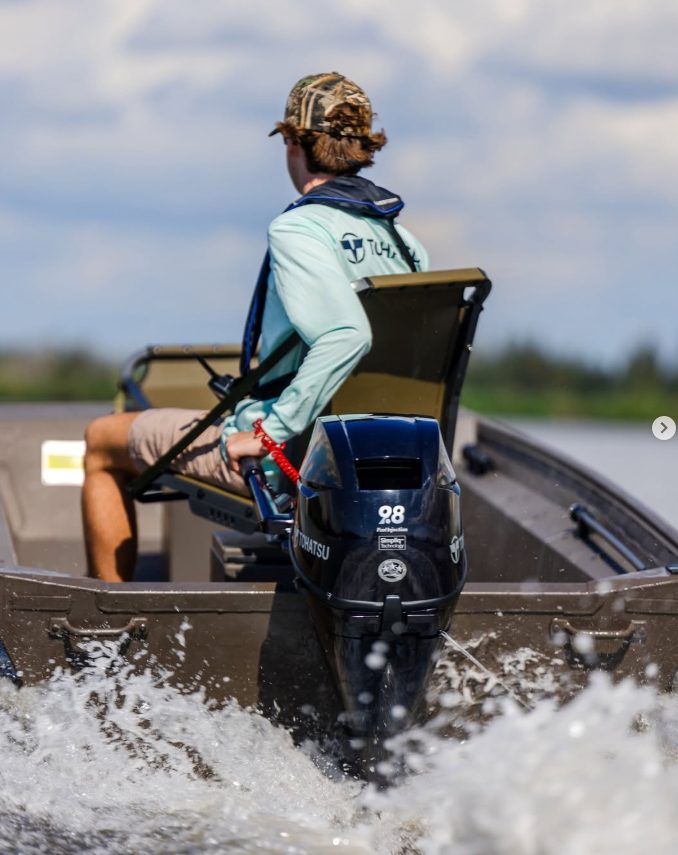
Horsepower Then and Now: It’s All About Where You Measure It
When comparing old 2-strokes with today’s 4-strokes, it’s easy to assume that a 40-horsepower engine from 1975 is more powerful than a modern 30. But that’s not always the case. “Back then, horsepower was measured at the powerhead,” John explains. “Now, it’s measured at the prop shaft, which is after you account for losses in the drivetrain.”
Add years of wear to an older 2-stroke, and the difference becomes even more pronounced. “That old 40-horse might really be putting out 30 horsepower now—or less,” John says.
The MFS30: Tohatsu’s Bridge Between Eras
Tohatsu’s MFS30 represents how far 4-stroke technology has come. With a weight of just over 130 pounds, it falls in line with legacy 2-strokes while offering modern-day benefits in fuel economy, noise, and emissions.
“We had to figure out how to lose weight without giving up strength,” John says. “We used plastic intake manifolds instead of aluminum and moved the engine around inside the case to improve the center of gravity.” The team even tested the outboards in high-impact scenarios, like running over submerged logs, to ensure durability.
Those design improvements have translated into real-world gains. “You’re going to see similar planing performance and top-end speed to your old 2-stroke,” John says. “But it’s going to be smoother, quieter, and you’ll burn way less fuel.”

Fuel Efficiency and Everyday Use
Fuel economy is where modern 4-strokes shine the brightest. “Where you might have needed 15 or 20 gallons for a day on the water with a 2-stroke, now you can get away with 10—or even less,” John says.
He shared a personal example: “I fish bass tournaments, and a buddy of mine with a similar rig but a 2-stroke has to fill his 40-gallon tank every trip. I just top off 10 or 15 gallons, and I’m good to go.”
And the savings don’t stop at the pump. “Today’s motors also draw less from your battery, so you don’t need as big a setup to get it started,” John says. “It’s just a smarter system all around.”
Why Propeller Choice Still Matters
Even with the right engine, performance can fall short if the propeller isn’t matched to the boat. “You’ve got to make sure you’re running in that wide-open throttle range,” John says. “If your motor is rated for 5,000 to 6,000 RPMs, and you’re only hitting 4,500, you’re leaving horsepower on the table.”
The prop’s role varies by hull type, too. “A Jon boat might need more stern lift, while something like a Boston Whaler might need more bow lift,” he explains. “We can go deep in the weeds on blade design, but it starts with picking something that fits the boat’s needs.”
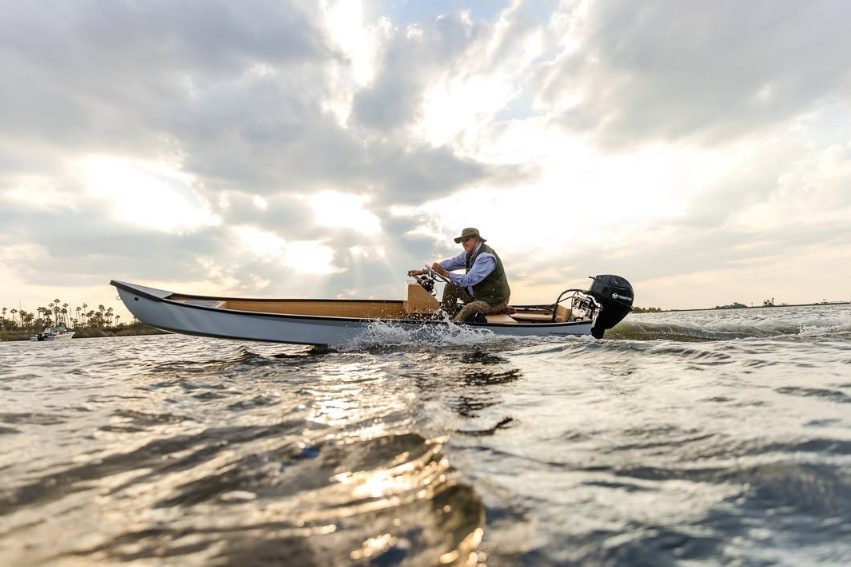
The Tiller Handle Evolution
Tohatsu’s attention to real-world usability shows in their tiller handle options. “A lot of older boats were built for really short tillers,” John says. “But today’s boats, especially duck boats, are set up with rear steps and other features that push you farther forward. So we now offer both short and long tillers, with features like power tilt and trim built right into the handle.”
This focus on flexibility ensures that users repowering older boats—or building new—can get a tiller that actually fits their layout.
Final Advice: Talk to a Dealer
For anyone considering a repower, John’s advice is simple: start by understanding your boat. “Transom quality, material, and design all matter,” he says. “If your boat is 40 or 50 years old, check for stress cracks or water-logged wood before making any changes.”
And when it comes time to choose a new outboard, don’t go it alone. “Use our website to see specs and models,” he recommends, “but then go talk to a local dealer. They’ll know what works best in your area and with your type of boat.”
At the end of the day, John believes that modern 4-strokes—especially Tohatsu’s designs—offer the best of both worlds. “Ten years ago, people would laugh if you said a four-stroke could outperform a two-stroke,” he says. “But now we’re seeing it every day. Lighter, faster, smoother. When it comes to 2-stroke versus 4-stroke outboard engines, today’s models prove you really don’t have to compromise anymore.”