

Have you ever found yourself feeling unsafe while navigating the boat in a dense fog that only allows for 15-20ft. of visibility? How about running early in the wee morning hours before first light? Or running back from offshore once the sun goes down? Do you find yourself running often in the dark? If a scenario like this is one you’ve experienced or go through regularly in your area then you know just how harrowing and anxious it can feel to be boating in zero light or low visibility conditions. Marine boat radar systems offer the perfect solution to boating in these situations and even have other perks as well.
There are several questions that may come to mind when considering purchasing a boat radar, things like: What uses does a boat radar have? What does boat radar detect? What are the components of a boat radar system? Are there small vessel options for boat radar? How much does a boat radar cost? And last but not least, do I need boat radar? Let’s take the time to go over some of these topics and get some answers from William Montgomery with Blue Water Ship Stores in Foley, AL.
What Is Boat Radar?
While radar units have become increasingly common sights on boats over the years, it’s always good to start conversations with a simple definition.
“To put it simply,” says William, “radar transmits and receives reflected signals to help aid in navigation and situational awareness. It allows you to essentially detect objects around you, whether it be land, navigational aids, other vessels, birds, or storm systems. Its main use is to promote safety while you’re underway or stationary.”
Uses For Boat Radar
We asked William which of his customers typically utilized boat radar, and what their specific usage case was.
We put them on all sorts of boats,” he responded. “We’ve installed them on big boats, little 20ft center-consoles, even sailboats. It’s not so much about the type of boat as it is what type of situation folks think they might use their boat in, although most of our business centers around offshore and coastal marine applications. If they have an inkling that, ‘Hey, I want to be out at night a lot,’ then a lot of guys really want that radar to help keep them safe. They’re looking for help with collision avoidance at nighttime.”
“Also,” he continues, “the bigger boats with higher powered radars, they’re using them to find flocks of birds that are diving on baitfish so that they can then target the bigger fish underneath those flocks. That’s a good use for them as well. ”
Components Of A Boat Radar System
Boat radar systems are made up of four different key parts that work together to transmit the most accurate layout of your surroundings. The antennae, the transmitter, the receiver and the display are the four components of a boat radar system.
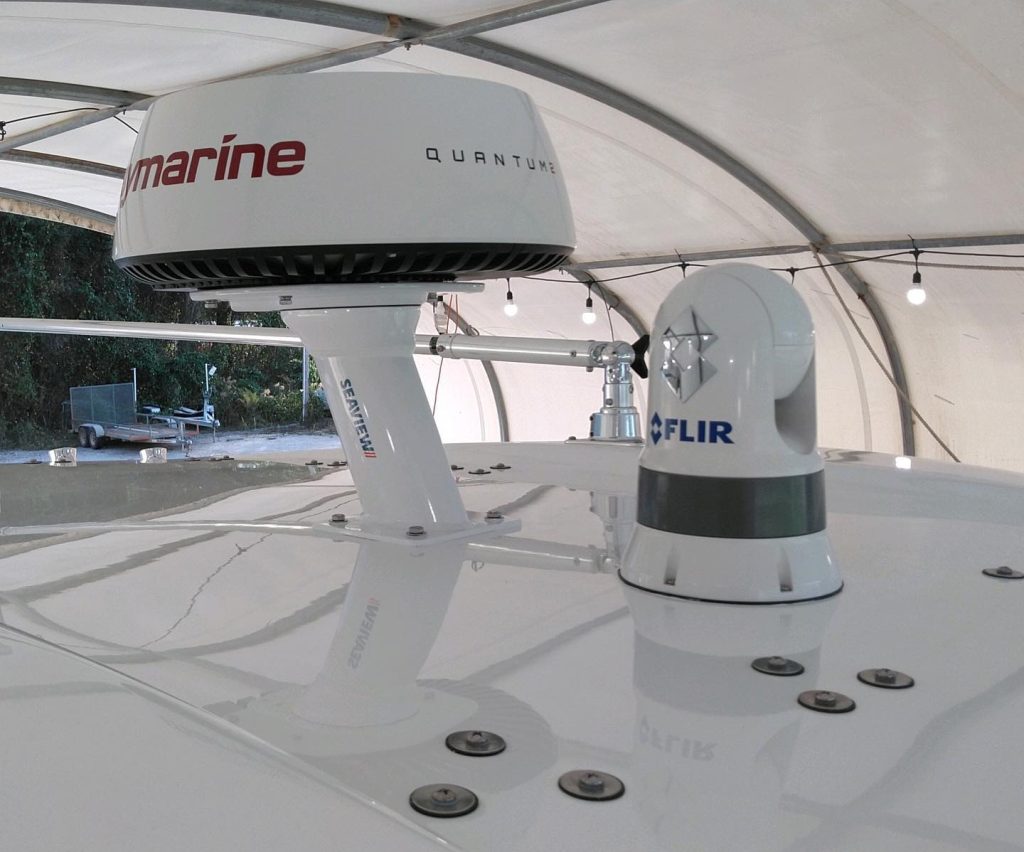
The antennae is the most visible piece of your system and is typically mounted on the t-top, arch or mast of the vessel. Rotating around on a horizontal axis creating a full 360 degree view, the antennae detects and receives radio waves that determine an accurate picture of the surrounding structure. The size and type of your radar’s antennae will vary depending on the size of the vessel, the radar’s range as well as its intended use.
The second piece of your boat radar system is the transmitter. The transmitter generates high frequency radio waves used by the radar, the antennae puts out these high frequency radio waves and the transmitter is responsible for converting the radar’s input power into radio frequency energy.
Thirdly we have the receiver. The receiver reads the radio waves that are reflected back to the antennae after bouncing back off of structures. These readings are then transmitted and amplified so that the radar display can read them in an accurate way.
Fourth and lastly is the display. The display is the screen where captains and boaters view the data that has been transmitted back via radio waves that gives an accurate picture of the surrounding environment. Some display screens have a circular screen with a rotating sweep that uses paint-like splotches as signals for structure and newer display systems show more sophisticated, high-resolution images of the depicted area.
Boat Radar Mount Considerations
Much like with sonar units, there are right and wrong ways to mount boat radar. According to William:
“The big thing is just to make sure that whether you’ve got a hardtop or ragtop, that whatever you’re mounting to is structurally sound and able to hold up to the weight of this radar. You know, you hit the water, and this thing is going to be banging around in four-foot seas, so you want to mount it somewhere where it can hold up to that load and those G-forces.”
“Usually, most new boats that leave the factory have a really good reinforced area to mount equipment up on the roof. So you’ll want to make sure that you bolt to that with properly sized fasteners and big backing plates. Not just a nut, but a good backing plate so that your load gets spread out and you’re not cracking the fiberglass.”
“The other big consideration is that other items up top can interfere with your radar, or your radar can interfere with them. All manufacturers will have specifications and recommendations about distances to maintain, and it’s important to be aware of that info. But essentially, you don’t want a high powered radar a couple of inches away from the antenna of another device, throwing 4,000 or 10,000 watts right into that device.”

“Lot’s of times, to avoid this, we’ll mount them on a pedestal to get them six, eight, maybe ten inches above any GPS antennas, satellite weather antennas, or two-way communication antennas. That way you get a good, clean sweep; without any interference.”
“The other big consideration is to maintain cable integrity. You know, I can’t tell you how many times we will get called to fix a radar and there’s nothing wrong with it, but the cable was cut and spliced improperly. If at all possible, do not cut the factory cable that interfaces from the radar. I know that sometimes when you’re installing things, they seem kinda long, but that just is what it is. There are technically ways to cut and splice them properly, but if at all possible, just leave it alone.
“And then with power, you’ve got to have a clean, steady source of power. Low voltage just wreaks havoc with all these marine electronics, and especially with radars when they’re trying to do all the amazing things they do. They’ve got to have proper volts and amps to work properly.”
Small Boat Radar Options
Boat radar systems play an important role in keeping large vessels safe, and small boats too. As technology advances year after year, several different radar options tailored towards smaller vessels specifically have become available. Let’s explore different types of small boat radar options and technologies as well as things to consider when putting a radar on a smaller vessel.
There are two main types of radar systems, dome radars and open array radars. These systems use different types of radar technology for different, specific purposes. Some of these radar technologies are broadband radar, digital radar, pulse compression radar and solid state radar to name a few. Dome radars, like the one Capt. Collier has, are easier to install, more compact and more compatible with smaller vessels. Open array radars offer better performance in range and target separation but are much more suited for larger vessels considering the size of open array systems. Broadband radar is known for excellent short range target resolution, these radars are usually compact and energy efficient making them suitable for small boats. Digital radars offer much improved target detection and detailed feedback and can often be found in compact designs making them another suitable option for a smaller vessel.

Pulse compression radars use sophisticated signal processing to increase target resolution and reduce the pickup of clutter in the radio waves. Pulse compression radars can be found in smaller sizes making them readily available for use on smaller vessels. Solid state radar is more energy efficient and extremely reliable, these radars have no moving parts making them compact and extremely suitable for small vessels.
One of the things to consider when adding a radar to your boat is power output and range. Choosing the correct power output is crucial for boats of smaller size. Higher power output provides extended range but moderate power is usually effective enough for the size of smaller vessels. Research the radar’s range capability to guarantee that it meets navigational requirements without an excess of power, aiming to find a balance between navigational performance and practicality for a smaller sized vessel. A second thing to consider for smaller boat’s radar systems is dual-range functionality capability. Some boat radars provide dual-range functionality, this gives the vessel operator the ability to watch detections for different ranges simultaneously. This is particularly useful for small vessels because it allows them to monitor close range structures as well as distant targets, allowing for a full, comprehensive view of the area. A third thing to keep in mind is integration functionality with current navigational systems. When shopping for a boat radar you’ll want to make sure that your navigational system and boat radar system are compatible as they are designed to integrate with a boat’s navigation equipment. A last notable mention is budget considerations, boat radars seem to range from around one thousand to four thousand dollars depending on their features. While safety is top priority, it’s important to find a radar that you need and not just one that you want. Determine what specific requirements you have for the boat radar and what you need it to be able to do. The options for a boat radar on your small vessel are endless, whether you go with Raymarine’s Quantum 2 or RD418HD Color Radome, Simrad’s Halo 20+ Marine Radar, Furuno’s Defender, Lowrance’s Halo 20+ Pulse Compression Radar or Garmin’s GMR Fantom Marine Radar, find the one that caters to your boat, your specific use and budget needs and stick to it.
Can Boat Radar Hurt You?
Boat radar systems are regulated and designed to be safely operated and should not pose a threat to users or nearby individuals. However, boat radars do release a potentially harmful type of energy, radio frequency energy, also known as RF. High exposure to radio frequency energy can lead to thermal and nonthermal effects on the human body. Thermal effects are heat related, RF energy can generate heat in body tissues that cannot escape, prolonged or high level exposure can lead to blindness, sterility, and possibly cancer.
With all of that in mind, it comes as no surprise to hear William urge boaters to exercise caution around their radar systems.
“There are minimum distances for safe operation. Radar is not something you should be standing in front of. If it’s transmitting, you don’t need to be in line with the radar, and it does not need to be mounted in a location where your normal use case would be that it could be scanning a human.”
He continues, “I’ve seen boats where they’ll have a radar mounted, and there’ll be an upper station. And if someone was in the chair, the radar would be like scanning their crotch two feet away. That’s just a terrible and unsafe thing to do. If you have high enough wattage, you can cause some serious damage to the body.”
Can Boat Radar Detect Wooden Boats?
The short answer is yes, boat radar can detect wooden boats. Boat radar works by detecting objects based on their ability to deflect radio waves. Whether a boat is aluminum, fiberglass or wooden the radar should detect the reflections put off by the boat’s hull and structure. The radar’s ability to detect depends less on what type of hard structure it is but more on size and shape of the structure. As long as the radar had the ability to detect the size of said wooden boat, it would show up on the display screen of the radar system.
Do I Need Radar For My Boat?
Boat radar plays a top role for increasing safety when navigating in zero-low light conditions and inclement weather scenarios because it provides accurate detection and information of an operator’s immediate and future surroundings. It’s just another highly useful tool that can help you have that much more of a chance for a safe trip out on nature’s mysteriously dark, vicious waters. We looped back around and asked Capt. Branden Collier what the deciding factor was for him that made him purchase his marine radar and he immediately reminded us what he’d said earlier, “safety”. So with all of that being said, ask yourself again. Do you run in the dark frequently? Are there a lot of foggy mornings and/or evenings in your area? Do you want to safely run on plane in those scenarios? Do you want another failsafe to ensure a safe return? Do you wish you knew where that storm was headed when you see it coming on the boat? Do you occasionally rely on birds to catch fish? If you answered yes to any of these questions Capt. Collier says he would highly recommend looking into getting one of many boat radar options installed on your vessel.