

As more and more people get into feral pig hunting, the most common statement I hear is “I bought a 300 Blackout AR-15 so I can kill some hogs”. I have heard this phrase weekly, sometimes daily, since forming my wild pig hunting business, Hog Rush, LLC. I cringe when I hear this, time and time again. Often when asked about the best caliber for hog hunting, the question likely ends with a “300 Blackout?” What I am hearing is that the person has listened to the local gun shop counter expert who usually is repeating what he read in a sponsored gun magazine article or on the internet when it comes to caliber selection for hunting feral pigs, both of which are only backed up by manufacturer hype and advertising campaigns in an effort to enhance sales, not actual field data.
Will a 300 Blackout kill a Hog? Sure. However, it lacks the required velocity to consistently create a temporary wound cavity large enough, and penetration deep enough to make it the best choice for hunting feral pigs.
In this article, I’d like to go over some mistakes I have made in caliber selection and other gear features that proved to be not up to what I read or heard about. Hopefully, my mistakes can be used to help you choose the right gear for the most efficient wild Hog harvest.
Feral Pig Hunting – Barrel Rifling Twist Rate
When a projectile enters an animal, the forces and velocity create a shock wave that opens the tissue up temporarily much larger than the projectile diameter, which causes excessive blood loss, trauma, and shock. This temporary wound cavity can be 6” or larger. So even though the actual bullet does not pass through or touch an artery or organ, the temporary wound cavity that is created by velocity, may cause damage to the artery or organ and cause instant incapacitation of the animal. Picture a mini explosion inside the animal.
Picture a mini explosion inside the animal.
In my experience, the faster the rifling twist on projectiles that impact above 2000 feet per second, the smaller the temporary wound cavity. A faster rifling twist will stabilize heavier bullets. Heavier bullets are slower. My goal when setting a rifle for hunting feral pigs is to achieve the best accuracy and the most velocity I can so that when the bullet impacts the target, it is traveling at least 2000 fps and is barely stabilized enough to remain accurate. This way the bullet will transmit most of its energy on the target, not pass through.
Think of sticking a needle into soft tissue vs. a writing pen. The overstabilzed bullet acts as the needle and the writing pen acts as the bullet that is barely stabile. The needle will poke on through easily where the writing pen will impact and yaw sideways leaving a larger hole and most likely taking a different route once inside.
A feral pig is a dense animal. Larger boar hogs have calcified fat surrounding their chest commonly called their “Shield”. This shield is similar thickness and density to a commercial 18 wheeler truck tire. To penetrate deep enough and achieve the desired 12-14 inches of penetration, you need a projectile that is traveling above 2,000 fps upon impact and has a bonded jacket and high sectional density.
In other words, the bullet needs to retain most of its weight and velocity upon impact.
Unfortunately, the 300 Blackout does not meet this criteria, and with the common .30 cal 110 grain ammunition available, most 16” barrels achieve a dismal 2100 fps muzzle velocity. Most 300BLK rifles also have a barrel with a twist rate of 1/8 to stabilize the heavier projectiles for subsonic use as well. So a lighter bullet over spins. In the field, this combination has a 50-75 yard effective range on wild hogs. Past 50 yards you will see more hogs, if knocked down, get up and run off. Why? Because the velocity upon impact did not create the temporary wound cavity large enough to incapacitate the central nervous system. Nor did the round penetrate deep enough.
My 300 Blackout example might not sit well with those who purchased a rifle chambered in that particular caliber and bought into the gun shop and magazine hype specifically for hunting feral pigs. I have seen that most occasional hunters who spend money and buy into their gear choices, cannot allow objective reasoning to override their EGO. I too was in that very position years ago and spent thousands of dollars on the 300 Blackout trying to get the caliber to live up to the hype. I had read about the caliber being the ultimate hog hunting caliber. Over 4500 wild hog rifle kills later…the 300BLK is NOT the ultimate hog hunting caliber.

Feral Pig Hunting – Rifle and Caliber Selection
When selecting a rifle caliber for wild hog hunting, look over the available ammunition and inspect the advertised velocity ratings and bullet composition. Calibers suited to deer hunting, might not perform well on wild hogs. Deer and other thin skinned animals, require a bullet that will expand upon impact to avoid a pass through. Wild hog ammunition needs more penetration and to expand slower. A .243 Winchester would be a good selection if you wanted to use a traditional bolt action deer hunting rifle for wild hog hunting. Most commercially available ammunition has a high velocity and low recoil to help follow up shots. A heavier .243 bullet selection would enhance the instability upon impact causing a yaw effect, creating a larger temporary wound cavity.
Feral Pig Hunting with an AR15 – Which Caliber?
As hunting wild pigs becomes more popular, more people seem to gravitate to military style rifles. Since wild hogs are seen as a nuisance by most states, the weapon regulations are not as strict as other game animals. Alabama does not have a weapon or a magazine capacity restriction on weapons for wild pig hunting. Therefore, people, including myself, choose “America’s Rifle”, the AR15.
The AR15 can be built to be as accurate as most bolt action rifles and can be chambered in numerous calibers including the before mentioned 300BLK. In my experience, the 6.5 Grendel is the best overall performer in the AR15 platform in terms of energy on target and remains supersonic and accurate out past 800 yards using the Hornady 123 grain AMAX. The 6.8 SPC is a decent round as well but does not have the ballistic coefficient like the Grendel to reach extended ranges, but out to 300 yards it is a solid choice.
I have found that the 5.56x45mm, commonly called the .223 Remington, is a great choice if the right ammunition and barrel twist rate combination is used.
Barrel twist rate you ask? Remember back when I spoke about velocity? Well the 5.56mm has velocity. With a 55 grain projectile and a 16” barrel, muzzle velocity is over 3100 fps. With that comes low recoil, a flat trajectory, and accuracy and make it a viable option for hunting feral pigs.
However, if you over stabilize the bullet using too fast of a barrel twist rate, the bullet will tend to “pin cushion” or pass through the hog leaving behind a small hole instead of that temporary wound cavity I spoke about earlier. This surely will allow the hog to run off and die a slow miserable death. For an AR-15 chambered in 5.56mm, a 1/9 twist barrel using a 55 grain bonded bullet seems to be the sweet spot for accuracy, stability, energy upon impact, and muzzle velocity. By 1/9 twist, I mean the bullet spins one complete revolution in the barrel every nine inches. If you have a 1/7 twist, the bullet spins one complete revolution in seven inches. Since most manufacturers use a 1/7 twist to stabilize bullets heavier than 69 grains, you may need to change out the barrel to a slower twist rate such as 1/9 when using lighter bullets. Heavier bullets will be slower.
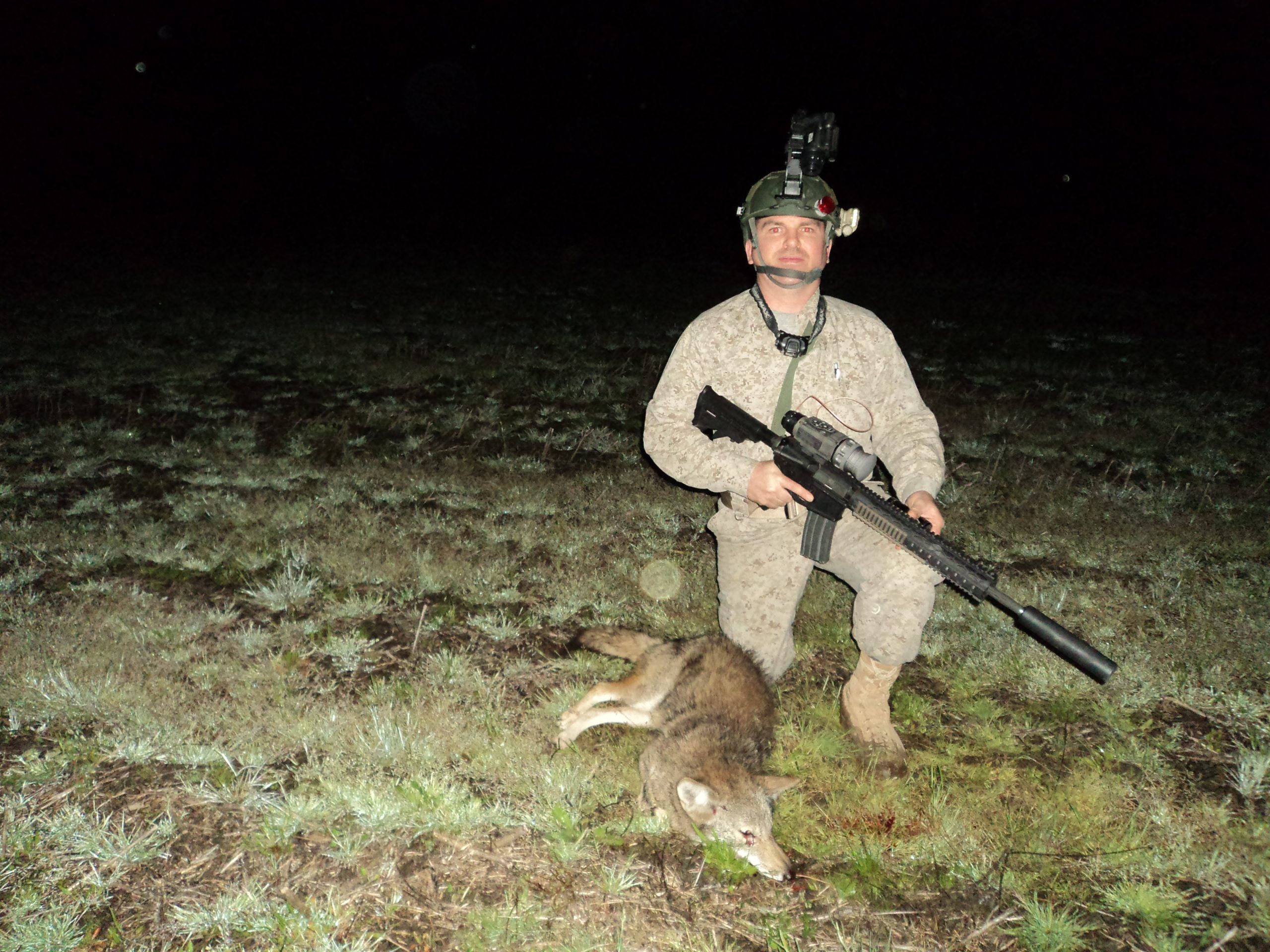
Remember, velocity incapacitates. The 5.56mm will also have a relatively flat trajectory out to 250 yards as well. So those longer coyote kills will be easier to take. Just put the crosshairs on the top of the animal’s back and squeeze. Also, on running shots past 100 yards, the 5.56mm will be more likely to connect vs. a slower running bullet.
Final Thoughts
I hope this article has been helpful and will allow you to open your mind when it comes to the best caliber for hog and specification selection. Remember, accurate but barely stable. Try and turn your bullet into double or triple its size inside the animal by forcing it to turn sideways once it impacts. Heavier bullets are not always better when it comes to hunting wild pigs.