
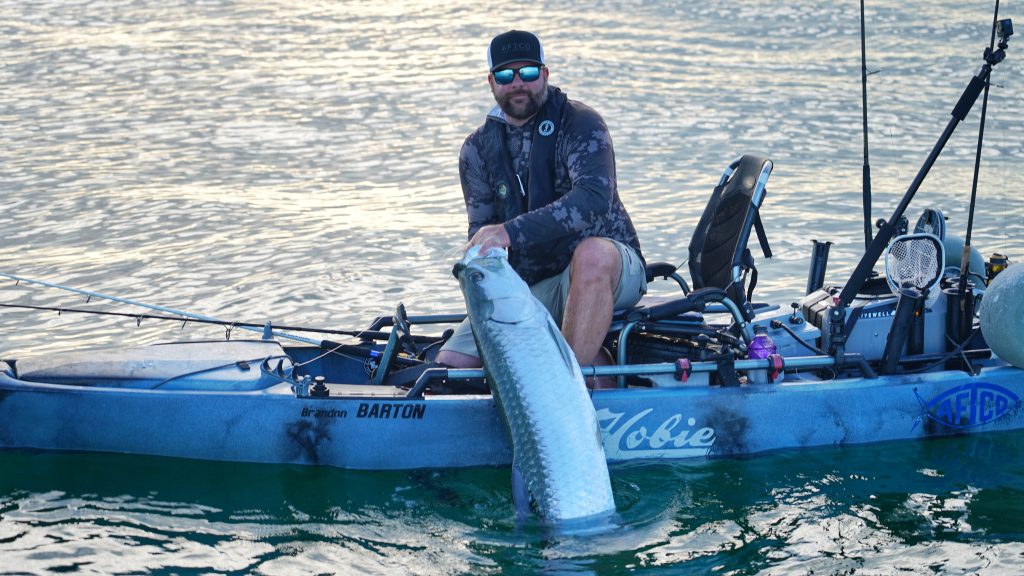
When you climb into a kayak with fishing rods, landing net, coolers, and as much bait and tackle as you can haul, you quickly realize that every square inch matters. Space is limited, conditions can change in an instant, and your setup needs to balance efficiency, safety, and comfort. Brandon Barton of Emerald Water Kayak Charters has spent years guiding clients on Florida’s Emerald Coast, and his boat is dialed in with kayak fishing accessories that truly transform a simple kayak into a serious fishing machine. Here’s what he swears by, what he avoids, and the lessons he’s learned along the way.
Start with the Right Hull and Propulsion
Before you start shopping for gadgets and upgrades, the most important step is getting the fundamentals right. A kayak with a stable hull and a reliable drive system is the foundation everything else is built on. Brandon Barton puts it bluntly: you can’t accessorize your way into greatness if the boat itself is junk.
Barton fishes from a Hobie Pro Angler 14 with the 360 drive, paired with a Torqeedo 1104 electric motor. It’s a high-end setup, but he says the lesson applies at every level. “When I first got into kayak fishing, I thought I could save a little money by buying a cheaper kayak and spending the extra on rods,” he explained. “But when I demoed a Pro Angler, I realized I didn’t need to add anything. It was already built for fishing.”

The difference, he says, is control and confidence. “The 360 drive is the most maneuverable on the market. You can rotate it in any direction at any time. In current or around structure, it lets you turn on a dime instead of making wide circles,” Barton said. Add in the Torqeedo motor, which pushes him at six miles per hour, and he saves energy and time while still relying on the pedal drive for precision.
For newcomers, Barton suggests investing in a solid pedal-drive kayak, even if it’s a used model. “If you go buy a cheap paddle kayak from Walmart or Academy, you’re fumbling between a paddle and a rod, and it’s not very stable. People get turned off,” he said. “At least get you a pedal drive kayak. It’s going to make fishing a lot more enjoyable.”
The takeaway is simple: start with a good hull and a drive system you can trust. Once you’ve got that, the accessories you add will elevate an already capable fishing platform into a true machine.
Life Jackets That You’ll Actually Wear
Right behind a good hull and drive system, your life jacket is one of the most important kayak fishing accessories you’ll ever buy—arguably even more critical than your paddle. You can have the slickest electronics and the fastest motor on the water, but none of it matters if you’re not safe when things go sideways. Brandon Barton has guided hundreds of trips, and his advice is simple: the best PFD is the one you’ll actually wear every time you go.
“That’s the key—it’s wearing it,” Barton said. “That’s why I wear the Hobie inflatable or inflatable period, because I’m more comfortable in it and I know I’ll wear it every time.” For him, comfort translates to consistency, and consistency saves lives.
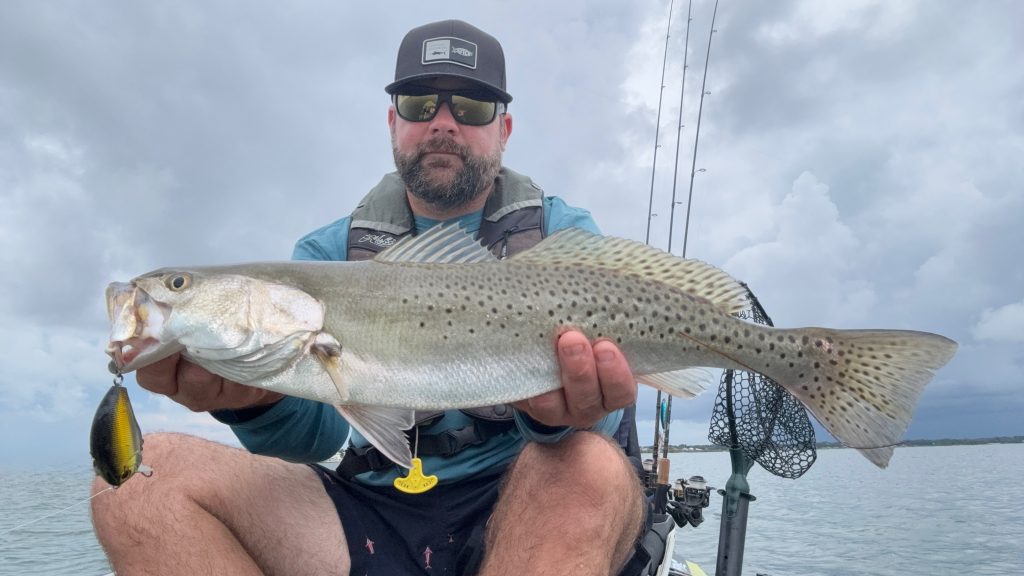
That said, Barton admits that his own choice—a manual inflatable—isn’t the safest option for beginners. “If something happens while you’re out on the water, you know, you have a medical emergency, or you get hit by a boat and you’re unconscious, how are you going to inflate a manual inflation?” he explained. His recommendation for new or less experienced kayak anglers is a hydrostatic inflatable like those made by Mustang. These automatically deploy when submerged, offering a huge safety net.
And don’t overlook the old-school foam vests. They may be bulkier, especially in summer heat, but as Barton pointed out, “They’re probably the safest option. You don’t have to worry about them inflating—they’re going to keep you buoyant if something happens.”
The lesson is the same as with choosing a kayak: skip the gimmicks and focus on fundamentals. Buy the safest life jacket you can, but make sure it’s one you’ll actually wear from launch to landing.
Electronics and Lighting
Electronics are one of the most tempting rabbit holes in kayak fishing accessories. With today’s technology, you can turn a kayak into a floating command center of screens, wires, and lights. But Barton’s approach is rooted in the same philosophy he applies everywhere else: quality and simplicity beat flashy doo-dads every time.
When he’s fishing offshore, Barton runs a nine-inch Lowrance Elite Ti2 paired with a Z-Pro lithium battery. It gives him GPS, sonar, and down-scan capabilities without sucking power too quickly. “The Hobies have a transducer pocket under the hull, so it’s protected,” he said. “That battery will last me multiple trips, so I don’t have to think about it.” For him, it’s about reliability and efficiency—not chasing the biggest or most complicated setup.
Even with that gear at his disposal, Barton says he uses it sparingly. “To be honest, the only time I even use electronics on my kayak is when I’m offshore, or maybe fishing deep water inshore,” he explained. “For the most part, when I’m fishing the flats, I already know the depth. I can see it. So that’s just another thing that’s going to catch on my rod when I’m twitching back and forth.”
Lighting follows the same logic. Instead of permanent wiring that corrodes in saltwater, Barton opts for rechargeable, battery-powered Guardian Angel lights with magnetic mounts. “You don’t have to wire anything, just charge them,” he said. “I use them for my running lights and my 360 white light on the back. They’re simple, they work, and they don’t get in the way.”
It’s a measured approach—use what you need, but don’t overload. Barton has seen plenty of anglers light up their kayaks like Christmas trees, only to spend more time troubleshooting wires than catching fish. “Saltwater destroys electronics and wiring like crazy,” he said. “I just got tired of dealing with it, so I try to go back to more of the basics.”
Storage and Live Bait Systems
Once you’ve got the hull, drive, and safety gear squared away, the next step in building a true fishing machine is figuring out how to organize your tackle, manage bait, and select the right kayak fishing accessories. For Barton, that means choosing storage solutions that are versatile, tough, and easy to swap depending on the trip.
On most inshore outings, he keeps it simple with a YakAttack BlackPak Pro crate. “It’s like a fishing crate, but more like a pro version,” Barton explained. “It’s got a lid on it and it’s decked out. It’s probably got eight to ten rod holders on it, so I can carry a good bit of rods when I’m fishing inshore.” Having one dedicated box for tackle keeps gear organized and accessible, without cluttering the deck.
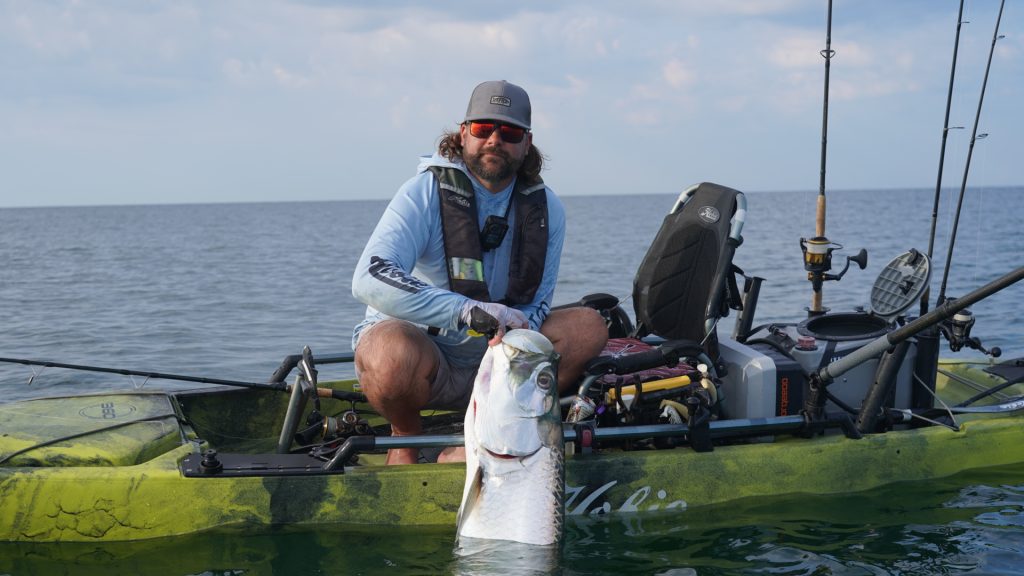
When the trip calls for live bait, Barton swaps the BlackPak for a Hobie livewell. “It sits back in the same spot, but the nice thing is it has its own separate battery and it actually pulls water from underneath the kayak and circulates it,” he said. “You’re getting constant fresh water to keep the bait alive. That’s really important when you’re offshore trolling—you definitely want to have good live bait.”
What makes this system work is the ability to change setups without reinventing the kayak each time. Offshore, Barton prioritizes bait and rod capacity. Inshore, he strips it down to the essentials. And he stresses that you don’t need to overpack. “When I take clients, they only get one rod—the one they’re using,” he said. “I learned that the hard way after someone flipped a kayak and lost gear. Just give them what they need.”
Anchoring Solutions
Even with the ultra-maneuverable Hobie 360 drive, there are times when holding steady with an anchor is the best option. Barton keeps things simple with a stakeout pole. “For the most part, the 360 drive means I don’t need to anchor much,” he said. “But there are certain scenarios—fishing heavy wind or working a specific piece of structure—where I’ll stake out and just sit there and focus on it.”
His go-to is the YakAttack ParkNPole, which he rigs with a clever modification. “A lot of people just tie a rope to their stakeout pole, but you want your rope down at the water’s level so it’s not pulling the pole over,” Barton explained. “I use a little strap with a D-ring on it. Slide it down to the water’s edge, clip on your rope, and it holds a lot better, especially in grass and sand bottoms.”
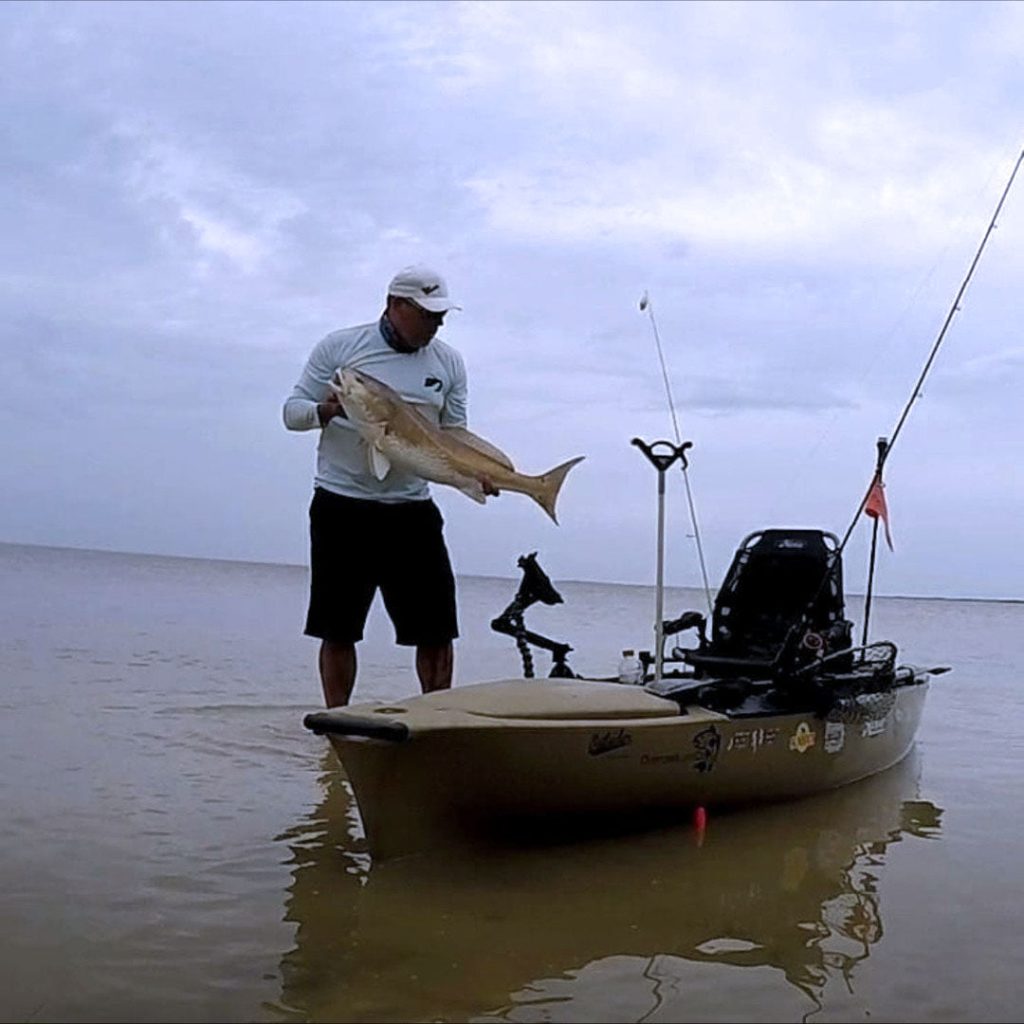
For anglers looking for a purpose-built option, Stayput’s Kayak Anchor Pole offers the same clean, dependable approach Barton prefers. Designed specifically for kayak anglers, the Stayput pole is lightweight, durable, and made to lock you quietly in place without all the moving parts and maintenance of more complicated anchoring systems. It’s the kind of tool that aligns perfectly with Barton’s advice: pick the simple solution that actually works, and don’t clutter your kayak with unnecessary gear.
Transport and Launch Gear
A fully rigged fishing kayak can weigh as much as a small jon boat, and getting it to the water is often half the battle. Barton admits that transport kayak fishing accessories aren’t as flashy as electronics or motors, but they’re absolutely essential if you want your kayak to fish like a machine.
For hauling, he uses a truck rack and a Boonedox T-Bone bed extender to protect his 14-foot Hobie Pro Angler. “It helps keep the stress off my kayak so it’s not bending in the sun and cracking,” he said. For hard surfaces, Hobie’s scupper carts do the trick. But when it comes to soft sand, Barton swears by a local invention: The Thang.
“That thing has been like a lifesaver, especially on them hot summer days when I’m doing guided trips off the beach,” Barton said. “It has four big beach wheels and a motor, and it connects to your phone. I can literally put my kayak on it, press a button, and it will take it down to the water. Being 40 years old now, I can tell you—it’s probably one of the best things I ever got.”
Back at home, Barton uses a rolling kayak table he cut to the same height as his truck bed. “When I get home, I can just slide it off onto the table and roll it into my garage. I don’t have to pick up the weight of the kayak at all,” he explained. It also lets him keep the kayak fully rigged and ready to fish, saving time on the front and back end of every trip.
Transport gear may not be the first thing new kayak anglers think of, but Barton’s experience shows that these often-overlooked kayak fishing accessories are every bit as important as what you carry on the water. The right setup makes launching easier; protects your investment; and, if you’ve got a tool like The Thang, saves your back for the fight that really matters: the one at the end of your line.
Safety and Overlooked Essentials
Beyond hulls, drives, and tackle storage, there are a handful of small items that can make the difference between a good story and a bad day on the water. Barton says too many anglers focus on rods and electronics while ignoring the gear that actually keeps them safe.
One of his must-haves is a pair of pliers strong enough to cut heavy hooks. “A lot of people take pliers to get hooks out, but you know how it is—you get a hook in you, you need something that can cut that barb and get it out,” he said. It’s not the kind of tool you’ll appreciate every trip, but when you need it, nothing else will do.
He also carries a simple roll of electrical tape. “You can use that in a lot of scenarios,” Barton explained. “If you get a cut, you can kind of wrap it up. It’s just one of those things that works for a bunch of different situations.”
Perhaps the most important piece of safety gear in Barton’s kit is a waterproof, floating VHF radio. Phones are great until they get wet or you lose service. “Sometimes you’re fishing areas with no cell phone service, or you drop your phone, and you still need to be able to call for help,” he said. “Having that floating, waterproof radio on a kayak is a must, especially if you’re going offshore.”
These kayak fishing accessories aren’t glamorous items, they won’t draw compliments at the boat ramp or rack up Instagram likes, but they’re the tools that keep you fishing another day.
What to Skip
If there’s one trap that new kayak anglers fall into, it’s believing that every accessory on the shelf is a must-have. Barton has seen it time and again: beginners load up their kayaks with gadgets, only to realize later that most of them just get in the way. His top example? Rod leashes and floats.
“I see that a lot on newer people getting into kayak fishing because they’re so scared to lose their gear,” Barton said. “They want to add all this extra stuff, but a lot of it just gets in the way—especially rod leashes. You’re hooked up to a fish and you’ve got some rope wrapping around your handle, messing you up.”
That doesn’t mean they’re useless. Barton admits there’s one scenario where he uses them: punching through the surf. “When you go offshore on a kayak, it’s not if you’re going to flip, it’s when,” he explained. “That’s when you need a rod leash or some kind of latching system to keep your rods tied down. But once you’re actually out there fishing, floats and leashes can do more harm than good.”
It’s a reminder that accessorizing is not about buying every gadget—it’s about knowing which tools truly serve you on the water.
Final Advice from a Seasoned Pro
After years of guiding and fishing offshore, Barton has stripped his approach down to the essentials. While many anglers dream of rigging their kayaks with every gadget imaginable, he’s learned that less is usually more. For Barton, the true mark of a fishing machine isn’t how many kayak fishing accessories you can bolt on, but whether your rig is safe, efficient, and ready to fish. His final piece of advice has nothing to do with gear at all, but it may be the most important. “Besides making sure you wear your PFD at all times, file a float plan when you go fishing,” he said. “Tell someone what time you’re going, where you’re launching, and when you’re supposed to be back. Too many people don’t, and you don’t know they’re missing until the next day. That can make all the difference.
In the end, Barton’s message is clear: build your kayak around the fundamentals, invest in the gear that truly matters, and leave the gimmicks behind.