

By Steve Strauss | Guest Contributor
In the first part of this three-part series, I introduced you to the Kenai Peninsula. In this 2nd installment, we’re going to focus specifically on Salmon fishing in Alaska, specifically on the Kenai Peninsula. Salmon fishing is unlike fishing for anything in the southeastern United States. For one thing, these fish are traveling in one direction, constantly swimming upstream against strong currents to reach the spawning grounds. It’s a one-way trip, with spawning and death as the reward for a successful voyage.
Rivers and Techniques for Salmon Fishing in Alaska
In the glacial melt rivers, such as the Kenai and Kasilof, the blue-green water makes seeing the fish impossible. In the snowmelt-fed rivers, such as the Russian, the water is crystal clear, and you can spot fish. Either way, you can’t just tie a worm onto your trusty Eagle Claw hook. You can best see the methods and techniques in the multitude of videos available. Just Google “sockeye salmon technique.”
Species, Timing, and Salmon Runs
The other salmon species are much more predatory, and fishing for them is a little more conventional. As far as timing, the following is very consistent. King Salmon will make two runs, occurring sometime around mid-May, June, and July. Sockeye will also make two runs, but these occur starting in mid-June and will conclude by mid-August. Pink and Chum are also available at these times but are really not sportsmen targeted.
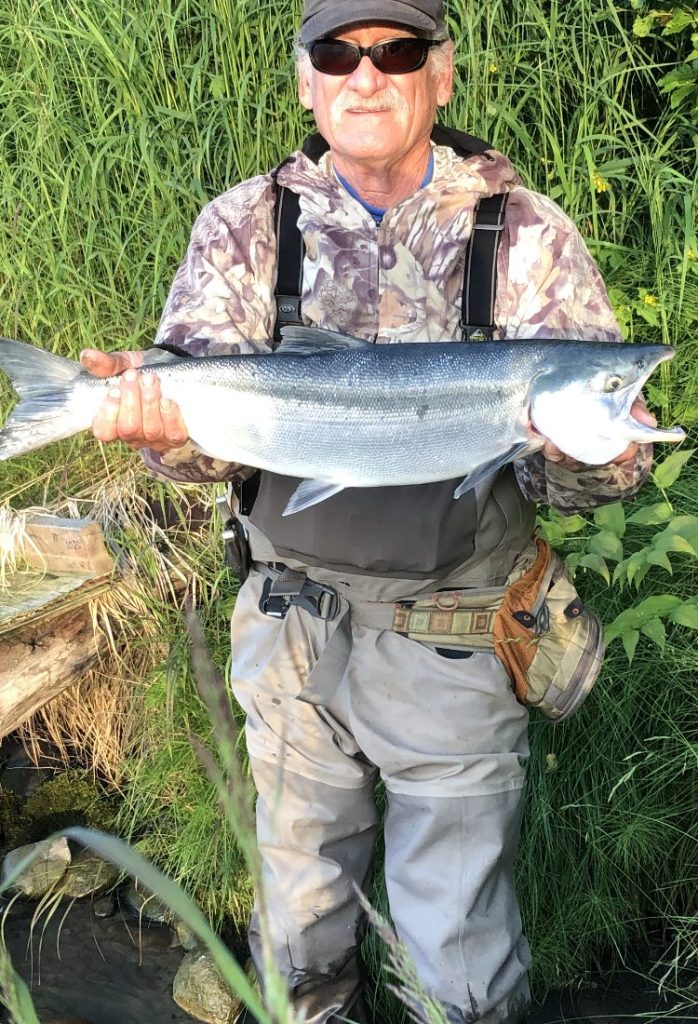
It should be noted that the magnificent in-river King run has decreased over the last decade; to such a point that most rivers will not allow these fish to be targeted. The sockeye run, on the other hand, has returned in record numbers, and throughout recent years the Coho run has stayed fairly consistent.
Regulations and Limits for Salmon Fishing in Alaska
Alaska Fish and Game strictly monitors the runs with in-river sonar counters. When a certain number of salmon return (called “escapement”) they raise the limits. Kings are one per day with a five-fish yearly limit. Sockeye starts out at three per day and increases to six-per-day when the escapement goal is met. In the last few years, some of the rivers (the Russian in particular) raised the limit to nine per day. The Silver limit is always two per day.
Best Times and Locations for Sockeye Fishing
For Sockeye fishing (the most commonly targeted salmon for vacationing anglers) prime time is June 18th through the 28th in the Russian River, and July 18th through August 7th in the Kenai River. These are the two most productive rivers on the Kenai Peninsula, and both provide ample shoreline opportunities.

As a side note, there are more rules and regulations surrounding the Kenai salmon fisheries than in a Destin, FL HOA. You must read and follow these, as Big Brother (Alaska Fish and Game) is very strict. And rightfully so, as to protect these fantastic fisheries.
Gear and Clothing for Salmon Fishing in Alaska
As far as outfitting yourself, let’s start with apparel. This is summer in Alaska. Alaskan Summers are quite unpredictable. They are usually between 50 to 70 degrees, but you can and will get much more extreme temperatures. It is also the Pacific Northwest, with quite a bit of overcast, drizzly weather. With global climate change, the summers in Alaska are getting much more moderate. The warming trend is terrible for glaciers and polar bears, but great for tourists! I’ve fished in 30-degree weather in June when you could see both your breath and the steam coming off the river. I’ve also finished in 80-degree weather in T-shirts, so be prepared for both extremes. Great rain gear is a must. You won’t need a winter coat, but bring plenty of clothing that you can layer depending on conditions.
Fishing in the rivers, you will be knee-deep in 40-degree water for hours at a time. Hip waders will be adequate most of the time, but there will be plenty of times that you would wish you had chest waders. Neoprene chest waders can be worn, but again, you will find yourself wishing you had breathable chest waders. I would strongly recommend breathable, stocking-foot chest waders. These will necessitate wading boots of some sort. If it’s not feasible to bring or buy wading boots, oversized sneakers that will fit over the wader booties will work, although you might look and feel like a doofus in them. I personally use studded, rubber-soled boots, as many rivers have slippery-smooth rock bottoms. They also have removable soles for boat fishing.
As stated, you will be standing close to the bank in knee-deep water. The fish migrating up the river will be traveling within 10 to 15 feet of the bank. They have to fight the current, and the weakest current is found close to shore and about one foot from the bottom of the river bed.
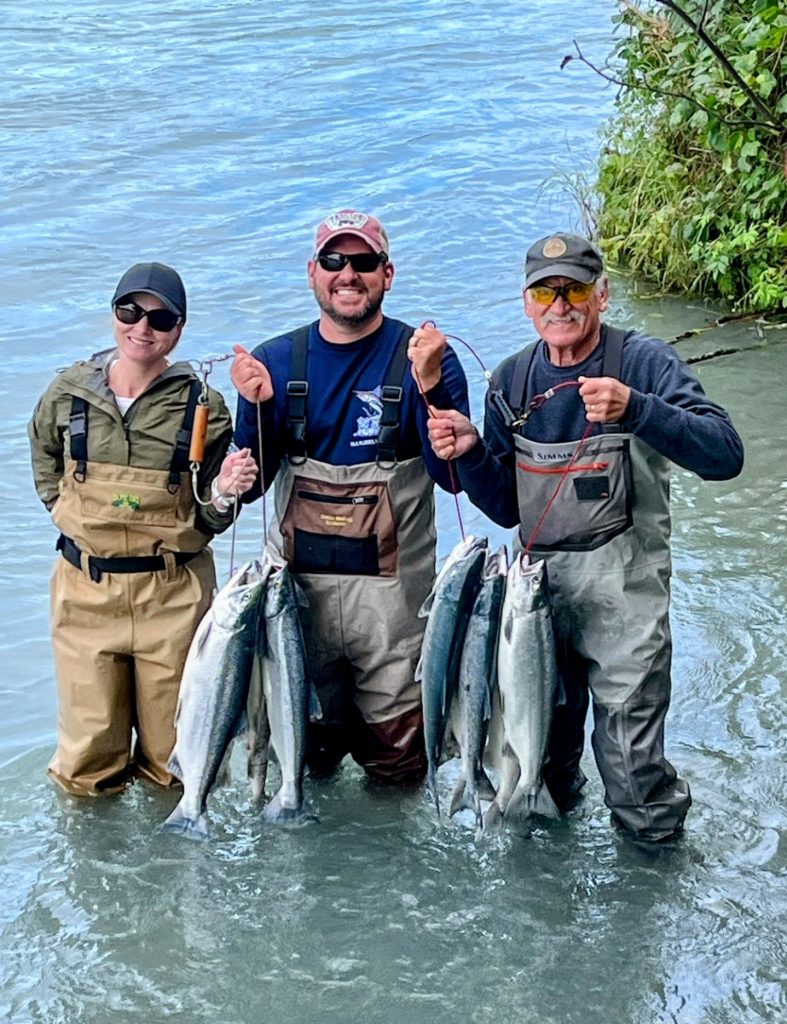
You will be casting upstream and drifting downstream until your line finds the open mouth of a salmon…or until you reach the end of your drift. Then you repeat the motion–again, and again, and again–if you catch my drift. Because of the dynamics, most accomplished anglers will use an 8 or 9wt fly rod with 7/8wt sized fly reel. You can use bait casters, or even spinning rods of at least eight feet in length, but they become quite cumbersome when casting for hours on end.
Although you are using a fly rod, it’s not actually fly fishing, as you have a weight as well as a fly at the terminus. I personally use a 9’, 9wt fly rod, but line it with a 30-pound mono instead of fly line. Believe me, an eight or nine-pound Sockeye getting out in the wrong current can easily snap a 30-pound test line. Besides the ease of casting it’s just so much dang fun fighting a salmon with a fly rod! Just make sure it’s graphite.
Essential Gear and Accessories
The actual terminal tackle for salmon fishing in Alaska is really quite simple. Just a 3/8 or 3/4 oz weight, depending upon the river current, and an appropriately sized fly for the day’s conditions. Buy a bunch of different colored and size flies at any one of the sports stores or fly shops. Learn to tie a modified clinch knot, and you are all set. For reference, Anchorage has a Cabela’s, Bass Pro Shops, Sportsman’s Warehouse, and numerous fly shops. Most of the towns on the Kenai Peninsula have fishing or sports stores.
In addition to the rod, reel, and tackle, you will of course need all the universal accessories: filet knife, pliers, stringer, most likely a salmon net, and a fish bopper. The protocol calls for “bopping” a netted salmon to stun it but not kill it. Then cut or tear the gills to bleed the fish while the heart is still pumping. Since the water is refrigerator-cold, you can put the fish on a stringer and put it back in the river. It can stay there for hours without affecting the quality. The most difficult thing about salmon fishing might be backpacking the filets back when the limits are increased. You usually filet the fish on the river and throw the carcasses out into the fast-moving water. For reference, a nine-fish limit will probably equate to 30 pounds of filets.
Beyond Salmon Fishing – Halibut and Other Saltwater Adventures
So what about the saltwater enthusiast? Man cannot live by salmon alone. Unlike salmon fishing in Alaska, where you can just find a place on the river, Halibut fishing requires a boat. The larger seaports on the peninsula; in Seward, Homer, and Whittier; as well as a half dozen beach departure locations, allow for some amazing deep-sea fishing. And it is usually very deep fishing indeed. Because of the mountainous terrain, you routinely fish in 250 to 850 feet of water. You can be a mere 200 feet offshore and be in 300 feet of water. Most anglers target the highly prized Pacific Halibut. These flounder-looking fish range from the 20-pound “chickens” to the 300-pound “barn doors.” Limits are the norm. My personal record is 188 pounds. On the same day, it was caught, my wife and I also caught a 108-pound, 77-pound, and 30-pound fish. That is not the norm, however!
In addition to Halibut, Rockfish, Yelloweye (which are similar to Red Snapper) and cod are easily attainable. There are boats that limit their focus to one of the above species, and combo trips that target all of the above. The latter would be my recommendation. Seward and Homer are the most productive saltwater departures. Seward, about five miles south of Anchorage, has the added advantage of providing a chance to see whales, seals, walruses, eagles, and other magnificent Alaskan wildlife. The scenery is also spectacular.