
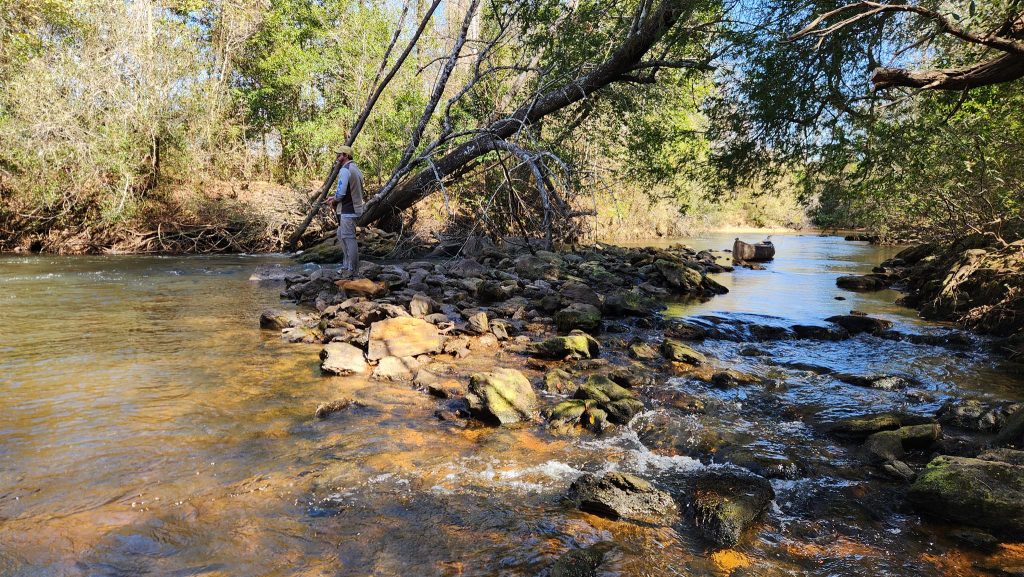
Fly fishing has always been about more than just catching fish. It’s an opportunity to connect with nature, test your patience, and find a rhythm that draws you into the environment. Now, imagine pairing that with the thrill of exploring remote wilderness areas. Backcountry fly fishing takes everything anglers love about the sport and adds an extra layer of adventure. As Andre Davis explained on a recent episode of the Alabama Freshwater Fishing Report, it’s about getting “lost in the forest, in the birds, in the sound of the stream” and truly “surrendering to nature.” Of course, it’s also at least a little bit about the fishing, and a backcountry trip can put you in front of fish that have rarely, if ever, seen an angler’s offering.
In the Deep South, November offers an excellent chance to enjoy cooler weather and less buggy woods. If you’re curious about how to begin your own backcountry fly fishing adventure, this guide covers everything you need to know, from finding the perfect spot to packing the right gear.
Why Try Backcountry Fly Fishing?
One of the most appealing aspects of backcountry fly fishing is the escape. As Andre explains, it’s a chance to leave behind the noise, the crowds, and the stresses of your day-to-day life. Hiking into remote areas to fish offers the opportunity to experience nature in its purest form. For many, it’s as much about the journey as it is about the fishing. There’s always the possibility that you might hike miles into the wilderness only to find that the fishing isn’t great—but the peace, the solitude, and the beauty of untouched landscapes make the entire experience worth it. “Even when the fishing is mediocre, the scenery is often unparalleled,” Andre shared, reflecting on one of his recent trips.
Finding the Perfect Spot
Selecting a location for your backcountry fly fishing trip is part of the adventure. While it can be tempting to go wherever the map shows water, it’s important to do a little research. According to Andre, a good starting point is looking at public lands, national forests, or wilderness areas. He recommends using tools like Google Maps, OnX, and Gaia GPS to find public access points. “Sometimes I like to blue line it,” Andre explained, “which means following a stream on a map and just hiking until I find the perfect fishing spot.” Remember, backcountry trips mean that you’ll be wading instead of boating. Smaller, shallow water is typically what you’re looking for. When e-scouting in Alabama, there are a few things to look for.
The Coastal Plain biome dominates the lower half of Alabama and much of the Gulf Coast Region. Here, you won’t find rocky trout streams. What you will find is “blackwater;” small, sand or pebble-bottomed ribbons of relatively clear water stained the color of sweet tea. These waterways are filled with sunfish, such as black bass, bluegill, and longear sunfish, as well as redhorse suckers, buffalo fish, gar, and catfish.

The best blackwater streams typically flow through areas on the map that show a little topographic release. You won’t exactly find “hill country,” this far south, but you’ll generally want to avoid areas that show up as featureless or swampy on a map. Sand bars, usually visible on an aerial map, are excellent indicators of a firm, sandy, wadeable bottom.
Above the Fall Line, you’re unlikely to see sand bars. Here, you’re looking for rocky bottoms. Again, avoid swampy areas and gravitate towards hilly ones. Many fine small streams are hard to see as they snake below the canopy, but here and there you may see pockets of water reveal themselves. These pools are usually excellent fishing.
Alabama offers several great starting points for beginners, such as the Talladega National Forest and the Sipsey Wilderness above the Fall Line, and the Conecuh National Forest and Perdido WMA below it. These areas are well-known for their beautiful landscapes and relatively accessible fishing spots, making them ideal for first-timers looking to dip their toes into backcountry fly fishing.
Essential Gear for Backcountry Fly Fishing
Packing for backcountry fly fishing can be a delicate balance between bringing what you need and keeping your load light. The key, according to Andre, is focusing on gear that is versatile and reliable. He suggests starting with an 8’6” 4-weight fly rod. This rod is light enough for delicate presentations but strong enough to handle “bigger” fish if you come across them.
As for flies, Andre advises carrying a small selection of tried-and-true patterns, including size 12 stimulators, hare’s ear nymphs, parachute Adams, and wooly buggers. “These flies are universal. They’ll work for most situations, whether you’re fishing for trout or panfish,” he said.

In addition to your rod and flies, consider bringing a Tenkara rod. These lightweight, collapsible rods don’t require a reel, making them ideal for ultralight backpacking trips. “I like to pack a Tenkara rod as a backup. It’s quick, easy, and can be great if you want to fish a small stream without much setup,” Andre noted. Tenkara rods excel at delicate, close range presentations, and even the smallest fish are fun to catch on these ultra-long, ultra-delicate fish yankers.
Backpacking Gear and Water Filtration
When venturing into the backcountry, your camping gear is just as important as your fishing equipment. One of Andre’s key tips for beginners is to test your gear before you head out. Whether it’s your tent, sleeping bag, or stove, make sure you know how everything works and that it’s comfortable to use. “You don’t want to be miles from civilization and realize your gear doesn’t hold up,” he warned. “Take it out to the local state park before you take it out into the backcountry. Get familiar with it.” While true ultralight gear is expensive and questionably necessary for weekend trips, lighter is always better, especially when you’re packing in extra weight in the form of fishing gear.
A critical piece of equipment for any backcountry adventure is a reliable water filtration system. Even the clearest streams can be polluted with giardia or cryptosporidium, and waterways throughout Alabama and the rest of the country also contain contaminants such as lead, mercury, arsenic, PCBs, PFAS, microplastics, and pesticide and fertilizer runoff.
For years, I’ve been a fan of bottle-style water filters, such as the LifeStraw Go Series. I’ve always loved how simple they were to use. Unscrew the cap, dip water with the bottle, cap, and drink. They’re so handy that I have multiples. One stays in my fly fishing sling bag so that I can drink straight from the stream when I want to. I have two for overnight backpacking and canoe trips for my wife and I, and another two live in my kitchen cupboard in the event that a hurricane leaves our tap water flowing but contaminated.

I didn’t think it was possible to improve on bottle-style filters, but this year I’ve had the chance to test Grayl’s Geopress Ti model, and I have to say I was wrong. For starters, the Grayl cartridge filters that their presses use are some of the best I’ve ever seen. In addition to filtering bacteria, they also filter out viruses as well as many of the more common chemical and heavy-metal pollutants. The unique design, which features an internal and external bottle as well as a one-way valve on the filter, also means that you can add electrolyte powders to filtered water. The titanium models’ outer sleeve also functions as a cook pot, and combined with Grayl’s ultralight titanium stove and an isobutane canister, you get a pretty nifty way to filter water and boil water for dehydrated meals or coffee. The filter is a little heavy, but when it pulls double-duty as a cookpot it’s a pretty nifty use of pack real estate.
Staying Safe in the Backcountry
Safety is a critical aspect of any backcountry adventure, and Andre stressed the importance of preparation. One of the simplest, yet most vital tips is to let someone know your itinerary. Make sure a friend or family member knows where you’re going, when you’re leaving, and when you plan to return. This ensures that help will come if you don’t return on time.
Having reliable navigation and communication tools is also important. While many smartphones now offer satellite texting features, dedicated GPS devices like the Garmin inReach Mini are invaluable in areas with no cell service. “I always bring a GPS device. You don’t want to rely on cell reception when you’re out there,” Andre advised.

Another tip is to be mindful of your energy levels and overall health on the trail. Hiking several miles with a fully loaded pack can be draining. Andre recommends pacing yourself and listening to your body. “If you’re feeling tired halfway in, don’t push it. Sometimes, setting up camp a little earlier than planned is the smart move.”
The unpredictability of the wilderness means it’s crucial to have backups for essential items, such as fire-starting tools and water filtration systems. Andre suggested packing redundancy into your gear when it comes to crucial items like a compass, and ensuring you have a method to start a fire, even in damp conditions.
Conclusion
Backcountry fly fishing offers the perfect combination of adventure, solitude, and immersion in nature. It’s not just about catching fish—it’s about the entire experience of hiking through remote areas, setting up camp, and testing your skills in wild waters. As Andre put it, “There’s something about being alone out there, with just your gear and the natural world around you. It’s life-giving.”
So, whether you’re casting into a small creek tucked away in the Alabama wilderness or planning a trip to the mountains, make sure to prepare carefully, pack smart, and embrace the adventure.