

This week’s Alabama Saltwater Fishing Report featured Angelo DePaola, Chris Vecsey of J&M Tackle, Tony Emmons with South Alabama Surf Fishing, and Capt. King Marchand with the Lady Ann out of Dauphin Island. The big theme this week was that Alabama’s saltwater fishing is offering several strong spring options, from swordfish and deep-water bottom fishing offshore to whiting, flounder, Spanish mackerel, and scattered pompano in the surf.
Angelo opened the show with an update on the strong swordfish action during the Mud Marlin tournament, where several boats brought in quality fish, including a 297-pound swordfish and another around 250 pounds. Chris Vecsey then broke down how he approaches daytime swordfishing with electronics, structure, bait, and fast bait deployment. Tony Emmons covered the surf scene from Fort Morgan and Gulf Shores, where pompano have been hit or miss but flounder and whiting have been steady. Capt. King Marchand finished the report with an offshore update centered on excellent scamp and beeliner fishing, improving live bait availability, tough tuna conditions, and scattered cobia opportunities.
Conditions Recap
Spring fishing is clearly moving forward along the Alabama coast, but the bite is not the same everywhere. Offshore, swordfish have been feeding well around structure and bait, with Chris Vecsey reporting fish in deeper water than he often targets, including areas from 1,600 to nearly 1,700 feet. Weather was a major factor during the Mud Marlin tournament, with storms, rough seas, and strong winds creating difficult conditions, but the fish still cooperated when crews found the right marks.
In the surf, Tony Emmons said the water has been clear overall, though east winds and evening gusts have made conditions more challenging at times. Sand fleas are starting to show up, but many are still clear and not yet full of orange eggs. That may be one reason pompano fishing has been inconsistent along the Alabama beaches, especially compared with better reports coming from farther east. Whiting and flounder have helped fill the gap, and Spanish mackerel, bluefish, jacks, trout, and the occasional redfish are also showing up.
Out of Dauphin Island, Capt. King Marchand said bottom fishing has been the most reliable offshore option. Scamp are biting well, beeliners are as strong as he has seen in years, and live bait is finally showing up around ships, rigs, and offshore structure. Tuna have been marked but difficult to trigger, while cobia are around but not yet consistent enough for him to call it a sure thing.
Offshore Swordfish Report
Chris Vecsey joined the report after fishing the Mud Marlin tournament and going four-for-four on swordfish despite losing time to weather and an onboard emergency. His biggest takeaway was that successful daytime swordfishing comes down to combining the right structure with bait, electronics, and fast bait deployment. Rather than simply drifting known swordfish areas, Chris prefers to mark an individual fish first, then get a bait down quickly before the boat drifts too far away.

Chris said he starts by dialing in his electronics so he can read bait and fish at depth without being overwhelmed by clutter from the deep scattering layer. He likes a split-screen setup with one full water-column view and one bottom-lock screen focused on the lower 300 to 400 feet. If fish are tight to the bottom, he zooms in closer. If the bite is slow or fish are suspended, he stays wider so he can see marks higher in the water column. That mattered this week because some swordfish may hold well off the bottom, even hundreds of feet up in the water column.
The gear approach centered on sacrificial weights, which let him deploy baits quickly and accurately. If he marks a fish, Chris does not want to waste time setting up a full drift. He sends one bait down fast, gets it near the fish, and works it as soon as the weight comes off. When he is not marking individual fish, he sets up a more traditional drift with buoy rods and multiple baits placed around bait concentrations.
Products and gear mentioned in this section included whole squid, octopus tentacles, sacrificial weights, buoy rods, 70-class international-style reels, short pro swordfish rods, and electric reels. Chris personally prefers hand-cranking swordfish because he likes the feel, the manual hookset, and the ability to control pressure during the fight. He said electric reels can work, but he feels more connected to the bite and the fish when using conventional tackle.

Chris also gave a detailed look at bite detection. With the right swordfish rod blank, he said anglers should be able to see bites even at extreme depth. The key is learning the rhythm of the rod tip as the boat rises and falls in the swell. A break in that rhythm can signal a swordfish striking the bait. Once a fish starts hitting, Chris likes to actively engage it by teasing the bait away and feeding it back, rather than just letting the fish hook itself. He believes that often produces a faster, more aggressive bite and helps him avoid gut-hooking fish.
Moon timing also played a role. Chris said he watches major and minor feeding periods, but he also pays close attention to moonrise and moonset. During this trip, one of their better fish came shortly after moonrise, which lined up with what he has seen on many swordfish trips. His view is that lunar timing can be especially important for daytime swordfish.
Gulf Shores and Fort Morgan Surf Fishing Report
Tony Emmons said the pompano bite along the Alabama beaches has been hit or miss, especially around Fort Morgan and farther west. Some days anglers are catching a few, while other days the fish seem to slide up or down the beach. He has noticed reports shifting between Orange Beach, Fort Morgan, and areas farther east, and he said this year’s pompano numbers have not felt as strong as past seasons.
One encouraging sign is that sand fleas are finally starting to show up in the surf. Tony said they have not fully darkened up or started carrying many orange eggs yet, but he did catch a pompano on sand fleas during the report window. He also said orange has been the best color lately, especially with Fishbites sand flea flavor, which makes sense as sand fleas begin to transition toward that egg-bearing stage.
For pompano, Tony has been fishing double-drop rigs with orange accents and Fishbites. When the water temperature warms up, he said the scent release from Fishbites becomes especially useful, and it is much easier than constantly gathering live bait. For whiting, he keeps the setup simple with a one-ounce egg weight Carolina rig and fresh dead shrimp fished close to the beach. The whiting have been holding in the first trough, especially along small drops and flats.
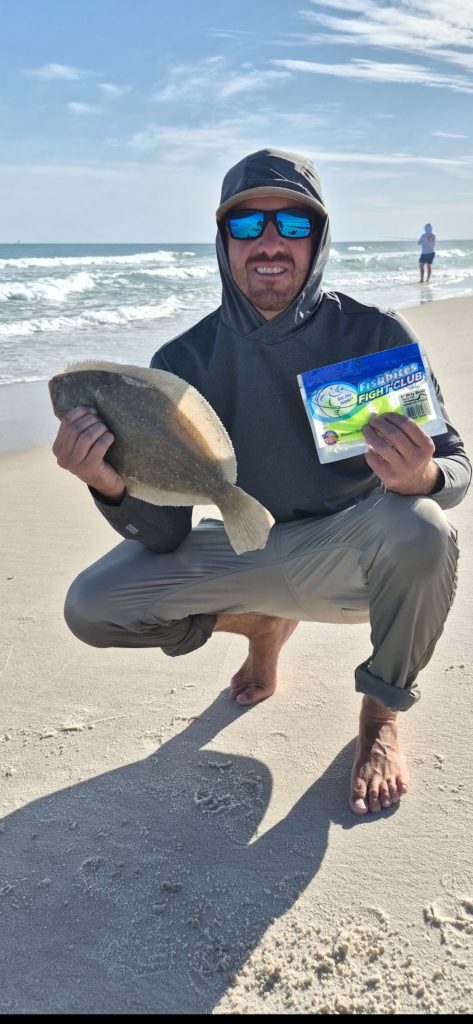
Flounder have been one of the better beach targets. Tony has been walking the Fort Morgan area and casting artificial baits around washouts, corners of sandbars, and rip-current areas. The better flounder have not been right at his feet; they have been farther out between the first sandbars and around deeper washouts. Because of that, he has been using heavier jigheads, including 3/8-ounce heads, to launch baits far enough and keep them in the strike zone.
Gear and products mentioned in this section included Fishbites Dirty Boxer baits, Z-Man soft plastics, tandem rigs, bucktails, 3/8-ounce jigheads, double-drop pompano rigs, orange Fishbites, sand fleas, fresh dead shrimp, and one-ounce egg weights. Tony also mentioned experimenting with a Whopper Plopper and the Berkley Choppo around the jetties, where bluefish, Spanish mackerel, and jack crevalle have been active.
Spanish mackerel have been showing up around the jetties, and Tony said the bigger fish have been hitting one-ounce bucktails. He does not typically use wire for them, preferring a four- to five-foot section of 50-pound mono leader instead. His advice was to check the leader constantly because Spanish mackerel will nick and cut line. Anglers should retie often instead of continuing to cast with damaged leader.
Tony said he is also seeing bait, jacks, bluefish, trout on the beach, and occasional redfish. For anglers who want help learning the beach, he is offering guided surf trips focused on artificial casting, set rigs, whiting, pompano, redfish, and flounder.
Dauphin Island Offshore Report
Capt. King Marchand said his offshore trips out of Dauphin Island have included a little bit of everything, but the most exciting and reliable bite has been deep-water bottom fishing. Scamp are one of his favorite fish to target, and he said the scamp bite has improved compared with the slower fishing many anglers saw in recent years.
King spent a lot of time explaining how he fishes for scamp in 200 to 400 feet of water. The main setup is a fish-finder-style bottom rig with a three-way swivel, lead on one side, main line on another, and a leader to the hook. He said the key is keeping the bait just above the bottom without constantly bouncing the lead. In deeper water with waves and current, anglers need to raise and lower the rod with the motion of the boat so the bait stays naturally suspended and bites are easier to feel.
One important adjustment has been lengthening the dropper to the weight. King said using a longer lead leg helps keep the bait suspended above coral and low bottom growth, which makes it easier for scamp to see the bait. He also shared a trick from one of his deckhands: when a scamp bites, lower the rod tip slightly and let the fish eat the bait more fully before coming tight. He said that can help with hookups, though anglers still need to be careful not to give the fish so much slack that it gets back into the rocks.
If a scamp does rock up, King said not to give up immediately. His tip is to give the fish slack for about 30 seconds, then come tight and pump the rod several times. Many times, that fish will swim back out of the structure and give the angler another chance to fight it clean.
Live bait has been the best option for scamp. King said dead bait such as blackfin tuna bellies can work, but it often gets picked apart by white snapper and beeliners before scamp get to it. Live scaled sardines, cigar minnows, croakers, and smaller live baits have been better. Hardtails are also available, but King said larger hardtails tend to produce more amberjack, snapper, and other bycatch than scamp.

Gear and bait mentioned in this section included three-way fish-finder rigs, egg sinkers or bottom weights, longer lead droppers, live croakers, scaled sardines, cigar minnows, hardtails, blackfin tuna bellies, diamond jigs, poppers, and live bait chumming.
Beeliner fishing has been outstanding. King said it may be the best beeliner fishing he has seen in 14 years, especially once boats get 20 to 25 miles offshore. He said limits can come quickly, and the fish are big. On trips where tuna did not cooperate, beeliners and scamp gave customers steady action and plenty of quality fillets.
Tuna fishing was much tougher. King marked both blackfin and yellowfin tuna, including fish holding around 120 to 150 feet, but they would not come up well for live bait, trolling presentations, or chum. He did catch one yellowfin and some blackfin, but the bite was not consistent. The best blackfin window was around sunset, and diamond jigs produced some fish after dark.
Cobia are around, but King has not seen them consistently enough to fully commit a whole day unless that is the goal. He has heard of fish being caught around ships, offshore rigs, and even from the beach, but his confidence level is still about 50/50 if he dedicated a full day to cobia right now.
What to Expect This Week
The best offshore bet right now appears to be bottom fishing when the weather gives boats a window. Scamp and beeliners are both strong options, and live bait is becoming easier to find. Swordfish are also a legitimate target for crews with the right setup, especially around structure and bait in deeper water. Paying attention to electronics, lunar timing, and fast bait deployment can make a major difference.
In the surf, anglers should not expect every day to be a lights-out pompano day, but there is still plenty to catch. Whiting remain the most dependable beach option, flounder are showing well around washouts and sandbar edges, and Spanish mackerel, jacks, bluefish, trout, and redfish are all possible. Orange Fishbites, sand fleas, fresh dead shrimp, bucktails, and heavier jigheads should all have a place in the beach-fishing bag this week.
Featured Sponsors
- The Coastal Connection with eXp Realty
- Fiber Plastics Inc.
- Hilton’s Realtime Navigator
- Coastal Brew Bait Company
- Baker Metal Works
- Destin Boat Show
- Alabama Marine Resources Division / Outdoor Alabama
- Make Wake Marine
- Foster Contracting
- Black Buffalo
- Deep South Crane Rentals
- SlipSki
- CCA Alabama
- Camper City Truck Accessories
- Moffett Road Dentistry
- McCoy Outdoor Company