




In this week’s Northwest Florida Fishing Report, host Joe Baya looks ahead to November as redfish continue to bite around Destin’s bridges and passes, larger pompano remain available in the surf, and anglers prepare for the approaching blackfin tuna run. This episode features Capt. Adam Schroeder of Ignite The Bite Charters, Nico Sanchez of Reel30A, and Evan Wheeler of Tall Pines Tight Lines. Alabama Saltwater Fishing Report host Butch Thierry also joins Joe to talk with Adam Knowles of Minn Kota about the new Draw & Navigate feature and other improvements to integrated trolling motor and fish finder technology.
Conditions Recap
Northwest Florida is moving toward November with productive fishing in some areas but an unusually unsettled fall transition in others. Around Destin, Capt. Adam Schroeder says redfish have continued feeding aggressively despite the recent hurricane, with schools gathering around bridges, jetties, and the pass. The trout bite has also been encouraging wherever anglers can locate concentrations of bait, with fish in the 22- to 27-inch range showing up. Persistent cooler weather has not yet arrived, however, so pompano have not fully concentrated in Destin Harbor and the deeper bayous where Adam expects to find them later in the season.
Along the beaches of 30A, Nico Sanchez reports that the surf cleared quickly after the storm, in some places returning to exceptionally clear water within days. Although the hurricane changed some of the troughs and holes, fishing has remained productive. Redfish are his most consistent target, and pompano are still being caught, with fewer fish than the unusually strong spring and summer bite but plenty of larger specimens. Calm water has made lighter leaders and less conspicuous terminal tackle particularly valuable. Drifting dune grass has occasionally complicated afternoon trips, making early starts and careful beach selection important.
Farther west, Evan Wheeler says the Pensacola-area inshore fishery has been more difficult to pattern. Heavy rain, the hurricane, warm spells, and short-lived fronts have left trout and redfish scattered between their late-summer and winter locations. He is putting extra emphasis on clean water, visible bait activity, and the brief feeding windows that develop around moving water. Looking offshore, a few calmer weather windows should give anglers opportunities to look for blackfin tuna around the ledges and nearer the beach as the fall run develops, although Adam says his recent attempt was still early and the fish had not yet shown in force.
Destin Inshore and Offshore Fishing Report – Capt. Adam Schroeder With Ignite The Bite Charters
Capt. Adam Schroeder of Ignite The Bite Charters says the redfish bite around Destin is one of the most reliable opportunities heading into November. The fish were biting well before the storm and continued feeding afterward, with schools holding around the bridges, jetties, and Destin Pass. Many have been in the 25- to 26-inch class, with occasional fish around 40 inches mixed in. Adam says the fish have been willing to eat a variety of natural baits, including pinfish, croakers, spot minnows, cigar minnows, and herring, so anglers do not have to depend on finding one particular baitfish.
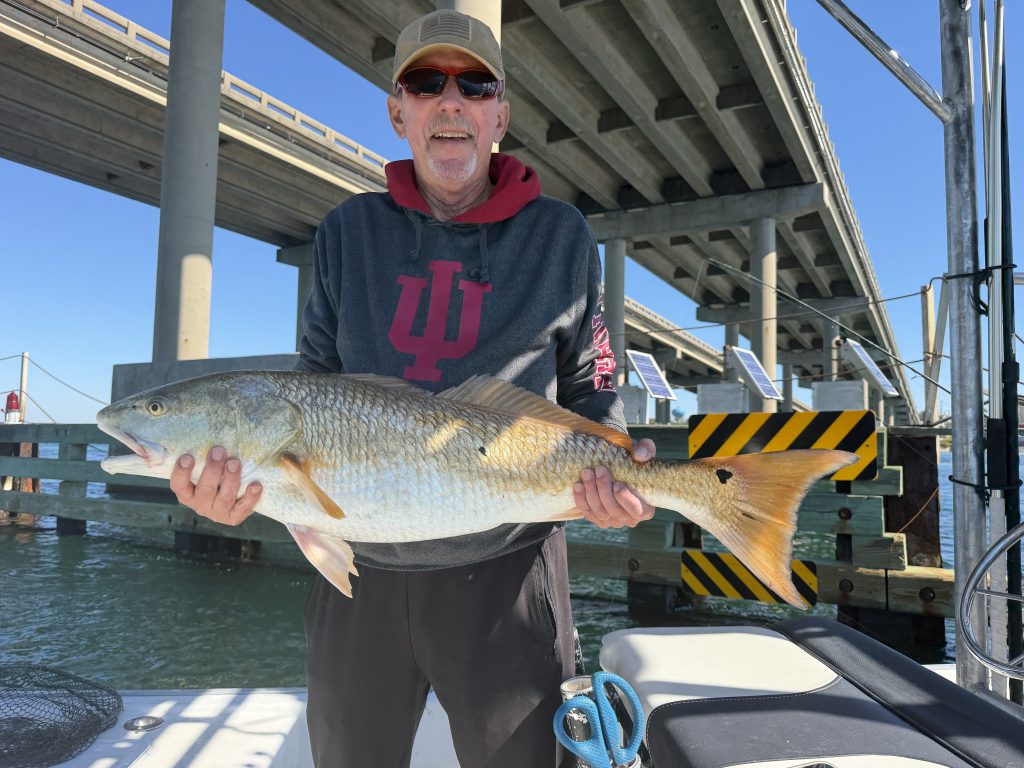
For bridge and pass fishing, Adam favors an outgoing tide, although the bite has remained good even when the current is relatively weak. Around the structure he uses heavy spinning tackle, 65-pound braided line, a 60-pound fluorocarbon leader, and a Carolina rig with six to eight ounces of lead. The weight needs to change with the current; on slower tides, two to four ounces may be sufficient. His preferred hook is a 5/0 Tsunami SaltX inline circle hook. The heavier outfit gives him more control when a redfish heads for the bridge pilings.
Adam is also finding quality speckled trout around concentrations of bait. He reports trout measuring roughly 22 to 27 inches and says finding the right bait school is often the difference between searching and catching. Most of his charter fishing relies on live bait, although he expects anglers using artificial lures in deeper water to have good opportunities as conditions cool.
For November pompano, Adam likes to search Destin Harbor and deeper holes in nearby bayous after a sustained cold push has moved fish inside. He covers water with a 3/8-ounce goofy jig in chartreuse and pink, usually with a small teaser fly tied above it on a loop knot and 15- to 20-pound fluorocarbon. His retrieve is a series of hops that lift the jig about a foot to a foot and a half off bottom before letting it flutter back down. He finds that adding the teaser fly produces more bites than the jig alone. His light-tackle combination is a seven-foot Star Rod with 10-pound braid and a 3000-size Shimano Stradic spinning reel. When he finds pompano that will not take the jig, he switches to free-lined shrimp.

Offshore, Adam expects blackfin tuna to become a much better option as November progresses. His starting approach is to locate bait and fish marks around the ledges, then slowly move live baits through the area. On his boat, he normally sets two staggered flat lines and one deeper bait, adjusting the boat’s speed to keep the baits swimming naturally. He uses a weighted deep line with a rubber-band release and a long section of roughly 40-pound fluorocarbon on his surface presentations. Chumming, chunking, and vertical jigs can also help once fish are located. If blackfin begin busting on top, he recommends having poppers or NLBN swimbaits ready to cast. Cutoffs from toothy fish may also be a reason to switch to wire and larger live baits in hopes of encountering wahoo.
Because offshore weather windows can be short this time of year, Joe emphasizes planning ahead and checking wind and sea conditions with resources such as Hilton’s Realtime Navigator. Adam’s approach is to take advantage of calm conditions offshore and fall back on the available inshore fishing when the Gulf is uncomfortable.
New Minn Kota Draw & Navigate Technology – Adam Knowles With Minn Kota
Joe and Alabama Saltwater Fishing Report host Butch Thierry talk with Adam Knowles of Minn Kota about the company’s new integrated fishing system and its Draw & Navigate feature. The feature lets an angler draw a route directly on a compatible fish finder screen and have the trolling motor follow that path, rather than steering manually from point to point. Joe sees an immediate use for working winding natural-bottom ledges offshore, while Butch sees applications ranging from fishing shorelines and creek banks to following productive edges over deeper water.
Knowles explains that Draw & Navigate can follow curved or irregular tracks totaling up to two miles. Anglers can draw a route at casting distance from a shoreline or along a section of bottom, then adjust their target speed over ground using cruise control. The system can pause a route when Spot-Lock is engaged, resume where the angler left off, and save productive tracks for another trip. Arrival settings can also engage Spot-Lock or compatible shallow-water anchors at the end of a route. It is a fishing and boat-positioning aid, not a substitute for an attentive operator keeping watch for other vessels, obstacles, and changing conditions.
One important part of the discussion is that the new functionality is not limited to owners buying an entirely new system. Knowles says software updates provide compatible features to Humminbird XPLORE, APEX, and SOLIX G3 fish finders paired with qualifying newer trolling motors. Other improvements include wireless communication between compatible fish finders and trolling motors, software enhancements to Spot-Lock, and shallow-water protection features. Newer motor models also offer up to a 50 percent tighter Spot-Lock hold compared with previous generations, depending on the model.
Owners can learn about compatibility, software updates, and the new Minn Kota integrated fishing system through the company’s website. The larger benefit, according to Joe and Butch, is being able to spend less time steering the boat and more time casting, helping another angler, and fishing a productive stretch thoroughly.
30A Surf Fishing Report – Nico Sanchez With Reel30A
Nico Sanchez of Reel30A says the beaches along Scenic Highway 30A have recovered their clarity surprisingly quickly after the hurricane. Many of the familiar cuts and holes have changed, and floating dune grass has occasionally been a problem, particularly when east winds move it along the beach. Nico has been avoiding the worst of the debris by fishing earlier and moving to cleaner stretches. Redfish have been his primary target, with quality pompano still being caught despite a drop from the exceptionally high numbers he saw earlier in the year.
With exceptionally clear, calm water, Nico believes a subtle rig is making a meaningful difference. He has been dropping from the heavier leaders he can use in rougher surf to 20-pound fluorocarbon, and sometimes 15-pound when the water becomes especially slick. For redfish he favors a single-drop rig with a long, clean leader, sometimes five to six feet, little or no decorative hardware, and no swivel. His pompano rigs follow a similar approach, using a single or double drop with minimal beads and often no floats. Nico says these longer, less conspicuous presentations are drawing more bites, though anglers have to fight larger fish carefully when using lighter line.

His casting distances change through the morning. Near first light, redfish and pompano may feed very close to the beach, so there is little reason to cast beyond them. As the sun comes up, he moves his rigs farther out. A single-drop rig has also helped him cast farther when grass or wind makes the extra hooks and hardware on a double-drop rig less practical. He prefers tying a direct connection to his leader rather than using swivels, partly because fast-moving fish have cut off rigs by striking the hardware.
Sand fleas have been unusually hard to find, so Nico has been bringing more bait to the beach. Fresh shrimp, cut mullet, pieces of blue crab, and scented bait strips have all had a role in his program. He has done particularly well with FishGum and also uses Fishbites, often favoring orange but noting that a variety of colors and scents have caught fish. After examining the stomach contents of pompano he caught, he found large quantities of coquina clams, which helps explain why the fish have been moving into very shallow water during the low-light hours even when sand fleas are scarce.

Nico’s ideal surf-fishing opportunity is early in the morning, particularly when the last part of a high tide overlaps first light. He likes a little northeast swell because it can put bait and feeding fish in motion, while a completely flat beach sometimes produces less active fish. Reduced beach traffic is another advantage of fishing early. For anglers trying to develop a repeatable pattern, he recommends keeping a photo log of productive trips and comparing dates, tides, weather, and water conditions from one season to the next.
Pensacola Inshore Fishing Report – Evan Wheeler With Tall Pines Tight Lines
Evan Wheeler of Tall Pines Tight Lines says the fall transition around Pensacola has been unusually difficult to pin down. Rainfall, the recent hurricane, and warm weather have complicated the typical movement of trout and redfish from their summer areas toward colder-season habitat. Fish have been scattered, and the same spot may offer a short burst of action one day and very little the next. For anglers who already know productive areas, Evan says there is value in staying patient and waiting for a school to move through. When scouting unfamiliar water, he puts more weight on what the fish and bait are doing at that moment.

His first priorities are cleaner water, active surface bait, and what he calls nervous water: subtle movement that may indicate bait being pursued. Large flocks of resting birds are not always enough to tell him that feeding fish are present. Pogies, mullet, surface strikes, and baitfish being pushed around can be more useful clues. Evan says even a small wedge of clean water with the right bait activity can produce a short, productive window, and anglers should be ready to capitalize when the bite begins.
When covering water with artificials, Evan relies on familiar search baits, including a MirrOlure 17MR, a four-inch pearl Z-Man Jerk ShadZ, and a croaker-pattern Pure Flats SLICK Jr. He also uses paddle tails, leaning more toward Matrix Shad as he moves toward deeper water and the upper reaches of the estuary. He may throw larger-profile soft plastics when specifically looking for bigger trout, but he stresses that lure selection should suit the task at hand: finding fish first, then refining the presentation once a concentration is located.
For anglers who prefer natural bait, Evan has been catching redfish on cut pogies that he saved and froze earlier in the season. He generally soaks the chunks on a Carolina rig, switching to a single-drop setup when strong current makes it difficult to hold the bait in place. Gold spoons and Berkley Gulp! soft plastics are additional options. When he needs help locating fish or identifying an area with bait-stealers and other life, he may add Pro-Cure scent to a durable soft plastic and treat even small taps as information about what is beneath the boat.

Evan notes that the Pensacola fishery does not always follow the same straightforward fall migration pattern that anglers see around Mobile Bay. Some trout stay in grassy, saltier portions of the system, while others become more likely to move toward rivers and upper-bay areas when cooler, more stable weather arrives. If daytime highs consistently stay below the 80s and overnight temperatures settle into the 50s, he expects the trout bite to become more predictable. Those conditions should also improve opportunities to catch trout and redfish together farther north in the estuaries.
Joe closes the discussion with a reminder about boat etiquette in smaller creeks and rivers. Fish holding near points and other structure may stop feeding when boaters run past at speed. Slowing down and giving other anglers room can help preserve the bite for everyone.