

On this week’s Alabama Saltwater Fishing Report, host Butch Thierry covers a late-May fishing scene that is shifting into summer mode across the Alabama Gulf Coast. This episode features Angelo DePaola with The Coastal Connection, Capt. Patric Garmeson with Ugly Fishing LLC, Jim Cox with the Orange Beach Billfish Classic, David Thornton, also known as the Pier Pounder, and Blakeley Ellis with CCA Alabama. The main theme this week is that fishing is heating up from Mobile Bay to the beach and the pier, but anglers need to pay close attention to tide movement, bait size, water clarity, Memorial Day crowds, and the details that separate a slow day from a productive one.
The show opens with a Memorial Day weekend safety reminder and a busy Gulf Coast update from Angelo DePaola, who talks about summer fishing season, the Gulf Coast Outboard Challenge, Abaco Orange Beach, and the way boating, sportfishing, and waterfront real estate are all overlapping as the season gets going. From there, Capt. Patric Garmeson breaks down a changing Mobile Bay trout bite, Jim Cox recaps a record-setting Orange Beach Billfish Classic, David Thornton gives a beach and pier report from Dauphin Island and Gulf Shores, and Blakeley Ellis previews the 2026 CCA Alabama STAR Tournament.
Conditions Recap
The Alabama Gulf Coast is settling into a late-May pattern with humidity, summer traffic, warmer water, and more anglers on the water heading into Memorial Day weekend. Inshore, Capt. Patric Garmeson says he has fished from the causeway to the Gulf over the last several days, and the bite has required a wide range of tactics. Low morning water has pushed him toward deeper structure early, while shallow water opportunities have opened later in the morning as the tide fills in and fish settle around bait, slicks, and current.
Mobile Bay is spreading fish back out after a freshwater flush, with trout, redfish, puppy drum, Spanish mackerel, croakers, catfish, and other species showing up in different parts of the system. Patrick says big tide swings and river levels returning toward normal have helped move fish throughout the bay again. The south end, Mississippi Sound, barrier islands, oyster farms, and the lower bay are all producing mixed-bag opportunities when water levels and clarity line up.
On the beach and pier, David Thornton says water clarity has been good, water temperatures are moving into the mid and upper 70s, and Spanish mackerel are becoming the main draw at the Gulf State Park Pier. Pompano have been inconsistent but are starting to improve as water temperatures normalize and conditions become more typical. Trout are showing in the surf, Spanish are feeding around the pier and beach, and live shrimp remains one of the most reliable baits for pier, surf, and set-rig fishing.
Coastal Connection Update – Angelo DePaola
Angelo DePaola with The Coastal Connection joins Butch to talk about the start of summer, Gulf Coast tournament season, and the continued development of Abaco Orange Beach. Angelo describes Abaco as a unique waterfront development for boaters and anglers, with large floating docks, steel pilings, big boat slips, marina access, rooftop terrace views, and quick access to the pass and Gulf of Mexico.
Angelo says the Gulf Coast Outboard Challenge is already showing the strength of the offshore season, with swordfish releases, a 37-pound dolphin, a 139-pound yellowfin caught by a young angler, and a 491.8-pound blue marlin leading the way at the time of the report. He sees Abaco as a natural hub for boaters and sportfishing families who want to be close to Orange Beach tournament action while still having amenities, marina access, and a secure waterfront setting.
He also gives a broader Gulf Coast real estate update, noting that the market has picked up going into summer. Angelo mentions waterfront homes, condos with boat slips, Little Lagoon lots, Ono Island properties, and Orange Beach and Gulf Shores options at several price points. For boaters, one of his main points is that the way people use coastal property has changed as boats have gotten larger and more families want a place where they can keep the boat close, access the water easily, and reduce the upkeep that comes with owning a single-family waterfront home.
Products and amenities mentioned in this section include floating docks, 70-foot and 90-foot boat slips, boat lifts, electric car chargers, golf cart chargers, gas grills on patios, gas ranges, fortified construction, marina access, and short-term rental opportunities.
Mobile Bay Inshore Report – Capt. Patric Garmeson With Ugly Fishing LLC
Capt. Patric Garmeson with Ugly Fishing LLC gives the inshore report from Mobile Bay, where he has been covering a wide stretch from the causeway to the Gulf. He says the last couple of weeks have required a flexible approach, with soft plastics, popping corks, live bait, artificial shrimp, slip corks, and free-lined shrimp all playing a role depending on water depth, current, structure, and fish behavior.

Patrick has been starting many mornings around deeper structures in the bay, including gas rigs, artificial reefs, and other structure that can hold trout. Slip corks have been effective when there is moving water, especially with live shrimp. If the current slows or the tide change weakens the flow, he switches to a light split shot and live shrimp to let the bait sink slowly through the water column. He says that when the water slows, trout often spread from top to bottom instead of staying locked to the bottom.
As the moon builds toward the late-May and early-June full moon, Patrick expects more shallow-water trout opportunities, especially early in the morning around high water. He says those full-moon windows can create explosive shallow bites when trout are around slicks, bait activity, and shallow feeding zones. On one recent trip, his crew had to work through catfish before the trout finally settled into a consistent area and started eating live shrimp under popping corks. The lesson was that the right sign matters. Slicks, bait, mullet, and occasional trout blowups told him the fish were there, even when the bite took patience.
Live shrimp has been a major part of the pattern, especially in the middle and upper bay where trout have been feeding on glass minnows and small pogies. Patrick says he has not seen many ideal bait-sized pogies yet. Most of the pogies have either been very small, around one to two inches, or larger six-inch baits that are better suited for trophy trout than numbers. In the lower bay, croakers become more useful, and Butch notes that he recently caught croakers on small hooks and Fishbites, then used them to catch quality trout and redfish farther south.

Patrick has also been throwing Pure Flats Slick Lures, including Slick Juniors on 3/16-ounce and 1/4-ounce jig heads, along with the OG Slick. He says the Slick Junior is easier for customers who do not throw lures often, while the OG Slick works well for anglers with more lure-fishing experience. Productive colors have included Cool Beans, Ice Candy, Swamp Thing, Cracked Pepper, Salt and Pepper, and other baitfish-style colors. Some days the fish are very particular about leader length, cork cadence, or presentation, while other times they will eat almost anything that looks like food once the right school is found.
Spanish mackerel are spreading through the lower bay and even showing as far north as Daphne. Patrick has also seen redfish, puppy drum, croakers, catfish, and a few flounder mixed in, though he says flounder have not been as common for him recently as they were in April. Around the Mississippi Sound, barrier islands, and oyster farms, live shrimp, croakers, popping corks, and lures are all producing mixed bags of trout, redfish, and flounder when conditions are right.
Gear and products mentioned in this section include Pure Flats Slick Lures, Slick Juniors, OG Slicks, 3/16-ounce jig heads, 1/4-ounce jig heads, 1/8-ounce jig heads, popping corks, slip corks, live shrimp, artificial shrimp, live croakers, live pogies, split shot rigs, Fishbites, and soft plastics.
Orange Beach Billfish Classic Recap – Jim Cox
Jim Cox with the Orange Beach Billfish Classic joins the show to recap the first leg of the Gulf Coast Triple Crown. The 30th year of the Orange Beach Billfish Classic set a strong tone for the season with 62 boats and a $1.6 million purse, making it the tournament’s largest fleet and biggest pot to date. Jim says the event feels like a family reunion because it is the first major Gulf billfish tournament of the year and brings many teams back together after the offseason.
One of the biggest storylines was the long-range nature of modern Gulf tournament fishing. Jim says many boats left Orange Beach with fuel bladders and made major runs in search of current, bait, rigs, and the right water. He mentions teams running hundreds of miles, including JJ Tabor on a 42 Freeman hooking a fish roughly 290 miles from Orange Beach. With calm seas, the entire Gulf was in play, and the range, speed, and fuel capacity of modern boats were on full display.
The tournament bite was good but not wide open. Jim says there were 52 or 53 blue marlin caught or released by the fleet, with three weighed, and much of the action happened in short windows around major and minor feeding periods. Some high-level teams did not release a fish, while others put up strong catch-and-release numbers. That unpredictability, along with the need to fish deep water, rigs, live tuna baits, sonar marks, pitch baits, teasers, dredges, and lures, is part of what makes Gulf Coast billfish fishing so technical.
Jim also talks about giant tuna during the tournament. Two bluefin were weighed, and one team fought a fish for more than 10 hours. He explains that fighting bluefin in deep Gulf water is very different from fighting them in shallower water because the fish can sound, turn into the current, and become almost impossible to move. The show also highlights a 222.4-pound yellowfin caught by the Panhandler crew, which would be a fish of a lifetime for most anglers but still finished third in the tuna category because of the giant bluefin weighed during the event.
Coming out of the first tournament, the Gulf Coast Triple Crown standings had BJ Teams and Jason Buck tied at 250 points in the weighed blue marlin and catch-and-release categories, followed by JJ Tabor and Metal Masher at 175 points, with Block Time and Never Surrender in third-place positions. Teams do not have to fish every event, but they must fish the Blue Marlin Grand Championship to win the Triple Crown.
Gear and products mentioned in this section include fuel bladders, tuna tubes, Starlink, sonar, SeaKeeper systems, Viking sportfishing boats, Freeman center consoles, live tuna baits, dredges, teasers, pitch bait rigs, and offshore satellite tools such as Hilton’s Realtime Navigator.
Surf And Pier Report – David Thornton, The Pier Pounder
David Thornton, known as the Pier Pounder, gives the surf and pier report after easing back into fishing on Dauphin Island and at the Gulf State Park Pier. On a recent Dauphin Island beach trip, he used live shrimp on set rigs to catch whiting, pompano, and a mixed bag of beach species. He also worked a Zoom Fluke through a deeper hole near the beach, expecting trout or flounder, and instead caught Spanish mackerel on six-pound mono without a leader.
David says the surf and pier are offering plenty of possibilities right now. Trout are being caught in the surf around Fort Morgan, Gulf Shores, and the pier area, while Spanish mackerel have become one of the main targets at the state pier. Live shrimp has been one of the best all-around baits because it can be drifted for trout, fished near the bottom for pompano and flounder, or freelined and floated for Spanish mackerel.
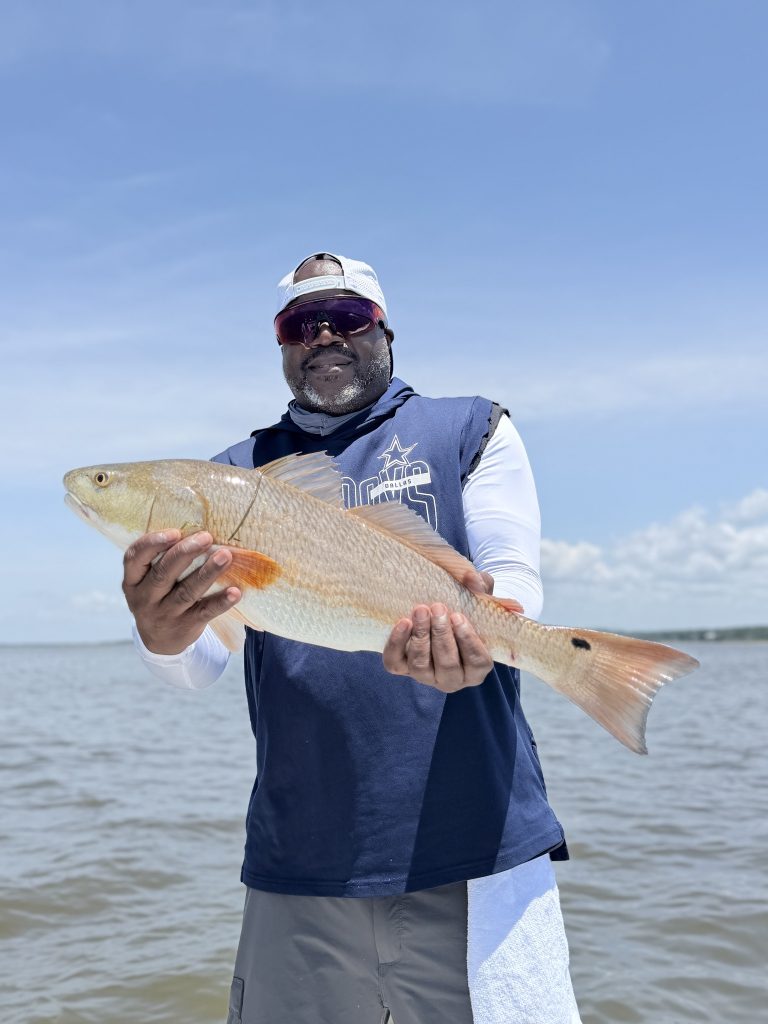
At the Gulf State Park Pier, Spanish mackerel have been the main event, especially in the afternoons. David says many of the mackerel are good-sized females, and their bite has been improving as the Gulf water temperature moves through the mid and upper 70s. The afternoons have been better than early mornings lately, likely because of tide movement, changing water clarity, longer shadows, and more feeding activity around the pier. He says the outgoing tide often pulls some sediment into the water, reducing visibility enough to help the bite.
For Spanish mackerel, David mentions bubble rigs, Gotcha plugs, shallow-diving plugs, live LYs, cigar minnows, and a dead-bait technique called snobbling. A snobble rig usually uses a short wire leader, small swivel, and small treble hook through the nose of a cigar minnow or LY. The bait is cast out, allowed to sink with the bail open, and then twitched lightly to look like a dying baitfish. Most bites come either right when the bait moves or as it falls back through the water column.
Pompano fishing has been inconsistent in Alabama compared to the Florida Panhandle, but David says there are signs of improvement. He believes cooler-than-normal water, very clear conditions, calmer-than-average surf, and the freshwater flush after Mother’s Day all played a role in slowing the Alabama pompano bite. Now that water temperatures are getting back above 75 degrees and conditions are becoming more typical, better pompano are showing around Gulf Shores, Orange Beach, and the pier.

David also talks about access and changing structure around Dauphin Island and the causeway. The public beach parking area at the old Dauphin Island Pier is now open, and the east end, West End beach, Sand Island area, spoil islands, and shoreline changes are creating new wading and surf-casting opportunities. He says the key this year is to stay flexible, read the water, and be willing to adjust presentation, location, timing, and tactics when the fish do not act like they did the day before.
Gear and products mentioned in this section include live shrimp, set rigs, Zoom Flukes, six-pound mono, bubble rigs, Gotcha plugs, Rapala-style plugs, Yo-Zuri-style shallow divers, live LYs, cigar minnows, snobble rigs, 30-pound wire, small swivels, number two or number one treble hooks, sand spikes, beach carts, and polarized sunglasses.
CCA Alabama STAR Tournament Update – Blakeley Ellis
Blakeley Ellis with CCA Alabama joins the show to preview the 2026 CCA Alabama STAR Tournament, which starts at 6:00 a.m. on Saturday, May 23. The tournament gives Alabama saltwater anglers a chance to catch one of 30 blue-tagged slot redfish released in Mobile County and Baldwin County. The key is that anglers must be registered before they catch a tagged fish.
The grand prize is a Skeeter SX 221 bay boat powered by a Yamaha 200-horsepower outboard and paired with a Skeeter trailer. Blakeley says about one-third of the tagged fish are typically recaptured during the tournament period, but Alabama is still waiting on its first registered angler to win the grand prize. Every year has had close calls, including anglers who caught tagged fish but were not registered.
Registration includes a CCA membership and STAR Tournament entry for new participants, or current CCA members can register for just the tournament portion. Anglers can sign up at JoinCCA.org or through the Fishing Chaos app. Blakeley says the tournament supports CCA Alabama’s conservation work, and he credits Skeeter and Yamaha for helping make the grand prize possible.
Products and organizations mentioned in this section include the CCA Alabama STAR Tournament, Skeeter SX 221 bay boat, Yamaha 200-horsepower outboard, Skeeter trailer, Fishing Chaos app, and CCA Alabama conservation programs.
Featured Sponsors
- Coastal Connection EXP Realty – Abaco Orange Beach
- Fiber Plastics Inc.
- Hilton’s Realtime Navigator
- Coastal Brew Bait Company
- Baker Metal Works
- Alabama Marine Resources Division / Outdoor Alabama
- Make Wake Marine
- Foster Contracting
- Black Buffalo
- Deep South Crane Rentals
- SlipSki
- CCA Alabama
- Camper City Truck Accessories
- Moffett Road Dentistry
- McCoy Outdoor Company
- EMS Endeck PVC Decking
- Pure Flats – Slick Lures