

Few names carry as much weight in the crossbow world as Barnett. With more than six decades of heritage, the brand has made a name for itself through continuous innovation, reliability, and its deep connection to real-world hunters. In 2026, Barnett is staying true to that legacy while continuing to push its crossbows forward through new designs, technologies, and a focus on the overall shooting experience.
Barnett’s history stretches back to 1962, when Bernard Barnett began building crossbows in his garage in the United Kingdom. What started as a small operation expanded throughout Europe and eventually into the United States, with Barnett permanently bringing its operations to the U.S. in 2003.
That history matters in a crossbow market that now includes a number of well-known manufacturers. Barnett was building modern crossbows decades before many of today’s major competitors entered the category, giving the company a unique position as both a legacy brand and an active innovator.
When we spoke with Joe Snatchko, Executive Vice President of Brand and Sales, in 2025, he pointed to that history as one of the threads that continues to define the company.
“We’ve been around for 63 years now… and the common thread through all of that is that we’ve always innovated.”
A Culture of Invention
At the heart of Barnett’s evolution is a hands-on, U.S.-driven approach to engineering, one that sets it apart from much of the competition. While some brands simply assemble imported parts, Barnett designs its crossbows from the ground up.
“I always kind of describe David [Barnett] as sort of like the mastermind of crossbow innovation,” said Snatchko, referring to the company’s third-generation owner and product pioneer.
That emphasis on innovation did not begin with the current Hyper Raptor lineup. Across several generations of Barnett crossbows, the company has pushed into new materials, higher speeds, safety systems, arrow designs, trigger technology, and more user-friendly cocking systems.
Models such as the Ghost 400 helped move Barnett into the 400-FPS era more than a decade ago. Anti-Dry Fire technology became an important part of Barnett’s safety systems. More recently, small-diameter HyperFlite arrows have been developed around penetration and accuracy, while the HALO riser and self-timing cam system have been designed to reduce cam lean and create more balanced string travel.

Barnett has also incorporated TriggerTech Frictionless Release Technology into many of its higher-performance crossbows, while newer cocking and de-cocking systems have addressed one of the biggest usability concerns for modern crossbow hunters.
Taken together, those developments show an evolution that has taken place over decades rather than a single product cycle.
Barnett Crossbows vs. the Competition Historically
The modern crossbow market includes several companies with very different identities.
Excalibur, founded in 1983, has built much of its reputation around simple and durable recurve crossbows. TenPoint, which entered the market in 1994, has become known for premium precision, engineering, integrated cocking systems, and high-end hunting platforms. Ravin arrived much later and helped push the market toward extremely compact, high-performance premium crossbows.
Barnett predates all three.
That does not mean other manufacturers have not made important contributions to modern crossbow technology. They clearly have. What separates Barnett historically is the length of time it has been involved in developing and selling modern crossbows while continuing to compete across multiple generations of technology.
The crossbow industry today is largely concentrated among a handful of significant players. Yet even within this group, some brands rely heavily on outside manufacturers that repeatedly package similar core designs with different cosmetic features while offering limited changes in performance or technology.
Manufacturing a high-quality crossbow at an ultra-low price point is extremely challenging anywhere in the world, and the old saying “you get what you pay for” is especially relevant when purchasing hunting equipment.
That easy, outsourced, hands-off process is how many budget crossbow brands get off the ground. But Barnett takes a different path.
“We’re designed and engineered here in the U.S.,” said Snatchko. “David and his team of engineers truly are designing new, innovative products.”
That philosophy gives Barnett a unique foothold in the market, he explained.
“We’re not the down-and-dirty price point, and we’re not the ultra-high-end either. We slide in between those extremes, and we fit that market perfectly.”
In other words, Barnett has built its model on the concept of delivering value without cutting corners.
“You’re getting a crossbow that looks, feels, and performs like it should cost more,” Snatchko said.
It’s that balance, engineering credibility paired with an attainable price point, that continues to define Barnett’s position in a crowded space.
Barnett’s Response to Where the Market’s Headed
For years, crossbow development has followed a familiar formula: shrink the footprint and increase the speed. And to a point, that chase has driven real innovation. Hunters want faster arrows; they want narrower profiles that navigate tight blinds and tree stands. And today’s top-end crossbows are definitely faster and more compact than ever before. But according to Joe Snatchko, that arms race is reaching its limit.
But according to Snatchko, that arms race eventually reaches a point of diminishing returns.
“The trend for the last several years has been all about getting shorter, narrower, and faster,” he said. “But that can only go so far.”
Barnett has been tracking that trend, but it’s also aware of its consequences.
“I’d argue that there are some out there in the marketplace that are almost too short,” Snatchko continued. “Where it just doesn’t feel right.”
That phrase—doesn’t feel right—gets to the heart of what Barnett believes the next evolution in crossbow design should focus on: the user experience. Beyond numbers on a spec sheet, what matters most to the hunter is how the bow actually handles in the field—how it shoulders, how it balances, and how easy it is to cock, decock, and shoot accurately.
“We’ve really been driving toward what we call optimal, rather than extreme,” said Snatchko. “It’s about shootability and experience.” That philosophy remains visible in Barnett’s 2026 lineup.
“There’s only so far you can take speed,” Snatchko added. “To get those higher numbers, you have to load more weight onto the limbs, which stresses the strings and cables.”
In Barnett’s view, the opportunity for improvement lies not simply in faster specifications but in smarter design: engineering crossbows that are safer, smoother to operate, easier to maintain, and more forgiving in the hands of the average hunter.
The 2026 Barnett Crossbow Lineup
For 2026, Barnett is continuing that philosophy with updates at both the Hyper Raptor and XP levels.
Rather than chasing a single extreme specification, the newest designs combine speed with compact dimensions, improved accuracy systems, adjustable ergonomics, easier cocking, and the technology that has been developed across previous generations of Barnett crossbows.
Hyper Raptor GTX
One of the biggest additions for 2026 is the Hyper Raptor GTX.
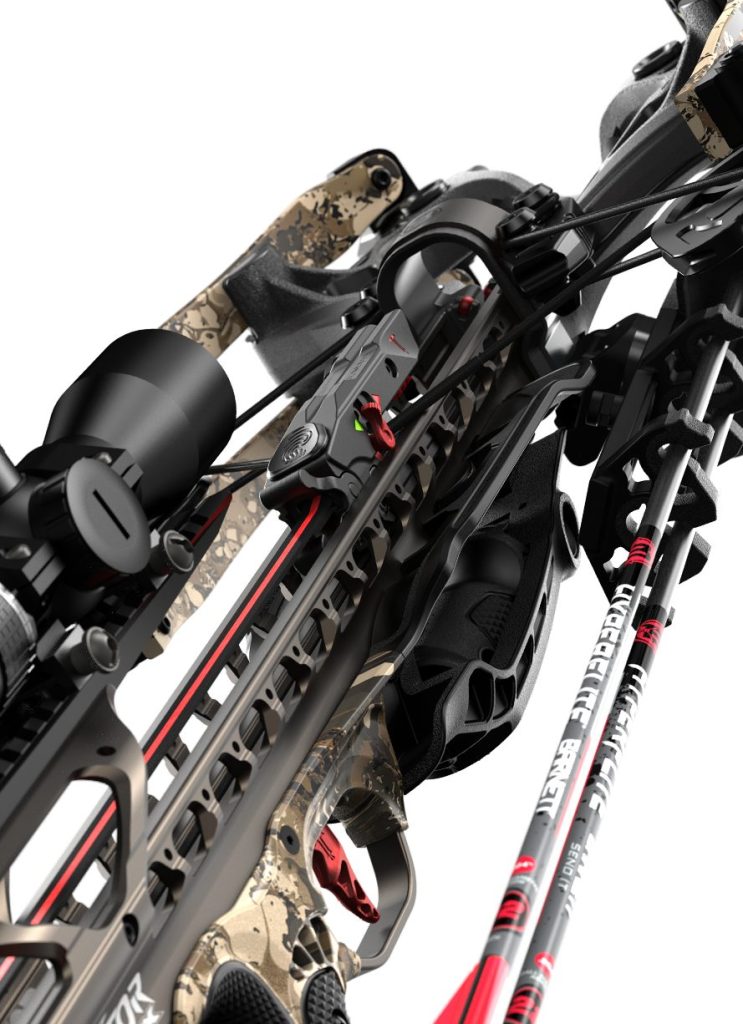
The GTX builds on the Hyper Raptor platform and sends 20-inch HyperFlite arrows downrange at speeds up to 425 FPS. It measures only 7.5 inches axle-to-axle when cocked, giving hunters a compact platform without moving completely away from the handling characteristics of a traditional hunting crossbow.
The HALO system eliminates cable crossing and reduces cam lean to create cleaner string travel, while Barnett’s self-timing Infinity cams, pivoting limb pockets, and CNC-machined aluminum flight track are designed around consistent performance and accuracy.

HyperFlite arrows continue to be an important part of that system. Their .204-inch small-diameter shaft is designed to reduce wind influence and improve penetration compared with standard-diameter crossbow arrows.
The GTX also incorporates TriggerTech Frictionless Release Technology with a 3-pound trigger, Anti-Dry Fire technology, Barnett’s Soft-Lok arrow retainer, Rope Hold cocking technology, an adjustable stock, padded cheek rest, and a 2-7x36mm illuminated scope.
The result is a crossbow that illustrates Barnett’s current approach particularly well: compact, fast and technologically advanced without automatically moving into the highest price tier of the crossbow market.
The Redesigned XPX Series
Barnett has also substantially updated its Explorer platform for 2026 with the new XPX series.
The lineup includes the XPX 420, XPX 410 and XPX 400, giving hunters several performance and price levels built around the same overall design philosophy.
At the top of the lineup, the XPX 420 uses a redesigned wide-limb platform intended to reduce rotational flex and create a more stable shooting platform. It also features a compact seven-inch cocked axle-to-axle width, a CNC-machined aluminum flight track, adjustable stock, Anti-Dry Fire system and TriggerTech trigger.

A self-retracting crank cocking device addresses another major trend in the industry: making high-draw-weight crossbows easier for a broader range of hunters to operate.
The XPX 410 and XPX 400 bring many of the same ideas farther down the lineup, including compact dimensions, adjustable ergonomics, safety features and simplified assembly.
That may ultimately be one of the more important parts of Barnett’s 2026 strategy. Technology developed for higher-end hunting crossbows is increasingly making its way into models designed for hunters who do not want to spend at the very top of the market.
DEMUN STORM and Break-Action Expansion
Barnett’s DEMUN series also continues to give the company a presence outside the traditional full-size hunting crossbow category.
The DEMUN STORM builds on Barnett’s break-action platform with a compound-style front end that ships fully assembled thanks to its SwitchLok rotating riser.
It features a patented two-stage break-action reloading system that reduces cocking effort while sending 10-inch carbon Hyperbolts at speeds up to 290 FPS.
It rounds out a family of approachable models that includes:
- Tri Strike: A top-loading repeater with a three-bolt magazine.
- Accu Strike: A single-shot model with increased speed and heavier limbs.
- Accu Strike Pro: Adds a patented two-stage cocking system that lets users manage heavier draw weights with less effort.
The DEMUN lineup is different from Barnett’s primary hunting crossbows, but it reflects the same long-running willingness to experiment with how a crossbow can be designed and used.
A Note on Optics
Crossbow optics have also become increasingly sophisticated.
Barnett’s BUK OPS offerings include options such as the Cycloptic-X digital scope and X-Factor laser rangefinding scope, giving hunters access to technology that previously would have seemed out of place on a crossbow.
The Cycloptic-X incorporates enhanced low-light imaging and recording capabilities, while the X-Factor integrates laser rangefinding directly into the sighting system.
These optics reflect the same philosophy as Barnett’s crossbows: using technology to make the overall hunting system easier and more capable rather than adding features simply to increase specifications.
Hunters should always check their individual state regulations before using electronic, digital, recording, or rangefinding optics for hunting.
Where Barnett Fits in the Modern Crossbow Market
Barnett’s 2026 lineup reflects the unusually broad position the company has developed over more than six decades.
At one end of today’s market are inexpensive entry-level crossbows designed primarily around price. At the other are increasingly sophisticated premium systems that can cost several thousand dollars.
Barnett generally occupies the space between those extremes.
That means offering hunters technology such as small-diameter arrows, compact riser systems, advanced triggers, anti-dry-fire protection, cocking systems, digital optics compatibility, and high arrow speeds without requiring every buyer to move into the ultra-premium category.
That position also makes more sense when viewed through Barnett’s history.
The company was building crossbows before many of today’s major competitors existed. It has seen the category move from relatively simple recreational and hunting crossbows into carbon construction, 400-plus-FPS speeds, advanced safety systems, compact hunting platforms, integrated cocking systems, specialized arrows, and increasingly sophisticated optics.
Through those changes, Barnett has continued to evolve along with the market.
Whether you’re buying your first crossbow, upgrading for serious hunting, or simply looking for a balance of technology, performance, and value, Barnett continues to build across a wide range of needs and budgets.
From a garage in England in 1962 to the Hyper Raptor GTX and XPX platforms of 2026, Barnett’s story is not simply that it has been around for a long time.
It is that the company has continued finding ways to change along with the modern crossbow.