
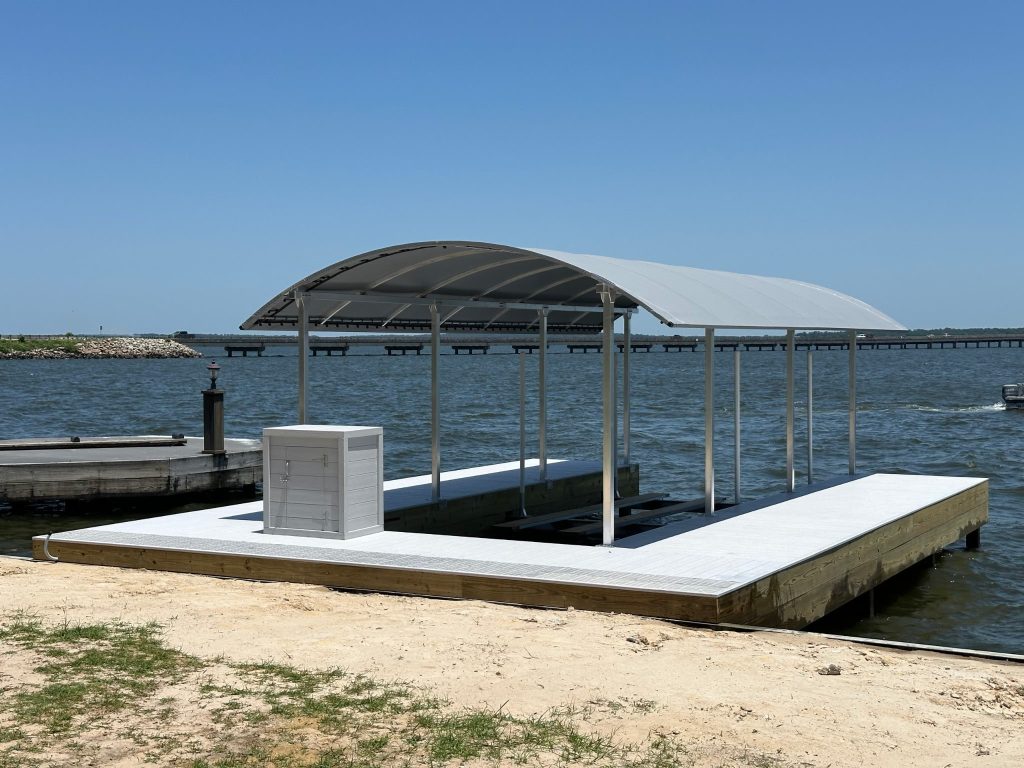
When you own a boat on the Gulf Coast, protecting it from sun and storms isn’t optional. It’s part of ownership. The real question is how you want to do it. Do you install a removable boat canopy system? Or do you invest in a fully framed roof structure? And for some dock owners, is there something in between?
To help sort it out, we spoke with David Weber, owner of What’s Up, Dock?, who has been building docks, seawalls, and marinas for 46 years. When homeowners call him about adding coverage, the motivation is usually straightforward. “They want their boats covered up so they don’t get faded out. That’s why they’re doing it.”
From there, the decision becomes about durability, appearance, cost, and long-term goals.
What a Permanent Boat Canopy Really Means
A permanent dock roof is a true structure. It’s not just attaching something to a lift. It often requires setting additional pilings and building proper framing overhead. Once it’s up, though, it’s solid. Especially if you use the right materials.
When it comes to roofing material, Weber is clear about what he prefers in a saltwater environment. “Tin is just more durable than shingles, because when the wind comes up at times it rips the shingles off… Tin is screwed down. It just seems to hold up better.” He adds that with properly fastened metal panels, “You’d have to have a tornado to rip that off the roof.”
That durability matters on the water, where constant wind and salt exposure accelerate wear. Using high-quality metal panels, proper fasteners, and corrosion-resistant trim components is critical. Local suppliers like Dixie Supply provide marine-appropriate metal roofing panels and accessories that contractors rely on for dock and boathouse builds along the Gulf Coast. Choosing the right profile and properly coated steel can make the difference between a roof that fades prematurely and one that holds up for decades.

Storm performance is one of the biggest selling points. After major hurricanes, Weber says there’s a pattern. “If you ever look at a hurricane, what is always left? The boat houses. The docks around might be gone, but the boat house is still there.”
Of course, there’s a cost. Weber estimates a dock roof with metal panels runs around $32 per square foot, with shingles slightly more. It’s a significant investment. But as he puts it, once it’s built, “You’re done with it. One and done.”
Where Traditional Canopies Fit
Boat canopy systems exist for a reason. They’re usually less expensive and can be added to an existing lift without major structural changes. In some neighborhoods, they may be the only option allowed.
Weber has seen canopy systems last seven to ten years in protected canals. “They’re faded, but they haven’t ripped up yet,” he says. In low-wind areas, they can perform well.
But open water is different. “You put them out there on the bay side, where you’ve got five miles across the bay and that wind picks up… those canopies are going to blow away.”
And if a major storm is coming, he recommends a proactive approach. “If you know it’s going to be a category two or a three, especially if you’re out on the main water… I’d take them down.” That’s one more step that comes with a fabric canopy system.
Quality also matters. “Make sure whoever you use has been doing it a while… Look at the stars on their company and do some research.” Not all boat canopy systems are built the same.
The Middle Ground: Engineered Slip Covers
For dock owners who want something more substantial than a loose, tarp-style canopy, there is a middle ground.
Companies like SlipSki design custom boat slip cover systems that go beyond the typical “canvas on a frame” approach. Their systems use welded, marine-grade aluminum framing paired with tensioned, UV-resistant fabric to create a much more rigid and durable structure. Instead of a loose canopy that flaps and stretches over time, SlipSki’s covers are engineered to stay tight, hold their shape, and perform more like a permanent structure than a temporary solution.
One of the key differences is how these systems integrate with the dock itself. SlipSki covers can tie directly into pilings in a way that mirrors the structural banding dock builders use in traditional wood-framed construction. That added rigidity allows the system to handle more stress and maintain tension across the entire structure, rather than relying solely on a lightweight frame sitting on top of a lift.

That structural approach also allows for wider spans than most traditional boat canopy systems. Instead of covering just a single boat lift, SlipSki systems can be designed to cover multiple slips, or even extend over both the boat slip and the dock itself in one continuous structure. That flexibility is a big reason many dock owners consider them as an alternative to a full wood-framed, metal-roof boathouse.
From a durability standpoint, the materials and construction matter. SlipSki systems use 6061 and 6063 aluminum frames with stainless hardware, along with marine-grade fabric designed to resist UV exposure, mildew, and water over long periods of time. The fabric is heat-welded for strength and tensioned to reduce wear points, which helps extend the lifespan compared to traditional loose canopies.
That added structure also improves performance in real-world conditions. Many of their systems are designed to withstand high winds and maintain tension without excessive movement, which reduces long-term fatigue on both the fabric and the frame.
From an aesthetic standpoint, that tighter, more engineered look makes a noticeable difference. One of Weber’s biggest critiques of traditional boat canopy systems is how they can look out of place next to well-built waterfront homes. A structured system like this presents a cleaner, more intentional profile, closer in appearance to a permanent build, without the cost and permitting requirements that come with a full boathouse.
That said, these systems still sit in the middle ground. They are not hurricane-rated structures, and they do not replace the full protection of a framed roof. But compared to lightweight canopy kits, they offer significantly more structural integrity, better long-term durability, and greater design flexibility.
Choosing What’s Right for Your Dock
In the end, there isn’t one correct answer. “Everybody’s got a preference,” Weber says.
If you’re on open water and want maximum storm resistance and long-term resale appeal, a permanent roof with galvanized framing and quality metal panels is hard to beat. If you’re in a protected canal and want a lower upfront investment, a traditional boat canopy may do the job.
And if you’re somewhere in between — wanting more structure and longevity than a basic tarp system, but without committing to a full boathouse build — a custom engineered slip cover system may offer the best blend of durability, flexibility, and cost.
At the end of the day, the goal is simple. As Weber put it, homeowners want their boats covered so they don’t fade out. The right solution is the one that protects your investment and stays within your budget while matching your dock, your location, and your long-term plans.