
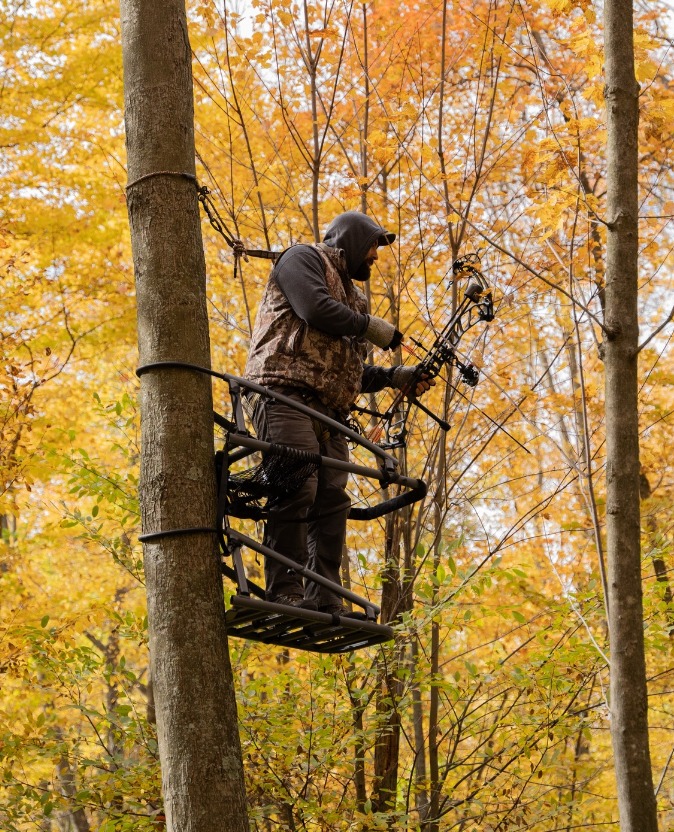
There’s no such thing as the perfect treestand. I know, because I’ve sat in most of them.
I have a much-coveted 5 lb. Windwalker hanging up in my closet. The light weight is awesome for packing in and climbing, but my size 11 shoes hang halfway off of it once I’m 20 ft up. I have a Summit Viper, which I love sitting in but hate carrying and setting up. I have one of John Reed’s original JX3 prototypes, and a closet full of tree saddles. The family lease is peppered with ladder stands and hang-ons, and I have two climbing treestands that are so old that they could be hanging in museums if they weren’t chained to the base of pine trees waiting on a good cold front.
Every type of treestand has a particular scenario it specializes in. Ladder stands are perfect for presets. Lightweight lock-ons and climbing sticks are awesome for sticking in crooked little trees. And climbing treestands can’t be beat when you want to inchworm 30 ft up a loblolly pine and peer down into the underbrush on a late season stakeout.
I’ve always had ready access to treestands thanks to my employment first at an outdoor retailer and then with an outdoor media group. I have the luxury of using the perfect tool for the job 95% of the time I hunt, whether that tool is a treestand, a box blind, or a simple ground chair. But I’m aware that not everybody has that luxury. I’ve met many hunters who had limited money and storage space to waste on treestands. I’ve also met lots of new hunters who were buying their first stand and wanted “the most bang for their buck.” Then you have my neighbor, who has no lack of money, storage space, or experience, but who in his retirement finds pleasure in simplifying his life as much as possible.
Much of the whitetail hunting industry has a strong midwestern bias, since the Midwest draws a lot of media attention and money from the trophy deer it produces. Hang on stands have become popular “do-it-all” stands in those states, because the CRP fields, ag fields, and cattail swamps of the Midwest often are peppered with trees that won’t allow any other type of stand. But climbing treestands are king in the southeast, where we literally grow telephone poles on millions of acres of land. Even our hardwoods grow straight and tall, fiercely competing with each other for sunlight throughout long growing seasons.
In my experience, nothing beats the convenience, comfort, and versatility of a climbing treestand as long as you can find a tree to put it in. And I don’t know that I’ve ever really hunted an area where I couldn’t get a climber on a tree.
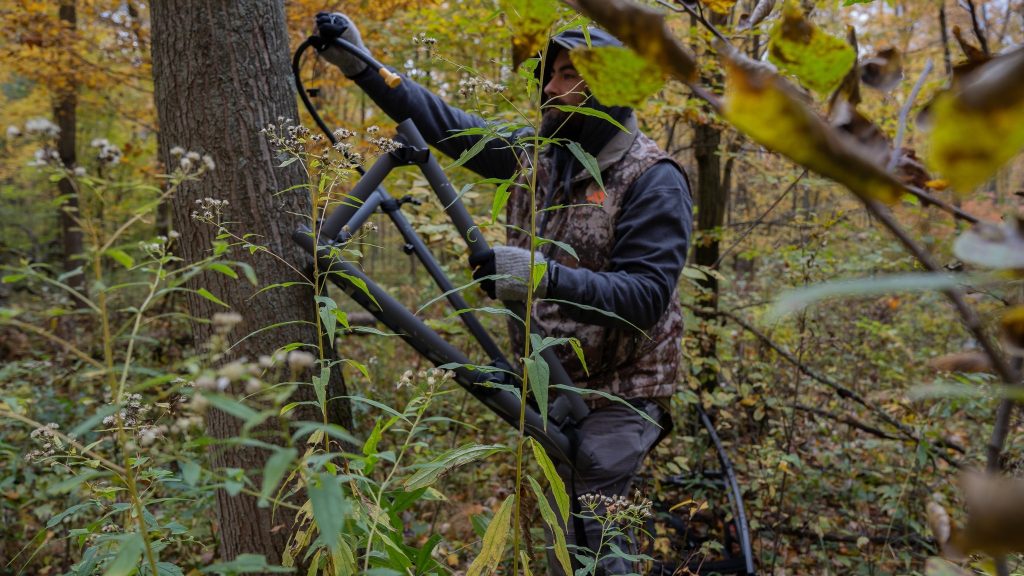
Factors to Consider When Choosing a Climbing Treestand
For most southern hunters, a climbing treestand will function just fine as your “do-it-all” stand. Plenty of great hunters, such as Alabama state record muzzleloader hunter Michael Perry or Georgia’s late, great Glen Solomon, have killed pickup-truck beds full of big bucks while sitting in a climber. Whether you’re hunting a high-end private lease or grunging it on public land, you’ll want your do-it-all stand to tick the following boxes.
Packability
Much is made about how light a new stand is. The ultralight phenomenon that swept the backpacking world swept across the western hunting scene first, and brushed across the whitetail landscape starting about five or six years ago. Now, hunters with deep pockets can purchase a handful of treestands made out of carbon fiber, titanium, and 7075 aluminum, which is lighter, stronger, and substantially more expensive than ye olde 6061. Lighter is definitely better in a stand. There’s a reason many companies sell a steel and an aluminum version of the same model stand, and tack on an extra couple of Benjamin’s to the price of the “Ultralite” version. Lighter stands are much more pleasant to carry through the woods than heavy ones.
But weight is just part of the packability formula. Which would you rather carry through the woods, a few bricks in a small daypack, or an 8 ft long 2×4 board? What about if the bricks were loose instead of rounded up in a pack?
When you just have one stand, that stand has to come in and out of the woods with you. It needs to be light, but it also needs to be packable. Look for designs that fold flat, and that can be easily and securely strapped to each other.
Buy a good pair of backpack straps to add onto the stand, or, better yet, one of the many treestand suspension systems currently on the market. These systems allow you to add all of the features that you love on your favorite frame pack to your treestand, such as load lifters, a chest strap, and a waist belt. A flat-packing stand outfitted with such a kit and with your hunting daypack strapped to it is a surprisingly easy burden if you’re used to carrying a stand slung across your shoulder, or worse yet, in your hands.
Ease of Use
Climbers inherently do well in the “fiddle factor” test. Instead of 4-5 climbing sticks, a stand, and all of the straps that you need to hang everything with, you have a top half and a bottom half. All of the hard work attaching the stand gets done at ground level, there’s no need to climb up and down or use a pullup rope to hoist the next item you need up in the air. You just strap the two pieces on the tree and go.
But not all treestands are as easy to use as that sounds. The first stand I ever used involved 4 bolts, 8 washers, and 4 wing nuts to attach the climbing blade to the adjustable arms. Once the dang thing was on the tree, it was a joy to climb with and hunt out of. But it took a while to tighten everything down, and heaven help you if you dropped a wing nut…
You don’t see many treestands with that attachment method any more. Instead, most treestands use either an adjustable traction belt or a cable that rides inside a tube and is secured with cotter pins. The latter design has been around for a long time, and while frequently replicated, the first stand I ever saw it used on was an Ol’ Man. Ol’ Man climbers have been around since the ‘80s, and the model I used in my childhood has changed very little over the years. With its folding arms, a mesh seat that slides out of the way while climbing, and its easily adjustable climbing cables, it was ahead of its time when it was introduced. Current models are only 21 lbs., which may not seem light until you start looking at the miniscule platform dimensions of most modern stands that weigh less.
Comfort and Stability
Which segways us nicely to our last point. The average hunter is in his 40s and weighs north of 200 lbs in his swim trunks. He weighs a little more and takes up a little more real estate bundled up in his deer hunting clothes. Most “ultralight” treestands are not conducive to comfortable sits in the deer woods for the average hunter. Next to a comfortable seat, room–particularly foot room, is perhaps the single most important factor determining how comfortable a stand is as the hours wear on. If you only have one stand, then that stand needs to be lightweight, sure. But it also needs to not be miserable to sit in during an all-day rut stakeout. Don’t skimp on comfort to shave a pound.
Climbing Treestand Tips and Tricks
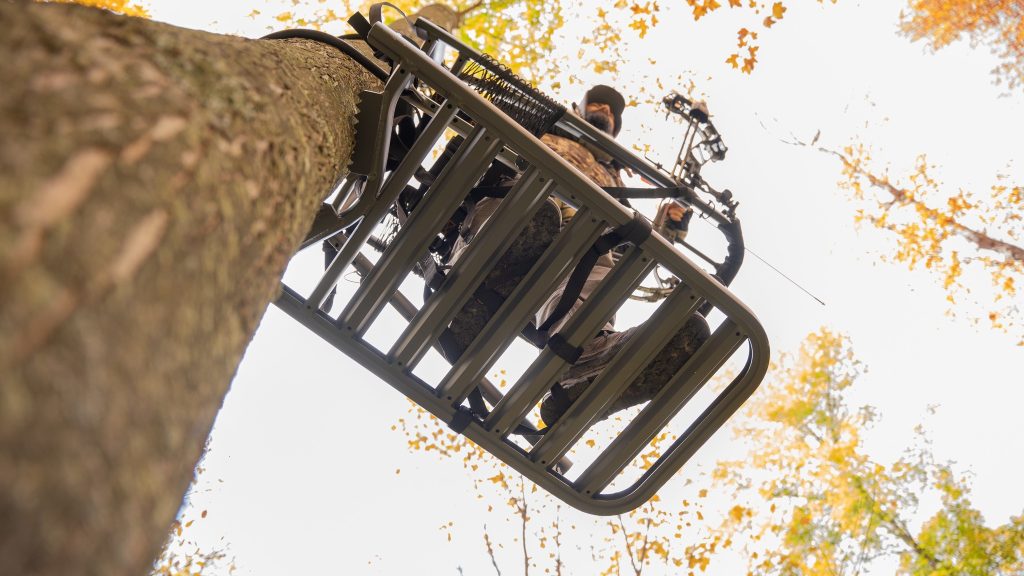
Once you have a good climber, a few simple modifications will make it much more functional.
Weapon mounts let you easily climb with a rifle or bow, and provide a convenient place to keep your deer-killer “at the ready” on stand. It’s possible to climb with your daypack on your back, but it’s easier and safer to use a retractable pullup rope. I like to keep a small, strap-on accessory hook in my cargo pants pocket. Once I’m at height, I strap it around the tree, haul my pack up, and hang it on the hook. The model I use has several hooks, which come in handy if I want to hang a shed jacket, rangefinder, or other item where it’s easily retrievable.
Almost every stand I’ve ever hunted with has also been quieted down with camouflage colored vet wrap. I just love the stuff. It’s cheap and durable, and can be easily cut off and reapplied when it gets worn out, unlike most fabric tapes. I wrap over the holes on my climbers arms, and then use a soldering iron to burn the holes out so that they’re functional. An old piece of carpet zip-tied to the stand’s bottom platform adds a marginal amount of weight, but further quiets the stand down.
Modifications aside, let’s talk tactics. First, it pays to get very familiar with assembling and disassembling your climbing treestand and attaching it to the tree. Anytime I get a new climber, I like to set it up how I will carry it into the woods, and time myself a few times putting it on and taking it off the tree. The goal isn’t to rush through it, but to do it smoothly, confidently, and quietly. Usually, I get substantially faster after five or six practice runs, not because I’m rushing, but because I’m familiar with the gear by then.
Practice climbing as well. Remember that slow is smooth, and smooth is fast. Rushing the climb just makes extra noise and puts you at more risk than you’re already up climbing a tree in a place where it’s hard to get an ambulance.
Finally, as you hunt out of your climber, try to remember that just because you can climb all the way up into the canopy doesn’t mean that you have to. This is perhaps the hardest part of getting good at hunting out of a climber. Over time, you’ll discover that sometimes you can see through the woods better climbing only 10-15 feet up in the air. I’ve even hunted out of my climber at ground level before!
Conclusion
While no stand is perfect for every scenario, a versatile climbing treestand can come close, offering the convenience, comfort, and adaptability needed for a successful hunt. With the minor alterations discussed, plus a good suspension system, a climbing treestand is easy to carry, easy to use, and very comfortable to hunt out of. I’ve spent so many hours in my Millennium Ol’ Man Alumalite over the years that it really feels like home.