
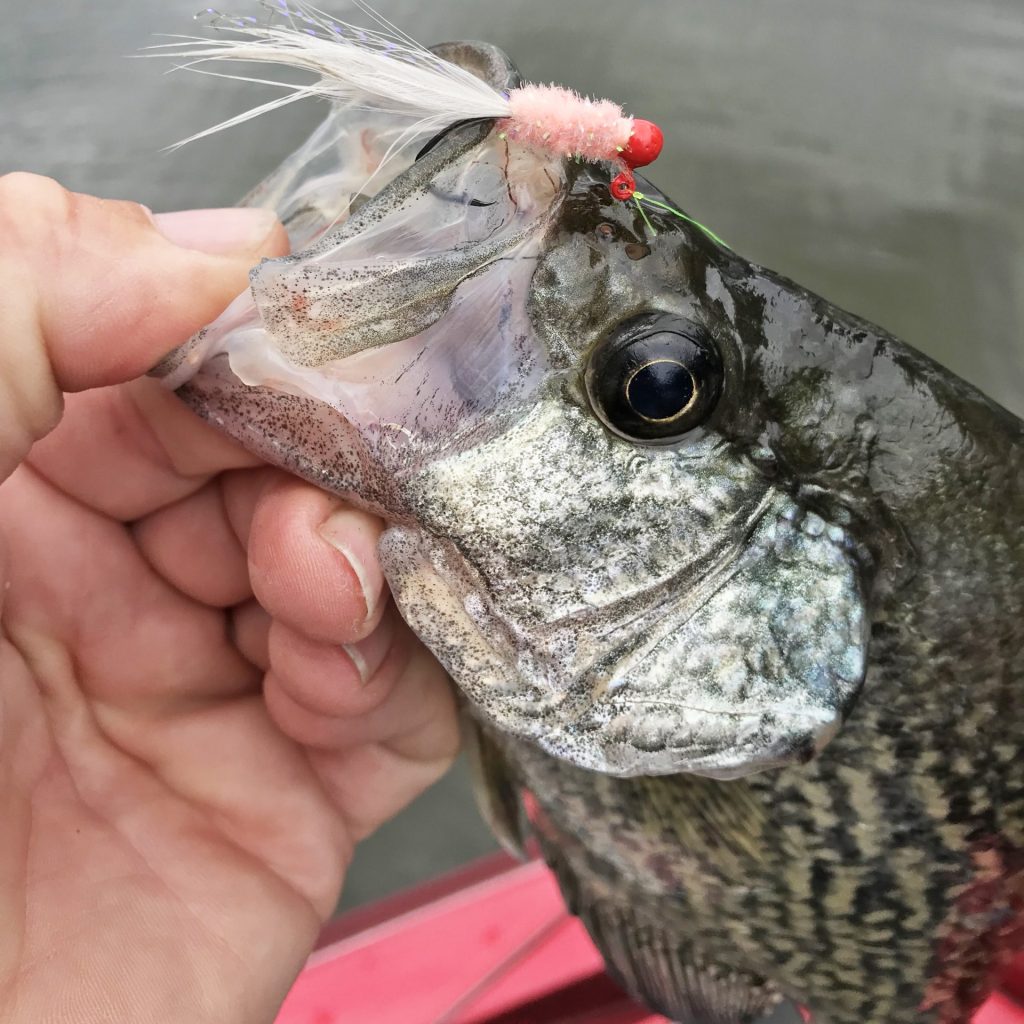
We have talked with avid crappie anglers across the Southeast to learn which lakes should be chosen to be named the 10-top southeastern crappie lakes that are best for fishing, and the best ways to fish them.
Mississippi Crappie Lakes
When talking about crappie lakes, one fact quickly surfaces. Mississippi has a lot of them. Every lake tries to lay claim to being “The Crappie Capital of the World.” And to be fair, there are a lot of really, really good crappie lakes scattered across the southeast. But Mississippi seems particularly crappie-rich. Lakes like Enid, Grenada, and Sardis don’t just hold lots of crappie, they hold lots of big crappie. The largest White Crappie ever caught came out of Enid, and weighed 5 lbs, 2oz. Stringers of three pounders are not uncommon.
With this in mind, it’s no surprise that almost half of the lakes mentioned in this article are in Mississippi. But residents in other states throughout the state will find some of their favorite lakes represented as well.
With that said, let’s dive into it!
“The Big Four” – Enid, Grenada, Sardis, And Arkabutla
Aaron Barton of Oxford, Miss, guides on and crappie fishes Enid, Grenada and Sardis lakes in northern Mississippi. He reports that these lakes are so good for crappie due to a combination of three things: a long growing season, which can produce bigger crappie faster; the variable nature of many of the different water depths that have good shad populations in each; and the 1- to 4 inch shad that tend to hang out in these lakes longer than some other lakes.
“For instance, if you go to a lake with a 9-inch slot limit, it will hold numbers of 8-3/4 inch crappie,” Barton says. “If you fish a lake with a 10-inch slot limit, there will be a ton of 9-3/4-inch crappie in it. So, the quality of fishing is often determined by the age class of crappie that can be taken out of a lake and the sizes of the ones thrown back.”
Barton reports that you can catch a 3-4-pound crappie in each of these lakes. But since the crappie aren’t full of roe in May-July, the crappie will tend to be smaller than those caught in early spring. Most people will say that to catch a 3-4 pound crappie from May– July that you need to fish Grenada. “I think that one of the reasons for that is the lack of boat access at Grenada in the winter months.”
Barton explains that he and his clients catch crappie in late spring – early summer by either pulling crankbaits like Bandit 200s and Bandit 300s in pink, black and chartreuse-and-white at 12-20 feet deep by putting weighted line in front of the boat or by power trolling 1/4-ounce and 1/2-ounce Beetle Spins.
“I also like to push crankbaits, minnows and/or 1/8-, 1/4- and/or 1/16-ounce jigs tipped or not tipped with minnows. I’ll also fish a combination of those three baits.”
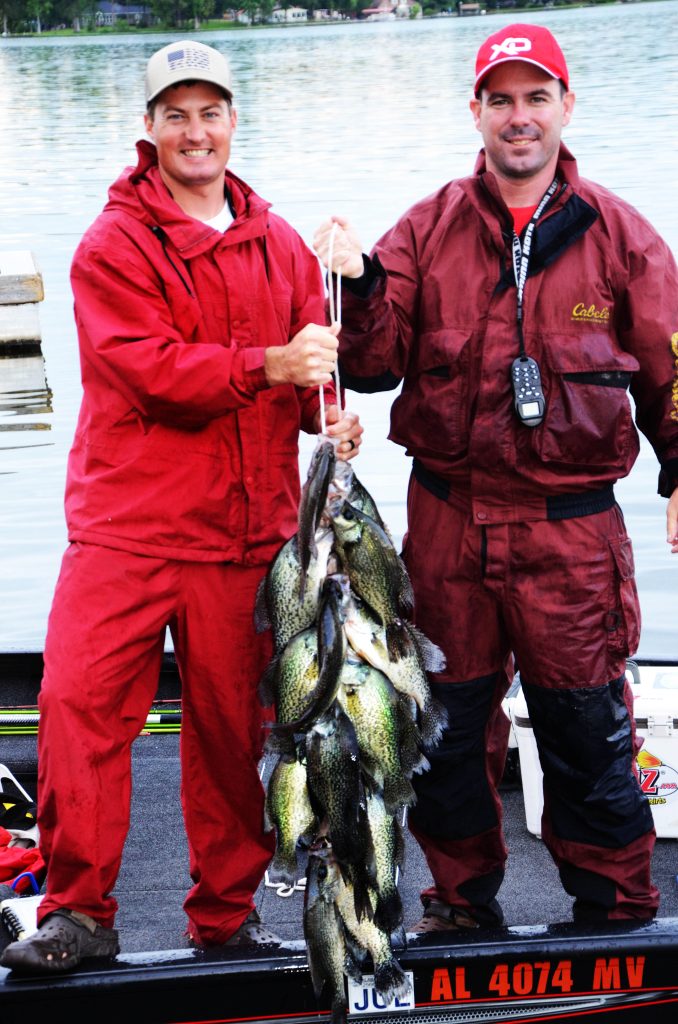
Barton says his favorite tactic for May– July is to push crankbaits, rather than long lining behind a bait. “I’ll fish crankbaits with eight rods off the back of my boat with 150 feet of line out on each and set my trolling motor on about 1.7 miles per hour. Then I’ll troll over the river channels. This technique is an action-filled yet relaxing way to fish and catch numbers of crappie.”
Your crappie-fishing success at these three lakes will be dependent on avoiding a windy day if you’re LiveScoping, a real-time scanning sonar technology from Garmin. This easy-to-interpret live-scanning sonar images will display clearly defined structures, your lure as you retrieve it and even enough detail to distinguish between different species of fish.
If you’re fishing minnows, according to Barton, there’s no bad minnow weather. Pay attention, and make sure you’re safe because bad storms can blow-up quickly. A 10 mph wind from one direction can produce 5-6 foot white caps, if the wind’s blowing directly down the lake.
Barton also mentions that, “Some folks like to night fish during hot weather at these lakes for both crappie and white bass. Sardis Lake is close to my home, so I guess I fish there more.”
In the 1990s, Enid produced some world-record white crappie. But Barton mentions that Enid feels like it’s fish-crowded. “You’ll catch numbers of 11 to 12-1/2 inch crappie from May- July at Enid that are close to the legal 12-inch limit. However, you can pinch the barbs down on your crankbait to fish deeper and often catch larger crappie.
At Enid, you also can tweak the location, the depth of your bait and how fast you’re trolling to catch catfish. “We’ll catch one catfish for every four crappie we take at Enid when fishing open water, May- July. These catfish will weigh from 4-20 pounds each during this time of the year.”
According to Barton, although numerous anglers have named Arkabutla Lake as a top crappie lake, “Arkabutla Lake has been closed for the most part for emergency repairs, at least temporarily. Today Enid is the only lake with a northern and a southern buffer to keep the folks who are driving up from Jackson, MS, or New Orleans, LA, from fishing there, since they’ll have to pass Ross Barnett and Grenada to reach Enid. People coming from Missouri, Illinois and Memphis, TN, must drive by Sardis before reaching Enid.”
Ross Barnett Reservoir, Mississippi
Brad Chappell of Glen Allan, Miss., enjoys fishing Bandit 300s in the popsicle, monkey milk, Sardis gold and purple colors at Ross Barnett, casting to the crappie with jigs and using K9 braided line in various colors.
“I like to alternate the line colors I’m fishing when trolling for crappie. I mainly locate these crappie with down-imaging sonar. I’ve been fishing this lake for so long that I have most of the productive ledges marked on my depth finder as waypoints. I try to pull my bait directly over stumps sitting on ledges in 12-18 foot deep water, since the crappie will be suspended over their tops. In May – July, we expect to catch 40-60 crappie in a day, depending on how many anglers are in the boat.”
Chappell says depending on who’s in the boat with him, some people like to use sonar and some people prefer to cast to the crappie. “I use my Garmin LiveScope, Model 126 SV, 7-1/2-foot B ‘n’ M series casting poles and 6-pound test high-vis yellow K9 fluorocarbon line to be able to see the line as I cast it out. Also I can spot a twitch on my line, even with a light bite. Typically I’ll use two, 1/8-ounce jig heads about 12-inches apart on the same line, tying one to the bottom of the line, and the second one about 12 inches above it. I like to fish two jigs because I believe a crappie can spot two jigs better than if only one jig falls. Also I can see two jigs falling on my screen easier.”
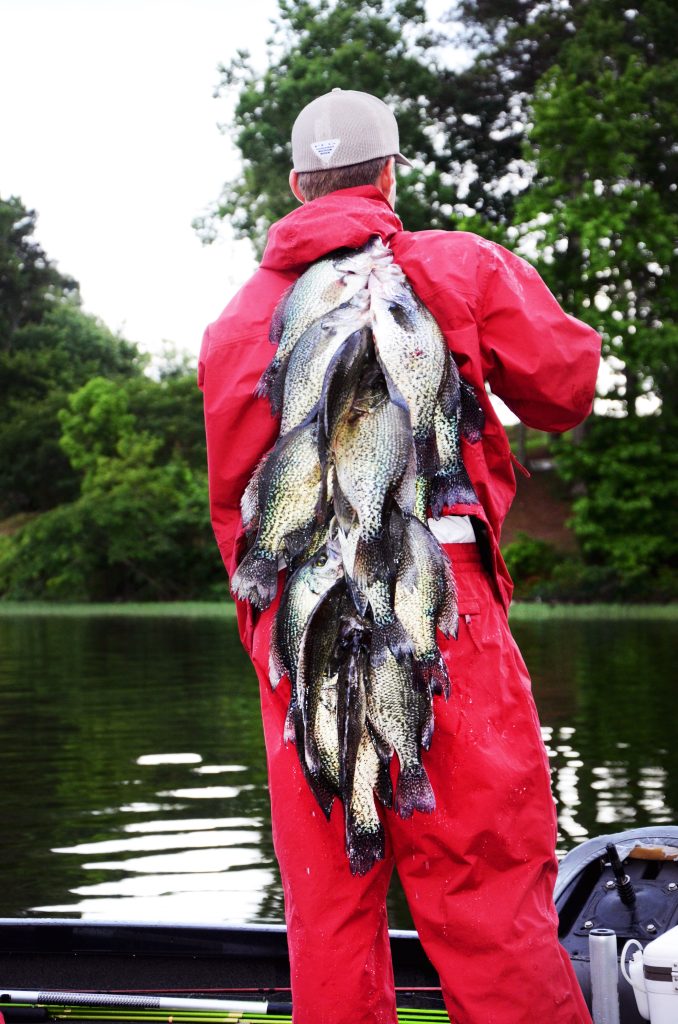
Chappell names May– July as months most people aren’t thinking about crappie fishing, but those are his favorite months to fish Ross Barnett, mainly due to the consistent weather. “Therefore the crappie will be holding in consistent patterns. Wherever you find them in May, you’ll generally locate them in those same places in July. After the crappie get over the spawn, they’re hungry, and they want to feed and add body weight, making the crappie aggressive at this time of the year.”
Chappell’s favorite jigs are Bobby Garland baits, especially the 1-1/4-inch Itty Bit Slab Hunter that’s deadly on crappie in June and July. The head sizes are from 1/16-ounce to as small as a 1/48–ounce heads. “I just have to determine how fast the crappie wants the jigs to come past them for the fish to take them. I’ve found that when fishing very-small baits, if you put those jigs right in the crappie’s faces, the crappie can’t resist them.
“My favorite jig is a 1/16-ounce, and on the bottom of the line, I’ll put a 1/32-ounce jig. I want my bottom jig to be lighter than the top jig. The back jig has total freedom to move, after the front jig stops moving. The heavier jig will take most of the momentum of the line being pulled, and the lighter jig behind it will dance around . Most of the crappie will be caught on that back bait.
“I like the jig head, a Crappie Pro Overbite, also from Bobby Garland, in 1/16- 1/32-ounce. I prefer small heads because when a crappie bites it, the fish will inhale it. I like the Mud Dauber, Grenada Gold, Fried Shad, Blue Ice, Blue Chrome and Junebug Chartreuse colors for heads.
My favorite structure to fish at Ross Barnett is stumps on ledges or manmade brush piles. Crappie like brush piles that lay flat on the bottom instead of sticking-up from the bottom, especially as long as that brush is near a ledge.”
Chappell Plans to catch 10-15-inch crappie from May– July in 12-foot-deep water, usually 30 crappie on a slow day and 60 crappie on a great day with two people in the boat. “Generally crappie will be holding in the same spots from May until the fall at Ross Barnett. I’ve probably got more than 200 waypoints I can go to and fish to catch crappie.
“You can locate structure in Ross Barnett fairly easy with live sonar. I enjoy using a contour map to pinpoint crappie holding right on the ledges. Once you locate them, they’ll be there until fall.
On one particular brush pile last year at Ross Barnett, I caught about 3,000 crappie off of it in the summertime. That spot would reload with crappie every day.”
The Best Crappie Lakes Outside Of Mississippi
My longtime friend, Whitey Outlaw of St. Matthews, South Carolina, has fished crappie tournaments for 40 years, including these lakes also named to the top-crappie fishing list – Alabama’s Weiss Lake, Lake Marion in South Carolina, Reelfoot Lake in Tennessee, Lake Oconee in Georgia and Lake Okeechobee in Florida. He explains that if a thermocline has set-up in some of these lakes, then seldom will the thermocline be deeper than 18 feet.
“My son, Matthew, guides crappie fishermen on Santee Cooper Lake, Lake Marion and Lake Moultrie,” Outlaw says. “Summer months are the best times to catch crappie in the Southeast, because we know pretty much where the crappie will be out on the river ledges, and on stumps and manmade brush we’ve put out in 12-18 feet of water.
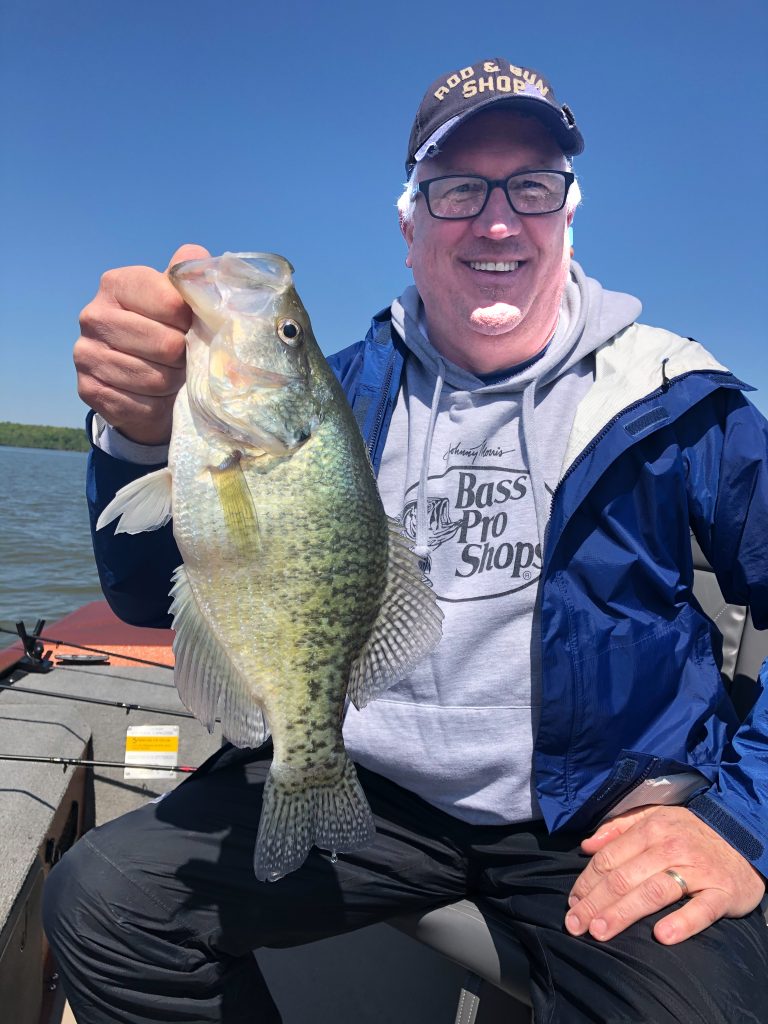
“At this time of year, we mostly cast 1/16-ounce jigs at these lakes. I like a 1-inch skirt in brown-and-chartreuse. My favorite jig is a 1/16-ounce jig with white-and-chartreuse or chartreuse-and-yellow. I’ll also fish some brown jigs like pumpkinseed or orange and yellow. However, when the crappie are feeding in their summertime pattern, you can catch them on almost anything. Generally they’ll be holding in 16-foot-deep water, with black crappie 4-5 feet above the brush and white crappie in the brush.”
Lake Marion, South Carolina
Outlaw says to look for brushpiles and underwater structure that you or someone else has put out on this 110,000+ acre lake, located in the central section of South Carolina. “We’ve found that putting-out oak brush in this lake pays the most crappie dividends. Also look for natural stumps along the edges of the river channels in 12-18 feet of water.
“You can catch crappie by casting 1/16-ounce jigs and/or vertical jigging. In the summertime, I’ll fish white-and-chartreuse jigs or orange-and-yellow jigs here. I like a pink-headed jig too. I’ll LiveScope or use a single pole for the best results. I’ve also found vertical jig fishing on manmade structure is profitable.”
Weiss Lake, AL
“This Alabama lake pays crappie dividends when you spider rig over the creek channels from May-July. Weiss contains numbers of stumps to fish that will be profitable for crappie and also are easy to locate. I use double-rigged minnows to spider rig with a 1/2-ounce lead and fish from 12-18 feet deep. I’ll be LiveScoping the stumps or pushing jigs over the stumps and using minnows as trailers. I’ll fish a 1/16-ounce white or chartreuse jig head with a No. 4 hook almost anywhere at Weiss and be successful.”
Reelfoot Lake, Tennessee
Outlaw recommends you stay in the lower Blue basin, and fish the big stumps in 8-12 feet of water at this Tennessee Lake. “You can Livescope the stumps, vertical jig them (I prefer a tube jig in white-and-chartreuse) or spider rig over them. I recommend you use minnows, due to there being numbers of white crappie in Reelfoot. I’ll fish double minnows and push them around the stumps. If I’m using my LiveScope, I’ll fish a tube jig in white-and-chartreuse with a 1/16-ounce jig head.”
Lake Okeechobee, Florida
Outlaw suggests you fish the drop-offs, ledges, stumps, treetops and underwater grasslines in the Kissimmee River for crappie. Spider rig with double-rigged minnows with 1/2-ounce leads, or LiveScope these areas. I like to fish the river with double-rigged minnows 12-18 feet deep, rather than the lake because the water there is somewhat deeper. Spider rigging will be your most-productive tactic. Troll along the edges of the grasslines slowly for success too. I’ll be fishing natural and manmade structure.”
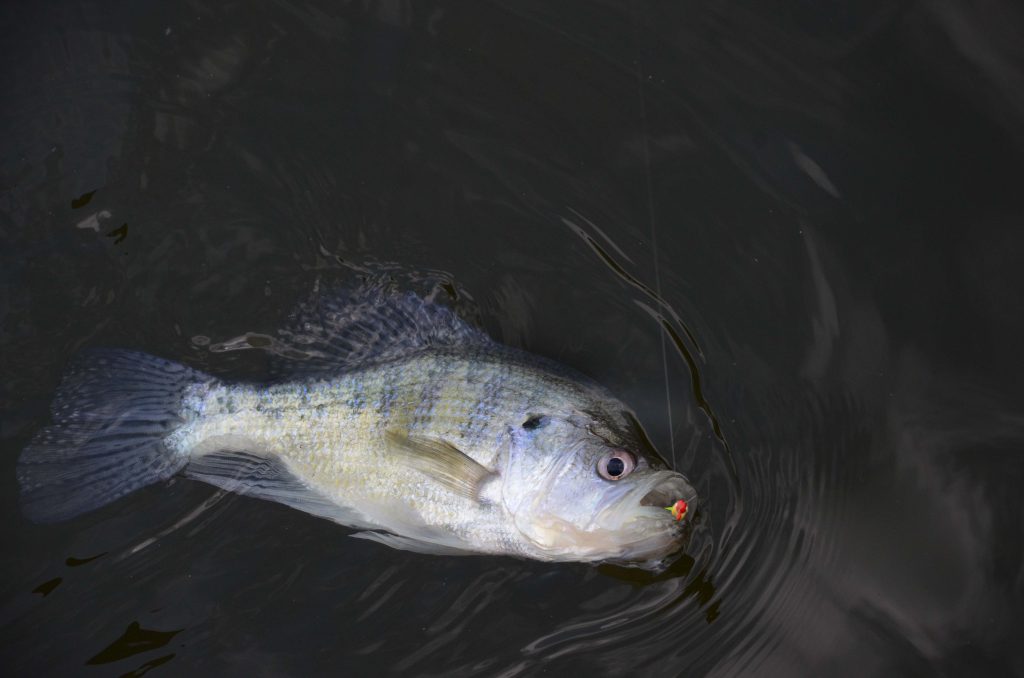
Lake Oconee, Georgia
According to Outlaw, this lake is a tight-lining, spider-rigging lake or a LiveScoping lake. “Stay in 14-18 feet of water, and look for structure. If you’re LiveScoping, use a 1/16-ounce jig with a pink head and a white-and-chartreuse skirt. If not, push double-rigged minnows.”
More and more crappie fishermen have learned they don’t have to pull fillets from their freezers from May– July to enjoy a delicious crappie dinner. They can have delicious, freshly-caught crappie if they know where to find the fish.