
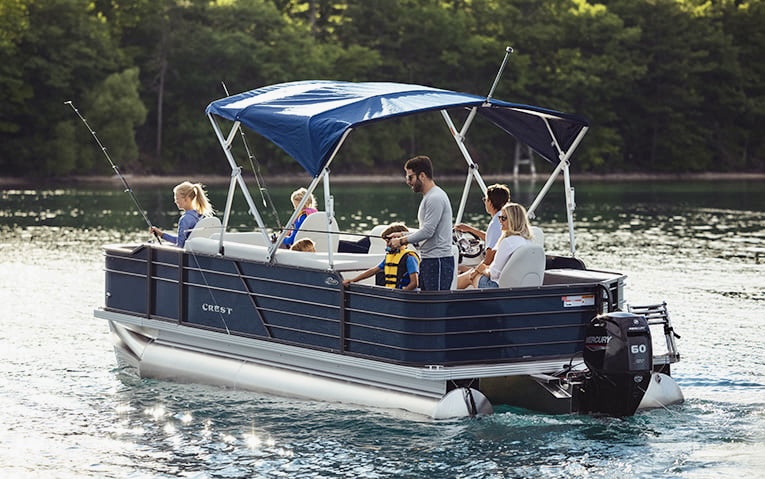
While cruising the Mobile-Tensaw Delta one day, a friend and I came across a strange sight. A solitary gentleman was bass fishing from the deck of a pontoon boat.
“See, that’s the way to do it,” my buddy chuckled as we drove by. “You can’t lose. If I see a guy fishing from a pontoon boat and he’s not catching anything, I think, ‘Well, he’s playing with a handicap.’ I don’t judge him the same way I judge a man getting skunked in a decked-out glitter rocket. But if I see him catching fish, it’s ‘Heck yeah! That dude’s killing them–from a pontoon boat!’ That’s the kind of guy you want to have a beer with, you know? He’s living life.”
Pontoon boats are typically thought of as the quintessential “party barge.” They’re usually seen plowing along big rivers and lakes, bench seats full of squealing kids, spring-breakers, or women in cover ups drinking mimosas. Sure, you may see a fishing rod propped up in the corner, but it’s almost never in use. The idea of fishing, seriously fishing, in a pontoon boat seems almost laughable.
But when you stop to think about it, pontoon boats have a lot to offer anglers. You can’t beat them for stability in calm waters. Despite their size and capacity, they draft incredibly shallow. And their large, open decks offer almost unlimited capacity for customization, with plenty of room for large livewells, rod lockers, tackle trays, ice chests, and other essentials. In recent years, manufacturers have started to offer angling-specific models with advanced electronics packages and open decks to better facilitate pitching and flipping.
New developments mean that, far from “playing with a handicap” anglers fishing from pontoon are fishing more effectively than ever, and in style and comfort to boot.
Pontoons vs Tritoons
One of the biggest changes in the pontoon world has been the advent of the “tritoon,” a pontoon hull with an extra flotation tube sandwiched between the traditional floats. While adding another toon is a simple design change, it offers big performance increases. Tritoons can carry more weight, and because they have increased surface area they can plane more easily. This means that a tritoon can reach planing speeds of up to 40-50 mph, while a traditional pontoon is going to cap out at around a 20 mph hull speed.
This lets you cover more water, which, as bass boaters have known for a long time, can be the difference between fishing and catching.

Fishing Pontoon Boat Layouts
Most pontoon boats are laid out with recreational boaters’ needs in mind. This means lots of bench seats and cupholders. Cupholders are fine and good, but bench seats are impossible to fish from, which is why many fishing-specific models now replace at least some of those benches with standard swivel chair mounts. These are easier to cast from, and let you face out towards the fish or in towards your company.
Another feature often found on fishing pontoon boats is an open casting deck. The “playpen” style rail around a pontoon boat makes some fishing techniques (flipping and pitching comes to mind) difficult if not downright impossible. The deck of a pontoon sits higher than a bass boat’s deck, but bass anglers will feel much more at home on an open deck.
However, for other anglers, the railing on a pontoon boat is a “pro” instead of a “con.” Catfish anglers who want to soak multiple lines have plenty of real estate to attach heavy duty rod holders, and crappie anglers who like to spider rig may quickly fall in love with monitoring a dozen rods from the comfort of the captain’s seat.
The great thing about a pontoon boat is that really, it can offer something for everybody. A pontoon is stable and roomy enough for grandparents, and in-laws, who can sit back and enjoy a beverage while the grandkids play under the bimini top. Fish-focused passengers can fish from the open deck, and more casual anglers can monitor a rod in a holder. Especially for the family men out there, having a boat that everyone can enjoy just makes sense.
Fishing Pontoon Boat Trolling Motors
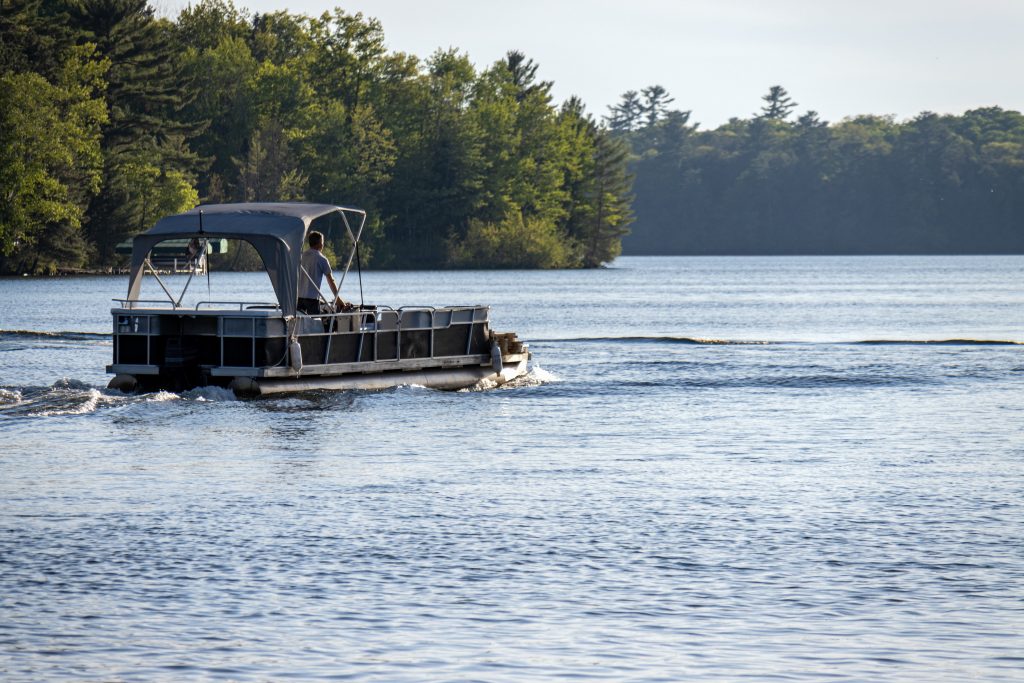
Especially if you’re actively fishing artificials, a good trolling motor is a must-have on any fishing boat. Pontoon boats are heavy, which means that they require a good bit of motor to push, but the great news is that they have plenty of space and freeboard for battery banks!
When picking out a trolling motor for your fishing pontoon, William Montgomery with Blue Water Ship Stores recommends starting with evaluating how much thrust you need and how long of a shaft you need.
“What you want to do to determine shaft length,” he says, “is to get your boat in the water, and load it just like you were going to go fishing. Get some passengers, fill the fuel tank, pack all of your gear, put ice in the ice chests, just a full load with everything where it will be when the boat’s in use. Then, take a tape measure and measure the height from the bow where you’re going to mount that motor down to the waterline.”
“Once you have that number, you can go to a trolling motor manufacturer’s website and reference a chart telling you how much they recommend adding to that number so that your shaft gets the prop down in the water where it needs to be. Typically, you’re looking at adding a foot to 24 inches.”
“For a ‘down-and-dirty’ rough estimate, you’re going to need about two pounds of thrust for every 100 pounds of boat,” Williams says. “So if you have a 5,000-pound boat, fully loaded and ready to fish, you’ll need about 100 pounds of thrust. Again, there are some manufacturer’s charts you can consult, but that’s a quick ballpark. And, when in doubt, always round up to the next size.”
“You’re not going to be able to get a very high thrust rating with a 12v system,” he continues. “As a general rule, you can get about thirty to 55 pounds of thrust off of a 12v system; 70 to 90 off of a 24v system, and once you get up to 100 to 115 pounds you’re going to need a 36v system.”
Size aside, there are three other highly-recommended features for fishing pontoon trolling motors. A remote, GPS-assist such as Spot-Lok, and a quick-disconnect bracket. It can be difficult to run a foot pedal motor on a pontoon, so being able to put the motor on auto-pilot and/or control it wherever you happen to be is a huge quality-of-life upgrade. A quick-disconnect bracket lets you remove the motor if you’re going on a pleasure cruise, and can prevent a lot of dockside bumps and tripping hazards.

Fish Finders for Pontoon Boats
If you’re serious about fishing from your pontoon boat, a good graph is also nice to have. Good downscan with the biggest screen you can reasonably afford and find room for on the console is the bare minimum. Sidescan shows you more of the water column, and it’s easy to spend hours slowly cruising likely fishing grounds with a buddy in a pontoon. Features like Humminbird’s Mega 360 Imaging, which scans 360 degrees around an anchored vessel, is particularly useful if you’re anchored up and soaking baits or trying to give casting directions to multiple anglers.
Pontoon Boat Financing
Big pontoon boats, which require big outboards and big trailers, aren’t cheap. By the time you outfit one with a good trolling motor, good electronics, and a fishing package, you can definitely get sticker shock. One good way to reduce your purchase price is to consider a used boat. But in order to avoid getting burned by a lemon, it’s important to either buy from a reputable used vendor or carefully inspect the boat yourself.
We spoke with “Katie the Boat Lady” who is the sales manager at Bucks’ Island, and she tells us that they can help buyers with financing a fishing pontoon boat.
“We can finance used boats less than 20 years old,” she says, “and we use different lenders through our financing services, and we can provide better rates of financing and longer terms than most other sources.”
“Before we even consider a trade-in boat, our technicians go through the boat and check everything. We do compression tests on the motor, we check the prop and lower unit, we go through the electrical system, even the trolling motor. We do a second check of all systems, and then we do an on-the-water test. And then when a customer is interested in a boat, we take the boat and buyer to the water and do another water test run.”
That last part is particularly important. Pontoon boats are BIG, and it pays to run one yourself to make sure that you’re comfortable trailering and docking that particular hull.
Conclusion
Fishing from a pontoon boat might seem unconventional, but with the right setup, it’s not just viable—it’s fantastic. These versatile watercraft have evolved from being mere “party barges” to well-equipped fishing platforms, offering stability, space, and comfort that few traditional fishing boats can match. A well-equipped fishing pontoon boat can bring together the best of both worlds—serious fishing capability and recreational comfort.