
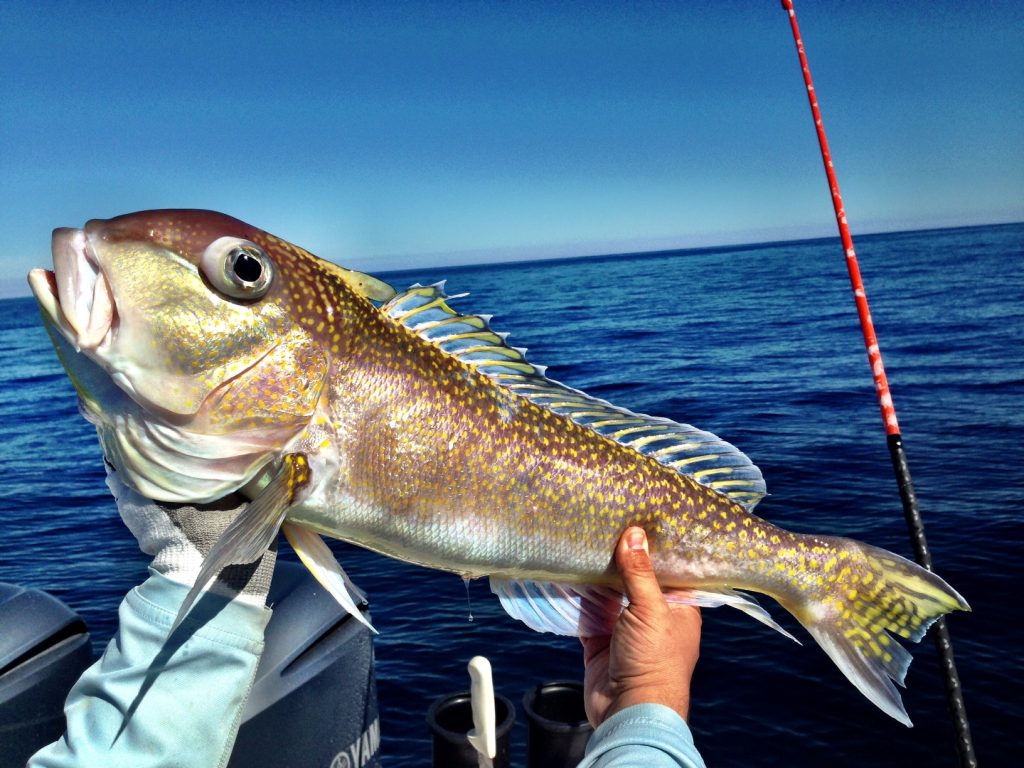
One of the most exciting things about fishing the Gulf of Mexico is the extreme biodiversity. There are targets aplenty both inshore and offshore. In recent years, deep dropping and slow pitch jigging have become a fun way to add variety to the fish box and scratch new species off at the same time. The golden tilefish is one of the main species that live in these dark depths that have rapidly become a favorite to pursue. Main reasoning being that they are first-class table fare and are a wide ranging species that can be taken in all seasons.
Knowing your Quarry
The great northern tilefish, commonly known as the golden tilefish, is found in the western Atlantic from as far north as Maine and Nova Scotia, and south to Venezuela and Suriname. This includes the entire Caribbean and Gulf of Mexico. They live their lives at extreme depths, ranging from 400 to well over 1,000 feet.
They are the largest species in the family Malacanthidae, reaching weights of over 70 pounds.

Golden tilefish are voracious eaters, preying on crustaceans, mollusks and smaller fish. Their preference for crustaceans becomes obvious at the dinner table. The flesh has a crab-like consistency and sweeter taste than most of the other deep-dwelling species.
Golden tilefish, like most deep-water fish, have an impressive tolerance to the frigid conditions they live in. However, they do have their limits when it comes to colder temperatures. In 1882, the entire North Atlantic stock of golden tilefish were nearly wiped out when the warm waters of the gulf stream diverted further offshore, allowing extremely cold, subarctic waters to encroach upon their habitat. Ships reported seeing miles and miles of dead golden tilefish off the eastern seaboard, and tiles weren’t seen in the area again for nearly 10 years.
Year-Round Golden Tilefish Opportunities
Whereas so many species in our region are subject to seasonal restrictions and low bag limits, golden tilefish can be harvested year-round. There are no minimum size restrictions and the federal bag limit for golden tilefish is *20 per person (*part of the federal reef fish aggregate).
Water temperatures along the gulf coast rarely escape the preferred thresholds for tiles. This means that tiles can be taken in all months of the year, making them a prime target or welcomed addition to any offshore trip.
Golden tilefish are still lightly pressured in our region, and can be found in good numbers along the entire northern gulf coast.
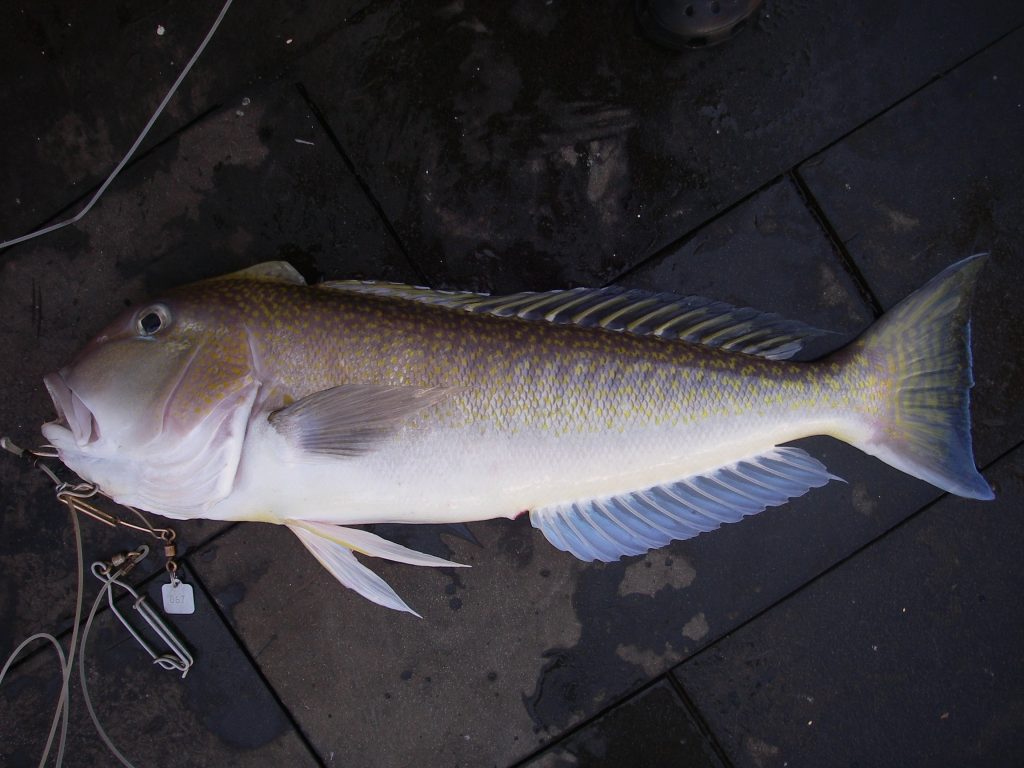
Tilefishing takes the minimal in deep-drop equipment and can be taken with both manual and electric gear. Local tackle shops can help even the greenest of offshore anglers score gold.
How-to Catch Golden Tilefish
The first step in finding tiles is to position along ideal depth lines, generally outside of the 100 fathom curves. Whereas tiles can be found in a wide range of depths, 700-1100 feet are typically best.
Once the boat is lingering in the proper depth range, locating real-estate for golden tilefish could be likened to “unlearning” how to bottom fish. You typically want structure like rocks and ledges right? Wrong.
Golden tilefish prefer very feature-less, flat, mud bottoms. Tiles carve “burrows” into the mud with their hand-like pelvic fins. They typically form colonies of these burrows along flat “plateaus” with little to no-grade.
In order to find these colonies, an angler has to think the opposite of traditional bottom fish scouting, and learn to look for nothing. The less grade the better and if your weight sinks deep into a muddy bottom upon impact, you’re probably in the right spot.
Rigging can be as simple or as elaborate as an angler makes it. Typically, a rig with anywhere from three to six hooks are used. Hook size depends on the baits to be used. Circle hooks from 7/0-16/0 can be used. Hooks can be spaced at varied distances along the rig and are often accompanied by glow beads or glow tubing, to catch the eyes of hungry tiles. In most cases, LED lights can/will be placed at the top of the rig to provide additional lighting. Some debate that this is not necessary, but it never seems to hurt either. Anglers can always experiment and find what’s best for them.
On the bottom end of the rig, a snap swivel is typically used to attach the weight, which can range from two to eight pounds depending on the current and depth. A good safety measure is to attach the weight with a loop of 50-60 pound monofilament so that in the event of a snag, the weight can be sacrificed and the rig salvaged.
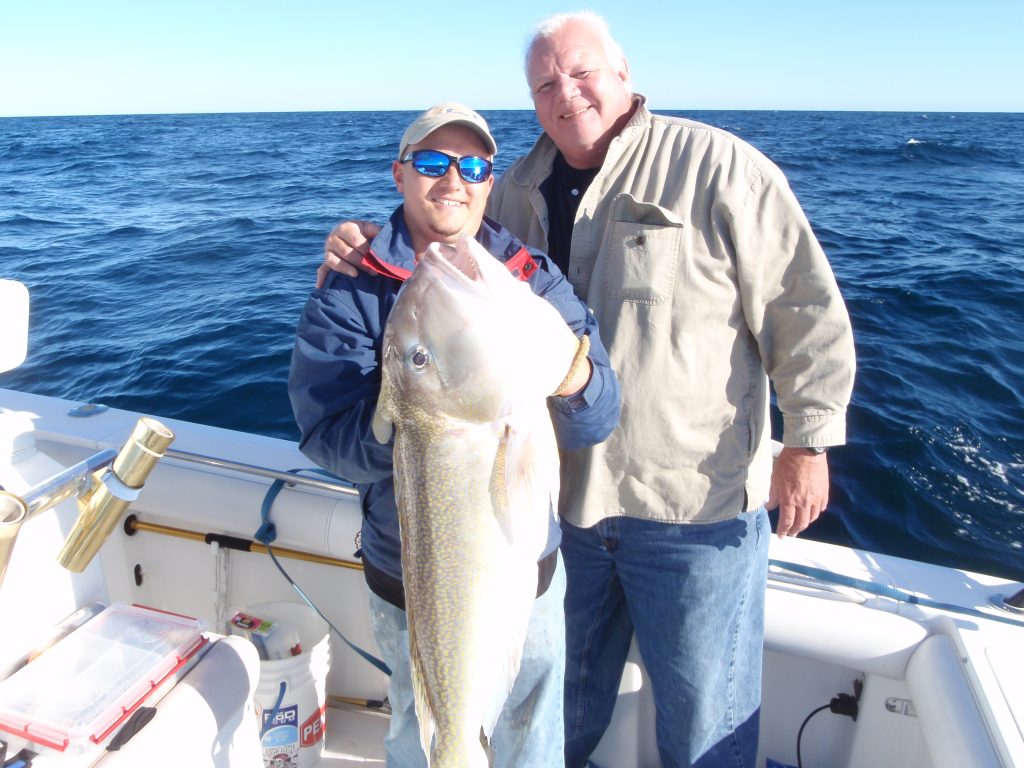
Tiles will eat most of the frozen bait choices that are available in most shops, with food-grade squid being a top pic. To me, nothing beats fresh baits with cut strips of bonito, mackerel or barracuda being the best choices. Many other species can be used as well, just be sure to be aware of which species can and cannot be used legally, as many reef species cannot be harvested for this purpose.
Rods and reels can be both manual or electric, although most anglers prospecting for golden tiles turn to the electric option. In either scenario, reels should have enough power for bringing up heavy weights from these depths, and should maintain a capacity of at least 500y yards to keep retrieve rates appropriate.
Rods for golden tiles do not need to be specialized, and most deep drop rods offered in retail rods will do the trick. Unlike some other deep drop species, tiles do not have soft mouths and are less prone to pulled hooks.
Setting the hook and scoring multiple fish per drop is a matter of paying attention and being more interactive. For one, tiles like to stay very close to the bottom, so maintaining contact with the mud through the drift is critical.
When a tile eats the bait, crank hard on the handle or apply power on to the motor, setting the hook. But for chances at multiple fish, a hooked fish can be kept near the bottom, encouraging other fish to join in on the feed. It can be a gamble however as sometimes fish are lost through this process.
Golden tilefish are a reliable and eager option on any offshore trip. Whether it’s the Plan A for the excursion or a backup if other targets are a no-show, they are the all-season species for a successful trip.