
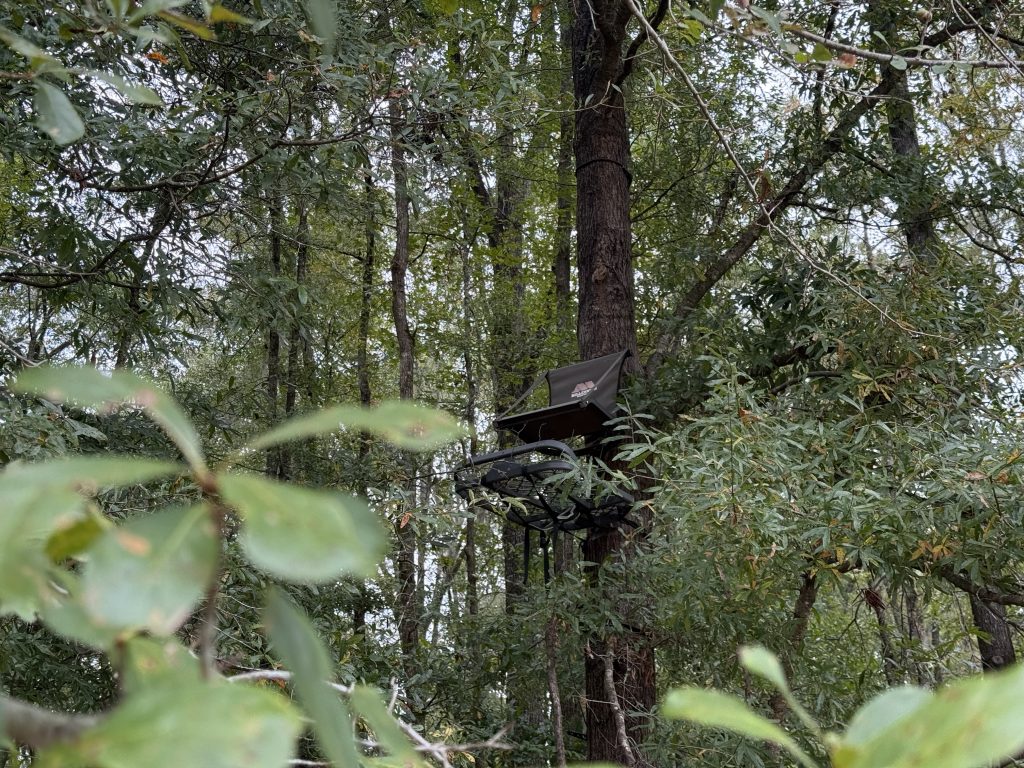
For a long time, my philosophy on hang-on tree stands was pretty simple: I’d rather own six inexpensive stands in six different locations than spend the same money putting one really good stand in a single tree. After five years of hunting from , I don’t think that way anymore. I’ve owned several of these stands, left them hanging on my property for extended periods, moved them when hunting conditions called for it, and spent some very long sits in them. That experience has shown me that there is more to the value of a treestand than how many trees you can afford to put one in.
Comfort matters. Durability makes “expensive” stands cheaper in the long run. How easily you can move a stand matters. And, especially with Millennium’s receiver system, buying one better stand doesn’t necessarily mean you are limited to hunting one tree. Five seasons in, the M-150 has held up well enough that I have considerably more confidence in that approach than I did when I got my first one.
The Biggest Difference Is Comfort
If there is one thing that has stood out to me across the Millennium stands I’ve used, it is the seat. Seat comfort affects almost everything about a long hunt. An uncomfortable hunter moves more. You shift from one side to the other, stand up, sit down, reposition your legs, and eventually start thinking about how long you have been in the tree. I believe the more comfortable you are, the longer you can stay still, and the longer you can stay in the stand. Sometimes simply being there another hour is what puts a deer in front of you.
I’ve personally hunted from the M-150 for more than six hours at a time. When I finally climbed down, it wasn’t because the stand had become unbearable; I was simply ready to be done hunting. That is an important distinction, and if I know I’m hunting a location where patience may be the deciding factor, this is the type of stand I want to be sitting in.

The M-150 also has a large platform. It feels like a substantial stand when you look at it, providing enough room to reposition your feet and settle into a comfortable setup without feeling like you’re balancing on a little square of metal. What surprised me when I first handled one was that the size doesn’t translate into the weight you might expect. It is a big stand, but it is still manageable to put in a tree and move when necessary. That combination of a roomy platform and manageable weight is a big part of why I have continued using them around my farm.
Five Years Changed My Opinion of Cheap Hang-On Stands
Before I started buying better hang-on stands, I went through the phase a lot of hunters probably go through. My thinking was that quantity mattered more than quality. Instead of spending more money on one stand, I could go to a big-box store, buy several inexpensive lock-ons, hang them everywhere I thought I might hunt, and always have a stand ready. On paper, that makes sense, but in practice I found several problems with it.
The first issue was durability. I’ve had inexpensive lock-ons begin showing substantial corrosion after being left outside, and when I start questioning the condition of the platform or the cables supporting it, whatever money I saved buying that stand suddenly doesn’t seem very important. The second problem was comfort. A lot of inexpensive stands give you a relatively small flat seat with a foam pad. You can add another cushion or modify them in an attempt to make them more comfortable, but you are still starting with a small seat and a small platform.
After several hours, you start moving around. That is annoying from a comfort standpoint, but it is also a hunting problem. Every time you shift around because your back or legs hurt, you are creating movement that an approaching deer may see. After using the M-150 for several seasons, I would rather have fewer stands that I trust and actually want to sit in than fill the property with stands I dread climbing into. But Millennium’s receiver system also means the choice doesn’t have to be quite that simple.
The Receiver System Changes the Economics
One of my favorite features of the M-150 is the way it works with Millennium’s receiver mounts. Rather than permanently dedicating an entire treestand to every location you might want to hunt, you can establish multiple receiver locations and move the stand between them. For someone who owns property or hunts the same ground year after year, that opens up a lot of possibilities.
Take white oaks as an example. I have several locations where hunting a particular white oak may be very good for only a couple of weeks while that tree is dropping acorns, so it doesn’t necessarily make sense to leave an entire treestand in that tree 365 days a year for a 2 week hunting window. I can leave a receiver and some climbing sticks or steps there instead. During bow season, I can check those trees and see which one is producing: if a particular oak is hot, I can put the M-150 into that receiver and hunt it; if the acorns are gone or the deer have shifted somewhere else, I can move the stand to another preset.
That makes a quality stand much more versatile than it first appears when you are simply comparing the price of one M-150 to several inexpensive lock-ons. Rather than buying a complete treestand for every possible hunting location, I can put my money into the stand I actually want to sit in and establish multiple places where I can use it.
A Quiet Way to Move With the Deer
There is also a hunting advantage to the receiver system that has nothing to do with price: stealth. One of the biggest problems I have with a traditional hang-and-hunt setup is the amount of equipment you have to attach to a tree when you arrive. If I’m slipping into a white oak close to bedding cover, I’m assuming there may already be deer fairly close, often within 100 yards, which is not where I want to start clanging metal against metal.

If I already have climbing sticks and a receiver in the tree, getting the M-150 into position can be extremely quiet. The receiver gives the stand a prepared attachment point rather than forcing me to completely install a hang-on tree stand from scratch. For the places I hunt, that can make the M-150 a practical alternative to carrying a climber. You can establish several trees ahead of time, then move the stand according to food, wind direction, deer movement, or hunting pressure without having to purchase a complete setup for every single tree. That flexibility has turned out to be one of the biggest advantages of the system.
Sometimes Moving 50 Yards Matters
Hunters have a tendency to leave tree stands where they are, and I’m guilty of it too. Once you have gone through the work of finding a tree, trimming shooting lanes, hanging the stand, and getting everything comfortable, it is easy to keep hunting that tree even when the deer are telling you that you should be somewhere else. The M-150’s receiver system makes it easier to avoid that trap by allowing me to move my hang-on tree stand between prepared locations.
I have a food plot on my property that is a good example. On Easterly winds, deer tend to approach the field from a bedding area to its Northwest. On a Westerly wind, deer tend to approach from a bedding area to its east. On a Southwest wind, I’ve got a tree in the Northeast corner that is perfect for ingress, egress, and hunting near three persimmons that hold onto some fruit just after bow season. On an East / Northeast wind, there’s a water oak about 100 yards away in the Southwest corner that gives me a bow-range shot of the major game trail they use. I could buy two complete treestands and leave both of them there, even though only one hunter will ever be sitting on that food plot at a time, or I can maintain two receiver locations.
Most of the time, the stand stays in the location that matches our more common wind. If the wind switches and I still want to hunt that plot, I can move the M-150 to the other location. Now I effectively have two setups without buying two stands.
How Has the M-150 Held Up?
I haven’t always treated these stands the way an equipment manual would tell you to. I prefer having my hunting property ready to go, and I’ve left several of my stands outside instead of taking everything down and storing it after each season. They have held up very well under that use.

That is especially meaningful to me because I have seen the opposite with cheaper lock-ons. I’ve owned stands where corrosion became obvious enough that I started questioning structural components after relatively limited exposure outdoors, and once I begin wondering about the cables or the platform beneath my feet, I’m done trusting that stand. I haven’t had that same experience with the M-150s. After five years, their durability is a large part of why I’m willing to spend more upfront on a stand I plan to use for a long time.
Of course, no treestand should simply be left in the woods and assumed to be safe indefinitely. Straps, attachment points, cables, hardware, and the stand itself should be inspected regularly. Trees grow, straps age, and conditions change. I also use a lifeline and safety harness on every stand as a failsafe. Even with equipment I trust, I don’t want my safety depending entirely on the assumption that nothing will ever fail.
Is the Millennium M-150 Hang-On Tree Stand Worth It?
10 years ago, I looked at more expensive hang-on tree stands and thought about how many cheaper stands I could buy for the same money. Today, I look at it differently. I think about how long I can comfortably sit in it, whether I trust it after several seasons outside, and whether I can move it when the deer pattern changes instead of stubbornly hunting the same tree because I’m feeling lazy.
And I think about the receiver system. That last piece is what really changes the value equation for me. One good M-150 combined with several receiver locations can cover a surprising amount of hunting ground (and keep others out of your stand if that’s a thing!). You aren’t necessarily buying one stand for one tree, you’re buying a stand you can move among a network of prepared locations.
After five seasons of using the M-150, I no longer believe that five cheap stands are are a better investment than one quality stand. I would rather own equipment that is comfortable enough to keep me in the tree, quiet enough to hunt close to deer, durable enough that I still trust it years later, and versatile enough to move when the deer tell me I’m sitting in the wrong place. For me, the Millennium M-150 has done all four.