

If you’re thinking about how to build a dock that will last, it starts with understanding just how hard the environment is on every component. Most dock owners aren’t looking for another weekend project. You want a reliable spot to park the boat, cast a line, or just kick back and watch the sunset. The problem is that the environment is trying to destroy your dock from day one. Between the baking sun, constant moisture, salt spray, and shifting water levels, it’s a brutal place for any building material to live.
Standard pressure-treated lumber and wood pilings have been the go-to for decades, and they do okay for a while. But wood is organic. Eventually, it’s going to warp, splinter, rot, or get chewed up by marine borers. On a backyard deck, a few bad boards are an eyesore; on a dock, where the structure is submerged or holding up a heavy boat lift, those repairs get expensive and complicated fast.
So, why not build it differently? Today’s materials allow you to move away from wood entirely. While the upfront cost is higher, the payoff is a dock that lasts longer and actually costs you less over its lifetime because you aren’t constantly throwing money at maintenance.
Building a 100% wood-free dock isn’t just a dream—it’s a reality if you stop thinking about it as a pile of boards and start thinking about it as a system. From the pilings in the mud to the screws in the deck, every component needs to be chosen to withstand the elements without failing.
This doesn’t mean every “wood alternative” is a perfect fit for every project. Composite pilings, aluminum frames, and PVC decking all have their own pros and cons. The key to a great wood-free dock is understanding those trade-offs before you ever drive the first piling.
Look at the System, Not Just the Surface
When people talk about upgrading their dock, they usually focus on the deck boards. It makes sense—that’s the part you see and walk on. But the “skin” of the dock is only as good as the skeleton underneath.
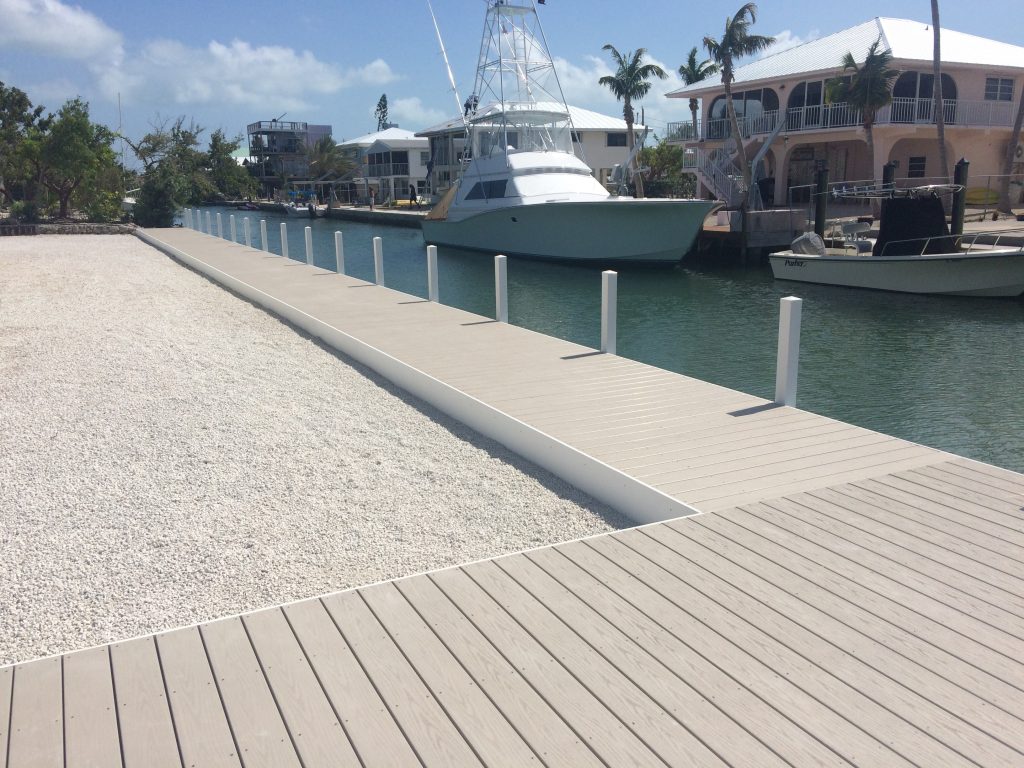
A dock is a complex machine made of pilings, beams, joists, lifts, and hardware. If you put high-end composite boards on top of a wood frame that’s going to rot in ten years, you haven’t really solved the problem. You’ve just hidden it.
That’s why you have to plan from the bottom up. Your choice of piling dictates how you frame it, which in turn dictates how you fasten the decking. While a wood-free dock is totally doable, it requires much more intentional planning than a traditional build.
Wood is forgiving. You can cut, notch, and “make it work” on the fly. Materials like aluminum and fiberglass composites don’t work like that. They need to be engineered and ordered to spec. But that extra effort at the start is what ensures the structure stays solid for decades.
A wood-free dock isn’t just a regular dock with different boards; it’s a long-term investment where every material is chosen for a specific reason.
The best way to start is by looking at the foundation.
Better Options for Your Pilings
Pilings are the most critical part of the dock, and unfortunately, the hardest part to fix later. If a deck board breaks, you unscrew it. If a piling fails, you’re hiring a barge and a crane.
For a wood-free build, composite or fiberglass-reinforced pilings—like the EcoPile—are the gold standard. They don’t need chemical preservatives, they aren’t susceptible to rot, and marine borers won’t touch them. They provide a permanent foundation that won’t degrade in harsh saltwater or brackish environments.
Sure, they cost more out of the gate. They also require a contractor who knows how to handle and drive them correctly. But if your goal is to build the last dock you’ll ever own, the foundation is the one place you absolutely shouldn’t cut corners. A fancy deck on top of rotting wood posts is a disaster waiting to happen.
Once the pilings are set, it’s time to talk about what holds the boards up.
Ditching the Wood Frame
Aluminum is the heavyweight champion of wood-free framing. It’s light, incredibly strong, and won’t rot or splinter. It also integrates perfectly with boat lift systems, which are usually made of aluminum anyway. This creates a unified, professional-looking structure that won’t twist or sag over time.
Composite framing is also an option, but you have to be careful. Not all composite is rated for structural loads. You need to make sure you’re using a product specifically engineered to hold the weight of the dock and the people on it. Aluminum is generally easier to engineer for marine strength, while composite might be chosen for specific aesthetic reasons or corrosion concerns in very specific niches.
Choosing the Right Walking Surface
The decking is where you’ll really feel the difference. It’s about more than just looks—it’s about bare-foot comfort, slip resistance, and how hot the boards get in July. You have a few great choices here:
PVC Decking: Products like ENDECK from Eastern Metal Supply are fantastic because they look and feel like high-end wood but have zero moisture absorption. They won’t swell, crack, or fade, and they stay cooler underfoot than most other materials.
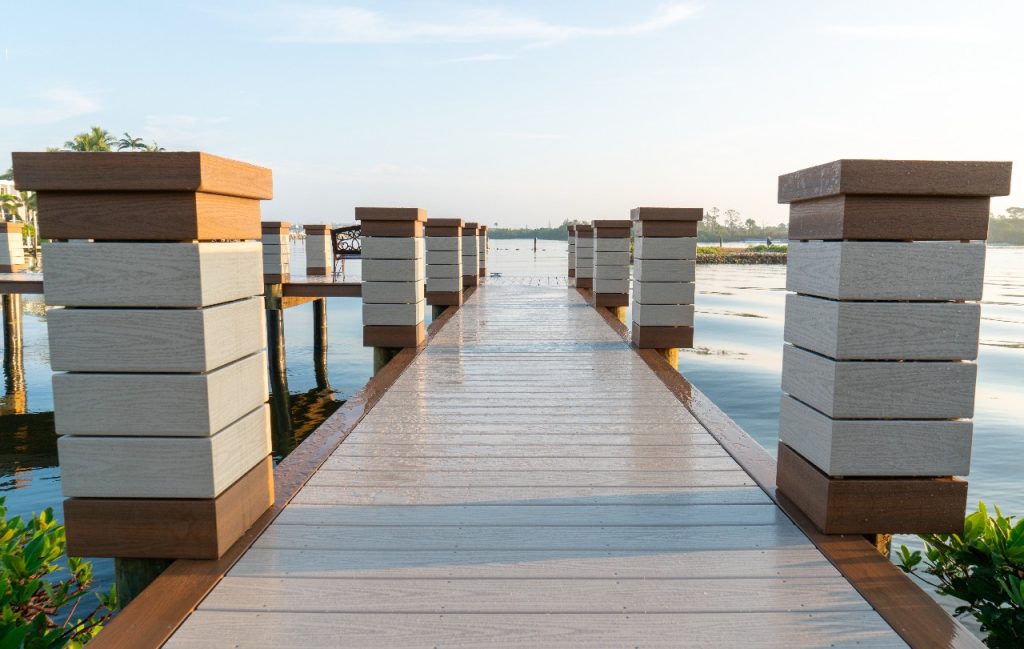
Aluminum Decking: This is a bulletproof option. It can span longer distances between joists and is incredibly durable. It can feel a bit different underfoot and can be noisier than PVC, but for a practical, rugged dock, it’s hard to beat.
Thru-Flow / Open-Flow Panels: These are the “grated” style panels like SureStep. They’re excellent for storm-prone areas because waves can move up through the dock instead of lifting the whole structure. They also let sunlight through to protect seagrasses below—often a requirement for permits.
The smartest builds often mix these. Use PVC for the “hangout” area where you want comfort, and use thru-flow panels for the walkways or boat lift areas where storm surge is a bigger concern.
Don’t Forget the Roof and Hardware
If you’re building a roof, and you want to skip the wood, aluminum roof systems are the way to go—they’re lightweight and match the marine aesthetic. For the boat itself, specialized lift covers like the Slipski system offer dedicated protection from the sun and rain without the massive footprint of a traditional roof. And Slipski systems also offer the ability to span more than just the boat lift, their aluminum canopies can be built to cover your entire dock.
Finally, the hardware. This is the glue that holds everything together. In saltwater, only use 316-grade stainless steel. In freshwater, 305-grade is usually enough. Using cheap galvanized bolts on a wood-free dock is like putting old tires on a new truck—eventually, the smallest part will cause the biggest problem.
Is it Worth the Investment?
Yes, a wood-free dock costs more today. But you have to look at the “total cost of ownership.” When you factor in the money you’ll save on stains, sealers, and board replacements—not to mention the value of your own time—the math starts to look very different. You’re paying for peace of mind.
Build it like it’s the last dock you’ll ever need. Choose materials that handle the water as well as you do. Then, instead of spending your weekends with a power washer and a paintbrush, you can actually enjoy the water.