
Over the years I’ve seen plenty of “game changing” products advertised to hunters. Fertilizer-coated food plot seed. Fresh-frozen doe pee. No-flash trail cameras. Various elixirs that promised to make your smell undetectable to deer, and a suit that hides your bad vibes from them.
It’s been my experience that hard-earned dollars spent on whiz-bang gadgets rarely translates to more trophies on the wall or brown paper parcels in the freezer. That’s not to say that money can’t buy success. It very much can. Whether it’s in the form of hiring a talented fishing guide, paying for a week at an intensely-managed resort, or purchasing a tract of recreational property in a prime whitetail state, judiciously applied dollars can do more than anything else to increase your odds of success afield. It’s just that most of the things that really matter can’t be purchased off the shelf of your sporting goods store.
However, there are a few items in my gear closet that really have made my time afield more successful. My tree saddle really has gotten me into some remote areas where I was able to connect with “the big one.” LiDar imagery on a navigational app probably doubled my waterfowl harvest last year. Primaloft insulation has allowed me to greatly increase the number of hours I can tolerate on-stand or in-blind during our fiercest cold fronts, and year-after-year those conditions provide my state’s best hunting opportunities.
But if I had to choose one piece of gear that’s just helped put more game in the freezer and on the wall than any other, it would hands-down be my hunting crossbow. There’s not even a close second. Archery season comes in over a month earlier than firearms season in Alabama, and the vast majority of public lands, whether Forever Wild, WMA, National Forest, or Corps lands, offer more opportunities for archery tackle than for powder burners.
In this article, we’ll look at what goes into choosing a “meat-getter” hunting crossbow that will fill your freezer for seasons to come.
Hunting Crossbow Legal Considerations
Before purchasing a hunting crossbow, it is essential to understand your state’s hunting regulations. Crossbow legality varies widely by state. While some states allow them throughout archery season, others restrict their use to specific seasons, types of game, age groups, or hunters who meet certain qualifications.
Hunters should verify the open seasons, legal game species, and whether any special permits are required. Regulations may also differ depending on whether you are hunting public or private land.
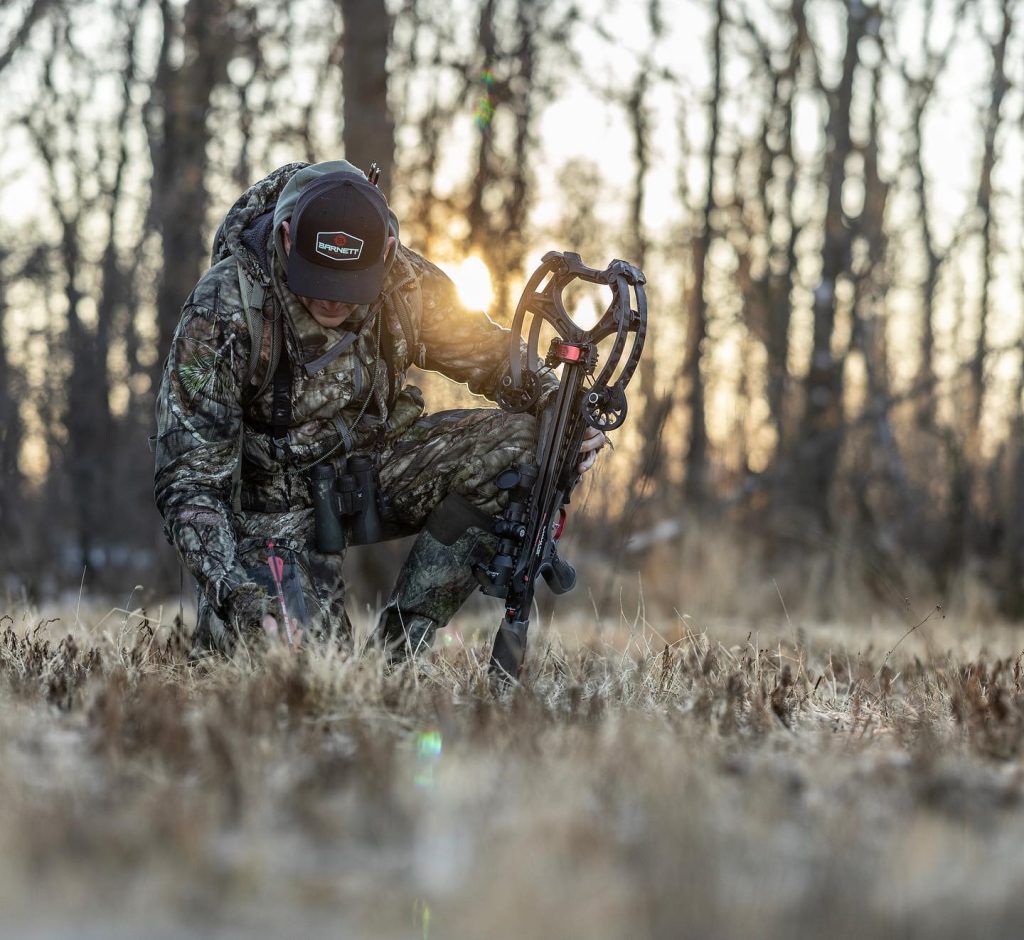
Staying updated on local laws will help ensure that your hunt is both ethical and compliant.
Crossbow Buying Guide
When shopping for a hunting crossbow, it is easy to get caught up in speed ratings, draw weights, new technology, and long lists of advertised features. Some of those features can make a real difference in the woods. Others may not matter much once you are sitting in a tree stand or ground blind waiting on a deer.
A good crossbow buying guide should focus on how the crossbow will actually be used. Think about where you hunt, how far you normally walk, whether you hunt from a stand or blind, and how easily you can cock and handle the crossbow.
The best hunting crossbow is not always the fastest or most expensive model. It is the one that fits the hunter, the hunting situation, and the budget.
Types of Hunting Crossbows: Recurve vs. Compound
Crossbows fall into two primary categories: recurve and compound. Each type has its own strengths and tradeoffs.
- Recurve crossbows have a simpler design with fewer moving parts. This generally means less maintenance and fewer mechanical components that can cause problems. However, recurve crossbows often require higher draw weights to produce similar power. They also tend to be wider, which can make them harder to maneuver in thick cover or inside a small blind.
- Compound crossbows use cams and cables to create a more compact and efficient design. They are generally faster and narrower than recurve models, making them easier to handle in tree stands, ground blinds, and dense woods. The tradeoff is that the added mechanical complexity may require more maintenance.
For many deer hunters, a compound crossbow offers the best combination of speed, compact size, and maneuverability. A narrower crossbow can be easier to move around a tree or through a blind window without bumping a limb against something.
Recurve crossbows still have plenty to offer. Hunters who prefer a simple and dependable design may appreciate having fewer cables, cams, and moving parts to maintain.
Neither style is automatically better for every hunter. The right choice depends on where you hunt, how much maintenance you are comfortable performing, and which design feels best when you shoulder and handle it.
Draw Weight
Draw weight—the force required to cock the crossbow—is a critical factor in both usability and effectiveness in hunting. Higher draw weights produce more powerful shots but are harder to cock, while lower draw weights may lack sufficient power for large game. For hunting deer, a draw weight of 150 pounds or more is generally recommended, while smaller game may require less. Balancing power with ease of use is key, as excessive draw weight can compromise handling and increase fatigue, especially during extended hunts.
Crossbow Speed Explained
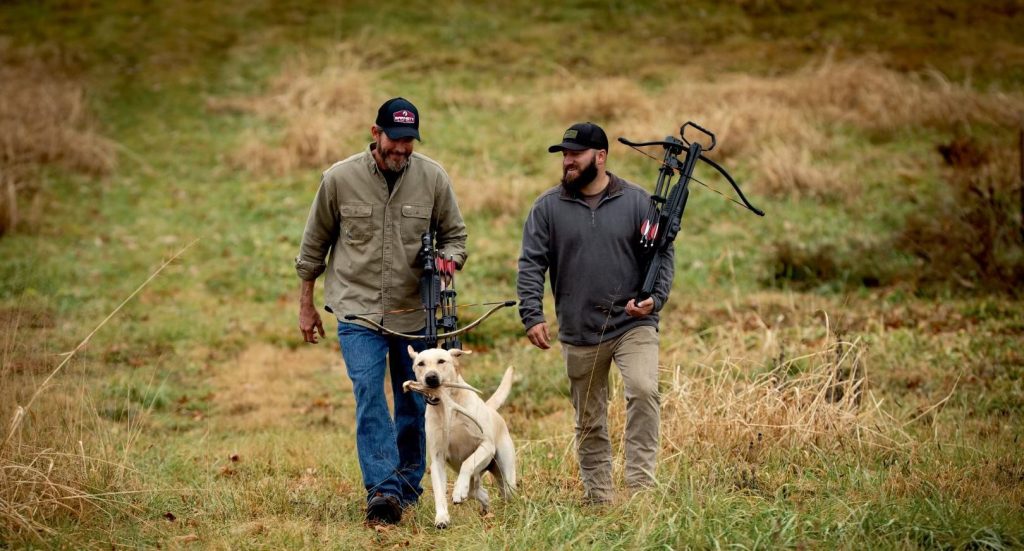
Crossbow speed is measured in feet per second, usually shortened to FPS. It is one of the first numbers manufacturers advertise and one of the easiest specifications for hunters to compare.
A faster crossbow produces a flatter trajectory and gets the shot to the animal more quickly. That can help reduce the effect of small mistakes in range estimation, particularly as the distance increases.
However, speed is not the only measure of a good hunting crossbow. Increasing speed can also increase noise, vibration, wear, and the amount of stress placed on the crossbow’s components.
Crossbows in the 300 to 400 FPS range are versatile enough for many common hunting situations. Newer performance models may exceed that range, but most deer hunters do not need to chase the highest possible number.
In open country, additional speed may provide some benefit. In thick woods where most shots are close, balance, accuracy, quiet operation, and ease of handling may be more valuable.
A fast crossbow is useful, but it should not come at the expense of comfort or control. A slightly slower crossbow that you can shoot accurately and operate confidently is a better hunting tool than a faster model that is difficult to handle.
Crossbow Weight and Size
Weight and size are important when determining how comfortable and practical a crossbow will be in different hunting situations.
Heavier crossbows often feel steady when shooting from a supported position. That can be helpful when hunting from a stand with a shooting rail. However, the additional weight can become noticeable during a long walk or when raising the crossbow into an elevated stand.
Lighter crossbows are easier to carry and maneuver. They can be especially useful for hunters who walk deep into public land, hunt from a tree saddle, or regularly move between locations.
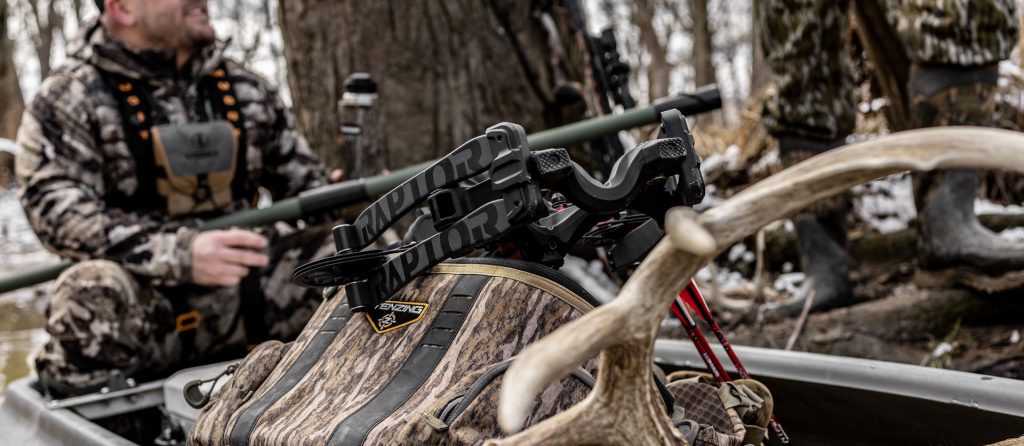
Overall width also matters. A wide crossbow may be difficult to move inside an enclosed ground blind or around the trunk of a tree. Hunters need enough room for the limbs and cams to move freely when the crossbow is fired.
Balance can be just as important as total weight. A front-heavy crossbow may become tiring to hold on target, even if it does not seem especially heavy on paper.
Think about your normal hunting style and terrain. Choose a crossbow that will not wear you out but still provides the stability needed for an accurate shot.
Trigger, Safety, and Cocking Features
Trigger quality deserves consideration when choosing a hunting crossbow. A clean and predictable trigger can make accurate shooting easier, while a heavy or inconsistent trigger can cause the shooter to pull off target.
The trigger does not need to be extremely light, but it should break consistently and feel comfortable to the shooter.
Safety features are also important. Many modern crossbows include an automatic safety and an anti-dry-fire system. Finger guards or pass-through foregrips can help keep the shooter’s support hand away from the string path.
A cocking system should also be considered part of the crossbow rather than an afterthought. Rope-cocking devices reduce the effort required and help pull the string back evenly. Crank-style systems require even less effort and may be a better choice for hunters with limited upper-body strength.
These features can affect how safe, accurate, and enjoyable the crossbow is to use. Make sure the controls are easy to reach and understand before making a purchase.
Crossbow Scope
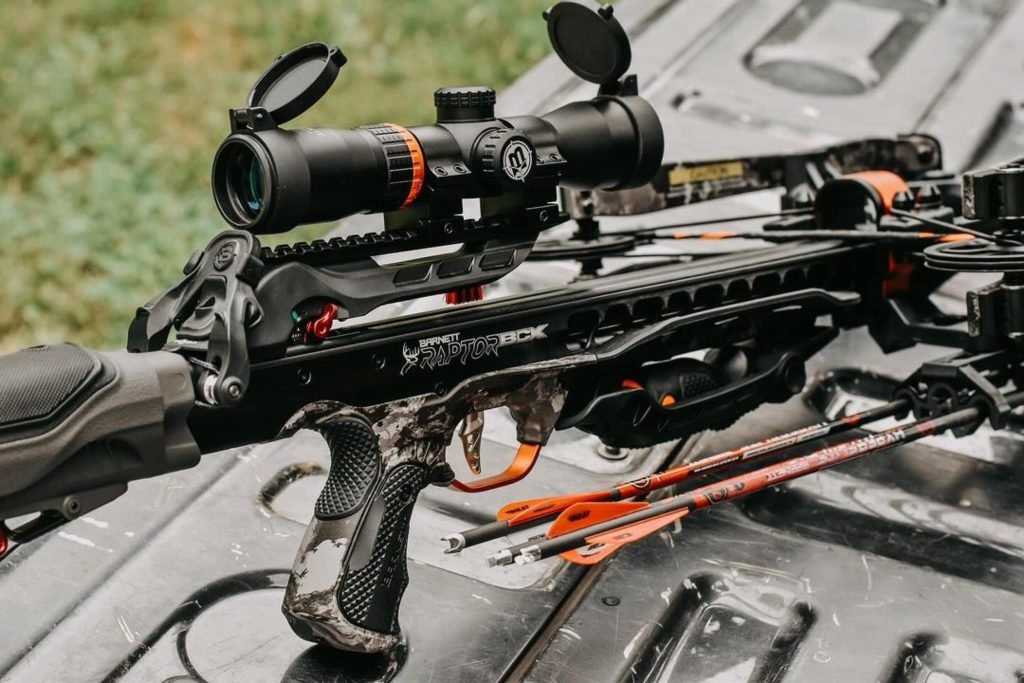
Most hunting crossbows are sold with a scope, but the quality can vary considerably from one package to another.
A clear scope with multiple aiming points can help hunters account for distance. An illuminated reticle may also be useful during the low-light periods when deer are most active.
The scope should be easy to adjust and should provide a comfortable sight picture when the crossbow is shouldered. Hunters should not have to stretch their neck or move their head into an awkward position to see through it.
When comparing crossbow packages, consider whether the included scope meets your needs or whether replacing it will add to the total cost.
Budget vs Premium Crossbows
Crossbows are available across a wide range of prices. Entry-level models may cost only a few hundred dollars, while high-end crossbows can cost well over $1,000.
Budget crossbows are generally heavier, wider, and more basic. They may come with simpler scopes, stocks, cocking systems, and triggers. That does not mean they cannot be effective hunting tools. A dependable budget crossbow that fits the hunter can still put plenty of meat in the freezer.
Mid-range crossbows often provide a good balance between cost and performance. Spending more may provide a narrower design, lighter materials, a smoother trigger, a better scope, or a more convenient cocking system.
Premium crossbows usually offer the latest technology, more compact dimensions, improved balance, higher speeds, and a greater level of fit and finish. Those improvements may be worthwhile for hunters who use their crossbow regularly or need a specific feature.
The key is to spend money on improvements that solve an actual problem. A mobile hunter may benefit from a lighter crossbow. A ground-blind hunter may place more value on a narrow design. Someone who struggles to cock a crossbow may get more benefit from an integrated crank than from additional speed.

As a mid-range to premium example, the Barnett Hyper Raptor combines a compact design, manageable weight, high speed, and several performance-focused features. Its maneuverability makes it well suited for dense woods, tree stands, and ground blinds where a wider crossbow can become difficult to handle.
The Hyper Raptor also shows why hunters should compare the complete crossbow rather than looking at only one specification. Speed is part of its appeal, but its compact size, trigger, cocking system, and overall handling are what make it a practical hunting option.
Choose a price range that matches how often you hunt and which features you will actually use. Quality gear can be a long-term investment, but spending more does not automatically make a crossbow the right choice for you.
Best Crossbow for Deer Hunting
The best crossbow for deer hunting is not necessarily the model with the highest speed rating or the largest price tag. It is the crossbow you can carry comfortably, operate safely, and shoot accurately under realistic hunting conditions.
Start by considering where you normally hunt.
A tree stand hunter may need a lightweight and narrow crossbow that is easy to raise with a haul line and maneuver around the tree. A ground-blind hunter should make sure there is enough room for the crossbow’s limbs and cams to move without striking the blind. A mobile public-land hunter may place more value on weight and balance because the crossbow must be carried for longer distances.
Most whitetail opportunities happen at distances where dependable accuracy matters more than maximum speed. The crossbow should shoulder naturally and allow the hunter to settle the sight without fighting the weight or balance.
The trigger should feel predictable, the safety should be easy to operate, and the cocking system should be manageable. These practical details matter far more when a deer steps into range than they do while reading a list of specifications.
Compact compound crossbows are popular for deer hunting because they provide plenty of speed and power without the excessive width of many recurve models. Models such as the Barnett Hyper Raptor are designed around that combination of speed and maneuverability.
The best crossbow for deer hunting is ultimately the one that fits your hunting style and becomes familiar through regular use. When the opportunity arrives, operating the crossbow should feel natural rather than complicated.
Crossbow for Beginners
A crossbow for beginners should be straightforward, manageable, and comfortable to shoot.
New hunters may be tempted to purchase the fastest crossbow they can afford, but speed should not be the first consideration. A beginner is usually better served by a dependable crossbow that is easy to cock, shoulder, aim, and operate safely.
Pay close attention to the cocking system. A rope-cocking device can reduce the physical effort required and help the string return to the same position each time. A crank system can make the process even easier.
Safety features should also be easy to identify and operate. Look for an automatic safety, an anti-dry-fire system, and a foregrip that keeps the support hand safely below the string path.
The crossbow should not feel excessively heavy or front-heavy. A beginner should be able to hold it on target without struggling and should be able to reach the trigger and safety without changing position.
A complete package can be a good starting point because the scope and cocking system are already matched with the crossbow. However, the hunter should still inspect the package carefully and make sure the included features are suitable for the way the crossbow will be used.
Whatever model you choose, spend time handling it before hunting season. Practice cocking it, operating the safety, shouldering it, and finding the aiming point in the scope. Familiarity is one of the most important features a beginner can have.
Testing A Hunting Crossbow Before Buying
While specifications and features are important, nothing replaces hands-on testing.
At a store or range, assess the crossbow’s balance, trigger feel, safety, noise level, and cocking mechanism. Make sure it feels comfortable and manageable.
Shoulder the crossbow several times and pay attention to how naturally the stock fits. Make sure you can see clearly through the scope without moving your head into an uncomfortable position.
Try the cocking system and confirm that you can use it safely. Check whether the crossbow feels too heavy or front-heavy when held on target.
Testing several models will help you identify the crossbow that fits you best. That fit can improve confidence, comfort, and effectiveness in the field.
Final Thoughts
Choosing the right hunting crossbow comes down to matching the crossbow with the hunter and the way it will be used.
Consider the design, draw weight, speed, size, weight, trigger, safety features, cocking system, scope, and price. Always check local hunting regulations before purchasing or hunting with a crossbow.
Hunters looking for the best crossbow for deer hunting should focus on accuracy, dependable operation, and practical handling rather than speed alone.
Someone looking for a crossbow for beginners should place additional value on a manageable cocking system, clear safety features, and a comfortable fit.
At the end of the day, the best hunting crossbow is not the one with the most impressive list of specifications. It is the one you can carry comfortably, cock safely, shoot accurately, and trust when a deer finally steps into range.