

Kayak catfish enthusiasts have embraced the timeless utility of kayaks, a craft with origins dating back thousands of years. Early builders ingeniously used materials like animal skins, wood, and whalebone to create lightweight, durable vessels for hunting and fishing. While modern kayaks are typically crafted from plastic, fiberglass, or other synthetic materials, they retain the basic shape and functionality of their ancient predecessors. Today’s fishing kayaks are specifically designed to provide stability, comfortable seating, ample storage, and versatile propulsion options, enabling anglers to navigate waters that larger boats simply can’t access. Outfitted with features like remote-control electric motors, these kayaks offer a stealthy, efficient way to pursue fish in shallow flats and secluded areas.
Choosing the Right Kayak or Canoe for Flathead Catfishing
The last couple of decades have seen an explosion in kayak design and construction. Since yellow cats can weigh upwards of 100lbs, using a stable model to pursue and land these giants is advisable.
The Native Titan 12.5, Old Town Predator XL, or a Jackson Big Rig are good choices and stable enough to bring a large yellow cat alongside and hoist it aboard.
Any fiberglass or polyethylene flat-bottomed canoe with a wide beam, sufficient weight capacity, and a quality trolling motor should also do the trick. A hybrid model like the NuCanoe Frontier 12 or Unlimited also works well.
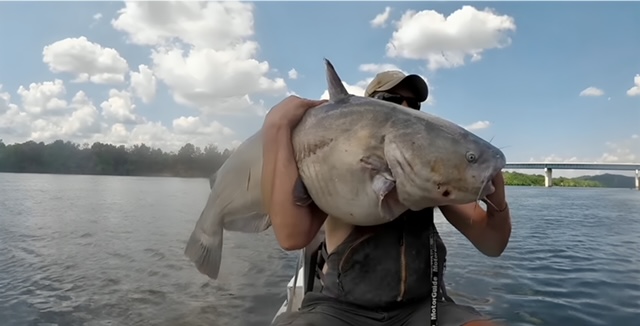
I recently discussed fishing for flatheads with Ryan Bortz. He is a Kentucky angler who has spent nearly a decade chasing giant catfish from various kayaks. He has won numerous catfish tournaments, and currently fishes from his heavily customized Jackson Take Two kayak. Over the last several years, he has experimented with various models by pushing the boundaries of his equipment and transforming his kayaks into dedicated catfishing machines. His stealthy rig is equipped with a custom seat, multiple heavy-duty rod holders, the latest electronics, and a 70lb thrust 24-volt MotorGuide Xi3 trolling motor.
The size and stability of larger kayaks or canoes are necessary to handle the heavier-duty gear required to fight and land these whiskered giants. Bortz has turned his two-seater Jackson kayak into a single seater with a comfortable Millennium marine chair that pivots 360 degrees. He built a seat mount that allows under-seat storage, which he positioned to keep him centered near his custom rod rack across the back and adjacent side-mounted rod holders. This setup enables Bortz to have nearly a dozen rods within easy reach.
Whether fishing suspended baits or dragging, Bortz uses a 70lb thrust MotorGuide remote control trolling motor with Pinpoint® GPS technology to keep his baits in close proximity to big cat territory. He also uses planer boards to keep his lines separated as he trolls, and with this setup, he can quietly comb the waters at various depths with different baits to entice a bite.
Gear and Tackle for Catfishing from a Kayak
Targeting giant catfish requires premium lines, rods, reels, and terminal tackle. Dependable equipment allows anglers their best chance of reeling in that trophy fish when the stars align, and one finally decides to take their bait. If your goal is larger flatheads, your gear needs to be able to handle the strain and hard runs this species is known for.
Bortz prefers Garcia’s 7000s and the Penn Squall 20 series of reels. He typically spools his reels with a 60-pound mono main line tied to a 200-lb heavy-duty barrel swivel, which acts as a stop for a sliding weight. He uses a 4-5 foot of 100lb test leader tied to a 10/0 Big Cat circle hook. A pegged float below the hook keeps the bait off the bottom, and by varying the length of his leaders, Bortz can control how far his bait rises. Depending on the current and depth he wants to fish, his weights can range from one to 16 ounces.
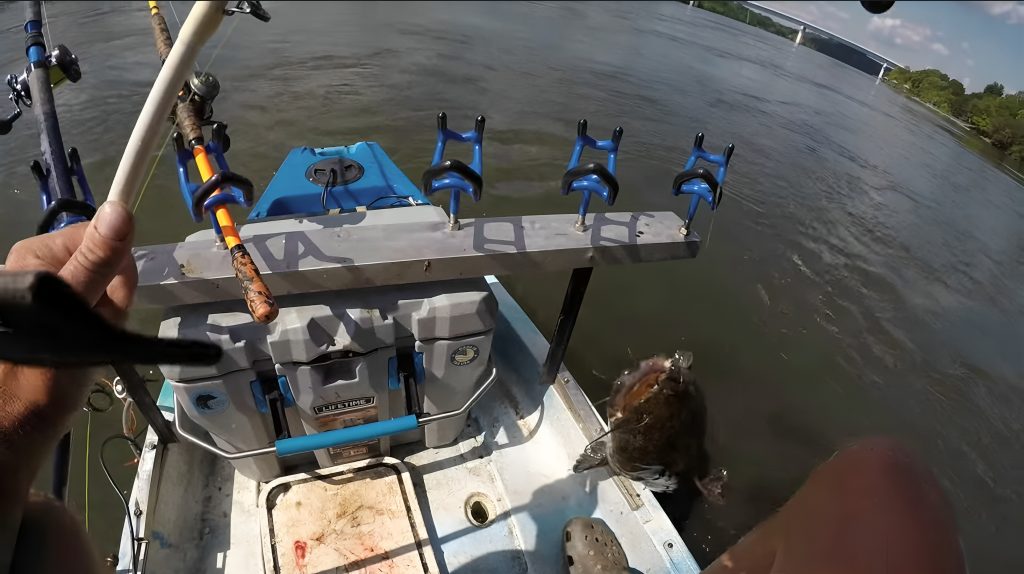
He also borrowed a page from walleye fishermen up north who incorporate planer boards to spread their rear lines and cover a wider swath of water. Bortz said that he and a partner have used B-Kat planer boards extensively and recently bought into the business.
Using a Kayak to Access Backwater Catfish
Flatheads inhabit many creeks and smaller streams that receive little fishing pressure. Many of these streams have limited launch sites, plenty of fallen trees, and shallow waters, which means that some of these isolated stretches are home to some impressive yellow cats. Several of my smaller local creeks have been known to produce 10-15 pounders, and slightly larger log-infested waters have produced 50+ lb behemoths.
These types of waters are the perfect place to explore with kayaks to discover a few deep holes that are certain to contain a few flatheads. Some of these under-fished stretches see little in the way of boaters, allowing these fish to grow into old age and large girths.
Some of the larger impoundments have smaller tributaries that are perfect feeding grounds for larger fish. Often, it’s difficult or impossible for larger boats to travel up these feeder streams, but frequently, there are bridges or put-in points upstream that are great places to launch and float to these remote feeding areas.
Techniques for Kayak Catfishing
Daytime fishing for flatheads involves fishing cut or live bait near structure in deeper waters. Flatheads typically move into shallower flats and near bank edges to actively feed during the last rays of sunlight into the evening hours. Bortz said if you know a good area for bream fishing, you can bet the flatheads know it too, and catching a 50 lb fish in 18 inches of water is not uncommon. Drop fishing or a controlled slow drift are the two primary techniques favored for enticing a catfish to one’s bait. Bortz mentioned he uses a Santee Cooper rig 80% of the time.
Catfish often rest in deeper waters during the daylight hours. Logjams or rock piles in deep holes and ledges will usually be home to several species of catfish. However, reading the current to determine its edges is essential to finding these resting fish. A premium sonar unit such as Garmin’s Livescope or Lowrance’s Active Target can help detect these hotspots and show nearby fish.
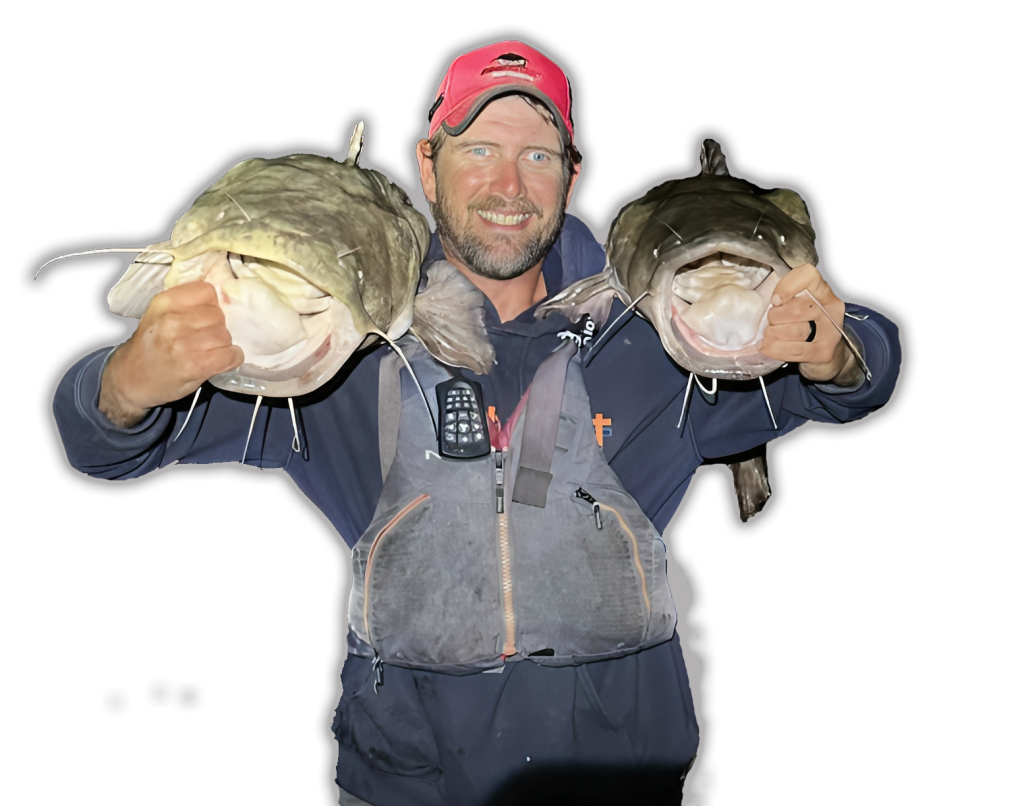
Bortz said that using B-KAT planer boards allows him to fish multiple rods off the back of his boat that fan out to cover a wider area. The amount of line spooled out determines how far these boards pull to the side, and with a bit of practice, the lines stay separated enough to avoid crossovers. Around .5 mph seems the perfect dragging speed, according to Bortz.
Using a variety of cut and live bait is often the critical factor in determining if you’ll be fishing or catching. Many, but not all, states allow using Skipjack, bream, crappie, and smaller catfish as a cut or a live bait offering. Always check your state’s regulations to ensure it’s legal.
Hooking and Landing a Flathead from a Kayak
Circle hooks take a little getting used to, but if you ask any serious catfisherman about the best hook for big cats, most will agree that the advantages outweigh any cons, especially for catch and release. Bortz prefers a 10/0-sized circle hook made by Catfish Sumo tied to a 100 lb test leader.
Whether drop fishing or trolling, Bortz allows the fish to set the hook. He often drifts along as he fights larger fish, and as they tire and come alongside, he can hoist them aboard or use a net. If you’re a big’un like Bortz, it’s a matter of reaching over the side, grabbing its bottom lip, and hoisting his fish onto the kayak floor. A dip-net works fine for those wanting to preserve their knuckle skin. After measuring and a photo op, his fish are released to fight another day.
Mercury Advisories for Alabama Catfish
Before indulging in the thrill of catching and consuming large trophy catfish, it’s crucial to check fish consumption advisories in Alabama. Elevated mercury levels in certain fish, including catfish, pose significant health risks. The Alabama Department of Public Health (ADPH) issues annual advisories based on extensive testing of fish from various water bodies across the state.
Mercury, a toxic heavy metal, can accumulate in fish tissue and pose serious health risks, especially to pregnant women, nursing mothers, and young children. Consuming fish with high mercury levels can lead to neurological and developmental problems. Therefore, understanding and adhering to these advisories ensures that you and your family can enjoy the benefits of fishing without compromising your health.
The 2023 advisories include 216 health warnings, many specifically targeting largemouth bass and catfish. Some advisories recommend limiting consumption to a few meals per month, while others advise against eating any fish from certain contaminated areas. Utilizing resources such as the Fish Guide hotline and the interactive map managed by Coosa Riverkeeper provides anglers with up-to-date information on safe fish consumption practices. You can call the Fish Guide hotline at 1-844-219-RISK to hear current advisories, or visit the Coosa Riverkeeper’s website for more details and to view the map of affected areas.
Final Thoughts
If you are up for the challenge of wrestling a large flathead while sitting in your kayak, mount a few heavy-duty rod holders, upsize your tackle, gather some fresh cut or live bait, and get ready for that adrenalin rush as you get towed by a large mottled yellowish fish with whiskers.
Check out Bortz’s YouTube videos on YouTube and TikTok if you need a few pointers about gear, techniques, or bait.