

The July morning had started out great. I had been fishing a beaver pond on a small creek an hour or so east of Birmingham catching some small but feisty bass. After awhile, I thought I would move downstream to another small beaver pond to give it a try. It looked easier to get back into the creek on the other side so I decided to cross the small 15 foot long beaver dam looking carefully for snakes that might be laying on top. After looking carefully for snakes, I decided to cautiously head across the dam. Two or three steps later, I stopped immediately as I saw the cottonmouth slowly rise up about 7-8 feet from me which was too close for comfort. I slowly retrieved from its holster my kit gun, a.22 revolver, which had #9 pellets for the first two shots in the cylinder. The cottonmouth was quickly dispatched and I breathed a sigh of relief. Fishing the next beaver pond didn’t seem as important as it had a few minutes earlier so I decided to head back to the truck for the psychological comfort of an ice cold RC and a Little Debby Fudge Round. Kit guns like mine are perfect for such situations, providing just the right balance of portability and power.
History Of The Kit Gun
Back in 1911, Smith and Wesson filled a special order from one of their dealers, Phillip Bakeart, for a .22 LR revolver with a 6-inch barrel based on their small I-frame platform. The new revolver became so popular that it became a regularly catalogued item in 1915.
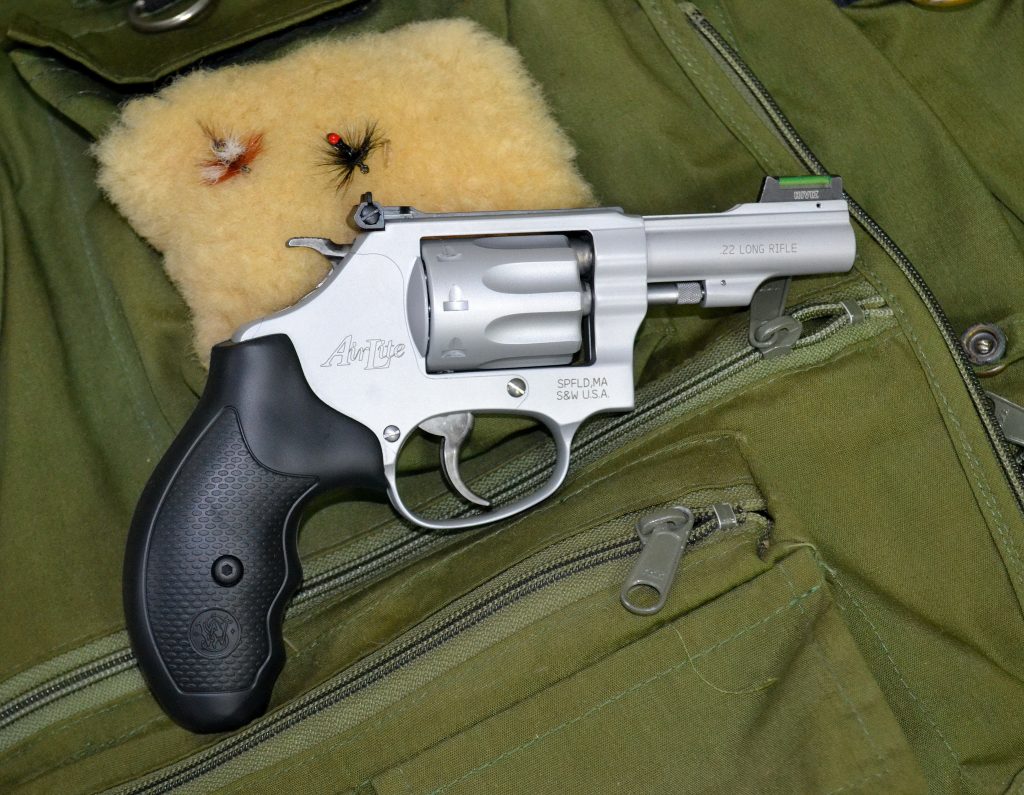
Sales were steady until the mid-1930’s when target shooters wanted heavier mid frame revolvers such as the S&W K22 which had adjustable rear sights and a ramp front sight. S&W refined their earlier small .22LR revolver with a 4 “barrel, adjustable rear sight and a ramp front sight. They named the new product the “Kit Gun”, meaning a hunter, fisherman, camper, trapper, and other outdoorsmen could pack the gun with their other gear in their kit bag, tackle box, pack or saddle bags. Because of its compact size and light weight compared to full size revolvers, it was often carried in a belt holster for easy access. The new model became very successful and S&W still builds kit guns to this day.
Kit Gun Variations
Over the years, there have been versions with 2”, 3”, 31/2”, and 4” barrels in .22LR and .22Mag. and cylinders that held 6, 7 or 8 rounds. Additionally, gun finishes have included blued, nickel, stainless steel, scandium and aluminum alloy.
In 1953, the S & W Kit Gun Airweight was built on the aluminum alloy J-frame which was the same as used on the Airweight .38 Special. In 1960, the .22 Magnum version was introduced on the steel J-frame.
Current S&W Models
Current models available are the Model 317 AirLite Kit Gun and the Model 63 both in .22LR. The Model 317 is the more recent model and has a stainless frame and 3’’ steel lined barrel with an alloy cylinder holding 8 rounds. The sights are a fully-adjustable rear sight with a Hi-Viz fiber optic green front sight. This sight combination makes it really easy to acquire the target. The 11 ounce weight of the Model 317 is amazing; this is one handgun you can wear on your belt and almost forget you are carrying it.

The Model 63, to me, is the iconic kit gun with its’ all stainless construction, 8 round capacity and 3 inch barrel. Having been on the market for a number of years and me having used a 63 in a variety of situations outdoors adds to its iconic status for me. The sights are a fully-adjustable rear sight with a High-Viz red fiber optic front sight. The 24 ounce weight of the 63 definitely gives a different feel in the hand and on the belt than the 317 at 12 ounces.
With either model, I would load #9 shot for the first two rounds and regular .22LR loads for the rest based on which brand of ammo my gun shot the best from a rest. Kit guns also come in handy when confronted with a rabid raccoon or feral dog.
Many times I have ended a successful day of fishing using my kit gun for plinking in the woods along the creek. At the farm or hunting club in the off-season, a lot of shooting at paper targets, paper plates, potatoes stuck on nails on the sides of a 2×4 stuck in the ground, water balloons, and balloons can be a lot of fun alone or with another person.
Brother From A Different Mother?
I have carried lightweight kit guns for years because of living in the land of cottonmouths, rattlesnakes and copperheads. Snake chaps and a kit gun are part of my gear from spring until frost in the fall. However, quite a few friends use the brother from a different mother, either the S&W Governor or Taurus Judge with their capacity to use a .44 Special or .410 shotshell. The bad news is they are heavy, much more weight than most outdoorsmen want to carry in a belt holster. For the fisherman, the answer is to carry it in a tackle box in his canoe, kayak, or boat. A number of hunters I know carry the big brother behind the seat of their ATV or truck.
Final Thoughts
Over the years, I have owned quite a few handguns in a number of calibers but none have been easier to carry and more fun to shoot than my kit guns. Once you use one in the field, you’ll be glad you have invested in one.