

Powered by RedCircle
This week’s episode blends community, offshore bottom fishing, and a red-hot winter trophy striper bite. Host Luke Barton sits down with Jeni Ohmsen of Shutter Speed VA
to preview her “Tribute to the Bay” photo-gallery event, then checks in with Captain Bill Pappas of Playing Hooky Charters for a hard-truths, high-value sea bass conversation (and a look ahead to January bluefin). The show wraps with Captain C.L. Marshall of Tangier Sound Charters, who breaks down how to consistently find and catch migrating trophy stripers on artificials while handling fish the right way.
Conditions Recap
Cold is the headline. Air temps have been in the 20s and 30s, and that winter weather has narrowed the “go” days offshore. When a window opens, black sea bass are providing the most dependable meat fishing, while bluefin season is right around the corner. Inshore, the cold water is concentrating big striped bass in migrating groups—when the wind lays down, the bite has been “amazing,” with fish pushing north through the bay on their way toward spawning areas.
Community Spotlight: Shutter Speed VA and “Tribute to the Bay” (January 23)
Jeni Ohmsen (Shutter Speed VA) has turned “slow fishing days” into a second career by documenting the Chesapeake’s fishing culture— captains, mates, tournament crews, weekend warriors, and the boats that tie it all together. Her work is built around candid moments: the net job, the gaff shot, the look in someone’s eyes when they spot a cobia, and the behind-the-boat perspective most anglers never see.

That body of work is now becoming a live, in-person gallery night: Tribute to the Bay on January 23. The event is designed like an art show with printed photos, captain features, and plenty of “you had to be there” moments brought off the screen and onto the wall. Doors open at 4 and the event runs until 9, with hors d’oeuvres and a beer-and-wine cash bar. If you attend and spot yourself in a printed photo, you can take it home. Tickets are limited—find the ticket link in Jeni’s Instagram bio: https://www.instagram.com/shutterspeedva/.
Cold-weather gear came up too. Jeni’s current setup includes base layers, ski overalls, a warm jacket, a beanie, and a West Marine windproof jacket. Luke also mentions AFTCO Breakwater gloves as a strong option for shooting and fishing in winter, plus other favorites like the AFTCO Barricade jacket and AFTCO helm insulated fishing gloves.
Offshore Report: Black Sea Bass, Winter Strategy, and a Look at January Bluefin (Captain Bill Pappas)
Captain Bill Pappas says the post–December 5 shift has put sea bass back in the center of the winter game plan—and he believes the fishery is in excellent shape. He expects management changes that could increase opportunity across states, but his bigger point is practical: when it’s blowing, there are very few safe, consistent ways to keep charters running, and sea bass matter because they keep captains working and families fed through the hardest months.
On the water, Bill’s approach is simple and ruthless: if you’re surrounded by “just enough bites to keep you hopeful,” you might still be wasting time. If the quality isn’t there, make the move. He also cautions anglers about bait choices when sharks are around. One of his best winter tips is to downsized bait aggressively—think pieces the size of a pinky—because tiny baits keep you locked onto sea bass instead of ringing the dinner bell for sharks. He calls out squid heads as a common mistake when sharks are present.

When the fish are suspended, boat control becomes the difference between “marking them” and catching them. Bill recommends using your boat’s surface bubbles as a drift indicator: don’t drop until you’ve neutralized the boat’s movement and your lines can present straight up-and-down. If you’re still sliding, your tackle is never really in the zone for long. He also encourages anglers to trust anomalies on the machine—if something looks “different,” it’s worth a drop.
Looking ahead, Bill’s gut call is an exciting January for bluefin out of Virginia. He expects plenty of opportunity for anglers to get involved, especially early, but emphasizes how quickly quotas and regulations can change. His advice: pay attention, be ready to act when the window opens, and have realistic expectations about what “one fish per vessel per day” means in a month where weather may only allow a handful of offshore days.
Inshore/Nearshore Report: Trophy Stripers on Artificials (Captain C.L. Marshall)
Captain C.L. Marshall says the trophy rockfish bite has been outstanding when the wind lays down, with recent trips producing double-digit fish over 40 inches and a steady stream of quality marks. The fish are migrating through the bay (moving north through the system toward spawning areas), and the key is staying mobile, leaning on electronics, and fishing quietly—motor off, minimal banging around, and an intentional drift that keeps anglers in the strike zone.
His program is built around casting artificials rather than trolling. The bite is often surprisingly subtle for such big fish, especially in cold water, so “lure awareness” matters—know where your bait is in the water column and keep slack out of the line. Many of the strikes happen on the fall after a snap-jig, and anglers often discover the fish was already there when they go to pop the lure again.
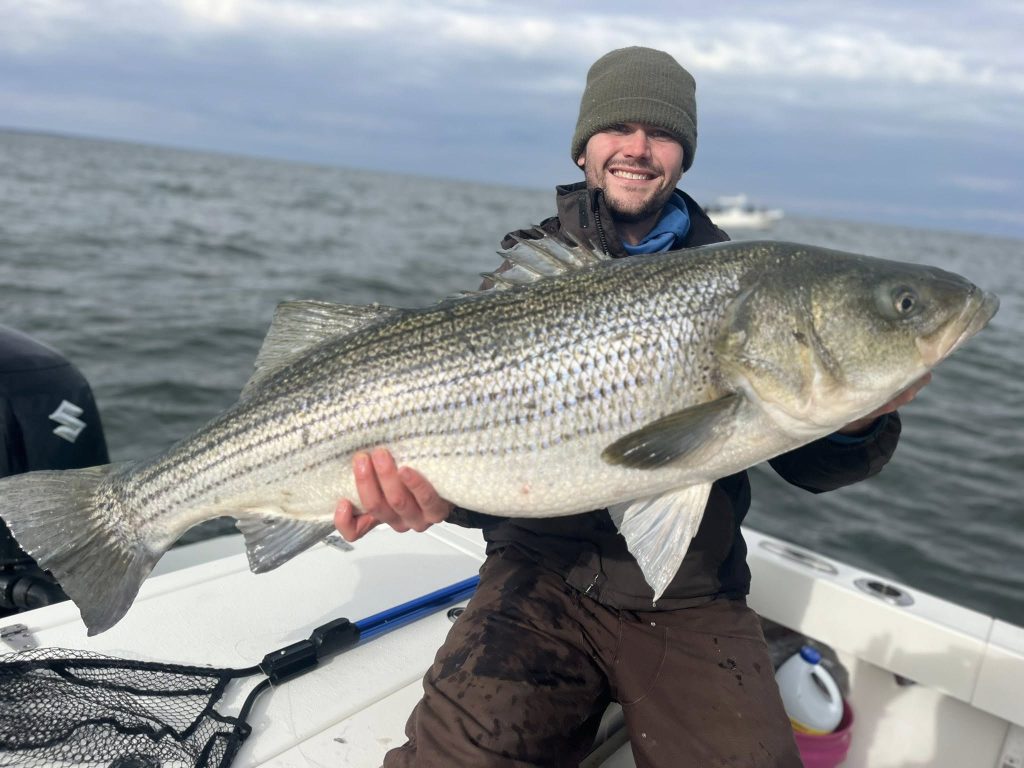
C.L. is throwing big profiles to match the forage, including large soft-plastic “eel” style baits in the 8–11 inch range when conditions call for it. When the fish are suspended (often because menhaden are still stacked in the system), he’ll lighten up to a lure that falls slower and stays in that mid-water zone longer. For anglers who struggle to “feel” the bite, he likes compact metal jigs (he referenced 80-gram range) rigged with sticky tandem hooks for a more direct connection.
Handling fish correctly is a big part of his approach, especially with pre-spawn females. He stresses preparation: camera ready, rods cleared, pick the sunny side of the boat, and minimize time out of the water. If you can avoid lifting the fish entirely, do it. If you do lift it, support the fish properly (mouth and back near the anal fin), avoid pressure on the belly, and don’t grab into the gills.
Tackle notes from C.L.’s winter setup included a 2500-size spinning reel, a medium-light rod with sensitivity, and 15 lb braid for bite detection and control.