

Running a boat at night comes with inherent dangers and challenges. Low visibility makes it difficult to identify navigational markers, spot hazards in the water, and see other vessels approaching. Without the proper technology, nighttime boating can induce stress and anxiety for captains trying to safely navigate. However, advances in night vision for boats are helping to change that by providing a clearer picture of the surroundings. Night vision cameras are becoming more accessible and affordable options for enhancing visibility during hours of darkness on the water.
On a recent episode of the Alabama Saltwater Fishing Report, we sat down with Giovanni Lepore from SIONYX to talk about their color night vision camera and the features that make it ideal for marine use.
Giovanni is a longtime expert in the night vision field. He currently serves as the Global Product Manager for the commercial division at SIONYX, and before he took that position he worked for FLIR for 17 years. In addition to his professional expertise, Giovanni is also an avid bluefin tuna angler, and has extensive experiences coming and going from the harbor after the sun has set.
Join us as we sit down with Giovanni to discuss the different types of night vision available for boaters, the features that make SIONYX systems unique, and some general tips on how to set up your boat’s night vision system.
Who Needs Night Vision On Their Boat?
Night vision technology can be invaluable for enhancing safety and navigation when boating at night. Being able to clearly see navigational markers, debris, and other vessels is critical for avoiding accidents in the low-visibility conditions at night. Night vision systems may seem expensive, but according to Giovanni, the damage they can prevent to your boat is much more expensive.
“Boats are notoriously expensive compared to cars,” he reminds us. “And any kind of damage on a boat because of the environment that it’s in, can quickly escalate to being extremely expensive. Your biggest risks to your boat after dark are non-water objects, right? And that can include something as simple as a buoy, to a lobster trap, to a rock, to the thing that everybody hates the most: driftwood. You don’t usually see it, it just bobs at the surface of the water. But it can be extremely large, and it does a lot of damage if you hit it.”
In addition to helping you avoid crashing into obstacles and damaging an expensive vessel, night vision also helps with general navigation.

Giovanni explains, “On the water, you don’t have lanes that you can follow like you do on a street. You have markers and buoys. But at night it can be really difficult to figure out if you’re looking at a green or red buoy. If you don’t know that information, you can’t decide whether that buoy needs to be on your port or starboard side, and being on the wrong side of a buoy can spell disaster. So our technology doesn’t just allow you to see those hazards and buoys, it lets you see the color of those objects. You can see if you’re looking at a swimmer down flag, a no-wake zone buoy, or a channel marker.”
Types Of Night Vision Technology For Boats
There are two main types of technology when it comes to night vision for boats – thermal imaging and night vision cameras. Thermal imaging uses heat signatures to detect objects in the dark, whereas night vision amplifies existing light and transforms it into a display that we can see. Both technologies have their pros and cons, as we learned from talking with Giovanni.
According to Giovanni, “Thermal is a fantastic long range detection technology. But when it comes to providing you the natural scene that you’re accustomed to seeing, thermal is sort of lacking. It doesn’t show color, you just see things in grayscale.”
Night vision technology, contrasted to thermal imaging, typically uses either image intensification or digital imaging to “see” at night. Older analog night vision systems provided green or white phosphor images with limited resolution and clarity. However, as Giovanni notes, newer digital options like the SIONYX camera now provide substantially sharper image quality.
“Our camera sees from 400 nanometers to 1200 nanometers,” he says. “Now, what’s really interesting is that the environmental light at night has a very large amount of energy in the near IR spectrum. So in that 1000 to 1200 nanometers, there is lots of extra environmental energy there.”
By detecting more of that near-infrared light spectrum, the SIONYX camera offers improved sensitivity and visibility compared to other night vision devices. Additionally, its digital imaging provides high-resolution color rendering of the environment. This allows for clearer identification of navigational markers and hazards compared to lower-resolution green/white phosphor or thermal imaging systems.
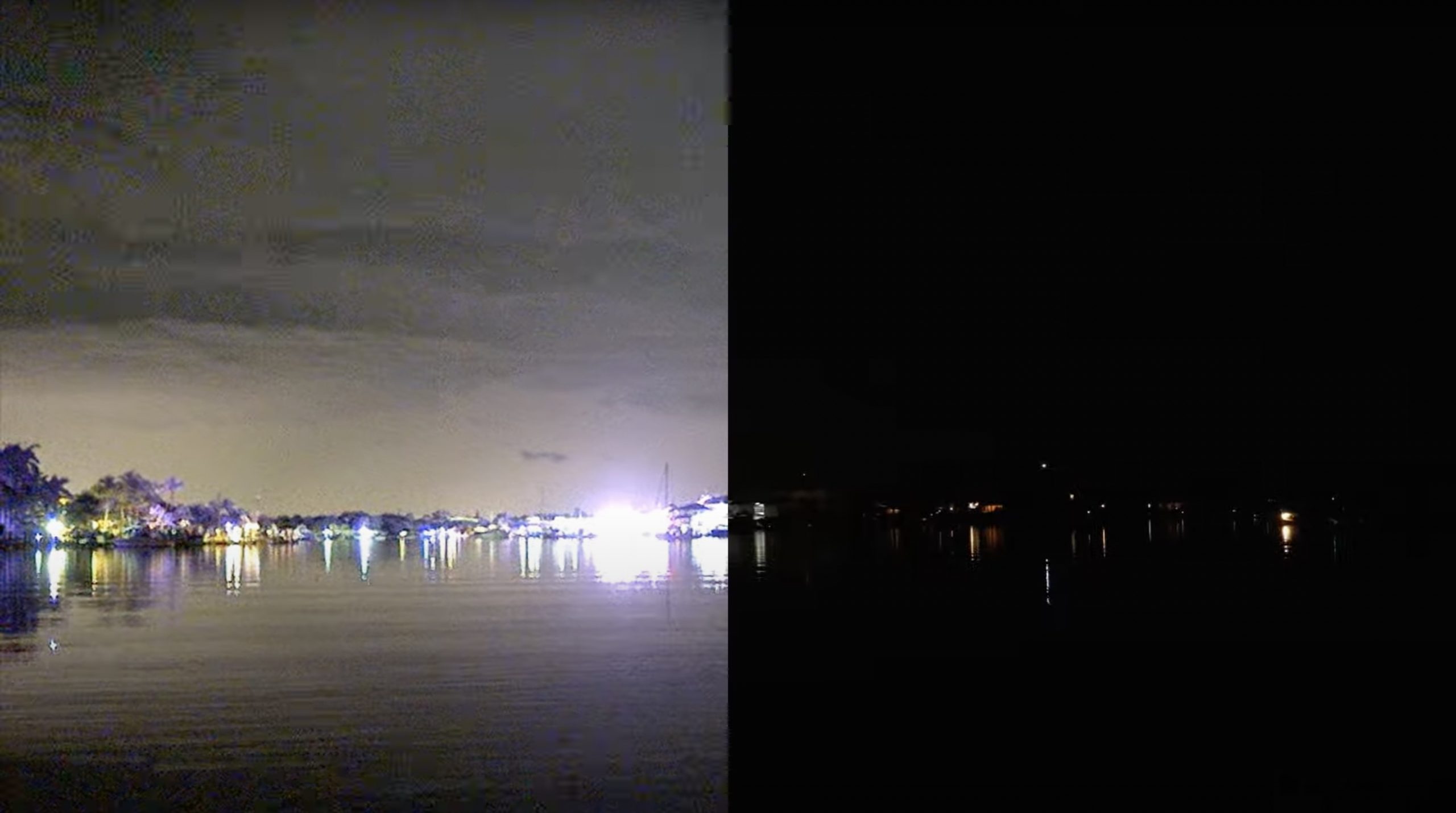
Basically, you can see what’s around you at close range much more clearly with color night vision than traditional green night vision or thermal imaging units.
So which option is best for boaters? According to Giovanni, “it depends.”
“It really depends on your application,” he explains, “the size of the boat, and what job you’re trying to accomplish. Our camera is going to be your best option when it comes to close quarter navigation and inlets and docking and all of that good stuff. But if you have a job that requires you to spot things very far away, maybe thermal is the best option. If you need a combination of long and short range, maybe both cameras working together is your best option. There is no silver bullet that fixes it all, really.”
Night Vision Cameras Durability
While high-quality, color night vision is great, everybody who owns marine electronics knows that their features are useless if they can’t stand up to marine environments. A night vision camera mounted to a boat is going to be subjected to vibration, temperature extremes, high humidity, sunlight, and salt spray.
Giovanni urges boaters to consider weatherproofing features when shopping for night vision for boats.
“We designed our camera specifically for a marine environment,” he says. “We didn’t take a preexisting camera that we already had and decide to market it to the maritime market.”
Giovanni also explains that the camera housing and internal components are nitrogen purged.

“What we do,” he explains, “is, once it’s fully assembled, we create a vacuum inside and suck out all of the possible moisture and wet air, and we replace it with completely dry nitrogen gas. This way, if there’s a shift in temperature, you don’t wind up with any internal fogging that you have to deal with.”
Given the extreme temperature differences that can occur on the water once the sun sets, nitrogen-purged optics are a must for nightime nav.
Setting Up Night Vision For Boats
If you’re like me, boat wiring is a chore that you tolerate in order to have functional marine electronics. Usually, whatever excitement I feel for a new sonar unit or radio fades once I pull the unit out of the box and start looking at the wiring diagram. Luckily, according to Giovanni, “I’ve seen TV installations that are more difficult than our camera.”
The biggest thing to be aware of when selecting a spot to install the camera is to make sure that the display is mounted in an area where you can easily see it, and to make sure that the camera is looking in the same area you are when navigating the boat.
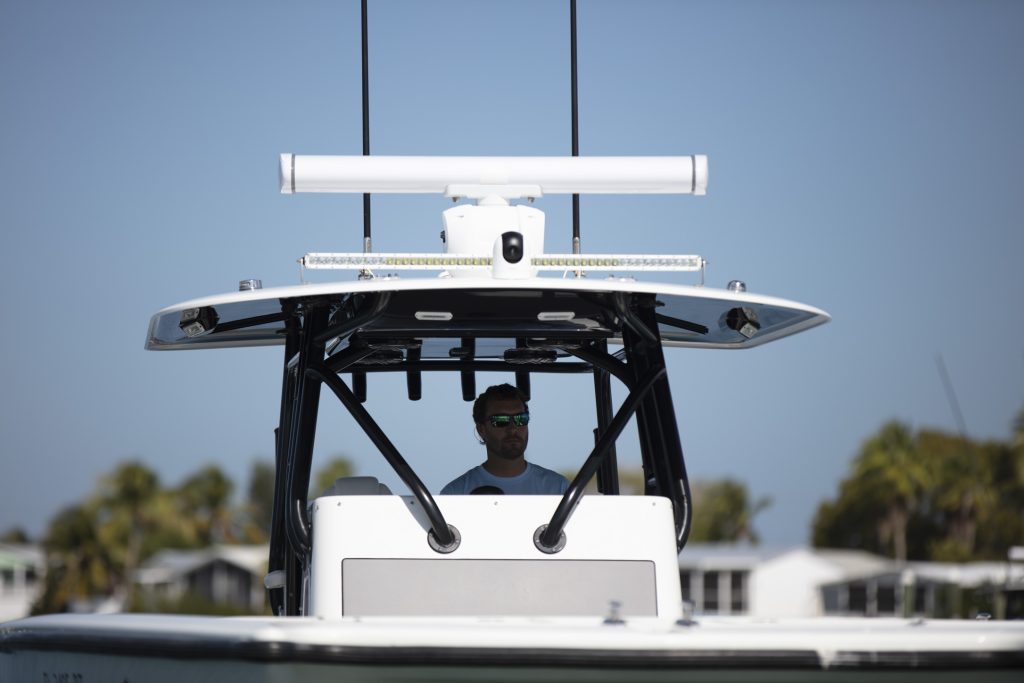
“What I tell the captains that I work with,” Giovanni says, “is to put the camera in a location where it feels natural. When you look out the windshield, the camera is going to replace your eyes. So, if you’re looking at the windshield when you drive, don’t put the camera way up high and off to the right, ‘out of the way.’ It’s going to feel unnatural to you once it’s dark and you’re trying to use it to drive. Try to mount everything so that it feels like you’re just looking out the windshield like normal.”
Proper setup of night vision for boats helps captains avoid distractions. Giovanni notes the SIONYX camera “allows you to know where you are, know where you’re going and focus on your primary job and safety.” This ensures nighttime boating is as safe as possible.
Final Thoughts
Navigating the waters after dark is a task that demands respect and careful preparation. The low-visibility conditions present unique challenges but, as we’ve learned from Giovanni Lepore, advancements in night vision technology, particularly color night vision for boats like that offered by SIONYX, are revolutionizing the way we approach nighttime boating.
Giovanni’s insights remind us that while the open waters at night can be treacherous, the right equipment can significantly mitigate risks. By offering a vivid and detailed view of the surroundings, night vision cameras make identifying navigational markers and detecting potential hazards much more manageable, providing you and your passengers with a safe and enjoyable boating experience.