




In this special episode of the Northwest Florida Fishing Report, Joe Baya and Butch Thierry take a closer look at one of the most interesting changes happening along the northern Gulf Coast: common snook are showing up with increasing frequency in Northwest Florida and coastal Alabama. They are joined by Zoey Hendrickson, a PhD student with the University of South Alabama’s Estuarine Ecology Lab, whose research focuses on the expansion of snook into coastal Alabama and the habitats helping these normally warm-water fish survive farther north.
Zoey explains why the increase in snook sightings appears to be more than a temporary anomaly, how warmer winters and thermal refuge may be allowing juveniles to survive cold events, and what researchers are learning from tagging and angler reports. The conversation also covers where these fish may move seasonally, what their arrival could mean for existing Gulf Coast fisheries, how anglers can catch and handle them responsibly, and why releasing snook may be the best way to help this developing fishery establish itself.
Why Snook Are Showing Up Farther North
For many Gulf Coast anglers, snook have traditionally been associated with South Florida. Joe remembers a time when catching them around Crystal River was noteworthy because that area was considered close to the northern edge of their range. That picture has changed dramatically.
Zoey says researchers began seeing a similar expansion around Cedar Key, near the mouth of the Suwannee River, during roughly the 2012 to 2016 period. At first, anglers and researchers encountered occasional large adults. Over time, smaller fish began appearing, followed by a broader range of sizes that suggested the fish were not simply wandering north for a season. A new population was becoming established.

Northwest Florida and Alabama now appear to be following a similar pattern. Anglers are reporting everything from small juveniles to fish approaching or exceeding traditional harvest-size ranges, and sightings have become frequent enough that some fishermen are intentionally targeting snook in areas where the species was once considered highly unusual.
Zoey says the key detail is that snook are being observed year-round. They have also survived multiple winters, including an unusually severe snow and cold event along the northern Gulf Coast. That survival strongly suggests the fish are finding places where they can avoid the most damaging cold temperatures.
Warmer Winters And The Importance Of Thermal Refuge
Snook are highly tolerant of changes in salinity, but cold temperature remains one of their major limitations. Zoey explains that temperatures around 50 degrees can become stressful for snook, making the frequency and duration of cold weather especially important as the species expands northward.
Research from the Estuarine Ecology Lab looked at cold-weather patterns going back to around 1980 and found a shift beginning around 2010, with fewer days below 50 degrees and shorter periods of sustained cold. That does not mean severe freezes have disappeared, but it does mean snook may have more opportunities to survive between major cold events.
In places such as Crystal River and Cedar Key, freshwater springs provide obvious thermal refuge because spring-fed systems maintain relatively stable temperatures. Coastal Alabama does not have the same abundance of large spring-fed estuaries, which makes the survival of snook there especially interesting.

Zoey is studying whether deep holes in rivers such as Fish River provide the refuge these fish need. Using Garmin marine sonar to examine bottom contours and depth, she is looking for areas where the water column can stratify. In those deeper pockets, bottom water may remain more stable in temperature and salinity even when the surface becomes much colder.
Juvenile snook may gather tightly in these favorable areas and remain there through winter. If enough suitable habitat exists, those pockets could serve as nurseries that allow a northern Gulf population to survive from year to year.
How Snook Use Rivers, Jetties And Estuaries
Thermal refuge does not mean snook spend the entire year buried in a deep river hole. Zoey explains that juveniles are more likely to remain in protected river habitat, while larger fish tend to move outward seasonally as temperatures rise.
Based on the Cedar Key example, adult fish may begin leaving rivers around February or March and spread into saltier estuarine habitat such as jetties, seagrass flats and oyster reefs. When temperatures begin dropping again in the fall, those fish can retreat back toward rivers and other more stable water.
That helps explain why Northwest Florida anglers are now seeing snook along jetties and in open estuarine areas during warmer parts of the year while researchers continue finding juveniles farther upriver. The fish may be establishing a seasonal pattern similar to other northern Gulf estuarine species, even though snook were historically associated with much warmer climates.

Exactly where the northern Gulf fish originated remains an open question. Zoey says there is not yet enough tagging information to show that a fish from Tampa or another established population made a direct long-distance move into Alabama or Northwest Florida. Genetic work could eventually help answer that question. Research in Cedar Key found enough genetic separation for those fish to be considered a localized population, suggesting that once snook establish themselves in a new area, many may stay and reproduce there rather than continually moving back and forth from South Florida.
Are Snook Becoming A Permanent Northern Gulf Fishery?
Zoey is cautious about making an absolute prediction, but the evidence increasingly points toward snook becoming a resident part of the northern Gulf Coast fish community. Sightings are increasing, juveniles are surviving winters, larger fish are appearing, and some anglers are now able to target them with repeatable success.
The biggest unknown is carrying capacity. Alabama has fewer obvious warm-water refuge areas than Florida’s spring-fed coast, and there may be a limit to how many fish can occupy the best winter habitat. A severe freeze could still cause a significant die-off, much like cold events can reduce snook numbers farther south.
Even so, the population may rebound if enough fish survive in protected areas. Zoey says the pattern could ultimately look similar to established snook fisheries farther south, with good years, occasional cold-related setbacks and a resident population that continues to reproduce and grow.
The expansion is also part of a broader trend. Anglers along the northern Gulf have reported species such as permit and bonefish that were once associated more strongly with tropical or subtropical waters. Zoey describes this type of movement as poleward range expansion, where warming conditions allow species to occupy habitat farther toward the poles than they could historically tolerate.
What Snook Could Mean For Speckled Trout And Other Native Fish
One of the most important research questions is whether a growing snook population will affect fish already established in Northwest Florida and Alabama. Zoey makes a distinction between a truly invasive species and a species naturally expanding its range. Snook did not arrive through an aquarium release, shipping pathway or other artificial introduction. They are moving into habitat they can now reach and survive in naturally.
Researchers sometimes describe species in this situation as novel natives or neo-natives. They are native to the broader region but newly established in a particular area.
That does not automatically mean there will be no ecological impact. Snook are generalist predators, and a growing population could potentially compete with other estuarine fish for prey or habitat. The northern Gulf also has less of some habitat types than South Florida, which could increase competition in important winter refuge areas.
At the moment, Zoey says there is not strong evidence that snook will displace speckled trout or cause a major problem for established fisheries. Determining those impacts is one of the questions researchers hope to answer as the population continues to develop.
Snook Fishing Tactics For Alabama And Northwest Florida
For anglers who encounter a snook, Zoey says there is no need to overcomplicate the tackle. Snook are opportunistic ambush predators and can tolerate everything from nearly full freshwater to full-strength saltwater. Their diet changes with habitat and the size of the fish, which means they can feed on a wide range of available forage.
The 25-inch fish discussed from Fowl River was caught on live shrimp, showing that familiar Gulf Coast inshore tactics can work. Zoey also notes that snook research farther south has found fish feeding on small finfish, including freshwater prey when they are holding upriver. Live finfish, shrimp and natural-looking baitfish imitations are all logical choices when fish are actively feeding.

Snook do not have the large cutting teeth of some other predators. Their mouths are more like coarse sandpaper, but larger fish are powerful, active and known for acrobatic fights.
Because many of the northern Gulf fish are still juveniles, Zoey recommends keeping tackle reasonable and avoiding unnecessarily large hooks. Anglers using treble hooks should be particularly careful with small fish. Pinching barbs down can also make release easier and reduce handling time.
Why Releasing Snook Matters Right Now
The conversation turns heavily toward conservation because anglers are watching a new fishery develop almost in real time. Snook have an unusual reproductive strategy. Zoey explains that they begin life as males and can transition to females as they grow, which makes larger fish especially important to spawning potential.
That is one reason Joe and Butch argue that anglers should think beyond what is simply legal to harvest. A fish that goes back into the water has another opportunity to reproduce and contribute to a population that is still small compared with established snook fisheries farther south.
Alabama currently lists a 28-inch minimum total length and a one-fish-per-person daily limit for snook. Florida’s Panhandle region uses a 28- to 33-inch slot limit with one fish per person per day and seasonal closures. Anglers should always check current Alabama regulations or current Florida snook regulations before fishing.
For anglers who want to see a strong snook fishery develop in Northwest Florida and Alabama, Zoey says releasing fish is the safest approach for the time being. The northern Gulf does not yet have the population data available for long-established snook fisheries, and many of the fish researchers are following are only now reaching the low-20-inch range.
Giving those fish several more years to grow could mean more mature fish, more successful spawning and eventually a fishery capable of supporting consistent recreational opportunity.
How Anglers Can Help Snook Research
Angler reports are one of the most valuable sources of information available to researchers right now. As snook become less unusual, Zoey says people may be less likely to report them, but every sighting helps researchers understand where fish are occurring, how frequently they are being caught and how quickly different size classes are growing.
If you catch or see a snook in Alabama waters, send the approximate date, general location, estimated size and a photo if available to hookedasnook@gmail.com. Researchers do not need an exact fishing spot, and Zoey emphasizes that specific honey holes are not being shared publicly.
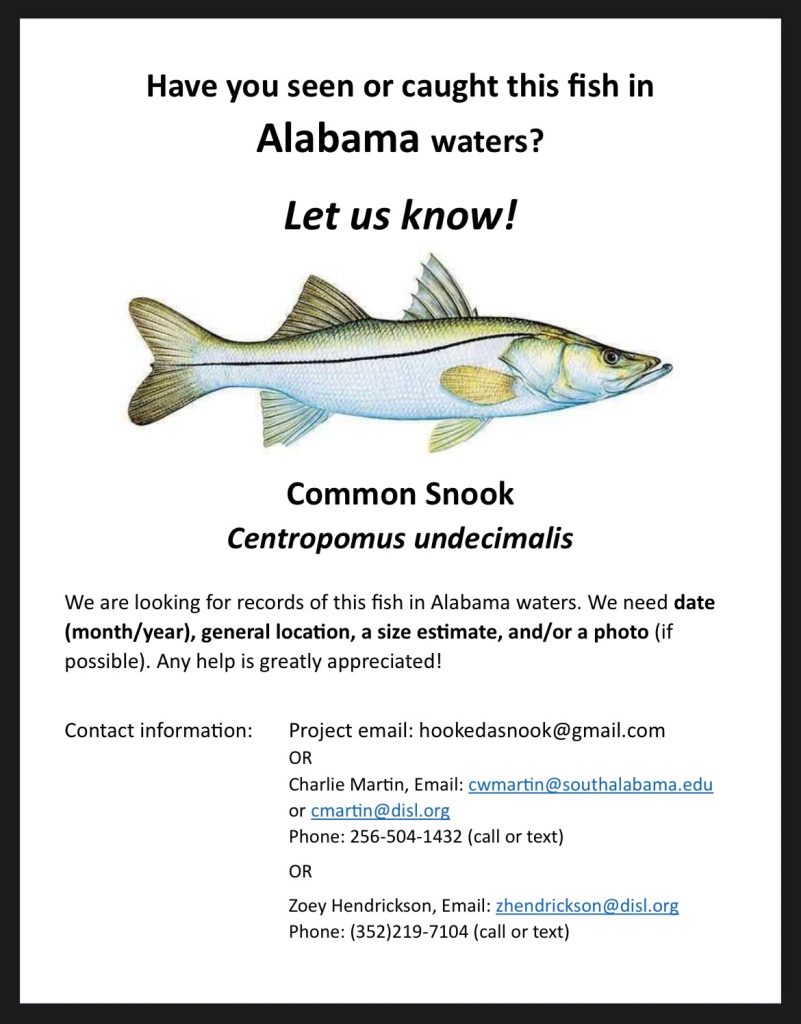
The lab is also working with conventional dart tags and hopes to expand movement research through additional tagging. One juvenile snook was recaptured within roughly six months in nearly the same area, providing an early indication that young fish may remain in specific river habitat while they grow.
If an angler catches a tagged snook, Zoey asks that they report the tag using the contact information attached to it. Those recaptures can reveal survival, growth and movement patterns that are otherwise extremely difficult to document.
Anglers can also follow the University of South Alabama’s Estuarine Ecology Lab for updates as the research continues.
A New Gulf Coast Fishing Opportunity In The Making
The biggest takeaway from this special episode is that northern Gulf snook no longer look like isolated accidental visitors. Researchers are seeing a developing population with juveniles surviving winters, anglers are encountering larger fish with increasing regularity, and the species appears to be finding enough suitable habitat to remain in areas once considered too cold.
There are still major questions about winter refuge, population size, genetics, ecological impacts and long-term survival, but anglers have an unusual opportunity to watch a fishery develop from its earliest stages. The decisions fishermen make now, particularly how they handle and release fish and whether they report sightings, could help shape what snook fishing looks like in Northwest Florida and Alabama over the next decade.