
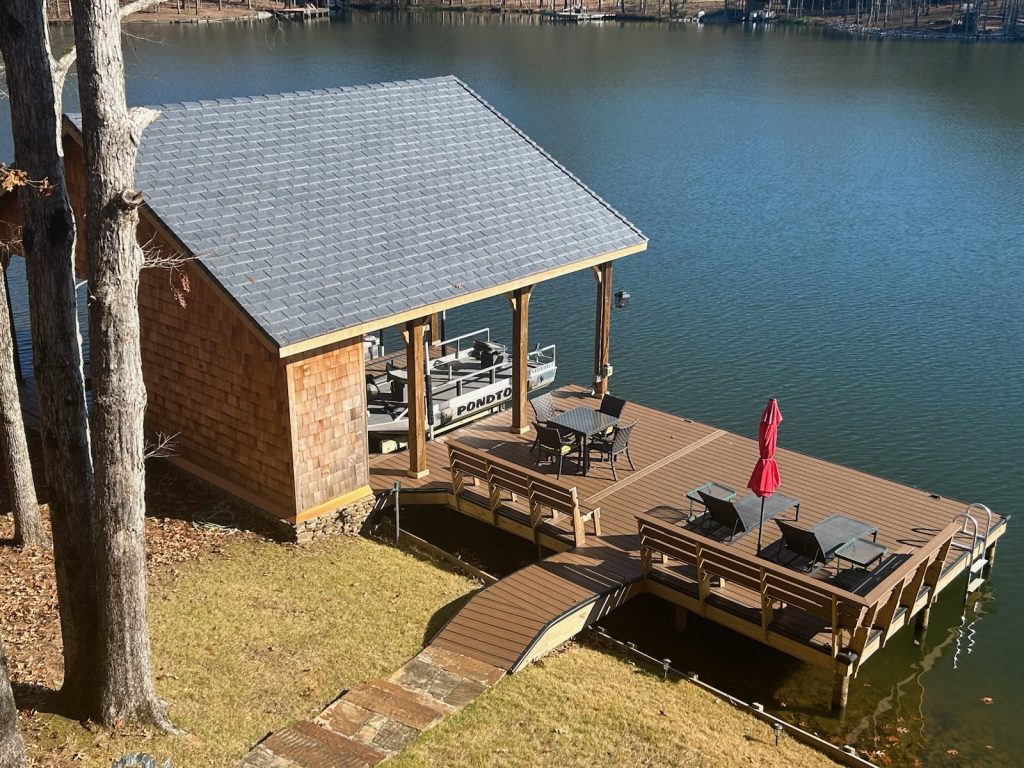
When most people think about building or rebuilding a dock, one of the first questions that comes to mind is: What deck board should I use?
That question matters, but it can also lead people into the wrong comparison. A dock is not a backyard deck. It is not just an outdoor platform with a prettier view. It may deal with salt spray, tidal swings, brackish water, freshwater, algae, mud, boat traffic, wet feet, fish slime, hurricanes, and the kind of constant moisture that can make ordinary building materials show their weaknesses fast.
That is the setting ENDECK PVC decking was built to serve.
Charlie Haines, ENDECK Product Manager for Eastern Metal Supply, said EMS first became connected to ENDECK because PVC decking fit naturally with the company’s marine and dock business. EMS has long been known as a major supplier of aluminum extrusions and marine-related aluminum products. For dock builders, boat lift manufacturers, and fabricators, the company was already supplying much of the aluminum framing and undercarriage material. Decking was the logical next piece.
EMS eventually acquired ENDECK, making the company both the producer and distributor of the PVC decking line. For Haines, who works with the product across sales, marketing, manufacturing, and customer education, the fit is straightforward. ENDECK is not just a board that can be used outdoors. It is a board aimed at places where moisture, heat, UV, and low maintenance matter.
“The founding company that produced ENDECK, and again, EMS acquired it, they really did the heavy lifting,” Haines said. “They really set out to say, ‘Hey, we’re going to set a new standard.’”
That standard starts with what the board is made of.
Why All-PVC Matters
To understand ENDECK, it helps to understand the difference between PVC decking and wood-plastic composite decking.
Composite decking has become familiar to many homeowners. It is often viewed as a step up from pressure-treated wood because it does not behave exactly like lumber. But many composite deck boards still contain wood fiber. Haines said that wood fiber is often called “wood flour” in the industry because it is ground very fine and used as filler inside the board.
For a residential deck, that may not always be a major concern. For a dock, it matters more. Docks are constantly exposed to moisture. Some are occasionally submerged. Some have stairs that run directly into the water. Some are in saltwater or brackish water. When a board contains wood fiber, moisture becomes a bigger question.
With ENDECK, Haines said, that issue is taken off the table.
“With ENDECK being an all-PVC, there is no recycled content in it,” Haines said. “It’s a pipe-grade PVC in its core. And then it’s got a capstock layer that’s top of the food chain for weatherability and fade resistance.”
The pipe-grade PVC core is a major part of the story. Haines compares it to the PVC used for pipes that carry water. In a dock setting, that gives the product one of its most important traits: zero moisture absorption.
“When you take a product that’s an all-PVC deck board like ENDECK, it absorbs no moisture,” Haines said. “Zero moisture absorption. So you don’t have all those things fighting it. You don’t have moisture trying to get in and out of it and cracking and opening and things like that.”
Submersible Means Submersible
One of the most important claims Haines makes about ENDECK is that it is submersible. That word can get fuzzy in building materials, especially when people hear terms like “waterproof,” “water-resistant,” “moisture-resistant,” or “marine-grade.” So when Haines explains ENDECK’s submersibility, he puts it in a practical dock setting.
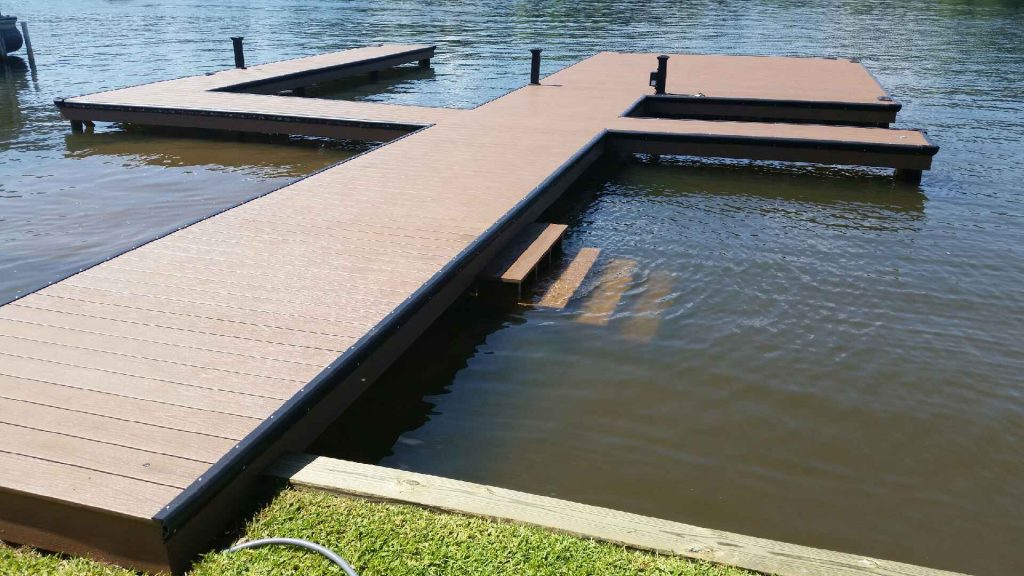
Most dock owners like having steps down into the water. Those stair treads may spend part of their life wet and part of their life completely underwater. On some lakes, water levels change through the year. A section of dock may be above water during one season and submerged at full pool during another. In coastal areas, storm tides and surge can create short-term submersion even where the dock is normally dry.
Haines said those are the situations where many manufacturers get nervous.
“I’ve been affiliated with other products in years past where if I ever got asked that question, all of a sudden I am really squirming,” he said. “Very few companies out there would be able to just look at them and say, ‘Yeah, no problem. It’s fully warrantable.’”
With ENDECK, Haines said, that question is much easier to answer.
“If you want a set of stairs going down into the water, and you are using ENDECK for the stair treads, and you’ve got the bottom four or five treads going completely into the water, and those things are going to be submerged permanently, it’s just not a problem,” he said.
Built for Strength, Stiffness, and Stability
A dock board needs stiffness. It cannot feel soft underfoot or require unrealistic framing to perform well. Haines said ENDECK uses a mineral additive to improve stiffness and dimensional stability.
“That gives us a little bit better span rating,” he said. “We can go 18-inch on center joist supports where others are 16 inch.”
The mineral additive also helps with expansion and contraction. Like other polymers and metals, PVC can move with temperature changes, mostly along the length of the board. But Haines said ENDECK is on the lower end of the expansion-and-contraction spectrum because of how the board is made.
“It was designed into it in the beginning for dimensional stability and extra strength and stiffness,” he said.
For the dock owner, that matters because a board needs to stay comfortable, stable, and properly fastened over time. The board itself is only one part of the dock, but if it moves too much, flexes too much, or requires special accommodations that were not planned into the job, the finished dock can suffer.
A Double-Sided Board With a Solid Profile
One of the features Haines said ENDECK is best known for is its double-sided design.
“If you take our board, you look at it, it’s got that embossed wood grain on it,” he said. “And you flip it over, it’s exactly the same on the other side.”
That may sound like a small detail until it shows up on a jobsite. A double-sided board gives builders more flexibility. It also means the board can be used in places where both sides may be visible, such as overhead applications, second-story decks, boathouses, privacy screens, or short fence sections.

“If you had an overhead deck or maybe a second story on a boathouse, and you are looking up on the underside, instead of seeing an unfinished bottom side or something scalloped out or anything like that, it looks exactly like the top side does,” Haines said.
The double-sided design can also save a board if something goes wrong. Haines gave the example of a contractor finishing a deck or dock when someone drops a drill, hammer, or other tool and dents the surface.
“With ENDECK, you can always take that board up, undo the screws, flip that thing over,” he said. “You’ve got a perfectly good usable side on the other side. So I like to tell people that dual-sided board, it’s not just a gimmick. It gives you two chances at it.”
Heat, Slip Resistance, and Barefoot Comfort
A dock board has to do more than survive. It has to be comfortable to use.
That is especially true in coastal and lakefront settings where people often walk barefoot. Kids climb out of the water. Anglers step out to check a boat or rinse gear. Families use the dock as an outdoor room. If the surface gets too hot, too slick, or too rough, the dock becomes less enjoyable.
Heat buildup is one of the biggest issues. Haines said treated lumber and composite decking can both get very hot in direct sun. In composites, recycled content, inks, carbon black, and other ingredients can hold heat. Darker colors can make that worse.
PVC behaves differently.
“PVC is naturally heat dissipating, so way less heat buildup than the competition,” Haines said.
That does not mean every ENDECK color feels the same in the sun. Lighter colors are still going to be cooler than darker colors. But Haines said ENDECK’s lighter colors have performed very well in full-sun barefoot settings.
“When you look at our lighter colors, which are ash wood, beech wood, and olive wood, those I would tell anybody, put them out anywhere,” he said. “Put them out in full direct sun. I’ve yet to hear anybody tell me they couldn’t just walk completely barefoot, middle of July, midday, full direct sun.”
Haines said the coastal gray color in the variegated Forest Series has also performed well for barefoot use in full sun. Darker colors like slate, chestnut, sequoia, and cedar will get warmer because they are darker, but he said they still do not hold heat the way treated wood or composite boards often do.
“Yes, it’s warm, but it’s not hot like pressure treated, not hot like a composite deck board,” Haines said of darker ENDECK colors used in full sun.
The walking texture matters too. ENDECK has an embossed wood grain, but Haines said it is not aggressive enough to feel rough under tender feet. He also said the board has strong slip resistance whether it is wet or dry.
“It’s got excellent slip resistance whether it’s wet or dry,” he said. “It’s really similar. Not a lot of difference between the coefficient of friction wet and coefficient of friction dry.”
That combination, lower heat buildup, a barefoot-friendly texture, and wet-dry slip resistance, is one of the reasons ENDECK fits the way docks are actually used. A dock is not just something people look at. It is something they walk on, sit on, fish from, and move across when they are wet, tired, barefoot, or carrying gear.
Colors, Fade, and a More Finished Look
Haines said ENDECK helped push PVC decking into darker, more finished-looking colors at a time when PVC deck boards were usually lighter. Early PVC decking often stayed in safer color ranges because manufacturers worried about heat buildup, expansion, contraction, and how dark colors would perform outdoors.
ENDECK’s Forest Series changed that by offering darker variegated colors with streaking meant to resemble tropical hardwood.
“Variegated is just a fancy word for streak,” Haines said. “It’s got kind of dark streaks in it to give that look of a tropical hardwood, or the high-end look.”
Haines said ENDECK offers a 30-year fade and stain warranty, which was a major point of pride when the darker colors were introduced.
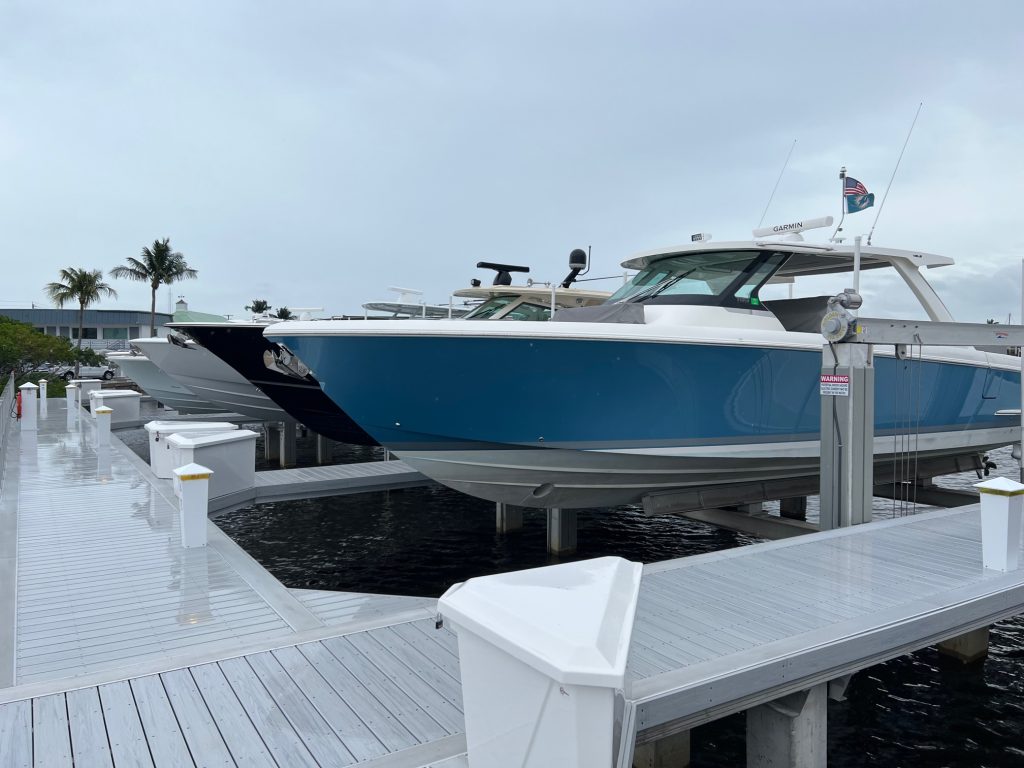
“We’re able to offer a 30-year fade and stain warranty to go along with it, which at the time kind of blew people away,” he said.
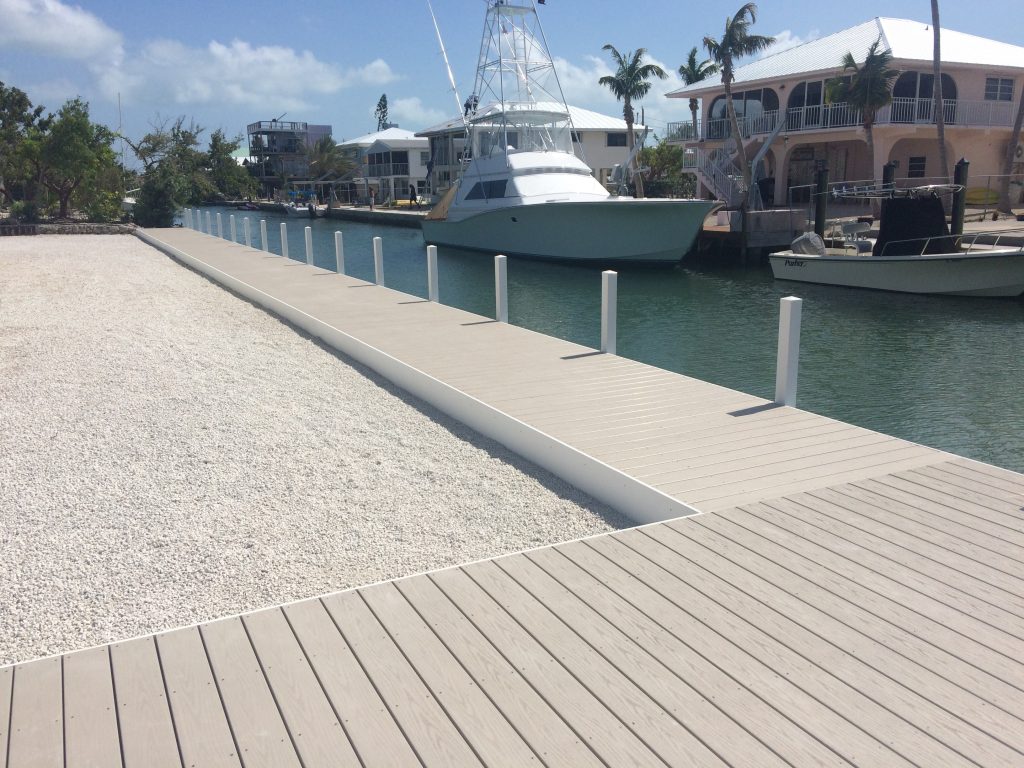
For homeowners and builders, the color choice is both practical and aesthetic. Lighter colors such as Ashwood, Beechwood, and Olivewood often fit coastal architecture and stay more comfortable underfoot. Coastal Grey gives a lighter variegated look. Darker colors can create more contrast, accent borders, or a more high-end visual effect.
Haines also offered practical advice for installation. With the Woodland Series, which includes the solid, non-variegated colors, board-to-board color consistency is fairly straightforward. Over time, boards may lose a little of their original sheen, but Haines said the color remains consistent and new boards will weather in.
With the variegated Forest Series, he recommends laying the boards out and blending them before installation.
“What I recommend people do is somewhat shuffle the deck,” Haines said. “Lay them all out ahead of time and don’t put two boards that look identical right next to one another. You’d want to blend the lights and darks together for better aesthetic appeal.”
Low Maintenance, Not No Maintenance
One of the biggest reasons people look at PVC decking is maintenance. But Haines is careful not to describe ENDECK as something that never needs cleaning. Outdoor surfaces collect pollen, dirt, leaves, food residue, fish residue, mildew food sources, and what he calls “environmental residue,” especially in the South.
The difference, he said, is that those things are on the surface. They are not growing into the board.
“There’s nothing that would grow on ENDECK or grow into the cell structure of ENDECK,” Haines said. “So it’s just what is on the surface.”
His cleaning advice is simple: do not overcomplicate it.
“I recommend to people, keep the pressure washer in the garage,” Haines said. “I look at it like, how would you wash your car? Most people would get out with a bucket of warm soapy water, maybe a soft bristle brush of some type, and just hose it down. That’s what I’d recommend with ENDECK.”
For most owners, that means washing the surface once or twice a year to keep it looking good. Haines said warm, soapy water and a soft nylon brush on a pole are usually enough to loosen dirt and residue.
“Treat it like your car,” he said. “If you left your car parked out for three months at a time in the spring and summer in the South, that thing’s going to turn green with all the pollen settling on it. Same thing with the deck.”
There are a few things to avoid. Haines said insect repellent and sunscreen can cause chemical reactions with polymer decking if they sit on the surface and bake in the sun. His advice is to apply those products away from the deck when possible or wipe up spills quickly.
He also recommends avoiding harsh solvents.
“Stay away from obviously paint thinner and things that would be very solvent based,” he said. “At the end of the day, it is a polymer. You need to make sure there is not something that you are using that would be designed to melt things, such as paint stripper or mineral spirits.”
Thinking About Cost the Right Way
PVC decking costs more upfront than basic pressure-treated lumber. Haines does not try to dodge that. But he argues that many buyers compare the cost the wrong way.
The mistake is comparing one linear foot of PVC decking to one linear foot of the cheapest pressure-treated pine on the market. That makes the difference look large, but it ignores the total project.
Haines said the framing, labor, pilings, and other costs may be the same whether the owner uses treated deck boards or PVC deck boards. The decking surface is only one part of the entire dock cost.
“Don’t look at just board versus board,” Haines said. “Look at the project cost.”
He gave a simple example. If the total material cost of a dock using pressure-treated decking is around $20,000, switching to ENDECK might bring that material cost to around $22,000. The exact number will depend on the project, but his point is that the percentage difference in the whole dock can be much smaller than the board-to-board comparison makes it seem.
Then comes maintenance. Treated deck boards may need staining and sealing every year or two, depending on the environment. They can splinter, crack, cup, twist, and warp. If the owner pays someone to maintain them, the cost adds up quickly. If the owner does the work himself, the cost still exists in time.
“That stain and sealer, if you count your time worth nothing, which I value my time, you’re easily going to make up that difference,” Haines said. “If you pay somebody to do it, you’re probably going to make up that difference in five years if not sooner.”
For Haines, the value is not only financial. It is also about how the dock is used.
“Better looking, better quality of life while you have it,” he said. “You don’t spend all your time on maintenance. You are spending 100 percent of your time going out there to get in your boat or jump in the water or hang out.”
That may be the cleanest way to understand ENDECK’s place in a dock project. It is not the cheapest board. It is not meant to be. It is meant for the owner who wants a cleaner-looking, lower-maintenance, water-ready surface that can handle the kind of punishment a dock receives without turning the dock into a recurring repair job.
A Deck Board Built for the Way Docks Are Used
ENDECK PVC decking is not just a dressed-up version of wood. It is a different kind of board built around different assumptions. It assumes moisture will be present. It assumes the sun will be intense. It assumes people may walk barefoot. It assumes the board may be used on docks, boat houses, stairs, walkways, privacy screens, and other places where both appearance and performance matter.
Its strongest selling points are practical: all-PVC construction, zero moisture absorption, submersibility, lower heat buildup, a solid double-sided profile, Class A flame spread rating, ground-contact suitability, fade and stain resistance, easy cleaning, and a finished look that can be planned like trim work rather than rough framing.
A dock should be a place to enjoy the water. The less time an owner spends sanding, staining, sealing, replacing, and worrying about the walking surface, the more time that dock can serve its real purpose.