
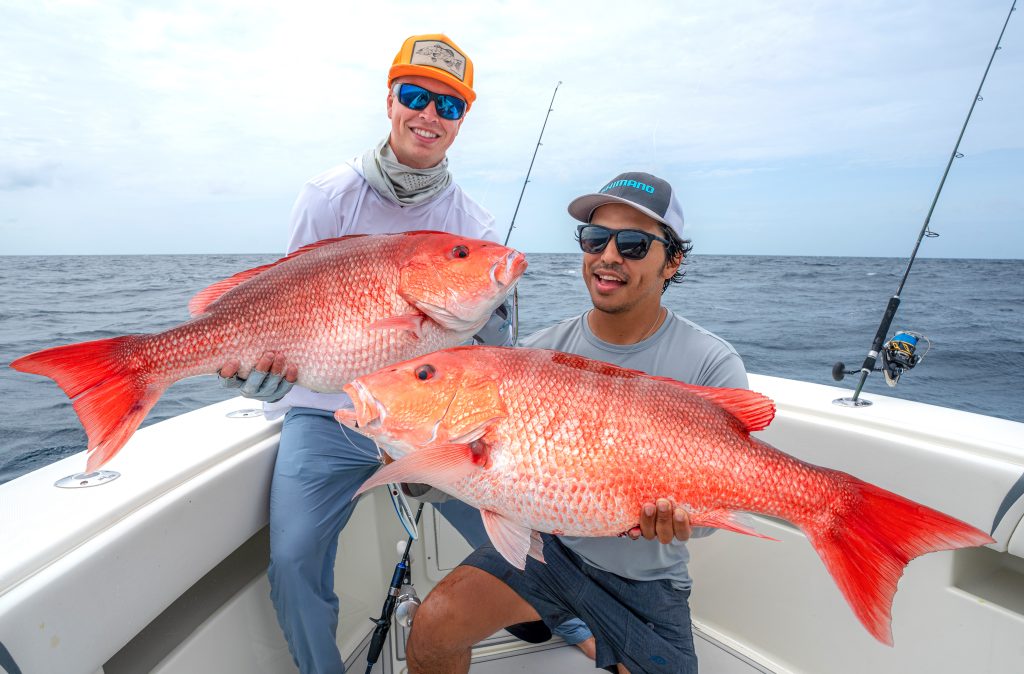
When the season opens and boats start crowding every reef and wreck in the Gulf, red snapper do not exactly roll out the welcome mat. These fish are notorious for getting lockjaw once they have felt the pressure, and that can make a great day on the water turn into a long, hot drift with nothing in the box but melting ice. But do not worry—there are still plenty of ways to pull a limit even when the fish are fussy and the crowds are thick. We asked a handful of seasoned captains from around the Gulf to share their best red snapper fishing tips for beating the pressure and putting red snapper in the boat.
Start High in the Water Column
Captain Tyler Massey says one of the simplest ways to increase your odds is to start your presentation higher in the water column. “Snapper will often be higher in the water and it’s easier to land the bigger size fish when you hook them higher,” he explains. “Try fishing a knocker rig or freelined bait with no weight.” That lighter presentation not only keeps your bait out of the junk on bottom but also helps you target the more aggressive fish before they wise up.
Adjust Your Tackle and Leader
If the bite slows down, Massey recommends downsizing and lengthening your leader. “A Carolina rig with 40-pound test and a 6- to 8-foot leader with a live cigar minnow is a great combo to get bites.” The idea is to make your bait look as natural and unobtrusive as possible—especially when other anglers are dropping heavy tackle and loud baits straight into the structure.
Vary Your Bait Selection
Bait selection matters, big time, when you are red snapper fishing. Massey always brings a variety. “Some days the snapper key in on dead bait, and some days they like live bait better. Boston mackerel, menhaden, and sardines are great dead baits to take. Live cigar minnows, scaled sardines, and threadfin herring are excellent live baits.” That flexibility lets you figure out what the fish are keyed in on without wasting too much time.
Kayak Strategies for Snapper
Kayak anglers face a different kind of challenge, but the fish respond to the same kinds of pressure. According to Brian Barton of Emerald Coast Kayak Fishing, free-lining cut bait can be one of the most effective ways to tempt the big ones from a paddle craft. “Cut up bonita or cigar minnows work well,” he said. “Throw quarter-sized chunks over the wreck to chum the snapper up in the water column. Then put a half-dollar-sized piece on a circle hook with no weight.” That same trick—long 40- to 50-pound fluoro leaders and no sinkers—gets the bait drifting naturally, and the lack of weight keeps kayak anglers from getting pulled down into the wreck.
“Keep your bail open and slow feed the bait down,” he explained. “When a fish takes it, you’ll see the line start shooting off the reel. Just lift the rod tip, flip the bail, and let the rod load up—no need to set the hook with a circle hook.” It is a clean, efficient way to fight smarter, not harder, and it keeps you from getting broken off by the wreck or reef below.

Go Light or Go Big Depending on Conditions
Captain Adam Peeples echoed many of those tactics. When the fish get wary, he recommends dialing everything down. “For pressured near-shore fish, downsize leader and hook size and free-line chunks of bait to catch your snappers. Add chum to the mix to get them fired up.” When you are fishing deeper structure—150 feet or more—he says it helps to go even longer on your leaders, in the 8- to 10-foot range, just to keep everything looking as stealthy and lifelike as possible.
But if you are hunting the big ones specifically, Peeples says go the other direction. “Use big baits. Large slabs of bonito and butterflied fish baits fished right on the bottom catch big ones. Make sure to up your leader size for this presentation to have abrasion resistance for the reef and rocks.” So while finesse works for numbers, sometimes heavy gear and heavy bait is the right call for targeting true giants.
Final Tips from the Pros
Captain Kendall Annan rounded out the red snapper fishing advice with a few straightforward reminders. First, leader matters—a lot. “Big fish are big for a reason,” he said. “Sometimes this [a longer, lighter leader] can finesse them to bite.” He is also a big believer in the drift line. “No lead, depending on the current, on a spinning rod out the back. A lot of big fish get away from the spot if they feel pressure, so casting outside of the wreck can lure them up.”
Finally, he offered a piece of advice every angler should take to heart: “Use good bait and take care of it, whether it’s dead or alive. Summertime is hot—don’t let it spoil while riding or fishing.” Sloppy bait leads to short strikes and slow bites, especially when the fish are picky and already on high alert.
Use Synthetic Baits for Staying Power
While good, quality bait can be a game-changer when it comes to catching pressure-weary fish, that bait first has to survive the descent down to where the snapper live. One popular way to prevent bait-stealers from leaving you dangling an empty hook in front of a snapper’s face is to tip your hook with a strip of Fishbites Offshore E-Z Pro. These synthetic baits stay on the hook incredibly well, even after multiple short strikes, and their slow-dissolving formula releases scent over time—giving your presentation just a little extra staying power when the bite gets slow or you are fishing deep.
Help Them Survive: Use Descending Devices
Whether you keep your catch or let some go, helping released red snapper survive is essential for sustaining the fishery—especially with fish caught from deeper waters. When snapper come up from more than 65 feet, they often suffer from barotrauma, a condition caused by expanding gases in their swim bladder. Without help, these fish struggle to return to depth and frequently die at the surface.
Return ‘Em Right, a Gulf-wide initiative, promotes the use of descending devices as the safest, most effective solution. These weighted tools quickly take the fish back to depth, where pressure compresses their swim bladder and allows them to swim off naturally. Unlike venting, which requires puncturing the fish and precise technique, descending is easier to do right—and it works. Studies show that red snapper released with descending devices survive at much higher rates, often exceeding 85 percent.
Return ‘Em Right offers free online training that teaches anglers how to identify barotrauma and use both venting tools and descending gear. Upon completion, eligible Gulf anglers can receive up to $100 worth of free gear, including a SeaQualizer and other descending tools. This helps ensure your released fish have the best chance at survival and supports long-term access to red snapper.
To comply with the DESCEND Act, every angler fishing for reef species in Gulf federal waters must carry either a venting tool or a descending device. Still, using a descending device is the recommended method. As Return ‘Em Right advises, only vent when barotrauma is evident and you cannot use a descending device effectively. Otherwise, descend and give the fish a fighting chance.
Final Notes: Flexibility, Finesse, and Conservation
Whether you’re dropping from a big boat or pedaling a kayak, free-lining or going deep, the same principles hold true: lighten up when the fish get spooky, keep your bait fresh and varied, and don’t be afraid to change tactics mid-trip. And most important, give released snapper the best shot at survival. With a little patience, attention to detail, and the right approach—including tools from Return ‘Em Right—you can still catch your limit, even when the snapper are seeing more hooks than bait.