

This spring marks the debut of a tournament unlike any other on the Gulf Coast: the East Pass Broadbill Open. As warming waters invite anglers offshore, this new event brings together fishermen, scientists, and conservationists with a shared fascination for one of the Gulf’s most mysterious species—the swordfish. With a $10,000 prize on the line for the heaviest catch, the stakes are high, but the goal runs deeper: to explore and advance understanding of a fishery still largely hidden in the depths through swordfishing.
A Tournament with a Purpose
Captain Adam Peeples of One Shot Charters, based out of Destin, Florida, has seen the Gulf’s swordfish fishery evolve firsthand over the past decade. For him, this tournament isn’t just a competitive opportunity—it’s a platform to give back to the fishery he loves. “We’re really excited about the research component,” says Peeples. “Every fish weighed in will be sampled by a biologist from the Dauphin Island Sea Lab, so it’s a win-win for everyone.”
That biologist is Crystal Hightower, a self-described “fish nerd” and research coordinator at the University of South Alabama’s Stokes School of Marine and Environmental Sciences. Based out of Dauphin Island, Alabama, Hightower has spent nearly two decades studying Gulf Coast fisheries. She’s particularly passionate about swordfish, a species she admits she’s “been obsessed with for as long as I’ve been studying fish.”
The Broadbill Open is a chance to merge two worlds: competitive angling and hands-on science. Hightower will be on site collecting samples—otoliths (ear bones), muscle tissue, fin spines, and more—from every swordfish brought to the dock. That data helps researchers determine the age, growth rates, and reproductive maturity of the fish. In an area where swordfish research is still relatively new, every sample adds a piece to a complex puzzle.
Tagging, Tracking, and Discovering
Peeples isn’t just coordinating the tournament—he’s one of Hightower’s most prolific citizen scientists. Through the Tag Alabama program, he’s tagged and released more swordfish than any other angler in the study. And he’s already had multiple recaptures. “Every single one was caught in the same general area, years apart, during the same time of year,” he notes. “It opens up so many questions about their movement, residency, and behavior.”
These tags help identify whether swordfish in the northern Gulf are part of a migratory or resident population—a question with significant management implications. “We’ve known for decades that the Gulf is a spawning ground and nursery,” says Hightower, “but what we haven’t known is how these fish behave once they’re juveniles. The tagging data we’re getting now is helping fill in those blanks.”
In addition to traditional tags, Hightower dreams of deploying pop-off satellite tags—PSATs—that collect high-resolution data on depth, movement, and temperature. They’re expensive, yes, and finicky, but they offer unparalleled insights into the secret lives of swordfish. “If any anglers are interested in funding or deploying one, I’m happy to help make that happen,” she says.
A Fish That Defies Convention
Swordfish are unlike any other pelagic predator. They thrive in extreme depths—Peeples commonly fishes between 1,400 and 1,600 feet—and have evolved a physiology that makes them well-suited to a high-speed, low-light lifestyle. They rely heavily on vision, not sound, for hunting, and their massive eyes are specially adapted for deep, dark environments.
Unlike other billfish, swordfish lack a functional swim bladder, making them uniquely resistant to barotrauma. That means juvenile swordfish often survive catch-and-release, a rarity for deep-water species. Peeples takes this into account when handling fish, especially smaller ones. “I’m always trying to tag and release when it makes sense, and I’ve been surprised how well some of these little guys bounce back,” he says.

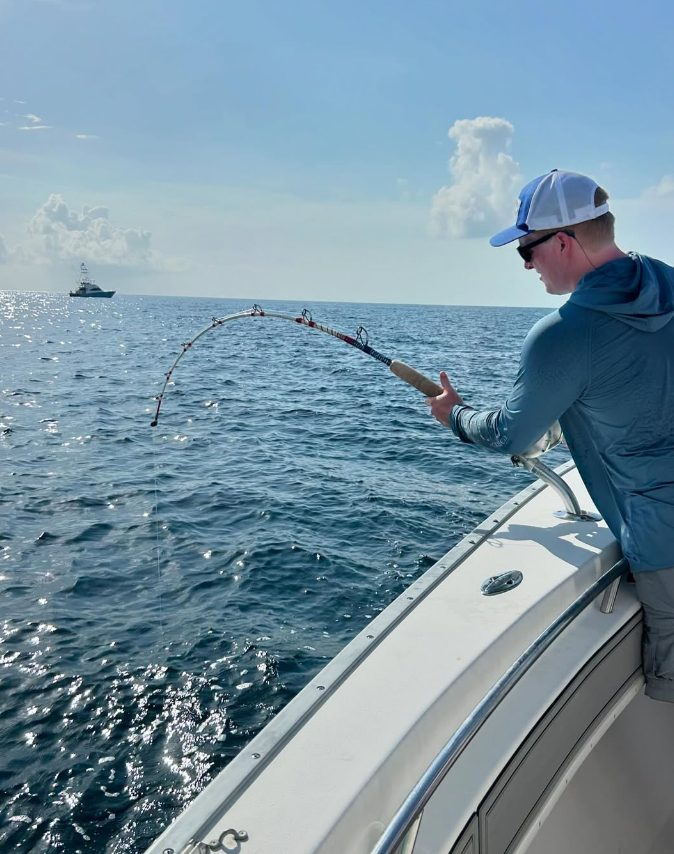
Yet even with modern gear and techniques, swordfishing is far from easy. Peeples describes his style as “light tackle, hand-crank swordfishing”—a stark contrast to the electric reels seen on TV. He uses one to two rods, often with minimal weight, and relies on precise boat control to keep baits in the strike zone. “It’s kind of a controlled blow troll,” he explains. “You’re not just drifting. You’re using the boat to stay oriented.”
And the bite? Inconsistent at best. “You might fish all day for one bite, or get five in an afternoon. You never know.”
Knowledge and Conservation Go Hand in Hand
For both Peeples and Hightower, the future of swordfishing in the Gulf hinges on a balance between opportunity and stewardship. While Peeples has noticed a decline in bite consistency over the years—possibly due to fishing pressure—he doesn’t jump to conclusions. “It could be cyclical, or it could be pressure. That’s why I tag every fish I can. We need more data.”
Hightower agrees. “We don’t have great age-length relationships for swordfish right now, especially in the Gulf. A 50-inch fish might be two years old—or it might be eight. That’s not good enough for long-term management.”
Part of her work at the tournament will include sampling otoliths and fin spines to compare aging methods. Eventually, she hopes to validate age estimates using a chemical marker—oxytetracycline (OTC)—in tagged fish. If a tagged fish is later recaptured, researchers can see exactly how much it grew in a known timeframe. That kind of data is rare—and vital.
Get Involved. Fish. Learn. Win.
The East Pass Broadbill Open runs the third weekend of May, with a four-day fishing window to give teams flexibility around weather. Entry is $500 per boat, with a guaranteed $10,000 prize for the biggest swordfish—regardless of how many boats compete. It’s a high-payout, low-barrier tournament where, as Peeples puts it, “Anybody can get lucky. It’s anybody’s tournament.”
Better yet, every fish caught contributes to the science. “If you’re planning to release a fish, we want to tag it,” says Hightower. “If you’re bringing one to the dock, we’ll sample it. It’s quick, non-invasive, and helps us all learn more.”
To register for the tournament, follow the East Pass Broadbill Open on Instagram. Full tournament details, a live leaderboard, and prize info will be posted via CatchStat.
And if you’re interested in tagging swordfish yourself, Hightower has kits ready to go. “Reach out to me or find me at a tournament,” she says. “I’ll get you what you need.”
In the end, this tournament is more than just big fish and big checks. It’s a chance to connect anglers with scientists, to better understand one of the Gulf’s most remarkable species, and to ensure that swordfish remain a fixture of these waters for generations to come.
Interested in tagging? Contact Crystal Hightower at:
chightower@disl.org