

Most people do not buy land because they are excited about the tax code. They buy it because they want a place to hunt, grow timber, farm, invest, or leave something meaningful to their children. The tax benefits of owning land usually come later, once they begin to understand how differently land can be treated from many other assets. According to Clint Flowers of National Land Realty, that is exactly how the subject comes up with many of the buyers he works with. “Usually, more times than not, it’s icing on the cake,” Flowers said. “They wanted to buy the land anyway, typically for some form of recreation or investment in general. But then when they find out about the tax advantages that go on top of it, that just gives that extra juice for the squeeze.” Those advantages can come from several directions.
Timber owners may be able to recover their timber basis before recognizing taxable gains. Expenses associated with managing land may qualify for deductions or depreciation. Equipment purchases can create tax-planning opportunities, conservation easements can produce substantial deductions in the right circumstances, and a 1031 exchange can allow an owner to defer capital gains when moving from one investment property to another. None of that means every tractor, hunting trip, or cabin suddenly becomes a tax write-off, however. Flowers repeatedly stressed that the treatment depends on the property, how it is used, the owner’s tax situation, and current law. The goal is not to become your own CPA. It is to understand enough about land taxation to know which questions you should be asking.
Tax Planning Should Start Before Tax Season
One of the most important lessons Flowers emphasizes is that good tax planning happens before a transaction, not after it. Too many landowners wait until tax season, hand an accountant a stack of receipts and tax forms, and assume every available opportunity will automatically be recognized. That can be especially risky when the accountant does not regularly work with farms, timberland, or recreational property. Understanding the tax benefits of owning land often starts with knowing which questions to ask before a major transaction takes place. Flowers said he typically communicates with his own accounting team at least quarterly and tries to raise questions about major activities before they occur. “If you’ve got a piece of property and you know you’re going to be thinning timber, you know you’re going to be doing something, then go ahead and let your tax team know, your legal team know,” he said. The question to ask is whether there is anything that should be done ahead of time “to prepare for any possible tax consequences.”
Flowers has encountered capable accountants who understood concepts such as depreciation, bonus depreciation, and cost segregation when dealing with rental homes or apartments but had simply never applied those tools to rural land. That does not necessarily mean a landowner needs a different accountant, but it does mean that working with a CPA who understands real estate, agriculture, and timber can make the process easier. For a landowner, being proactive can be the difference between planning around a taxable event and finding out months later that an opportunity was missed.
Timber Basis Can Save Landowners Serious Money
For timberland owners, Flowers says one of the most common and potentially expensive mistakes is failing to establish and track timber basis. It can also be one of the most important tax benefits of owning land when timber is part of the property’s value. When someone purchases timberland, the value of the property may be divided among the underlying land, standing timber, and certain improvements. The portion assigned to the timber becomes the owner’s timber basis and can generally be depleted as qualifying timber is harvested. Flowers used a simple example to explain the concept: if a tract contains $1,000 worth of timber per acre when it is purchased, harvesting that first $1,000 per acre is not necessarily the same thing as earning $1,000 of new profit. “All you did was convert $1,000 an acre in timber to $1,000 an acre in liquid money,” Flowers said. “It’s like going from liquid to a gas, still the same thing.”
In another example discussed during the interview, a buyer purchases a $500,000 timber farm and determines that $250,000 of its acquisition value is attributable to standing timber. That $250,000 becomes timber basis, while separate basis remains in the land and other property components. As timber is harvested, that basis is depleted, and taxable gain generally becomes more relevant once the applicable basis has been exhausted. Flowers called failure to properly track the number “probably the most common mistake I see made all the time.” For someone buying timberland through National Land Realty, establishing that number early can therefore be almost as important as understanding timber volume, access, or future harvest potential.
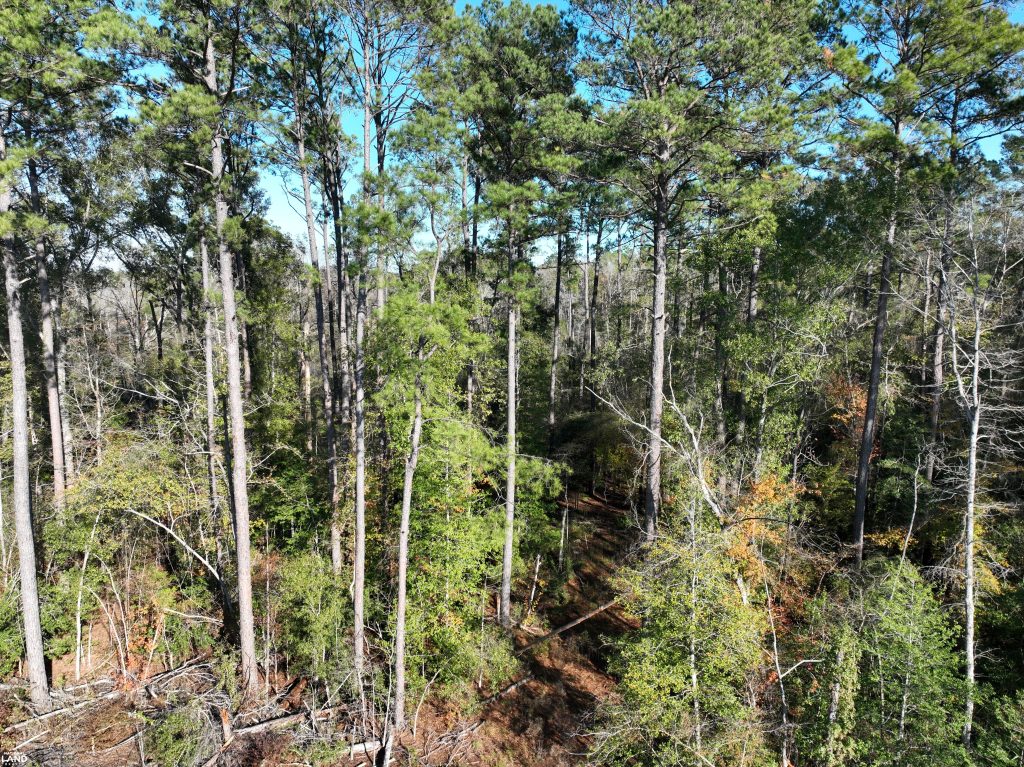
Ideally, timber basis is established around the time of purchase with the help of a consulting forester, but Flowers said owners who failed to do that immediately are not necessarily out of luck. A forester may sometimes be able to prepare a historical basis letter using information about the age and type of timber, soils, past imagery, harvest records, and other evidence. Modern satellite imagery, lidar, and other tools can make reconstructing past conditions possible even after timber has already been cut. The broader lesson is that timber income should not simply arrive on a tax return as a number with no context. A landowner needs to know how much timber basis exists, how much has been depleted, what professional expenses were associated with a harvest, and how those numbers should be treated. A six-figure timber sale can look very different from a tax standpoint depending on the owner’s existing basis, which is why Flowers encourages landowners to have that conversation with both their forester and CPA before the logging crew arrives rather than after the check is deposited.
Land Management Creates Legitimate Expenses
The tax benefits of owning land do not stop with timber sales. Once a property is being actively operated or managed as an investment, farm, or timber property, the owner may accumulate a surprising number of legitimate expenses associated with maintaining and improving it. Flowers mentioned property taxes, professional forestry services, equipment, fencing, gates, culverts, roads, cameras, and other management costs as examples worth tracking, along with mileage associated with legitimate trips to the property. “Even your mileage to and from the property—that’s another big one people don’t know about,” he said. “Especially during hunt season, you’re up there every weekend, things like that, checking on the farm.” The distinction between a legitimate management expense and a purely recreational expense obviously matters. Driving to a farm solely to hunt is not automatically transformed into a deductible business trip because there are pine trees on the property. But if the owner is inspecting timber, working on roads, meeting a contractor, repairing a gate, conducting prescribed fire, spraying invasive plants, or performing other legitimate management activities, those expenses are worth documenting and discussing with a tax professional.
That overlap between recreation and investment is one of the things that makes rural property unusual. A timber tract can simultaneously be a working farm, a long-term real estate investment, and the place where the owner spends deer season. Flowers said landowners can sometimes benefit from tax concepts associated with both farming and real estate investment, but it is important to categorize activities correctly. “Make sure that you’re tracking all that and getting into it with your tax team and letting them put it in the right bucket,” he said. That does not require an elaborate accounting department. Flowers said many owners with one or two properties can keep adequate records with a spreadsheet, while more complex operations may benefit from dedicated accounts or accounting software. He also cautioned against assuming an LLC automatically creates a tax advantage. “LLCs, for the most part, don’t have a tax benefit,” Flowers said. “They’re for general liability.” An LLC may still make sense for liability protection, ownership structure, or clean bookkeeping, but the tax treatment of the underlying property does not magically change simply because three letters were added after the owner’s name.
Equipment, Improvements, and Section 179
Equipment is another area where planning ahead can matter. A landowner managing timber, agricultural ground, or a larger recreational property may eventually need a tractor, UTV, mower, bulldozer, sprayer, or other expensive machinery. Flowers discussed Section 179 as one potential way qualifying equipment used in a farming or business activity can be expensed more rapidly rather than depreciated entirely over a long period. That can make the timing of a purchase particularly important for business owners or other taxpayers whose income varies significantly from year to year. If someone already needs to replace a tractor and expects an unusually strong income year, that may be the time to sit down with a CPA and determine whether buying the equipment creates a useful deduction. Flowers also noted that financing the purchase does not necessarily eliminate the potential benefit.

“You can finance it,” he said. “So if you just put 10% down, you still bought it all that year. So you still get the same 100% benefit of that deduction, even though you didn’t pay it off completely.” Selling or trading depreciated equipment later can create additional tax consequences, however, which is why buying machinery simply because it appears to generate a deduction is not necessarily good financial planning. Roads, fences, culverts, gates, and certain other improvements may also have depreciable components, and larger or more complex properties may sometimes justify looking at tools such as cost segregation. The common thread is recordkeeping: know what you bought, what it cost, how it is being used, and whether it belongs in the farming, timber, or real estate side of the operation.
Conservation Easements Can Create Major Tax Benefits
For some owners, the most substantial potential tax benefits of owning land comes not from harvesting or improving property but from permanently agreeing not to develop it. A conservation easement generally involves voluntarily giving up certain rights associated with a property, such as subdivision, intensive development, or in some cases mineral extraction. If relinquishing those rights reduces the property’s appraised market value and the easement meets the applicable requirements, that reduction may form the basis for a charitable deduction. Flowers has extensive experience with conservation transactions and has worked with landowners through National Land Realty to evaluate properties where conservation and tax planning overlap. “If you actually voluntarily donate the right to pursue whatever that higher and better use is, then you get the equivalent loss in value as a deduction,” he explained. He offered the simplified example of land that could be worth $30,000 per acre as a development property but only $3,000 per acre once development rights were removed. The $27,000 difference per acre deduction illustrates why easements can become extremely valuable to high-income taxpayers who already want to permanently protect land.
Flowers has seen situations where the resulting tax savings fundamentally change the economics of purchasing property. “In some cases, we’ve even paid for the property with that tax deduction,” he said. “I don’t want to say that’s an all-the-time thing, but there are circumstances where that’s very plausible.” That does not mean easements are free money. They involve professional costs, appraisals, legal work, and permanent restrictions, and an owner who believes development is the property’s eventual highest and best use may be giving away precisely what makes the land most valuable. Flowers also cautioned against overly restrictive easements that make land difficult to use or sell. In many cases he prefers a working-forest approach that prevents unwanted development while still allowing timber harvesting, roads, management, and other productive uses. The best easement is therefore not necessarily the one that generates the largest possible deduction; it is one that achieves the owner’s conservation goals without unnecessarily destroying the practical or market value of the property.
A 1031 Exchange Can Keep Land Equity Working
Eventually, some landowners decide to sell, and that is where a 1031 exchange can become another important tool. A properly structured 1031 exchange allows qualifying investment real estate to be sold and the proceeds reinvested into other qualifying investment real estate while deferring capital gains tax. One of the most useful features is that the replacement property does not necessarily have to resemble the property being sold. “It just has to be investment real estate,” Flowers said. “So that can be a beach condo, residential real estate, apartments, commercial properties—anything along those lines.” A landowner could therefore sell a timber farm and exchange into a larger farm, another type of rural property, or an entirely different category of investment real estate. That flexibility can be useful at several stages of life. Someone building a land portfolio might use an exchange to move from a smaller tract into a larger one, while an older owner who no longer wants to maintain hundreds or thousands of acres might exchange into income-producing real estate requiring less hands-on work.
The catch is that 1031 exchanges have strict procedures and deadlines. Flowers explained that in a common forward exchange, the owner generally has 45 days after the sale to identify potential replacement properties and must complete the transaction within the applicable 180-day window. Just as importantly, the sale proceeds must be handled through a qualified intermediary rather than received directly by the seller. This is why a 1031 needs to be considered before the original sale closes, not after the money is already sitting in the owner’s bank account. National Land Realty offers a 1031 exchange service for landowners navigating that process. Flowers also warned against becoming so focused on avoiding taxes that the seller makes a poor investment decision. Buyers facing a deadline sometimes overpay simply to complete an exchange. If the premium paid for a mediocre replacement property exceeds the tax that would otherwise have been due, the exchange has defeated its own purpose. Tax efficiency matters, but it should not override the fundamentals of buying good real estate.
Land Can Carry Tax Advantages Into the Next Generation
The tax benefits of owning land can continue even after the original owner is gone. Under the rules Flowers discussed, inherited property can receive a step up in basis to its current market value when it passes to heirs. That can be particularly important with timberland because an owner may have depleted much or all of the original timber basis during his lifetime while new timber continues growing and the underlying acreage appreciates. Flowers used the example of property where the original owner’s timber basis had fallen to zero but the standing timber was worth $2,000 per acre when the property passed to the next generation. “You get what’s called a step up in basis,” he said. “So both your land and your timber would step up to current market value.” That can make the difference between inheriting decades of unrealized appreciation and beginning with a new basis much closer to what the property is actually worth today.
It also means decisions about gifting, selling, or holding family land should not be made casually. Property transferred during the owner’s lifetime may be treated differently from property inherited at death, and the best strategy depends on the owner’s basis, estate, family situation, and current law. Flowers’ advice here is surprisingly nontechnical: talk to your children. Find out whether they actually want the land, whether one child feels more strongly about it than the others, and whether the family’s plans have changed over time. Tax planning is only useful if it supports what the family actually wants to accomplish.
The Biggest Advantage Is Knowing What to Ask
Tax benefits of owning land probably should not be the reason someone buys land in the first place. Rural property still costs money to maintain. Timber income can be irregular, equipment breaks, roads wash out, and land often does not produce the predictable monthly cash flow associated with apartments or commercial rentals. But ignoring the tax side means ignoring a meaningful part of the economics of ownership. Timber basis, operating expenses, depreciation, conservation easements, 1031 exchanges, and estate planning can all materially change what owning a property costs and what an owner ultimately keeps.
Flowers’ larger point is not that landowners should hunt for loopholes. It is that they should be proactive enough to recognize opportunities before they disappear. Establish your timber basis. Keep track of expenses. Tell your CPA about a harvest before it happens. Talk about an equipment purchase while there is still time to plan for the year. Consider a 1031 before the property closes. Think about conservation restrictions before signing anything permanent, and talk to your family about the land before an estate plan forces decisions onto the next generation. For most buyers, the tax benefits of owning land may always remain what Flowers called “icing on the cake.” The land itself is still the reason to own it. But when a property can offer recreation, timber or agricultural income, long-term appreciation, conservation value, and a family legacy while also providing several legitimate ways to reduce or defer taxes, understanding those advantages can make land ownership an even stronger long-term investment.
This article is intended for general informational purposes and should not be considered legal or tax advice. Tax treatment varies according to individual circumstances, how property was transferred, ownership structure, applicable basis, and current law. Heirs and landowners should consult qualified tax and legal professionals before making a sale, gift, exchange, or estate-planning decision.