

It all started at a gas station. Kent Grimm wasn’t a duck hunter himself, but his son-in-law was the type who’d take November off just to chase birds. When Kent spotted him fueling up, he asked what he was up to. The answer was simple: changing out bedding in the two dozen wooden wood duck boxes he maintained—part of his small but meaningful contribution to wood duck conservation. Kent, who owned a custom molding plastics plant with his brother at the time, tossed out an idea: what if they built the boxes out of plastic instead of wood?
That offhand conversation kicked off a project that has now grown into DuckHut, a company that produces lightweight, durable plastic wood duck boxes used by conservationists, hunters, and landowners across North America.
From Prototype to Production
The first season, Kent and his team built thirteen prototypes and set them out after the hunting was done. By winter’s end, every single one had been used by ducks. “That gave us enough encouragement that we went back and made some changes,” Kent recalls. A year later, they produced about 75 to 100 more boxes and gave them away to friends, employees, and hunters. The response was overwhelming, and soon DuckHut invested in full injection-molding tooling, refining their product into what is now one of the leading cavity nesting boxes on the market.

Unlike traditional wooden boxes, DuckHut’s plastic models are extremely durable, resistant to rot, and designed with practical features for both ducks and the people who maintain them. They support wood duck conservation by including ventilation to keep temperatures cooler in summer, a built-in ladder for chicks to climb, and a bottom panel that snaps open for safe, easy cleaning.
Conservation with Results
What sets DuckHut apart isn’t just the material, but the results. At Iowa’s annual Winter Fest, where conservation leaders from all 99 counties gather, Kent heard firsthand how much difference his boxes were making. One biologist told him bluntly, “We’re steadily replacing our old wood ones with yours.” In that county, they kept precise records: traditional wooden boxes were producing about a 25 percent success rate, while DuckHut boxes were hitting closer to 65 percent. Others approached Kent at the event to say, “We raise more wood ducks out of your boxes than we ever have with wood.”
Kent believes the higher success comes down to design details that address problems wooden boxes simply can’t solve. Ventilation is critical. In hot weather, wooden boxes trap heat, but DuckHut’s molded walls include airflow channels that keep interior temperatures cooler, protecting eggs and chicks. Cleaning is easier and safer, which means landowners are more likely to keep bedding fresh, monitor nests, and prevent overcrowding. Even something as simple as weight makes a difference. A two-pound plastic box can be installed in minutes and carried by the dozen, so more landowners are willing to put them up in greater numbers, reducing egg-dumping problems and spreading nesting opportunity across a property.
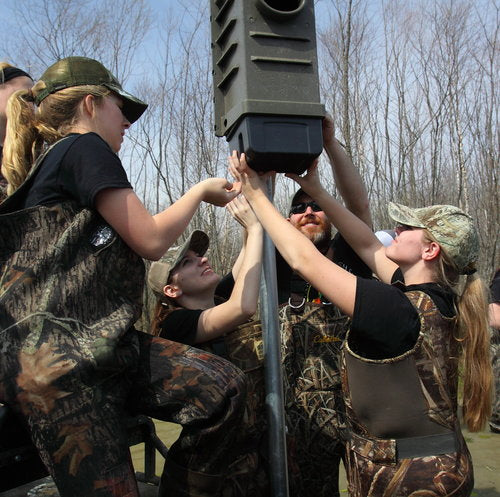
He also points out that a lot of “rules” repeated online don’t hold up under real-world observation. Conventional wisdom says boxes should be kept far apart, so hens don’t dump eggs in each other’s nests. But Kent has customers who run dozens of boxes on a single property, sometimes stacked in twos and threes on a single pole, with no drop-off in success. “The babies are imprinted to that box,” he explains. “They’re trying to beat the mother back to raise their brood. If you don’t give them enough boxes, that’s when you get overcrowding. The mistake people make is not putting out enough, not putting them too close.” In his experience, wood ducks are surprisingly tolerant neighbors, and what matters most is offering enough cavities, not spacing them by an arbitrary distance.
Those advantages have led to what Kent calls a “snowball effect” in conservation. Because wood duck chicks imprint on the box they hatch from, they’ll return to that same spot the following year, often beating their mothers back to it. When a landowner starts with just a handful of boxes, they can quickly fill up, leading to crowding and failed nests. But when the boxes are durable, safe, and easy to expand in number, a property can support generations of ducks season after season. “If my boxes weren’t working,” Kent says, “these chapters wouldn’t be buying 200 or 250 more every year.”
Lessons from the Field
For anyone considering putting up nest boxes, Kent Grimm’s advice is straightforward and rooted in years of feedback from both hunters and conservationists. His first recommendation is to start small but plan to grow. Wood duck chicks imprint on the box they hatch from, which means they’ll return to it the following year. If there aren’t enough boxes available, overcrowding leads to “egg dumping,” where multiple hens lay into the same cavity. That’s a recipe for poor hatching success. Kent suggests beginning with a dozen or so on a medium-sized property and adding more as they fill up, ensuring every brood has a space of its own.
Placement is just as important. Boxes can go on ponds, drainage ditches, or small creeks, but hens want access to moving water. Within 24 hours of hatching, broods leave stagnant ponds and head for streams or rivers, no matter how small. Landowners should think beyond the pond’s edge and place boxes where hens can safely lead their young to running water.

Predator protection is non-negotiable in wood duck conservation. Raccoons, snakes, and even large bass can wipe out broods if boxes aren’t properly guarded. Kent recommends pole-mounted boxes fitted with cone or molded plastic predator guards, which deflect climbing raccoons and keep nests secure. Mounting directly to trees may seem easier, but without proper skirting, it only teaches predators where to look for an easy meal.
Finally, don’t forget maintenance. Each season, bedding should be swapped out with large-flake pine shavings, not cedar. Fresh bedding keeps boxes attractive to hens and safer for chicks, and inspecting them annually ensures that landowners know which boxes are being used and how successful they are. “Nature doesn’t change the bedding,” Kent admits, “but in this case, you need to monitor what’s going on. Otherwise, you don’t know whether your boxes are working.”
For Kent, the message is simple: start, protect, and maintain. “If you don’t get started, you’re never going to raise wood ducks,” he says. “But once you do, it feeds on itself. Those birds come back. That’s the reward.”
A Growing Standard
What began as a plastics experiment is fast becoming a new standard in wood duck conservation. From California rice farmers lining drainage ditches with hundreds of boxes to conservation groups in Delaware buying two hundred at a time, DuckHut is proving that sometimes the best conservation ideas start with a simple question: why not try something new?
For Kent Grimm, the answer is clear every time he hears from a customer about ducklings leaping from one of his boxes into the water below. “You start raising wood ducks, and it’ll get you so wound up and excited,” he says. “Because it’s not a lost effort. They’re coming back.”