
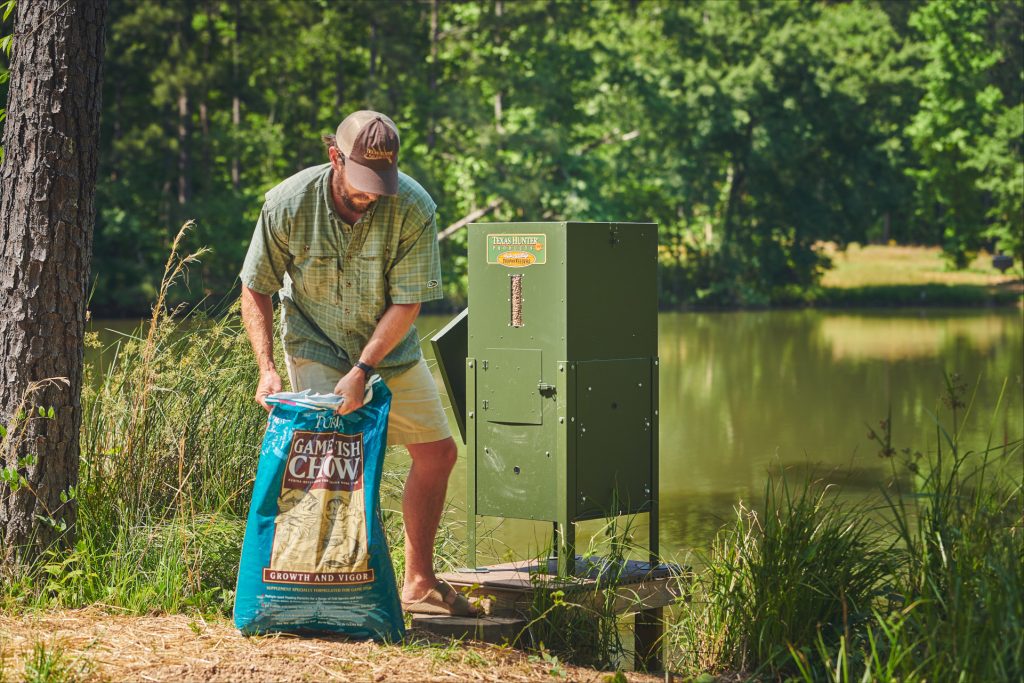
When it comes to stocking and managing ponds, Norm Latona is a trusted expert with over 30 years of experience. As owner of Southeastern Pond Management, Norm works with pond owners across Alabama to improve fish health, growth, and catchability. Whether installing new ponds or recommending enhancements to existing waters, Norm understands all aspects of pond ecology and fish behavior. One popular recommendation from Norm is the use of an automatic fish feeder. By providing supplemental feeds on a regular schedule, pond owners can boost their fish populations while also making fishing more enjoyable for themselves and visitors. In this article, Norm provides his best tips for choosing, installing, and programming an automatic fish feeder to maximize benefits for one’s pond.
Choosing A Quality Automatic Fish Feeder
Norm has been providing pond management services and selling feeders for a long time; over thirty years. In that period of time, he’s acquired experience with almost every automatic fish feeder on the market. While it’s easy to try and “cheap out” on a feeder, Norm warns that “cheap” is rarely cost-effective in the long run.
“The feeders we sell are primarily Texas Hunter products,” Norm explains. “We have installed many, many, many of these units over the years, and the vast majority of them have very few problems. Occasionally, we do have to go out and service these units, of course, but they are very problem-free. Admittedly, they’re not the cheapest option out there. You can go out and buy a cheaper feeder, but you end up paying for it one way or another in the long run. We just don’t sell products like that.”
Norm is a big fan of Texas Hunter feeders because Southeastern Pond Management doesn’t just sell feeders, they install and service them. Quality products don’t just make his customers happy, they make his job easier. Less feeder failure creates less work for his employees!

“We don’t just sell somebody a bunch of feeders in a box,” he explains. “Rarely, you get a repeat customer who calls and explains that he just needs another feeder, and he’ll do the rest himself, but that’s generally just not what we’re in the business to do. What we’re in the business of doing is coming out, assembling the thing, installing it, putting the battery in it, placing it on the pond bank, filling it up with fish feed, programming it to go off this many times a day at these times, and making sure it’s working right. And if the thing quits working or starts giving you trouble, the remedy is pick up the phone and call me, and we’ll go out there and deal with it. The only thing our customers are responsible for is opening the lid up, dumping a bag of fish food in it every once in a while, and shutting the lid back”
Automatic Fish Feeder Types
Aside from making sure that you’re buying your feeder from a reputable pond management company that sells high-quality products, choosing the type of feeder to install is your most important consideration. The most common types are floating fish feeders and bank mounted, directional feeders.
Floating Fish Feeders
Floating feeders are common in farm ponds, but Norm generally advises against them for recreational ones.
“The advantages to floating feeders are that you can scatter food 360 degrees, and it’s all gonna go in the water,” he explains, Whereas bank mounted feeders typically feed in one direction. But the problem with the floating stuff is that it’s more stuff to maintain, and you’ve got to have it floating on something. You’ve got to maintain the feeder and whatever apparatus you’re floating it on. And, obviously, you’ve got to get a boat involved to service the feeder, or just to fill it, really. So we tend to stay away from them.”
Directional Fish Feeders
Most of what Norm sells are Texas Hunter directional feeders.
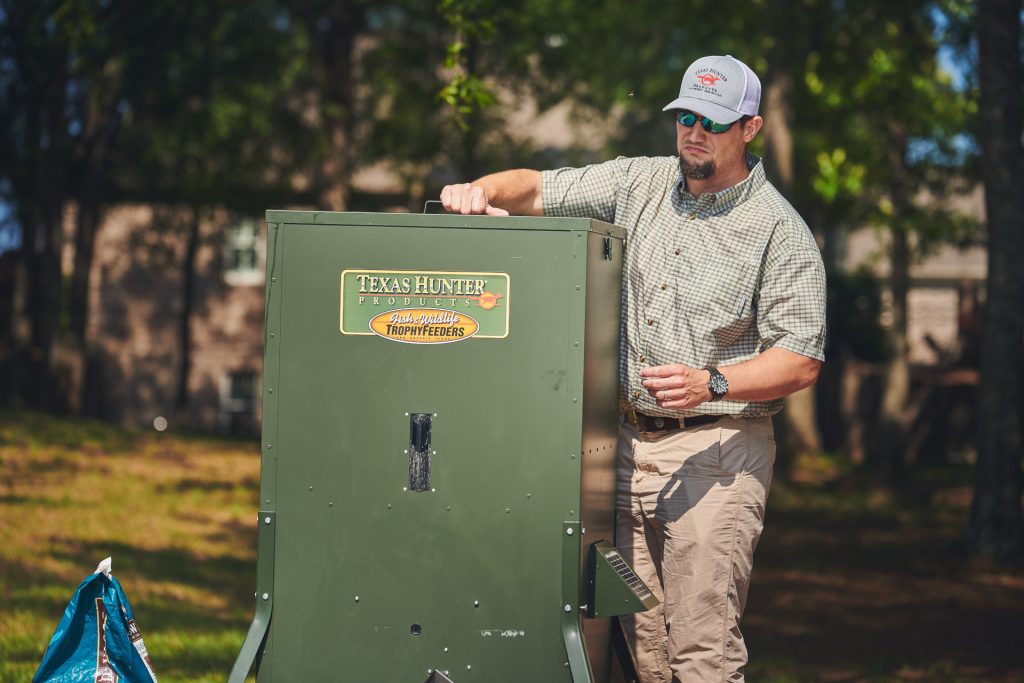
“Texas Hunter makes a good directional feeder, and they offer several different models of it. And really, the different models just correspond to different hopper sizes. So we’ve got one that holds about 100 pounds of feed, and we’ve got one that holds about 300 pounds of feed. But they do a great job of shooting the food out in one direction. Typically we use a floating pellet, but it’ll handle sinking feed as well if folks want to use sinking feed. And you can mount it on a pier, or you can mount it right on the bank. They’ve got adjustable legs so you can change the launch angle, and once you get that thing anchored down it’ll shoot it out into the water from one direction with no trouble.”
What Size Fish Feeder Do I Need?
Many anglers believe that bigger is always better. That may be true when it comes to boat engines and trophy bass, but Norm says that’s not always the case when choosing your hopper size.
“Bigger is definitely not always better here,” he explains. “We tell folks that the only difference between a 300 pound hopper and a 100 pound hopper is how often you have to feed it, and if it’s not a huge burden for you to fill it, go with the smaller hopper. There are some applications where a large hopper is useful, but generally you just run a bigger risk of, say, the lid not being installed properly, and now you’ve got 300 lbs of rotten fish food instead of 100.”
He continues, “The longer food sits in that hopper, especially in our humid environment, the greater the chance of it clumping up and clogging, or bugs getting to it, or stuff like that. And if you got a five acre lake and you’re feeding five pounds a day, it’s not that much trouble keeping up with it. You literally open the lid and dump food in them. So by far the most popular model that we sell is that 100 pound capacity hopper. It’s a fairly low profile, and doesn’t stick out like a sore thumb. And it’s got plenty of food in it to run for at least a couple of weeks at a time in most ponds.”
How Often Should I Feed My Fish?
“How often should I feed my fish?” is one of the more common questions Norm gets. Ultimately, the exact amount of food you distribute depends on your pond size, stocking density, and management goals, but Norm offers the following advice as a general guideline for most pond owners.
“As far as the frequency of feeding, bluegill in particular get really habitualized on these feeders. All sorts of research has shown that fish will eat more, if you feed them small amounts over a longer period of time, instead of lots of food all at once.”
He continues, “Texas Hunter feeders can be programmed to feed up to twelve times a day. Now, we don’t really do that. But breaking the feeding up into a morning and evening feeding is a great idea. And so we almost always do that. Sometimes we’ll even do it three times a day, although that can present a problem. In the summertime it often just gets too hot to feed unless you have a feeder that happens to be in a shady spot.”
What Should I Feed My Fish?
Most of the time, pond managers are feeding bluegill, either to produce big and fun-to-catch “slabs” or to indirectly feed trophy bass. To do this, Norm advises a good, high-protein feed.
“We began to use some of the higher protein ratio stuff that’s 48-50% protein; stuff with a real high fish meal content. And boy, you want to talk about growing? You can almost watch the fish grow! I’ve seen some remarkable bluegill over the years, particularly in customers’ ponds that are really diligent about feeding high-protein feed year round. It is not unusual for us to go out and shock the pond for sampling and see 32 or 36 oz bluegill. I’m talking legitimate 2 lb bluegill. It’s really amazing. Quality growth is definitely achievable through the right feeds.”

He specifically suggests Purina AquaMax feed.
“Purina has, in my estimation, the best options when it comes to the high protein stuff. It’s a commercial grade feed. And they make it in several different sizes, but it’s really high in protein. The bluegill will grow right before your eyes on that stuff.”
Final Thoughts On Automatic Fish Feeders
Wrapping it all up, Norm Latona isn’t just throwing around suggestions; his thirty years in the pond business really show when he talks about what works and what doesn’t. He’s big on quality, which is why he sticks with Texas Hunter feeders—they’ve stood the test of time and keep both him and his customers away from unnecessary headaches. The choice between floating and directional feeders? Well, Norm leans towards the practicality and ease of use that come with directional feeders. And it’s not just about selling you the biggest and most expensive feeder; he’s all about what makes sense for your pond and your fish.
Norm’s parting wisdom is pretty straightforward: don’t overdo it. Whether it’s the size of your feeder or how often you’re feeding, more isn’t always better. Keep it simple and consistent, and you’re set for some great fishing. With the right setup and some quality feed, like the Purina AquaMax that Norm swears by, your pond will be teeming with healthy, hefty fish. It’s this blend of practical advice, proven products, and real-world experience that makes Norm’s guidance stand out.