
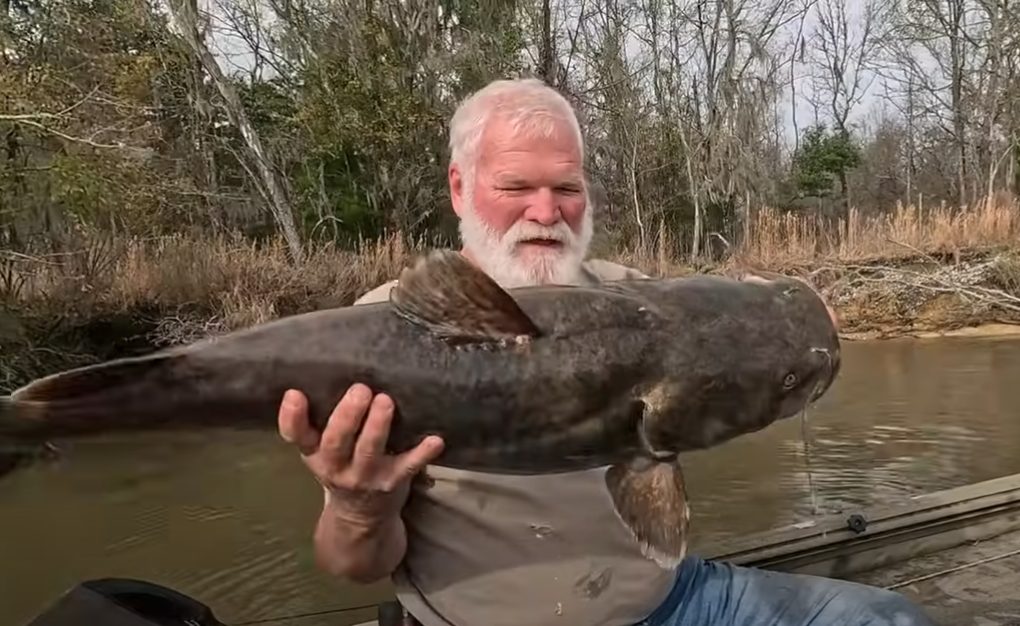
There’s something timeless about the art of set line fishing for catfish. Whether it’s jug lines drifting down the river, a stout limb line tied off to a cypress limb, or a bank pole bending under the weight of a big flathead, these old-school tactics are as effective today as they were generations ago. For anglers who enjoy both catching fish and tinkering with homemade rigs, set line fishing is a perfect blend of tradition, patience, and adrenaline.
I recently talked with veteran angler Darren Shirah about his approach to running set lines for catfish in Alabama’s Mobile-Tensaw Delta. His decades of experience shed light on both the practical side of the sport and the deeper enjoyment that comes from doing things the old-fashioned way.
Healthy Waters, Healthy Cats
The Mobile-Tensaw Delta is one of the most productive river systems in the country, and that diversity spills over into its catfish population. Fed by several major rivers and countless creeks and backwaters, the Delta is a blend of fresh and brackish water that creates prime habitat for flatheads, blues, and channels. Strong currents sweep baitfish through narrow cuts, deep holes provide ambush points, and sprawling cypress swamps offer refuge where big fish can grow old.
Shirah has spent much of his life learning these waters and says they remain one of the healthiest catfisheries around. “Our catfish population is very healthy, in my opinion,” he told me. “Blues, flatheads, channels, by far we have the best fishery in the state.” For him, the Delta’s Middle River stands out as a particularly rich hunting ground for catfishermen. “It’s probably the least fished of any of the rivers. I catfish a lot in there. It’s got good current, but it’s not as strong as the Mobile side.”

That combination of varied current, abundant forage, and relatively low fishing pressure keeps the Delta full of opportunity. One bend might hold a school of eating-size channels, while the next logjam could hide a 40-pound flathead. As Shirah put it, “Our Delta is extremely good.”
Flatheads First
While blues and channels fill plenty of coolers, it’s the flathead that captures Shirah’s imagination. Known locally as yellow cats, these predators are built different from their whiskered cousins. Their huge, gaping mouths and bulldog bodies make them perfect ambush hunters. “He’s a very unique predator,” Shirah said. “We think he’s laying in a hole somewhere, but he’s out hunting and looking for something. A 20-pound flathead has a mouth twice the size of a blue. They can eat whatever they want—bass, anything.”
Unlike channel cats that readily take stink bait or cut shad, flatheads are selective feeders. “They’re pretty much strictly live bait,” he explained. “They will hit a fresh dead brim, but he’s got to be just, just died. Cut bait probably ain’t gonna catch a flat on it.” To Shirah, that makes them a special challenge and a more rewarding catch.
He also sees flatheads as the tastiest of the trio. “That one is the most desirable fish for me, as far as eating goes,” he said. Blues, especially bigger ones, can have a stronger flavor if not cleaned properly, but flatheads are consistently mild and firm.
For Shirah, chasing flatheads is as much about the process as the payoff. To do it right, you have to invest time in catching live bait, often a morning spent filling a bucket with bream or crickets. “That’s just fun, you know,” he said. “Part of the whole thing is catching your bait. Then when you drop that bait at dark, you know you’ve got a chance at a real fish.”
Bait: From Croakers to Crickets
For Shirah, fishing for catfish starts long before a line ever hits the water. Catching bait isn’t a chore—it’s part of the ritual. He grew up in a time when store-bought bait was rare, and that mindset has stuck with him. “We never bought bait. We dug our own worms, caught our own crickets, grasshoppers, salamanders—whatever we could get. That’s in me, and that’s what I like,” he said.
Live bream are his go-to when targeting flatheads, and he puts in the effort to collect them himself. On a typical outing, he might burn through fifty crickets in the morning, fishing until he’s got a bucket of hand-sized bluegill. “I’ll get up around three o’clock, catch my bait, then set my lines,” he explained. “That’s part of it—catching your bait is just as fun as catching the catfish.”
When fishing for catfish, Shirah keeps things simple. A light bream pole, a handful of crickets, and the quiet patience to work the shallows are all he needs. Sometimes he’ll catch enough to keep them alive overnight in a livewell, but he’s quick to adapt if they don’t last. “I probably had twenty little brim, but they didn’t hold very good in the live well overnight. So I just cut them up for cut bait,” he said with a shrug.
He makes the bait-gathering process a family affair too. “I’m teaching my grandboys, I tell them, ‘We gonna fish in the morning, we gotta go get us some bait.’ That’s part of the whole thing.” For Shirah, the time spent chasing crickets and filling a bucket with bream is every bit as rewarding as running the lines later.
And while bream remain his favorite, he won’t overlook other options. Croakers, mullet, shrimp, and even crabs all have their place in his arsenal. But at the heart of it, he keeps coming back to the satisfaction of doing it himself. “I try to catch my own and have fun catching my bait. I’m having fun whatever I do, as far as fishing. I’m gonna enjoy myself.”
Bricks, Jugs, and Swivels
Every set-liner has their own favorite way to rig a jug, and Shirah’s system is both clever and practical. Instead of store-bought weights, he relies on half-bricks wired with a clip. “I like a half brick, and then I take a wire and wire it, make me a hook, little hook on there,” he explained. “It’s just a little cleaner and neater. I put all my half bricks in a milk crate with the wire clips, so when I’m ready to fish, I can grab one quick.”
The float is usually a Powerade or Gatorade bottle, some painted fluorescent green for visibility, others left plain. Each jug gets a mainline about 10 to 12 feet long. “At the bottom, I put a loop about a foot to 16 inches up, and that’s where I attach my hook,” he said. By keeping the bait just off bottom, the fish can find it while staying in their natural feeding lane.

Shirah uses a simple slip knot to connect the jug line to his brick. That makes it easy to remove the brick for storage or transport—jugs in one crate, bricks in another—without dealing with a tangled mess. “It’s easier to haul around that way. They don’t get all jumbled up,” he said.
The business end of the rig is a short tag line, about a foot long, with a hook and a swivel. “You can take those off easy, and they don’t get all hooked up and mess you up,” Shirah explained. When fishing for catfish, the swivels are crucial, especially when dealing with spinning blues and channels. “A blue is a spinner. They’ll twist and ball your line up until you just cut it loose and throw it away. That’s why I use good swivels, usually three-ways, so everything can spin.”
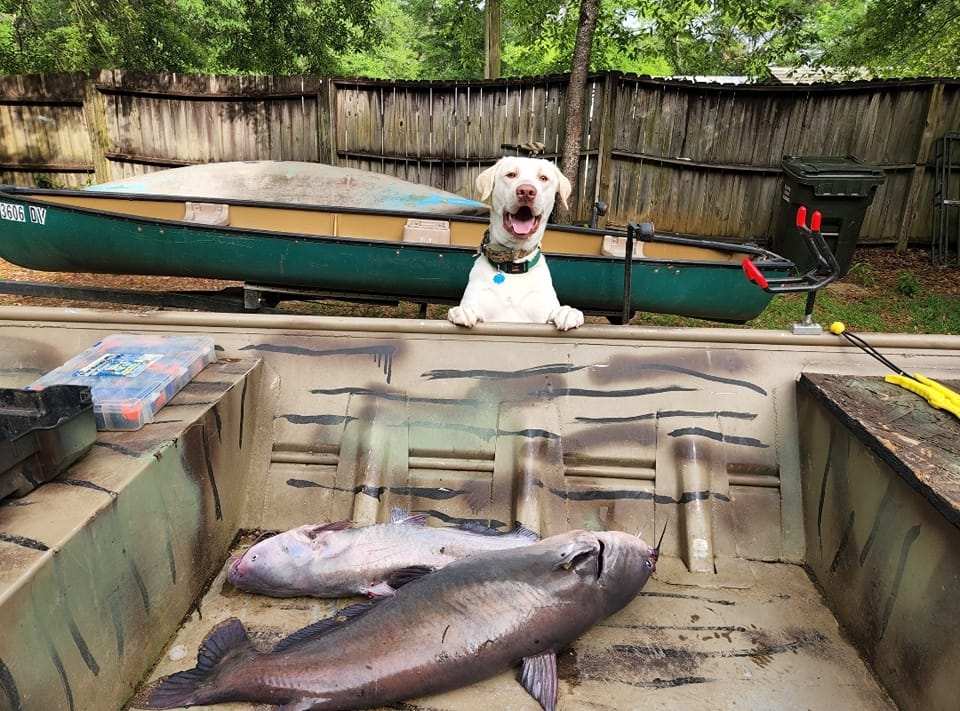
Once set, the rig is simple but effective. The brick keeps the bait anchored near bottom, the jug provides just enough tension to keep it in place, and a lively bream does the rest. “When you get a fish on it, you’ll see the jug pulling and moving,” Shirah said. “Them two fish I got this morning were not moving the brick—they’d pulled it a little ways and hung it on something. I knew a fish was on there, bigger than a brim, and sure enough they were catfish.”
For Shirah, the beauty of the system is that it adapts easily. On calm creeks and backwaters, the brick-and-jug keeps bait tight to the bottom during the day. But he knows other rigs have their place. “A short line, three to five feet under a noodle, that’s probably better at night when the fish roll up to the surface to feed,” he said. “But in the daytime, I like ‘em right on the bottom, smooth.”
Safety on the Water
For all the fun and satisfaction that comes with set line fishing for catfish, Shirah is quick to remind folks that safety has to come first. These aren’t light tackle rigs. They’re heavy hooks, strong lines, and big fish often fought in current or in the dark. It doesn’t take much for a good trip to turn dangerous.
“The safest thing in running lines is have two people,” he said plainly. “I’ve done it by myself, and I still do sometimes, but two is better.” Even with a partner, he never cuts corners on basic precautions. “Wear your life jacket. And keep a knife handy within arm’s reach. I’ve been hooked in the arm and nearly drug out of the boat from the current pulling you. If you get hooked up, you can just reach up there and cut your line and you’re done. You’re not getting drug out or drug under.”
That mix of common sense and caution is what keeps him coming back to the Delta year after year. For Shirah, running jug lines and chasing big cats is about more than filling a cooler—it’s about tradition, the thrill of the fight, and enjoying every part of the process, from catching bait at dawn to pulling a jug at dusk. But above all, he says, it’s about doing it safely so you can enjoy it again tomorrow.
“You’ve got to respect the water,” he said. “Wear your life jacket, fish with somebody if you can, and have fun. That’s what it’s all about.”