
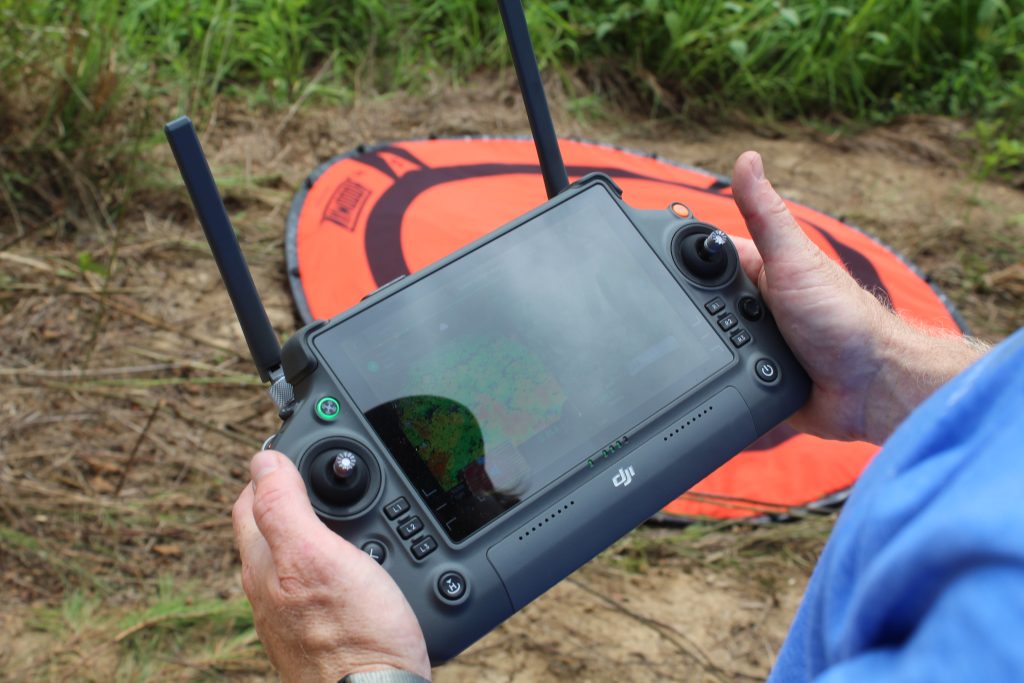
Most deer hunters build their management plans around what they can see. They watch food plots from a box blind, check trail cameras, map tracks, compare buck pictures, and try to piece together what is happening on the property from small windows of information. Over time, those observations start to feel like facts, that a certain cutover is “full of deer,” a certain field “always has does,” or a coyote running through a greenfield “ruins the hunt.” A tract has “plenty of deer,” or maybe “not enough bucks,” simply because hunters have seen that from the stand. But assumptions are not data, and that is where drone deer surveys and getting above the property to see the whole picture become invaluable.
After surveying 192,000 acres of deer habitat last season, Justin Ballard of Paragon Aerial Solutions has had a view of whitetail properties that most landowners will never get. His company uses drones to survey deer, document buck-to-doe ratios, identify where deer are actually spending time, and give landowners data they can use to make better management decisions. Last season alone, Ballard said Paragon surveyed “right at 192,000 acres” just on deer surveys, roughly triple the acreage from the previous year. That amount of ground changes the conversation: it is not one hunter’s opinion from one box stand or one trail camera on one feeder, but observation across more than 100 properties and thousands of deer. Ballard said, by his rough estimate, the company looked at more than 20,000 deer last year—a number that quickly challenges long-held assumptions.
“Man, we’ve learned all kind of crazy good stuff out there,” Ballard said. The biggest lesson may be that good deer management is less about guessing and more about getting the right information. A landowner may still need a wildlife biologist, a forester, a good burn plan, better food plots, or more disciplined harvest goals, but the starting point is knowing what is really on the property and where those deer are actually living.
Mature Bucks Usually Come From Balanced Herds
Most hunters want mature bucks, but not everyone manages in a way that produces them. One of the clearest patterns Ballard has seen is that properties with good mature bucks tend to have their buck-to-doe ratios in good shape. That does not mean a drone survey turns every property into a trophy farm, and Ballard is careful to point out that he is not a wildlife biologist. But after flying the same properties over multiple years and watching how landowners respond to the data, the trend is hard to ignore. “I can tell you for certain that on the properties that have mature bucks, good, nice bucks and several of them, more times than not, they’ve got their buck-to-doe ratio in a good place,” Ballard said.

That matters because a lot of hunters are still working from assumptions. Maybe the club has always shot 20 does a year, so they keep shooting 20; maybe they do not shoot many does because they are afraid of seeing fewer deer; or maybe they pass three- and four-year-old bucks that will never be more than average deer because they believe every buck gets better with age. Those ideas may be right for one place and wrong for another, but without a real count, the landowner is guessing. Ballard said the value of a drone deer survey is that it gives a more accurate look at the ratio of bucks to does on the property so landowners can decide what kind of herd they want and what harvest strategy gets them closer to that goal.
That does not mean every landowner has the same goal. Some people simply enjoy seeing a lot of deer, while others are willing to see fewer deer if it means a better age structure and more mature bucks. But Ballard said many properties do not get both. “A lot of people want their cake and be able to eat it too,” Ballard said. “Either you need to manage the property for harvesting mature bucks, or do you want to see a lot of deer? Most places, you don’t have the luxury of both.” That may be uncomfortable for hunters who love watching 20 deer in a greenfield, but it is one of the most practical lessons from the surveys: if a property is carrying too many deer, the food and cover have to be divided among too many mouths, whereas bringing the herd closer to balance may result in fewer deer per sit, but better overall conditions for those that remain.
The Best Properties Reduce Stress
When Ballard was asked what separates properties that consistently hold mature bucks from properties that do not, he did not start with antler genetics, mineral sites, or a magic food plot blend. He started with stress. “I think stress is the number one pressure,” Ballard said. That may sound simple, but it touches everything on a deer property. Good cover, adequate food, good bedding, and low human pressure all reduce stress, allowing a property to hold more of its own deer because they do not have to leave to meet basic needs. “The properties that have good food sources and tons of bedding, they’re self-sufficient, and they hold their own deer,” Ballard said.
That is the difference between a property that occasionally benefits from deer passing through and one that consistently holds deer. A tract that has only food may pull deer at certain times but lose them when pressure rises or bedding is better next door, while a tract with only bedding may hold deer during the day but send them elsewhere to feed. The best properties have enough of each piece that deer can live there with less reason to move.
For many landowners, this is where drone deer survey data becomes more useful than a simple deer count. Paragon drops pins where deer are located during the flight, allowing landowners to see where deer are concentrated so the real work can begin on the ground. If deer are consistently using one block of timber, the landowner can ask why, and if another area looks good on a map but does not hold deer, he can look at what is missing. That kind of data can fundamentally change a management plan—whether a section needs more cover, an old field needs to be converted, stand access is blowing scent into bedding areas, or the best move is simply to stop going into places where deer already feel safe.
Deer Are Not Always Where Hunters Think They Are
One of the more surprising things Ballard has seen is where deer spend most of their time in the Southeast. Many hunters, especially those who grew up hunting cutovers and hardwood bottoms, assume deer will be in the thickest, nastiest cover on the place. Ballard expected some of that too, but after flying thousands of acres, he said the strongest pattern has been deer use of managed pine plantations. “I always thought that your deer were going to be in the thickest areas, like the cutovers, and I also thought that they were going to be in those big hardwood bottoms,” Ballard said. “Not to say that they’re not, but, overwhelmingly the most popular spot for the majority of the deer is in the pine trees.” More specifically, “Usually it’s about a 15- to 20-year-old pine plantation that has been thinned a couple of times, and of course on a burning regimen,” Ballard said. Those stands have canopy, but they also have enough sunlight reaching the ground to create usable understory.
That observation can change how landowners think about timber management. A wide-open clearcut may be easy to see across, so you might see deer there every time you hunt it, and it may be great at certain stages, but visibility does not always mean deer are spending the most time there. Ballard said he grew up liking cutovers too, but after seeing properties from above, he has questioned whether hunters like them partly because they can see more ground. “Maybe the reason I liked hunting cutovers growing up was because I thought I saw deer in there more often,” Ballard said. “Well, oftentimes you can see a long way in a cutover.” That does not mean clearcuts are bad or that landowners should never clearcut timber, but it means deer habitat and hunter visibility are not the same thing: a thinned and burned pine stand can offer cover, food, and security while still being open enough for deer to move comfortably.
Sanctuaries Work, Even When Landowners Do Not Call Them Sanctuaries
Hunters talk about sanctuaries all the time, but the word can mean different things depending on the property. For Ballard, a true sanctuary is not just a place that is hard to hunt or a piece of ground nobody likes; it is usable deer habitat that receives little to no pressure. By that definition, sanctuaries have been one of the more noticeable patterns in the drone deer surveys. Ballard said that out of the properties surveyed last season, roughly a dozen or more had what he would call a true sanctuary, and the difference was obvious from the air. “By sanctuary, I mean an area that they truly do not mess with,” Ballard said. “They never go in there, but then you get to flying the property, once you get over the areas, that’s where the deer are.”
The important part is not just that deer are present, but how they behave. Ballard said deer in those low-pressure areas look calmer—they are not on their feet looking around nervously, but bedded and relaxed. “They just look calm,” he said. “They’re not on their feet looking around the whole time. They’re just laid up. They look relaxed, and it’s noticeable.”
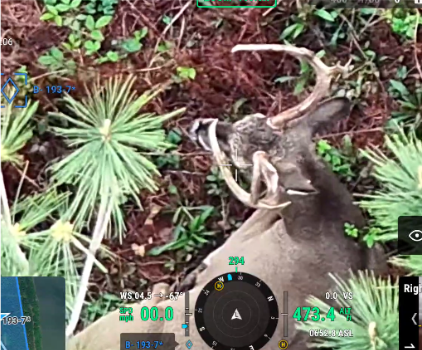
There is no perfect acreage rule for a sanctuary. A 300-acre property may not be able to give up 100 acres that no one ever enters, whereas larger tracts may set aside hundreds. Ballard has seen sanctuaries of 50, 60, or 70 acres on smaller tracts and 500-acre sanctuaries on larger properties, proving that size matters less than function: it needs to be habitat deer actually want to use, and it needs to stay quiet. He has also seen properties where the landowner did not call an area a sanctuary at all, but simply never went there due to poor access or lack of food plots. “We’re flying properties, and people don’t call it a sanctuary, but that’s what it is,” Ballard said. “Because you never go there, of course, there’s no pressure, no stress out there.” For landowners, that lesson is easy to apply: fewer UTV rides, better access routes, shorter walks from the edge, smarter stand placement, and a willingness to leave some places alone can all make a significant difference.
Rut Activity Looks Different From 400 Feet Up
Every deer hunter has seen a buck chasing a doe across a greenfield or slipping through the woods behind her. From the stand, it may look like one or two bucks are involved, but drone deer surveys have shown Ballard that the picture is often much bigger. “What we’ve realized is when you’re 400 feet in the air and you can see the whole big picture, very rarely is it less than eight or 10 bucks chasing that same doe,” Ballard said. That kind of observation explains why rut hunting can feel so random from the ground: a hunter may sit for days seeing only cruising bucks, then suddenly be in the middle of chaos because he happened to be near a doe that was truly ready. Ballard said when a doe is in heat, the bucks in that area are often gathered within a relatively small zone around her. “Usually all the bucks in that same area are, when she’s in heat, they’re all within a 25-, 30-, 40-acre area of that doe,” he said. “They’re all running after each other.”
That does not necessarily give hunters a simple formula, but it reinforces that rut activity seen from a stand is only a small slice of what is happening, and that a balanced herd and mature buck age structure matter deeply. It also gives hunters perspective: when the woods seem dead one day and wild the next, it does not mean the rut “started” or “stopped,” but simply that the hunter was or was not near the right doe during her short window.
Predators May Not Ruin A Hunt The Way Hunters Think
Many hunters have had the same reaction to seeing a coyote during a sit: the hunt is over, the deer got pushed out, and nothing else will happen. Ballard used to think that way too, but drone deer surveys have changed his mind. “I would have always thought that the predators kind of mean the end of the hunt, and it ruined the day,” Ballard said. From the drone, he has seen coyotes bedded within 50 or 60 feet of bedded deer, completely aware of each other without the expected panic, and has even watched a mature buck turn the tables on a predator. “I’ve got it on film,” Ballard said. “He was probably a mid-135-inch deer, a nice decent deer for Alabama, but he’s walking by an old pine tree or something that had fallen over, and a bobcat jumped out. He chased that bobcat up the tree.” While coyotes certainly impact fawn recruitment, seeing a predator does not automatically ruin a hunt. “That no longer means my hunt’s over,” he said. Deer live around predators every day and may be far more tolerant of their presence than hunters assume.
Trail Cameras Help, But They Do Not Tell Everything
Trail cameras are one of the most useful tools deer hunters have, but they are still limited to what walks directly in front of them, and triggers the image. While some property owners review thousands of photos a week and have a solid grasp on their herd, the drone often finds deer they have never seen before. For most landowners, the bigger issue is overestimating total deer numbers. “I’d say the majority of people always think they’ve got way more deer than what they do,” Ballard said.

That can affect management in several ways: a landowner who overestimates buck numbers may be afraid to harvest enough does, while another may believe he has more mature bucks than he actually does due to repeat photos of the same individuals. Furthermore, someone might assume a buck was killed or left the property simply because he stopped showing up on camera. Ballard said Paragon frequently gets calls from landowners who lose track of a known buck later in the season, only for a drone deer survey to find him still bedding nearby. “People think that the buck’s not on their property, that they think he’s gone,” Ballard said. “They think somebody else shot him. But if they did know, now maybe you don’t hunt him as hard because you’re not worried about him not being there.” That information allows hunters to adjust their strategy, hunting smarter, reducing disturbance, and waiting for the right conditions rather than burning out the area.
Every Buck Is Still An Individual
As much as drone data can reveal patterns, Ballard has also learned that mature bucks do not all behave the same way. Some have small home ranges outside the rut, while others travel much farther or cover a mile or more in a short period. “Every buck’s different,” Ballard said. Even on the same property, one mature deer may spend most of his time in a small block of cover while another roams widely, a pattern that gets even harder to predict during the rut. “There’s some mature bucks that just don’t move around a whole lot outside of a few weeks of rut,” Ballard said. “And then there’s other bucks that we’ll follow around and track them for a mile, mile and a half in a six-hour period.” Ultimately, that reinforces the importance of obtaining property-specific information rather than relying on broad generalizations.
The View From Above Changes the Way You Manage
The common thread is that what hunters see from a stand, a trail camera, or even years of experience on a property is still only part of the picture. The more complete that picture becomes, the easier it is to make decisions based on what the deer are actually doing instead of what hunters assume they are doing.
That does not mean a drone replaces good habitat work, disciplined harvest decisions, or time spent learning a property. Drone deer surveys simply give landowners another piece of information and in some cases, information that challenges what they thought they already knew.
After seeing nearly 200,000 acres from above, Ballard’s experience suggests that some of the biggest improvements in deer management may start with a simple question: What if what you think is happening on your property isn’t actually what’s happening?