
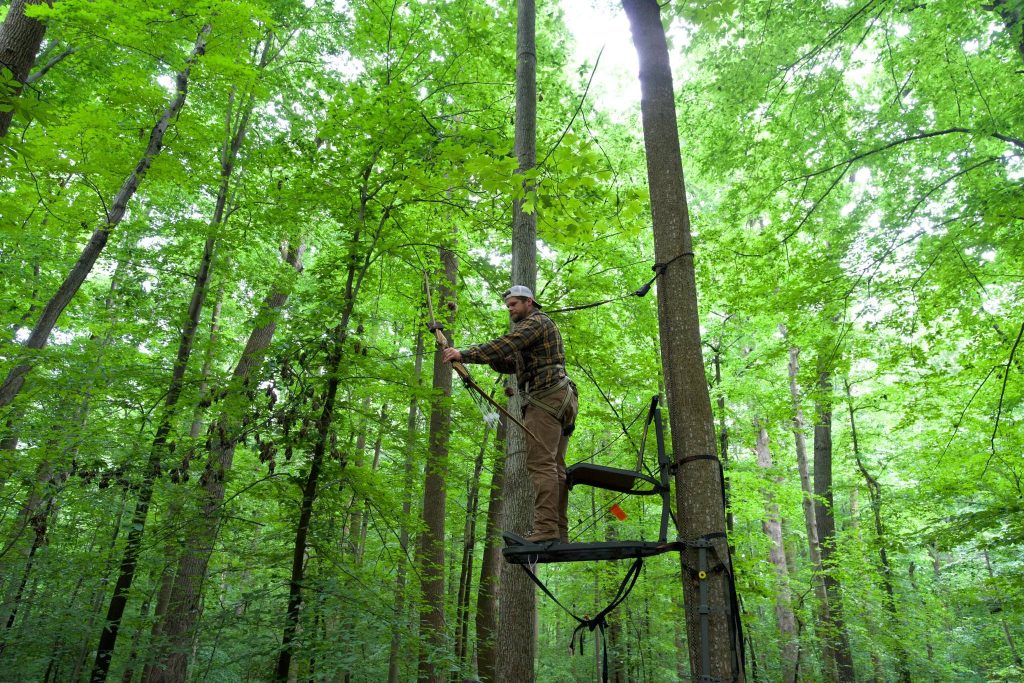
Hanging a treestand is enough work that it is worth getting right, especially in the Southeast, where a lot of preseason stand work happens during the hottest part of the year. You can spend several miserable, buggy, sweaty weekends hauling stands, climbing trees, trimming limbs, cutting shooting lanes, and sweating through your clothes, only to discover during hunting season that a few avoidable treestand mistakes have left you with a setup that just doesn’t work.
Over the years, I have hunted private leases, hunting clubs, and public land throughout Alabama and neighboring states. One of the interesting things about public-land hunting is that you get to see a lot of other hunters’ setups while you’re scouting. I’ve always found myself studying those stands and wondering why somebody chose that particular tree, how they were getting to it, what they were trying to hunt, and whether I would have done anything differently. And of course, I’ve also made plenty of mistakes with my own stands over time.
Most of the biggest problems aren’t complicated. Hunters put stands where deer aren’t likely to move during daylight, choose a good general area but the wrong tree, or don’t think about how they’re going to get in and out without disturbing deer. Other times they hunt the wrong wind, climb too high, don’t trim enough shooting lanes, or choose a stand that’s so uncomfortable that they can’t sit still when it matters. Fixing those fundamental issues can make a much bigger difference than simply adding another stand to the property.
Your Access Can Ruin a Perfect Stand
If I had to identify treestand mistakes that has caused me the most trouble over the years, it would probably be ingress and egress. Hunters spend a tremendous amount of time asking where the deer are and where the stand should go, but then they forget that they have to physically get there. A stand can be positioned over great sign and still be almost worthless if reaching it requires walking through the area where deer are feeding or bedding.
I’ve made that mistake myself on public land. I hunt one swamp property where the easiest walking is through relatively open oak woods because the ground is high and dry. For years, that seemed like the obvious way to get into the area, but the problem was that those same oak woods were where deer were feeding at night. I was walking through them in the dark on my way to hunt the edge of thicker cover, bumping deer before I ever reached the stand. It took me an embarrassingly long time to realize that the jack-o-lantern eyes I was seeing every time I walked in were the deer I was counting on walking by me later in the morning.
Today, I carefully consider where the deer should be at the exact time I’m entering or leaving. If I’m walking in before daylight or leaving after dark, I assume deer may be feeding, whereas if I’m moving through the property during daylight, I think about where they’re likely to be bedded. Sometimes the easiest route is exactly the route you shouldn’t take.
A good access route often uses areas where human activity is already normal. Deer can become surprisingly tolerant of vehicles on roads, people walking established trails, farmers moving around equipment, or boat traffic on a creek. What tends to bother them is something unusual happening in a place where they normally feel secure. If the deer are accustomed to trucks driving a road, getting dropped off near a stand may create less disturbance than parking half a mile away and sneaking through the woods. I’ve hunted places where accessing the stand by boat or canoe was even better. One thing is certain, deer don’t feed or bed in lakes and rivers!

One of my public-land stands eventually became an extreme example of that strategy. I knew the area was good because several scrape lines came together there every year, but I constantly had trouble getting into it without bumping deer. Eventually I quit approaching it through the dry woods altogether. Now I access it from the river, get out in hip waders, and walk through a tupelo-cypress swamp where there’s little food and nowhere dry for deer to bed, though I don’t hunt that stand unless I can stay most or all of the day. Sometimes that kind of inconvenience is simply what it takes to hunt a good location correctly.
Overlooking your entrance and exit trail is one of the treestand mistakes that can ruin an otherwise good setup. That route deserves almost as much preparation as the stand itself. If you have to walk through the woods, trim the route so you aren’t fighting brush in the dark, and mark it well enough that you can follow it quickly without wandering around. In some places I’ve gone as far as mowing a trail through the woods. The goal is to give yourself as little opportunity as possible to disturb deer. Like I tell my kid in the grocery store, “Don’t wander off, don’t touch anything, and please try to be quiet for just a little bit, ok?”
And sometimes the correct conclusion is that a great-looking spot simply isn’t huntable. There are places where, if somebody could lower you into the tree from a helicopter, you’d probably kill deer, but there may be no realistic way to get there without blowing them out. In that case, your best option is to hunt somewhere else along the deer’s route.
Don’t Force a Stand on the Wrong Wind
Most hunters understand the basic idea of hunting the wind. If your scent cone crosses the route you expect a deer to use, you are asking for trouble. But wind discipline starts long before you reach the stand. A deer doesn’t have to walk underneath your tree to smell you; it can smell you approaching the area, and it can encounter the scent you leave behind after you’ve gone. That’s another reason why understanding bedding and feeding areas matters so much.
Thermals can complicate the picture even more. In the relatively flat country I hunt, I don’t obsess over thermals everywhere, but there are situations where they make a stand extremely difficult to hunt. Creek bottoms are a good example: in the evening, cooling air can carry and pool scent into those bottoms, making them particularly tricky to hunt late in the day. On the other hand, a cold morning on higher ground can work beautifully if you’re elevated and warming air is carrying your scent upward, creating a much more forgiving setup.
Some stands are simply wind-specific, which is one reason I like having more than one stand available around major features such as food plots. When my dad and I hunted a lease together, we often had two stand locations on the same food plot to give us options as the wind shifted. We would also frequently set up an obvious gun stand alongside a smaller, less conspicuous bow stand tucked into the woods, letting us choose the setup that fit that day’s conditions rather than forcing the same stand to work every time.
One of the most costly treestand mistakes is knowing the wind is marginal but hunting the stand anyway because you don’t have anywhere else to go. Do that enough times and you’re going to burn out a good location.
A Good Area Can Still Have a Wrong Tree
This is probably one of the most common mistakes I see. Finding the right general area is not the same thing as finding the right treestand location. With bowhunting in particular, there may be only one specific tree that makes the whole setup work.
A rifle hunter can cover a large area. If I’m gun hunting a road, clearcut, ridge, or food plot, I’m thinking primarily about visibility so I can take advantage of shooting a deer 100 or 200 yards away. Bowhunting is entirely different, as your useful hunting area is essentially a circle extending about 20 yards around the tree, which means you have to commit.
If I’m hunting a scrape with a bow, I want to be within roughly 20 yards of that scrape; if I’m hunting a hot feed tree, I want to be right on top of it; and if I’m hunting a trail or creek crossing, I want to be right on the movement I’m expecting. One big mistake hunters make is trying to bowhunt what is really a gun stand because they’re afraid to get close enough to the deer to actually kill one. Or trying to, in the words of Reese Witherspoon’s dad in Sweet Home Alabama “ride two horses with one ass.” Sometimes you have to pick exactly which scrape, feed tree, or trail crossing you want to optimize your location for, and not try to hang a stand where you “maybe” could shoot two or three target areas.
Food plots are a great example of this. If I’m bowhunting a food plot, I often don’t want to be right on the edge of the opening at all. Instead, I would rather identify the trail deer are using to approach it and move 10 or 20 yards back into the woods. A deer approaching an open plot often pauses at the edge to study the area before stepping out. By sitting back on the approach trail, you can get an opportunity while the deer is still relaxed and feels hidden by the timber, with its attention directed toward the opening ahead instead of toward you.
That brings up another factor that gets overlooked: where is the deer naturally going to look? If a trail points directly toward your tree, the deer is approaching with its eyes facing right at you. I’d much rather position myself off to the side so the animal passes at an angle, so don’t just think about where the deer will walk, think about where its head and eyes will be pointed.
The easiest tree is not always the best tree, either. I’ve found public-land stands where somebody chose the lone straight pine in an open area simply because it was easy to climb, resulting in a setup visible from 100 yards away that deer could easily spot. Sometimes the right answer is to use a less convenient tree, a different type of stand, or even no tree at all.
Let the Location Choose the Stand
For a period of my hunting career, I became a tree-saddle guy and wanted to hunt everything from a saddle, but I eventually realized that was a mistake. I’ve gone almost full circle now, utilizing hang-ons, climbers, ladder stands, saddles, ground blinds, enclosed blinds, or simply sitting on the ground depending on what problem needs solving.
There are plenty of places where climbing a tree doesn’t accomplish anything. In a marsh, young pine plantation, mature palmettos, or other low-cover environment, getting higher can actually reduce your visibility or make you more visible to deer. I’ve hunted situations where sitting low in a turkey seat let me see underneath vegetation much farther than I could from a tree, just as there are places where a tripod solves a problem simply because there isn’t a useful tree nearby.
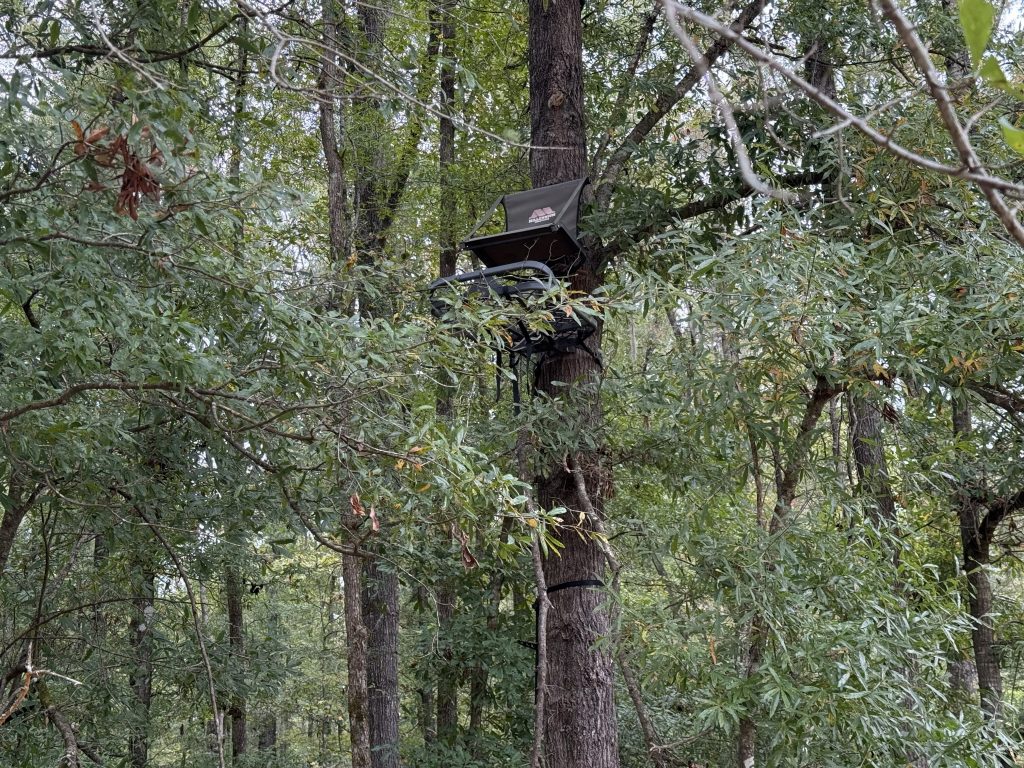
Permanent ladder stands and larger setups make sense in locations you’ve already figured out, while lightweight hang-ons, climbers, and saddles shine when you’re still learning a spot. In fact, using a climber for a season is a great way to test a location before committing to a permanent setup—something I wish more hunters would do. Put the portable stand there first, hunt it, learn where the deer actually move, and figure out the right height in the right tree. If you realize you need to shift 20 yards, moving a climber or lightweight stand is a lot easier than relocating a big two-man ladder stand that took three people to install.
Stop Being Afraid to Move the Stand
Hunters can become strangely attached to a treestand once they’ve done the work of putting it up, and I’ve certainly been guilty of it too. One of the biggest treestand mistakes is letting that effort keep you in the wrong spot. The reality is that I rarely feel like I absolutely nailed a stand location on the first attempt; sometimes I’ve hunted an area for two or three years before I really understood how I wanted the stand positioned, and there are places I’ve hunted much longer where I’m still fine-tuning things.
If deer routinely see you before you’re able to shoot, or if trail cameras show daylight activity disappearing the moment you start hunting, something about your stand location, stand access, or how you hunt that stand is off. This is why every property you hunt should have at least one stand option that can be moved easily, whether that’s a climber, lightweight ladder stand, saddle, or portable hang-on. Things constantly change: timber gets cut, an oak suddenly starts producing heavily, a scrape line appears in a new location, or a buck shifts his pattern. You want to be able to react quickly, and a stand that is such a project to relocate that you refuse to move it will ultimately cost you more opportunities than a simpler stand you are willing to put exactly where it belongs.
One way to make that kind of flexibility easier is to use a stand that can be moved between multiple trees without having to start the installation process from scratch every time. That’s something I particularly like about Millennium’s camLOCK receiver system. Instead of permanently committing a hang-on stand to one tree, you can install receivers in several locations and move a compatible Millennium stand between them as conditions change. The receiver stays attached to the tree, and the stand’s mounting post slides into it and locks into position. You’re still responsible for having a safe climbing system at each location, but you aren’t wrestling with the entire stand attachment process every time you decide to hunt somewhere different.
Millennium offers several stands that work with this system, including the M100 Ultralite, M60U Ultralite, and M150 Monster. The M100 is a good all-around option for someone who wants a relatively lightweight stand without sacrificing comfort, while the 13-pound M60U makes sense for hunters who expect to move around frequently. The M150 is a larger stand with a roomy platform and adjustable seating, making it a better fit for someone who spends long hours in the tree. All three use the same receiver system, so the decision really comes down to how much weight you’re willing to carry and how comfortable you want to be once you get there.
I think this approach makes a lot of sense on properties where you’ve identified several promising locations but don’t necessarily want to buy a separate stand for every one of them. You might have one tree overlooking a scrape line, another positioned for a different wind, and a third tucked along a travel corridor that only becomes productive during the rut. Rather than leaving three stands hanging in the woods all season, you can move the same stand between those locations as needed. It also makes it easier to experiment with a spot before deciding whether it deserves a more permanent setup. The important thing is having the flexibility to hunt where the deer are actually moving and avoid one of the most common treestand mistakes: feeling obligated to sit in a particular tree simply because that’s where you spent an afternoon hanging a stand.
Don’t Climb Past Your Cover
There isn’t a magic treestand height. I’ve killed deer with my feet only a few feet off the ground, sitting on the ground, and hunting 30 feet up; it all depends on the specific location. The biggest rule I follow is to never climb past my cover. One of the easiest treestand mistakes to make is assuming higher is always better. If climbing another five feet puts you above the surrounding limbs and leaves you silhouetted against open sky, you’ve made the setup worse. With a bow, excessive height can also create severe shot angles at close range.
I pay particular attention to what’s behind me, as a big tree trunk can hide a hunter better than a bunch of small limbs in front. I actually prefer relatively open shooting lanes in front of the stand with substantial cover behind me so I can see the deer before it sees me. If an animal approaches from an area I can watch, I can control my movement, whereas the animal that sneaks up behind me is the one likely to catch me moving. That’s also why I rely on tree trunks and permanent structure for concealment rather than leaves, which fall in December and leave a previously hidden October stand completely exposed.
Trim Enough Shooting Lanes
Hunters worry so much about concealment that many don’t trim enough, but that’s one of the treestand mistakes I’ve learned to avoid. I’ve lost far more shot opportunities because I couldn’t get an arrow or bullet through vegetation than because a deer saw a trimmed shooting lane. If I’m going to cut lanes, I want them wide enough to actually use, ideally radiating out from the stand in several directions so a deer doesn’t have to hit one tiny opening perfectly.
This is especially important with a bow, where you have to think through the entire mechanics of the shot: where you can draw, where the animal will be at full draw, whether you can turn your body, and whether limbs will block your bow. A stand isn’t properly set up just because you can see a deer from it—you have to be able to execute a shot and kill one from it.
Comfort Is a Hunting Advantage
Treestand comfort gets treated like a luxury, but overlooking it is one of the treestand mistakes that can cost you time in the woods. I consider it a vital hunting tool because if you’re uncomfortable, you’re going to move. Your back starts hurting, your feet go numb, or your legs need stretching; eventually you shift your weight, and deer have an incredible habit of showing up at exactly that moment.
I’ve had cellular trail-camera pictures of bucks walking past stands 20 minutes to an hour after I climbed down, and I’ve seen enough late-morning movement that I try to stay until at least noon whenever possible. There is a legitimate 10-to-2 period when deer get up on their feet when most hunters are napping or watching the game, but you have to physically stay in the tree to take advantage of it.
The rut really drives that lesson home. I know that if I sit a funnel in a couple of locations long enough during the right two-week period, eventually a mature buck is going to move through. It’s as certain a fact of nature as the tide changes and the sunrise. He may come Monday or he may come Friday, so my job is simply to still be sitting there when he does. Trying to do that from an uncomfortable stand is brutal.
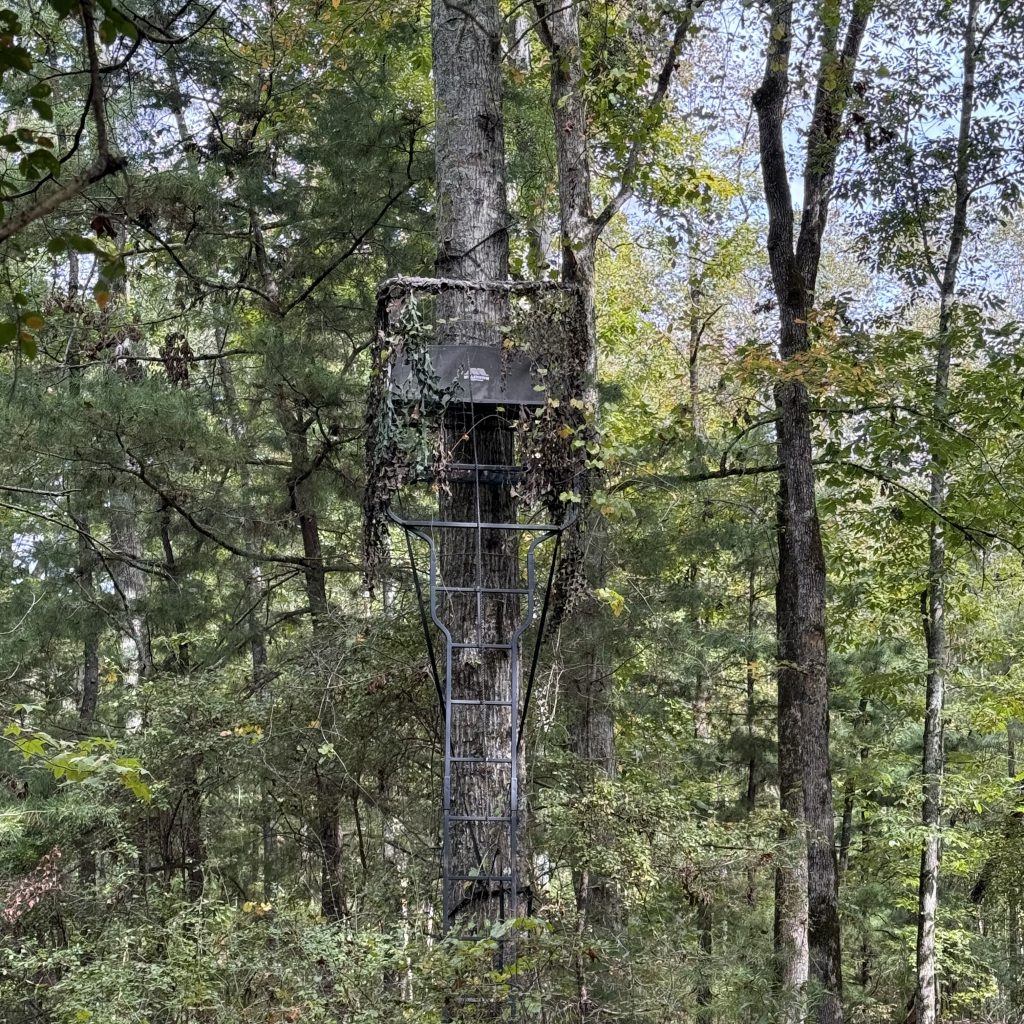
That’s one of the biggest things I’ve always liked about Millennium stands: their seating is genuinely comfortable. The mesh-style seats are especially nice during hot early-season hunts, a good backrest makes a major difference as the hours pile up, and features like swiveling seats or a footrest let you shift pressure without constantly fidgeting. A roomy platform matters too, giving you space to position your pack, move freely without banging into things, and tolerate long sits.
I think the mobile-hunting world has occasionally taken the lightweight philosophy too far. I did it myself, prioritizing weight to the point that comfort became secondary. If you’re buying a saddle, lightweight hang-on, or other portable stand, it still needs to be comfortable enough that you can remain reasonably still for several hours. Saving a few pounds on the walk in isn’t much of a victory if the stand becomes unbearable before the best part of the hunt.
Sometimes an Enclosed Stand Is the Right Tool
I’ve changed my opinion on enclosed stands as I’ve gotten older. For a long time I wasn’t a big shooting-house guy, but hunting with my wife, having a child, and spending more time on long rut stakeouts changed my perspective. There are situations where being fully enclosed is fantastic.
Inclement weather is an obvious example. Some of the most productive deer movement happens around changing weather, and an enclosed stand lets you stay comfortable through rain, cold, and wind that might otherwise drive you out of the woods. That is where designs such as Millennium’s Buck Hut series make complete sense: if the location allows for an enclosed setup, the ability to get out of the elements, shift your weight, pour a cup of coffee, or eat something without every movement being visible makes a long hunt dramatically easier. That doesn’t mean every stand on the property should be an enclosed box, but rather that you should match the tool to the location.
Don’t Hunt a Good Stand to Death
Finally, remember that a treestand is not automatically good every day just because it produced once. One of the most common treestand mistakes is hunting a location too often. Some locations can tolerate tremendous pressure—if a stand can be accessed directly from a road or approached cleanly by boat, I may be willing to hunt it repeatedly—while other stands are almost one-shot propositions.
A good clue is what happens to daylight activity. If you were consistently seeing deer or getting daytime trail-camera photos and those same animals suddenly start showing up strictly after dark once you begin hunting, you’ve likely applied too much pressure. Multiple stand locations help prevent that by giving you options when the wind isn’t right, when a spot has been hunted heavily, or when conditions favor another area. Still, more stands aren’t automatically better—I’d much rather enter hunting season with three or four locations that I really understand than a dozen mediocre stands scattered across a property.
Build the Setup Around the Deer
Treestand hunting gets complicated because it’s easy to focus on the hardware. Hunters debate stand types, height, camouflage, and equipment when the more important question is whether the entire setup works together in context. Can you get there without disturbing deer? Can you hunt it on the wind you’ve chosen? Are you close enough to the movement you’re trying to intercept without being spotted? Can you actually draw your bow or shoulder your rifle, and can you remain comfortable enough to still be sitting there when an opportunity finally arrives?
If one of those pieces doesn’t work, fix it. Trim another shooting lane, change the access route, hunt a different wind, adjust the height, move the stand 20 yards, replace an uncomfortable seat, or swap stand styles altogether. One of the biggest treestand mistakes is assuming that because you’ve put the work into hanging a stand, the job is finished. Sometimes the deer are telling you exactly what’s wrong—you just have to be willing to move.