
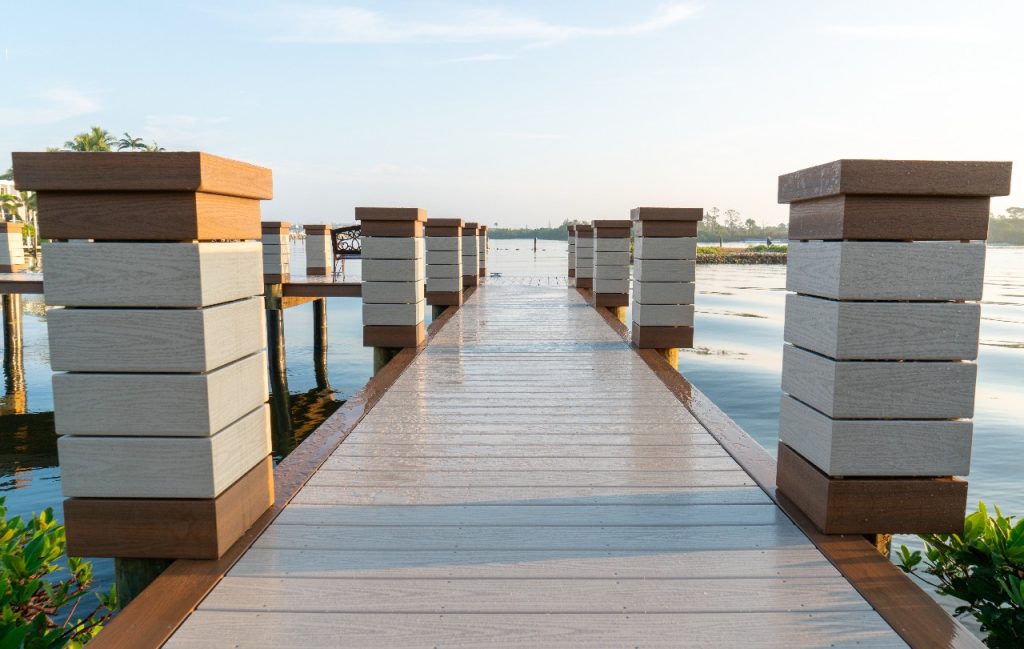
A dock may look like a deck built over water, but that is where the similarity ends.
A backyard deck has to stand up to rain, sun, furniture, foot traffic, and the normal wear that comes with outdoor living. A dock has to do all of that while sitting in one of the toughest environments a building material can face. Depending on where it is built, a dock may be exposed to saltwater, wave action, strong UV, heat, humidity, storms, and movement that a deck attached to a house never has to handle.
That difference is the first thing dock owners need to understand before choosing deck boards. The best material is not always the cheapest board, the prettiest board, or the one they used on their porch. The best material is the one that matches the dock, the water, the structure, the budget, and the way the dock will actually be used.
This article looks at the major deck board options a dock owner is likely to consider, including pressure-treated wood, composite decking, PVC decking, open-flow polypropylene panels, and aluminum. It also looks at the tradeoffs that matter on the water, including cost, heat, moisture, maintenance, installation, repair, span, comfort under bare feet, and whether the material makes sense for freshwater, saltwater, fixed docks, floating docks, walkways, ramps, or resurfacing jobs.
Charlie Haines of Eastern Metal Supply said the first questions he asks about a dock project are simple but important.
“Where are they? Are they in salt water or are they freshwater?” Haines said. “What kind of project is it? Is it oceanfront? A freshwater lake? Is it a floating dock? Is it a fixed dock?”
Those questions start to narrow the field. A fixed dock on a freshwater lake is not the same as a floating dock in a coastal marina.
Build it to Last
For many dock owners, the goal is not just to build something that works for a few years. They want to build it once and spend their time enjoying the water instead of maintaining the dock.
“A lot of people, when they get around to building a dock, it’s a little bit different than a deck attached to your house,” Haines said. “They want that thing to be the last dock they build. They want to show up there and just enjoy it. They don’t want to do maintenance on it or repairs because that window of opportunity for them to get all the enjoyment out of it is pretty small most of the time.”
That is why dock boards need to be chosen with long-term performance in mind. A dock is often a place for fishing, swimming, tying up boats, launching kayaks, cleaning gear, sitting with family, and watching the water at the end of the day. If the boards crack, splinter, fade, warp, get too hot, or become a maintenance headache, the dock stops being a place to relax and starts becoming another project.
Moisture Resistance Should Be Near the Top of the List
When Haines is thinking about dock boards, moisture resistance is one of the first things he looks at. A dock may not be submerged all the time, but it is still in a wet environment. In coastal areas, the dock is exposed to humidity, splash, rain, salt spray, and storm conditions. Even on freshwater, moisture is a constant factor.
“You have to think about, what am I choosing that’s really going to be resistant against moisture?” Haines said. “Being constantly wet. If it is coastal, that thing might as well just be constantly wet.”
That is where the differences between treated wood, composite, PVC, aluminum decking, and open-flow panels like Sure-Step become important.
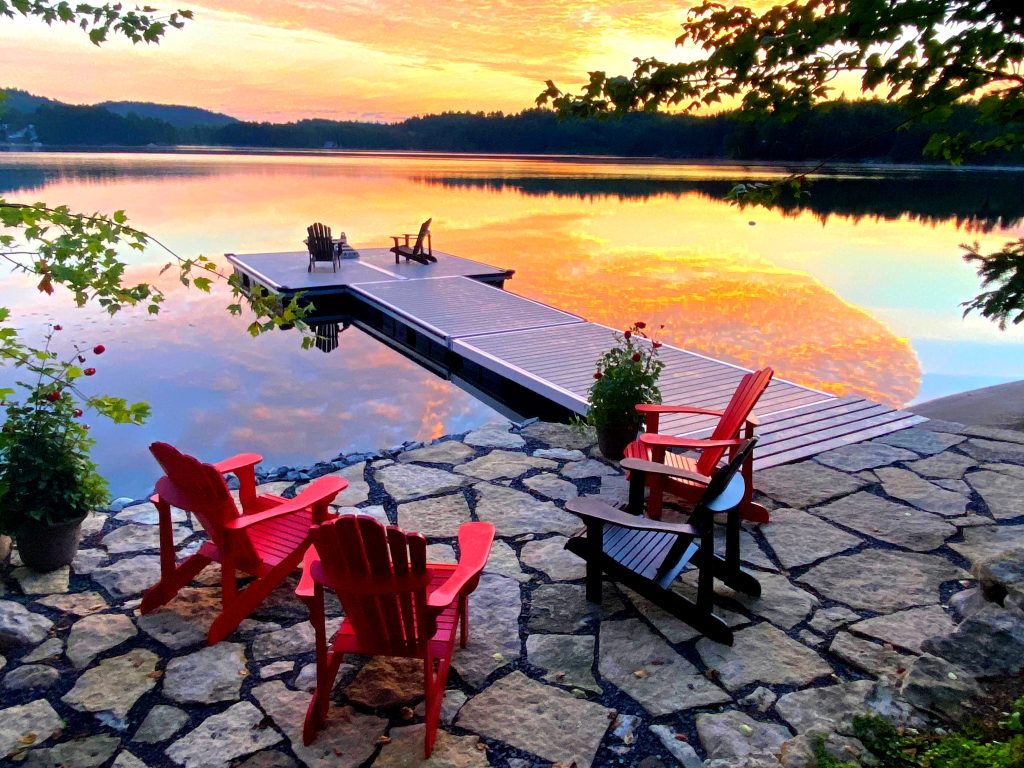
Treated wood can still be used in some dock applications, but it is still wood. It can absorb moisture, dry, shrink, move, crack, splinter, and require maintenance. Composite decking can be a good option in some residential deck settings, but dock owners need to understand what is inside the board and what the warranty actually covers. PVC has strong moisture resistance, but it also usually costs more upfront and requires attention to manufacturer installation details. Aluminum and open-flow panels can solve some problems better than traditional boards, but they also change the feel, look, and use of the dock.
Many composite deck boards are wood-plastic composites. They contain plastic and wood fiber. Haines said the wood fiber in composites is often called “wood flour” because it is ground very fine and used as filler. The plastic is supposed to encapsulate those wood fibers, but if moisture reaches wood fiber inside the board, problems can start.
That does not mean every composite deck board should be ruled out for every dock. It does mean the dock owner needs to read the fine print. A board may be marketed as moisture-resistant, but that does not automatically mean it is approved or warrantied for dock use, submersion, or constant wet conditions.
“Read the fine print as far as what’s covered on a warranty,” Haines said.
Dock Decking Options at a Glance
| Material | Where It Often Fits | Advantages | Tradeoffs to Consider |
|---|---|---|---|
| Pressure-treated wood | Budget-minded freshwater docks, less harsh sites, repairs where matching old boards matters | Lower upfront cost, widely available, familiar to builders, easy to cut and repair in sections | Needs maintenance, can check, cup, twist, splinter, crack, fade, and move with wet-dry cycles |
| Composite decking | Some residential dock settings where the specific board is approved for the exposure | Lower maintenance than wood, improved colors and capstock options, familiar residential look | May contain wood fiber, can hold heat, may have warranty limits around dock use or submersion, higher-performing lines can be expensive |
| PVC decking | Low-maintenance docks, coastal or wet environments, barefoot family docks, projects where moisture resistance matters | No wood fiber, strong moisture resistance, lighter weight than many composites, lower heat buildup, low maintenance | Higher upfront cost, requires careful attention to expansion, contraction, gapping, fastening, span, and installation instructions |
| Open-flow polypropylene panels | Walkways, gangways, stairs, boat lift access areas, seagrass-sensitive sites, storm-surge-prone areas | Lets light and water pass through, can reduce upward hydraulic pressure, useful in specific dock zones | Different look and feel than a solid board, may not be the desired surface for a finished sitting area |
| Aluminum decking | Ramps, commercial areas, second-story boathouse decks, places needing long spans or aggressive slip resistance | Strong span potential, water is not absorbed, durable in marine applications, can shed heat well | More industrial look and feel, can be noisier underfoot, may not feel as warm or residential as wood or PVC |
For a closer look at how PVC performs around water, heat, maintenance, and dock construction, see our full guide to PVC decking.
Where Treated Wood Still Makes Sense
Pressure-treated lumber is still widely used, and for some dock owners it may still make sense. It is familiar, available, usually less expensive upfront than many low-maintenance decking options, and easy for many builders to work with. It is also easier to repair in small sections. If a few boards are damaged, a dock owner or local carpenter can often replace those boards without hunting down a specialty product, matching a hidden fastener system, or reworking a larger section of the dock.
Those advantages matter. Cost is not a small issue on a dock project, and neither is serviceability. Wood can be cut, patched, replaced, and modified with ordinary tools. If the dock owner expects to change cleat locations, add accessories, repair storm damage, or replace only a handful of boards at a time, wood has a practical simplicity that should not be dismissed.
Haines said treated wood may be a reasonable choice on a freshwater lake, in a less harsh environment, on a fixed dock, or in a project where the budget is limited. In those cases, he still recommends raising the standards. Use the right level of treatment. Use good fasteners. Pay attention to the structure. Consider ways to protect the framing.
“If someone’s on a freshwater lake, or if someone is in a less harsh environment, and they want to do a fixed dock, and they’re on a limited budget,” Haines said, treated lumber can still have a role. But even then, he suggested using treated material for pilings and structural members while considering a low-maintenance deck board on top.
That walking surface can help protect the framing below from UV exposure. Joist tape can help reduce moisture intrusion around screw penetrations. Stainless screws can keep the fasteners from rusting out over time.
“If a guy does a good job with it and uses the correct level of treatment, like a marine-grade treated, it’ll last a pretty long time,” Haines said. “Will it be lifetime? Doubtfully not these days, because the lumber is not what it used to be and the treatment’s not what it used to be either.”
The coastal environment is a different story.
“I just don’t know that I would go that route if I was on the coast, with all that salt water,” Haines said.
That is a helpful way to frame treated lumber. It is not useless. It is not always wrong. It has real advantages in price, availability, repairability, and familiarity. But it also comes with real tradeoffs. The harsher the environment and the less maintenance the owner wants to do, the more it makes sense to consider other dock board options.
Composite Decking on Docks
Composite decking has improved a lot since the early days, and many homeowners are familiar with it from residential decks. But dock owners should be careful about assuming a composite board is automatically the right choice over water.
Haines said early composite decking was introduced as a step up from pressure-treated lumber because it would not crack, warp, twist, rot, or decay the same way wood could. But those early boards had their own issues. They were often plain-looking, could fade badly, and could stain.
Over time, composite companies improved their products by adding capstock layers, fade warranties, and stain warranties. That helped keep composite decking relevant. But Haines said dock builders still often prefer PVC because of its performance characteristics in wet environments.
“You still have your dock community that still prefers the PVC board,” Haines said. “They just have learned it’s lighter weight, less heat buildup.”
With composite, Haines said buyers often have to be more selective. A company may offer several product lines, but not all of them may be equally suited for dock use. Some may have heat-mitigating features while others do not. Some may be rated for certain conditions while others are not. Some may have warranties that sound strong until the owner reads the exclusions.
“If somebody says, hey, we have this cool technology we use, not all their boards necessarily have that technology,” Haines said. “Usually only the higher-end boards have things like heat-mitigating technology, plus being able to be submerged, plus having these fade warranties.”
That creates a cost question. If the only composite board that meets the dock owner’s needs is the most expensive line, it may no longer be the value option it first appeared to be.
PVC as a Dock Board Option
PVC decking entered the market as a higher-performing alternative to early composites. Unlike wood-plastic composite boards, PVC decking does not rely on wood fiber as filler. For docks, that matters because wood fiber and moisture are not a great combination.
Haines said the high-end deck and dock builders were drawn to PVC because of several practical advantages.
“They’re like, ‘Wait a minute, this stays cooler. It could be submerged. It doesn’t stain. It looks good,’” Haines said. “It’s just a higher price point. That’s all it is because you didn’t have all that filler, all that recycled content in it.”
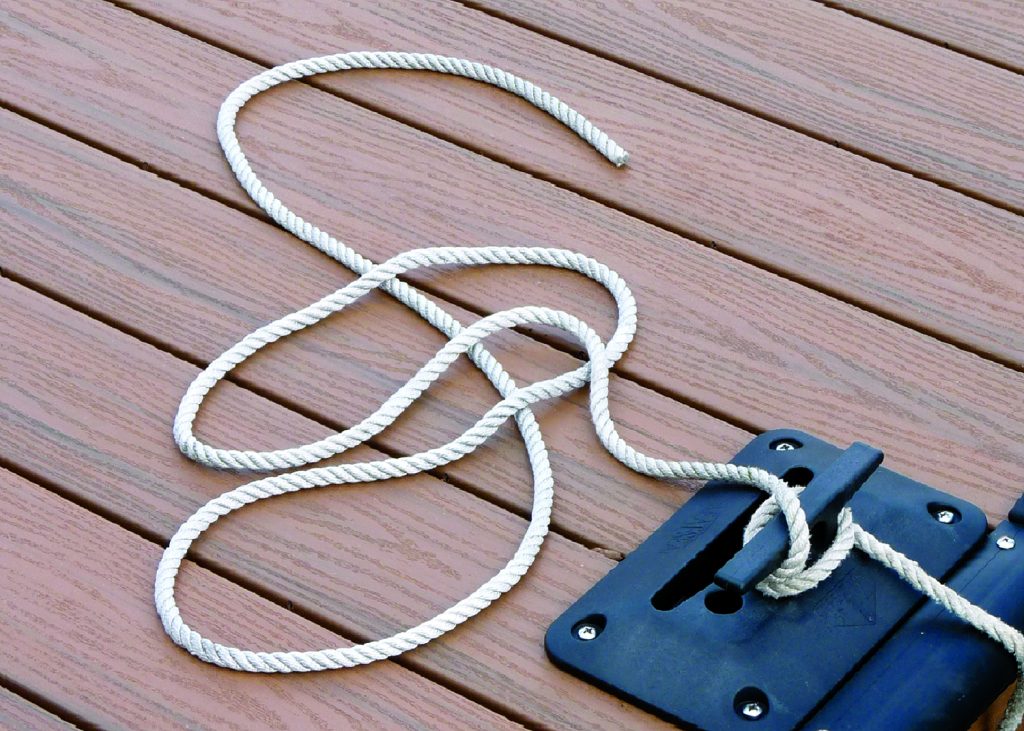
For dock owners, the higher upfront cost of PVC has to be weighed against long-term maintenance, comfort, and performance. If the goal is simply to build the cheapest possible dock, PVC may not be the first choice. If the goal is to reduce maintenance, avoid splinters, improve moisture resistance, and make the dock more comfortable to use, PVC becomes a stronger option.
PVC is not free of tradeoffs, though. Cost is the obvious one. A dock owner who is comparing a bundle of treated wood boards to a premium PVC system may see a large gap before labor, fasteners, and framing are even considered. That does not mean PVC is a bad value, but it does mean the value depends on how long the owner plans to keep the dock, how much maintenance they want to avoid, and how harsh the site is.
Expansion and contraction also need to be taken seriously. Any decking product can move as temperature and moisture conditions change, but plastic-based products require installers to follow the manufacturer’s spacing, gapping, fastening, and span instructions. That is especially important on docks where boards may see intense sun, reflected heat, and quick temperature swings. A good PVC installation is not just a matter of swapping one board for another. The framing, fasteners, board spacing, butt joints, edge details, and cut ends all need to be planned correctly.
That installation nuance can affect both price and builder selection. A contractor who is used to pressure-treated lumber may need to adjust habits when installing PVC, composite, aluminum, or open-flow panels. In a resurfacing job, the existing joist spacing may also limit what can be used without adding framing. The best material on paper can still disappoint if it is installed like the wrong material.
“You just have performance characteristics with PVC that you just don’t have to think about,” Haines said. “Where with composite, you have to really pick and choose which one you use, if you want to even try to have an equal performance to a PVC deck board.”
Where Sure-Step and Aluminum Decking Fit
Not every dock surface needs to be a traditional solid board. In some applications, especially walkways, gangways, boat lift areas, stairs into the water, and projects where storm surge or environmental rules are part of the conversation, an open-flow panel may make more sense than a standard deck board.
That is where Sure-Step Dock & Decking fits into the comparison. EMS distributes Sure-Step, which Haines described as an all-polypropylene open-flow panel rather than a conventional board.
Sure-Step has a grid-style surface with a chevron pattern, which lets light and water pass through the walking surface. Haines said that original design was driven partly by environmental concerns in places where municipalities wanted sunlight to reach seagrasses and aquatic habitat below a dock or walkway.
“The original concept for it was you want as much open space in that deck panel as you could get to allow light penetration,” Haines said. “They wanted a certain amount of light to come through a dock or a walkway to allow for the seagrasses to continue to grow for the aquatic life. They didn’t want something to block all the sun and kill all the seagrasses.”
That open-flow design can also matter when storms push water up against a dock. A solid walking surface can catch that upward pressure. Sure-Step’s open spaces allow more water to move through the panel instead of pushing against it.
“What they noticed when tidal surges came in, let’s say you had a hurricane come in, and you had all the tidal surges, you had all the wave action and everything, Sure-Step had such open areas that allowed a lot of water to come up through,” Haines said. “You didn’t have that upward hydraulic pressure wanting to pull things up and pull pilings up out of the ground and pull deck boards loose.”
That does not mean Sure-Step is the right surface for every part of every dock. A homeowner who wants a finished, residential-style sitting area may prefer a solid board. But on walkways, boat lift access areas, stairs, gangways, and docks where light penetration or storm-surge pressure are major concerns, Sure-Step gives dock owners another tool to work with. Haines said EMS often sees projects where both materials are used together, with ENDECK on one part of the dock and Sure-Step in areas where open flow is more useful.
Aluminum decking is another option that deserves a place in the dock board conversation.
“With aluminum decking, it’s got some really good attributes,” Haines said. “The spans are really good. You can go two foot on centers with aluminum decking.”
Moisture also is not the concern with aluminum that it is with wood, and Haines said aluminum can be good for heat dissipation. The tradeoff is feel and appearance. Aluminum may be a better fit for ramps, second-story boathouse decking, commercial areas, or places where a knurled surface is needed for strong slip resistance. For a family dock where the owner wants a warmer, more finished look and a quieter feel underfoot, PVC, wood, or another board-style surface may still feel more natural.
Heat and Barefoot Comfort Matter
Heat buildup is one of those issues that can be easy to overlook until the first hot day after installation. On a dock, people are often barefoot. Kids climb out of the water. Anglers walk down to check lines. Families use the dock as an outdoor room. If the surface gets too hot, the dock becomes less comfortable and less useful.
Haines said both treated lumber and composite decking can get very hot. With composite decking, recycled materials, inks, carbon black, and other ingredients can draw and hold heat. Darker colors can make the problem worse.
“There’s so many boards out there, especially in the composite category, but even treated lumber, they get incredibly hot,” Haines said. “That heat really gets held in those composite deck boards and even in treated lumber as well, especially if it’s got a stain on it.”
PVC, Haines said, is naturally more heat-dissipating. That does not mean every PVC board stays cool in every color under every condition. Darker colors will still get warmer than lighter colors. But a material that releases heat more readily can be more comfortable on a dock than one that holds heat.
“So it’s going to stay cooler,” Haines said. “And when it does warm up a little bit, let’s say if you go with the darker color, it cools off faster.”
Color selection is part of this decision. A dark board may look great beside the house, but on a full-sun dock in July, a lighter color may be the more practical choice. On the coast, grays, tans, khakis, and lighter natural colors often fit the setting and help with barefoot comfort.
Haines said the big criteria he would look at are moisture resistance, heat buildup, heat dissipation, and fade resistance.
“How well does it hold up against moisture?” he said. “How well does it do against heat buildup? Does it dissipate heat very well? And then what’s the fade factor?”
Those are not small details. They affect how the dock feels, how it looks over time, and how much the owner enjoys using it.
Choosing the Best Deck Boards for Your Dock
There is no one best deck board for every dock. A freshwater fixed dock on a limited budget may lead to one decision. A coastal dock in saltwater may lead to another. A family swimming dock where kids run barefoot may have different needs than a commercial marina walkway. A gangway, ramp, second-story boathouse deck, or boat lift access area may lead to another choice entirely. A resurfacing job may depend on what the existing frame will allow.
The best place to start is not with the board itself, but with the conditions. Is the dock in saltwater, brackish water, or freshwater? Is it fixed or floating? Will any part of it be submerged? How much direct sun will it receive? Will people use it barefoot? Is the owner willing to maintain wood, or is low maintenance a major priority? Does the existing frame have the right spacing and condition for the new material? Are the fasteners suitable for the environment?
In the end, choosing the best deck boards for your dock is really about choosing the material that lets the dock become what most owners wanted in the first place: a place to enjoy the water, not another thing to constantly repair.