

A good food plot does not have to look like a golf course. That may be hard for some landowners to accept, especially after spending money on lime, fertilizer, seed, fuel, and weekends away from home trying to get a plot established. When weeds show up, the first instinct is often to clean everything up, start over, or reach for the best weed killer for food plots. But in a wildlife food plot, clean is not always the same as productive. Some plants that look messy to us may still provide cover, seed, insects, structure, or browse. Others are just taking up space, shading out the plants we actually want, and stealing moisture and nutrients from the plot. The challenge is knowing the difference.
According to Dr. David Russell, an associate Extension professor for crop, soil, and environmental science with Auburn University, that is where food plot weed control has to begin. Russell has a PhD in weed science, a master’s degree in agronomy, and a bachelor’s degree in landscape architecture. He is also a hunter and land manager himself, so he understands the difference between managing a field for livestock, row crops, or wildlife.
In a food plot, a weed is not simply “a plant that showed up.” A better definition is a “plant out of place.”
“What one may see as an undesirable, somebody else may love that plant there in that particular space,” Russell said.
That one idea changes the whole conversation. Choosing the best weed killer for a food plot is not just about chemical versus mechanical control. It is about deciding what you want the plot to do, what plants are helping, what plants are hurting, and how aggressive you really need to be.
Start With What You Want the Plot to Do
A food plot can have different jobs at different times of year. A fall plot may be designed to attract deer during hunting season. A clover plot may be intended to provide food through spring and into summer. A summer plot may be planted for high-protein forage, soil cover, or attraction during a stressful part of the year. Some openings may be managed as much for turkeys and poults as they are for deer. That means choosing the best weed killer for food plots, or deciding whether weed killer is needed at all, should not start with a sprayer, mower, disk, or roller crimper. It should start with the goal.
If the goal is a clean seedbed before planting, a more aggressive approach may make sense. If the goal is to maintain an existing clover stand, wiping everything out may waste forage that is already working. If the goal is turkey brood habitat, a little structure and diversity may be a good thing. If one aggressive plant is beginning to dominate the whole plot, doing nothing may be the wrong choice. Russell said food plot managers sometimes feel pressure to “start over” anytime a field gets ugly. That can mean disking everything, mowing everything, or using a non-selective herbicide to kill the whole plot. Sometimes that is the right move. But it should not be automatic.
“I don’t think our food plots need to fit a look,” Russell said.
A food plot should be judged by wildlife use, forage value, soil condition, and long-term productivity, not just by how neat it looks from the side-by-side.
Mechanical Control Is Simple, But Not Always Easy
Mechanical weed control includes mowing, disking, tillage, hand-pulling, and tools such as roller crimpers. These methods are appealing because they are easy to understand. You can see the work happening. You are not dealing with herbicide labels, chemical rates, spray drift, or plant-back restrictions.
For many landowners, mechanical control also feels more natural. If a field is too tall, mow it. If a plot needs to be replanted, disk it. If a cover crop is mature, crimp it. Those tools have their place.
Mowing can knock back top growth, open up a plot, and keep some plants from shading out desirable forage. Disking or tillage can prepare a seedbed and help reset a field. Roller crimping can terminate certain cover crops and lay down a mat of residue that protects the soil and helps suppress weeds. But mechanical control has limits. The first is timing. A roller crimper, for example, works best when the target plants are at the right growth stage. That window may not line up with rain, work, kids’ ball games, turkey season, or the one weekend a landowner can make it to the property. When timing is off, results can be disappointing.
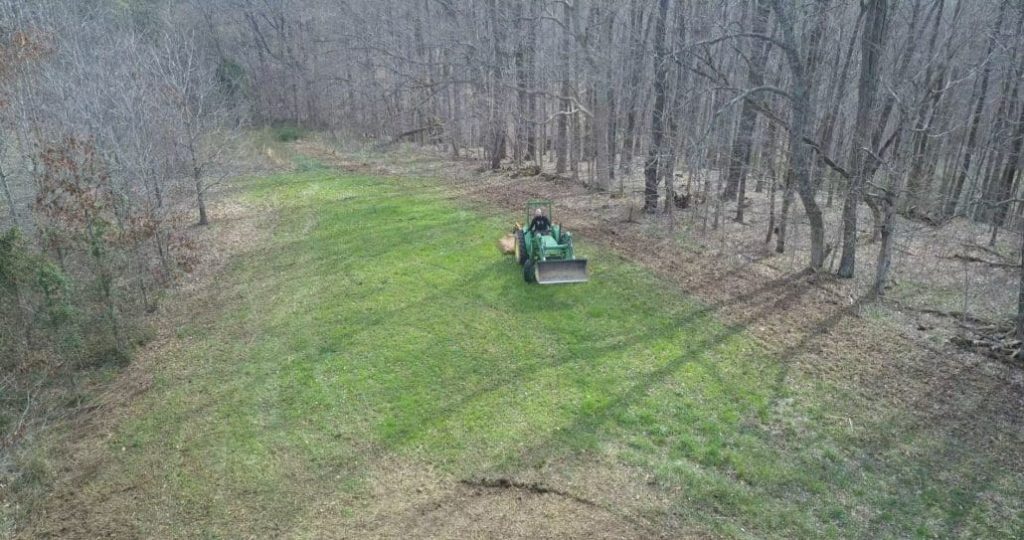
The second issue is soil disturbance. Tillage can dry out the soil, burn up organic matter, damage soil structure, and bring buried weed seeds to the surface. In dry years, that can be a real cost. A field may look clean after disking, but the soil may lose moisture that would have helped the next planting.
The third issue is regrowth. Cutting the top off a weed is not the same as killing the whole plant. Some perennial weeds have strong root systems and can come back after mowing or shallow tillage. In those cases, mechanical control may suppress the problem for a little while without truly fixing it.
That does not make mechanical control bad. It just means it should be used for the right reasons. If the goal is short-term suppression, residue management, seedbed preparation, or setting up the next planting, mechanical tools can help. If the goal is long-term control of a tough perennial weed, mechanical control by itself may not be enough.
Chemical Control Is Efficient, But It Can Be Too Broad
Chemical weed control can save time, fuel, and labor. For landowners who live hours from their property or manage multiple plots, that efficiency matters. A sprayer can cover ground faster than a disk or mower, and in many cases, herbicides can control plants that mechanical methods only set back.
There is no single best weed killer for food plots, but the best-known example of broad-spectrum chemical control is glyphosate. It is widely used because it is effective, relatively simple to understand, and useful when the goal is to start clean. If a field needs to be reset before planting, a broad-spectrum herbicide can be the most practical tool available. But broad-spectrum chemical control comes with a tradeoff. A non-selective herbicide does not care which plants you like. If it contacts green, growing tissue, it can injure or kill the plants you may have wanted to keep.
That is fine when the plan is to wipe the slate clean. It is not fine when clover, beans, peas, brassicas, or other desirable forage is already established and doing well. This is where a lot of food plotters get frustrated. They do not want to disk the field because they want to protect soil moisture and keep living roots in the ground. They do not want to spray everything because part of the plot is still useful. But they also do not want one problem plant taking over. That is the gap between mechanical control and broad-spectrum chemical control, and it is where selective herbicides become important.
Selective Herbicides Are the Middle Ground
Selective herbicides give landowners another option. Instead of killing everything in the plot or relying only on mowing and tillage, a selective herbicide can target certain types of weeds while preserving certain desirable plants.
That does not mean selective herbicides are magic. They still require correct plant identification, correct timing, correct rates, correct application methods, and careful label reading. But when used properly, they give hunters more precision.
A few common examples are worth knowing. Clethodim is often used to control grasses in broadleaf plantings such as clover, alfalfa, soybeans, and cowpeas. 2,4-DB is commonly used where landowners need broadleaf weed control in certain legume plots, including clover and some bean or pea plantings. Triclopyr-type products are often useful on tougher woody or perennial broadleaf weeds, depending on the crop, target weed, and application method. Other products, including imazethapyr-based herbicides may also fit certain legume-based food plot situations.

The point is not to memorize every herbicide name before you manage a plot. The point is to understand that “spray” does not always mean “kill everything.” In some cases, a landowner may be able to remove grasses from clover, suppress certain broadleaf weeds in legumes, or clean up problem patches without resetting the entire field.
The Best Method May Be a Combination
Mechanical and chemical control do not have to be enemies. In many food plots, the best answer may involve both.
A landowner might mow to reduce height and improve spray coverage later. He might roller-crimp a cover crop, then use selective herbicide to manage escapes. He might spot spray problem areas rather than treating the whole field. He might use a non-selective herbicide before planting, then use selective herbicides later to protect the crop he established.
Doing nothing can also be part of the plan. If a plant is not hurting the plot and may be helping wildlife, it may not need to be controlled. Russell’s point was not that every food plot needs more spraying. It was that landowners need to understand what they are looking at before they decide. That is especially true because every control method has a cost. Tillage costs fuel, time, moisture, and soil disturbance. Mowing costs time and may not kill the target plant. Non-selective herbicide may remove desirable forage. Selective herbicides require more knowledge and better timing. Doing nothing may allow a problem plant to spread. There is no perfect tool.
Do Not Guess at the Plant
Before choosing any weed control method, landowners need to know what plant they are dealing with. A grass problem is not the same as a broadleaf problem. An annual weed is not the same as a perennial weed. A plant that is nearly finished with its life cycle may not be worth fighting, while a young perennial weed may be at the perfect stage for control.
This is where many mistakes happen. A landowner sees a plot getting messy and reacts to the mess instead of identifying the plants. That can lead to mowing when herbicide was needed, spraying when mowing would have been enough, or killing a plot that still had plenty of wildlife value.
Russell recommended using Extension resources before guessing. Every state has an Extension system tied to its land-grant university, and county or regional agents can often help with plant identification, herbicide questions, sprayer setup, and management planning. In Alabama, landowners can work through Alabama Extension and Auburn University resources.
That help is especially valuable for food plotters because the goal is not always the same as it would be in a hayfield, pasture, or crop field. Wildlife plots often involve mixed species, changing seasonal goals, and a higher tolerance for plant diversity. A good recommendation depends on those details.
Finding the Right Product
Once a landowner knows the target plant and the control method that fits, the next challenge is finding the right product. Some local stores carry basic herbicides, but more specialized food plot and land-management products are not always easy to find in the right size or formulation.
That is where a supplier like Chemical Warehouse can be useful. For landowners looking for the best weed killer for food plots, as well as selective herbicides, non-selective herbicides, adjuvants, dyes, or related application supplies, it can be a convenient way to source what the plan actually calls for.
The Goal Is Not to Kill More Weeds
If a field needs to be reset, tillage or a non-selective herbicide may be the right tool. If the soil needs protection and the plot is still producing useful forage, a lighter touch may be better. If one category of weeds is hurting an otherwise good stand, a selective herbicide may be the best middle ground.
That is the main lesson for hunters and landowners. You do not always have to wipe the slate clean. You also do not have to let aggressive weeds take over because you are afraid of spraying.
Start with the goal. Identify what is growing. Decide what is helping and what is hurting. Then choose the least disruptive method that will solve the problem.
A productive food plot is not always the prettiest field on the property. It is the one that feeds wildlife, protects the soil, fits the season, and keeps working without being restarted every time something unwanted shows up.