

Nobody expects their day on the water to end with a towing bill. Most boaters picture a breakdown as a minor inconvenience, maybe the engine won’t start, the battery is dead, or they ran out of fuel just a few miles from the dock. In their mind, help shows up, tosses them a line, and gets them back to the marina in short order. But without a boat towing membership, that “simple” tow can quickly turn into a bill far larger than most boaters anticipate. In fact, average boat towing costs for non-members can run around $900 to $1,000, depending on the time, distance, weather, and conditions involved.
Captain John Bilski, owner of Sea Tow Southern Connecticut, notes that the biggest misunderstanding is how towing is priced. It isn’t just about the distance your boat needs to be pulled, or the time from when the towline is attached until you reach the dock. Often, the clock starts the moment the tow boat leaves its berth and doesn’t stop until it returns.
To you, it might feel like a short tow. To the captain, it’s a full port-to-port job. “Although the tow might be a 20-minute tow, it might take us 35 minutes to get there each way,” Bilski explains. The captain still has to reach you, slow down when conditions require it, tow you safely back, and then return to the base.
You might be just a few miles from your marina, but if those miles involve a long approach, a no-wake zone, rough water, or poor visibility, the time adds up quickly. Bilski notes that across Sea Tow’s network of boat towing and on-water assistance providers, the average non-member tow runs about $900 to $1,000, a figure that is often a reality check for those used to simple distance calculations.
Why a “Short Tow” May Not Be Cheap
There is a common belief that a short distance should automatically equal a low cost, but marine towing depends more on time, safety, and conditions than mileage. Unlike a roadside tow truck, a captain can’t just haul a boat at highway speeds. Towing a boat is a delicate, slow process, usually kept between 5 to 10 miles per hour to ensure everyone’s safety. No-wake zones, in particular, can stretch a job out significantly.
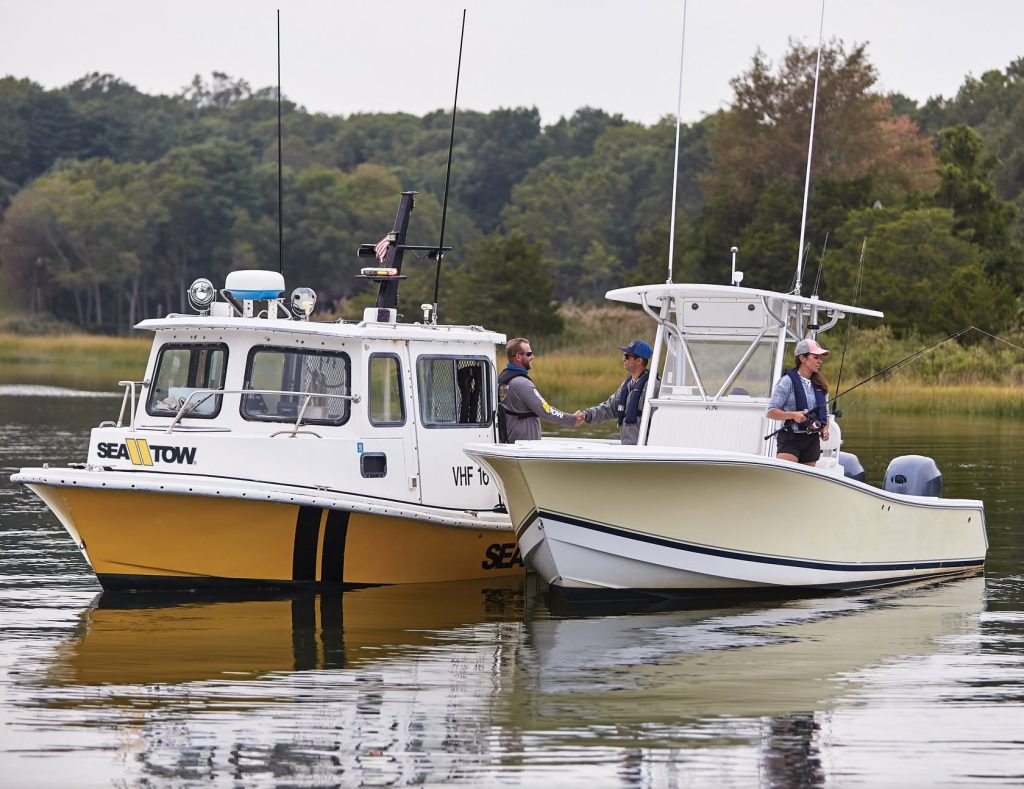
If you’ve broken down just outside a long, protected waterway, the towboat is legally and safely bound to the same slow speed you would be. “You can’t blast through a no-wake zone,” Bilski says. When you’re stuck, the marina might feel like it’s right around the corner. But for the captain, it’s a careful, slow moving operation where they have to be mindful of the wake they create near docks, other boats, and tight harbors.
Weather Can Change Everything
A simple tow on a calm, sunny afternoon becomes a different story when you factor in wind, rain, fog, or rough seas. Weather dictates how fast a towboat can travel to reach you, how fast it can tow your vessel, and the difficulty of the return trip. When conditions are “snotty,” speeds drop for safety, which increases the total time and, therefore, boat towing costs for non-members. In some instances, hazardous weather may even involve additional charges.
Complicated situations, like groundings, are another matter entirely. If a boat is stuck on a sandbar, it’s not treated as a simple tow; there is often a per-foot ungrounding charge. If the rate were $20 per foot, a 20-foot boat would cost $400 just for the effort of breaking free, long before you factor in the time spent getting there and returning.
Furthermore, the type of boat matters. Larger vessels, inboard boats, or those stuck near rocks require more care and risk, all factors reflected in the cost of service.
Small Problems Can Still Become Expensive
It’s frustrating when a minor issue, a loose battery connection, a throttle that isn’t quite in neutral, a blown fuse, or a missing emergency lanyard leaves you just as stranded as a major engine failure and facing unexpected boat towing costs. Whenever possible, Bilski and his crews try to help boaters solve these simple problems over the phone. A “self-rescue” is a win for everyone, as it saves you time, money, and stress.
Early in the season, loose battery connections are a frequent culprit. A mechanic or owner might have installed the batteries but failed to tighten the leads properly. In other cases, especially with modern fly-by-wire controls, the throttle might appear to be in neutral but be slightly out of position. The boater turns the key, nothing happens, and they assume the battery is dead.
Sometimes, a quick conversation is all it takes. If the engine fires right up, that’s a free fix provided over the phone. However, if the phone call doesn’t solve it and the captain has to leave the dock, run out to the boat, and diagnose the issue, a minor problem suddenly becomes a paid service call. That’s where many boaters get caught off guard: the fix itself is trivial, but the cost of the professional assistance is not.
Fuel, Jump Starts, and Other Common Calls
Every day, boating headaches like dead batteries or spun hubs aren’t just frustrating; for non-members, they often trigger service fees in addition to the hourly rate. Fuel is typically charged as a delivered product (for members and non-members), and services like jump starts often carry their own flat fees, depending on the area.

When you add a service call, a jump-start fee, and the captain’s time, a small hiccup can quickly snowball into a multi-hundred-dollar bill. If the engine won’t start and you need to be towed, the situation becomes even more expensive.
The Coast Guard Is Not a Free Tow Service
Some boaters mistakenly believe public emergency responders are their backup plan. While the Coast Guard, fire department, and police are lifesavers in emergencies, such as a medical crisis, a sinking boat, or an immediate threat to life, they generally do not provide free towing services for routine breakdowns or fuel issues.
Boaters shouldn’t assume public agencies will come to the rescue just to avoid paying for commercial assistance. This often leaves stranded boaters with a tough choice: wait around in hopes a friend can help, or pay the non-member rate for professional service. That wait can get uncomfortable fast, especially as weather changes, darkness falls, or kids become restless.
How Membership Changes the Math
Ultimately, a towing membership is about risk management. With an open-water membership often costing around $249/year, it compares sharply to a single non-member tow that could run $1,000 or more. For members, the cost of most on-water services is covered, making the experience far more predictable. You aren’t just paying for a tow; you’re paying to avoid the shock of a massive bill and to ensure you have priority service. On a busy summer weekend, being a member means you aren’t stuck at the back of the line while non-members are left waiting for help.
You Cannot Wait Until You Break Down to Join
If you want to avoid unexpected boat towing costs, membership isn’t something you can purchase once the problem has already occurred. Sea Tow has a 24-hour waiting period, which requires that your boat be in seaworthy, good working order when you sign up. Trying to buy coverage after you’ve run out of fuel or hit a sandbar won’t work, much like trying to buy auto insurance after a fender-bender. The time to get covered is before you leave the dock.
The Local Side of the Yellow Boat
Beyond the logistics, Sea Tow is part of the local boating community. These locations are locally owned and operated, employing local captains who work closely with fire and police departments, marinas, and fishing tournaments. They often provide resources like life jacket loaner stands, and they take pride in helping boaters get back on their feet. A breakdown can turn a fun family outing into a stressful situation, but a professional captain deals with those moments every day. What feels like a disaster to you is just another day on the job for them, and that experience is worth a lot when you’re in the middle of the water.
The Real Cost of Going Without Coverage
Boat towing costs rarely cross a boater’s mind until the moment the engine refuses to turn over. Without a membership, you are at the mercy of variables you can’t control: the distance, the weather, the time of day, and the local demand for services. A membership doesn’t prevent your boat from breaking down, and it’s no substitute for proper maintenance and safe habits, but it does transform a potential financial surprise into a manageable, predictable line item. When you compare the cost of a membership against the other expenses of boating (fuel, maintenance, electronics, gear, etc.), it’s a relatively small investment. But when your engine fails, and the sun is starting to dip, it’s arguably the smartest purchase you’ll make all year.