

Fishing with buzzbaits for bass in early spring can yield incredible results, with some anglers catching and releasing 50 to 75 bass ranging from three to seven pounds in a single outing. Four-time Bassmaster Classic champion Rick Clunn is a firm believer in starting the buzzbait bite early. “I like to be the first angler to start fishing the buzzbait each year,” Clunn says. “I’ll begin fishing the buzzbait in late February or early March because the bass haven’t seen it for four or five months. Often, I’ll catch some of the biggest prespawners of the year with a buzzbait.” As water temperatures rise and bass move toward their spawning areas, this topwater lure can be one of the most effective tools for landing trophy fish.
Water Temperature and Clarity Affect Buzzbaits’ Success
The water temperature where you fish determines the best time of the year to start fishing the buzzbait.
According to longtime guide, Phillip Criss of Albertville, Alabama, who has guided on Guntersville Lake since 2013, “When the water temperature reaches 52-54 degrees, I’ll begin fishing the buzzbait. That may happen the last two weeks of February and/or the first two weeks in March at Guntersville. I’ll look for minnows scurrying away from the spot I’m casting to in shallow water. Then I know it’s time to fish the buzzbait. Minnows will be in that shallow water because the water’s warming-up, and/or the bass are pushing those minnows into shallow water.”
Water clarity dictates the color of buzzbait Criss fishes. In stained water, he’ll use a dark buzzbait like black, and in the clearer water, he’ll fish white or white and chartreuse.
However, Criss is quick to say that Mother Nature sometimes throws you a curveball.

“I’ve had great days of March bass fishing, throwing a black buzzbait when the water’s gin clear, and then when the water’s stained, throwing a white-and-chartreuse buzzbait. I always have both colors rigged on my casting deck. I let the bass tell me which color buzzbait they want each day,” Criss said.
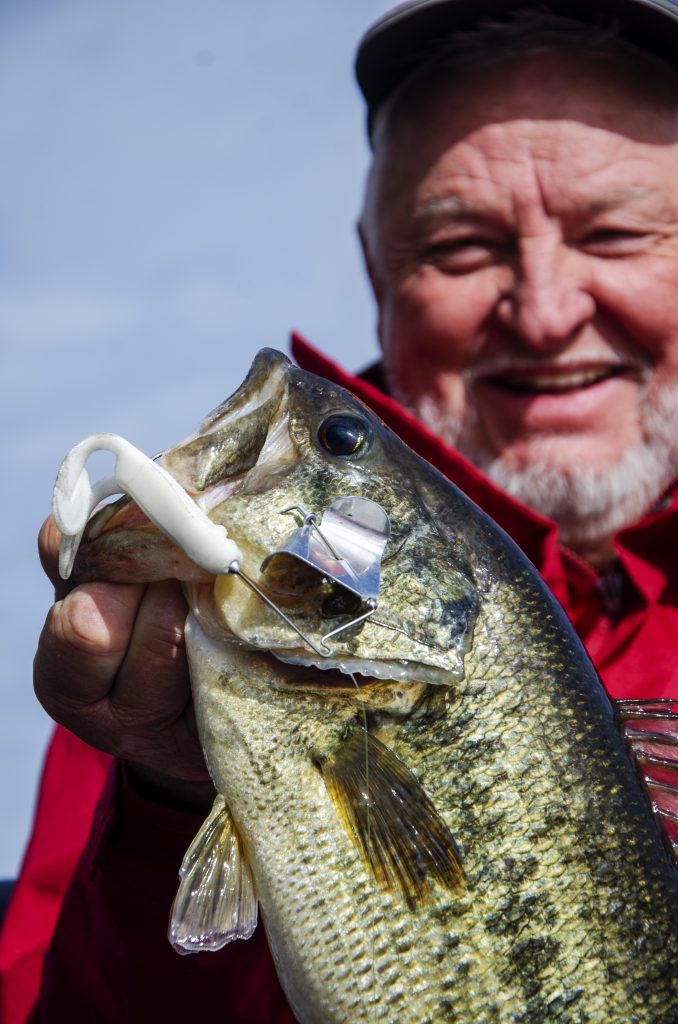
In the past, most anglers fishing buzzbaits primarily were concerned with the colors of the skirts on the buzzbaits. However, anglers now put swimbaits, frogs and giant, soft-plastic, twisty tail grubs like Fishbites on buzzbaits, instead of skirts.
“The key to knowing what type of lure to put behind the buzzbait is dependent on how active the bass are,” Criss reported.. “If bass are aggressive, I’ll put a twin-tail frog on the back of a buzzbait to give the buzzbait more action and attract bass to bite. Once I see bass chasing shad in shallow water that’s 56-58 degrees, I’ll put a small, paddle tail swimbait on the back of the buzzbait.”
Another rule of thumb Criss adheres to is – the colder the water, the smaller the buzzbait and the lure behind the buzzbait he fishes. The warmer the water – 60 degrees or so – the bigger the buzzbait and lure he’ll use.
“When the water’s at 52-54 degrees, I’ll fish a 1/4-ounce buzzbait. As the water warms up, and the bass becomes more active, I’ll increase the size of my buzzbait to 3/8- or 1/2-ounce as well as the size of the swimbait I put behind it,” Criss explained.

Criss likes a shad-colored frog on the back of his buzzbait, but in stained water, he prefers a black or a black-and-blue colored frog. All kinds of buzzbaits are on the market today, including dual-blade and single-blade buzzbaits. Criss has fished the dual-blades but generally opts for the single blade.
“I fish the buzzbait in, around, on top of and beside grass, and I’ve found that a dual-blade buzzbait will get tangled-up in the grass more often,” he added.
The Importance of Grass
One of the reasons that Guntersville’s one of the top big-bass-producing lakes in the nation is due to the lake’s abundant grass that’s ideal habitat for bass providing: an ambush point for bass to attack baitfish; hiding places for the young of the year bass just spawned; and heat during the colder months and oxygen in the hotter months. The type of grass determines how and where Criss fishes the buzzbait.
“If I’m fishing what we call primrose grass [an invasive, highly-adaptable species that forms thick mats featuring yellow flowers], I can fish the buzzbait over its top, around its sides or down its edges,” Criss said. “Anywhere I can run the buzzbait through or over the top of grass is where I’ll cast. But when matted milfoil gets close to the top or on the top of the water, I’ll have to fish that buzzbait down the edges of the milfoil.”
Criss also searches for dark spots under the water.
“Those dark spots are usually underwater grass. If the bottom’s clear around that dark spot, you can bet bass will be holding there to attack baitfish. So, if you cast past that dark spot and retrieve that buzzbait over its top, often the bass will blow-up out of the grass to attack and eat that noisy, big bait. Anywhere you can find hard, clear bottom around a patch of underwater grass, you’re almost assured of catching a bass,” he said.
Equipment for Fishing Buzzbaits
Criss prefers a seven foot medium-heavy action rod with a soft tip, a 7:1 reel and 40-65 pound test braided line. He explained that the buzzbait is a reaction-type bait – causing a bass to strike, although the bass doesn’t know exactly what the buzzbait is.
“I’ve learned that when the weather’s the coldest, I catch more bass reeling a buzzbait slowly enough to hear its blades squeak, clack or gurgle as they turn. As long as the bass are eating the bait with that type of retrieve, I’ll stay with it. But if not, I’ll speed-up my retrieve,” Criss said.
“If you’re using a fast retrieve, the bass has to decide if it will: attack the bait, kill it, and come back and eat it; eat the bait immediately as soon as it spots it; or not bite at all.”
Criss utilizes 40-65 pound test braided line.
“The braided line doesn’t get down in the water most of the time when you’re retrieving a buzzbait. If you’re fishing it properly, the buzzbait’s the only part of your cast that’s in the water. I like the braided line since I’m almost always fishing the buzzbait around some type of cover, grass, blowdowns and/or logs. When you hook a bass on a buzzbait, it will try to go down in that cover. Therefore,with heavy braided line, you usually can turn the fish’s head up and away from the cover as soon as it attacks the bait and pull it out of the cover easier,” he said.
Criss doesn’t fish fluorocarbon line with a buzzbait because fluorocarbon pulls the nose of the bait down in the water, instead of allowing it to ride on top. He pointed out that a 1/4-ounce buzzbait casts better on 40-pound braided line than on 65-pound braided but on Guntersville, he usea 65-pound braided line about 90% of the time.
Although many anglers prefer heavy-action rods, Criss likes a medium-heavy action rod with a soft tip.
“When a bass blows-up on a buzzbait, it’s trying to get a lot of the lure in its mouth at one time. With a heavy-action rod, you may jerk that bait away from that fish when you see it blow-up. With a medium-heavy action rod, even if you set the hook as soon as you see the bass blow-up, you won’t move the buzzbait away from the bass as quickly as with a heavy-action rod. That rod allows a bass to get the buzzbait all the way in its mouth before you set the hook. Another problem associated with fishing a heavy action rod is if you don’t have your drag set just right, a fast, hard hook-set may rip the buzzbait out of the bass’s mouth,” he said.
If 10 bass strike buzzbaits, Criss expects to land 80% of them with the rod, reel and line he uses.
“When you’re fishing the buzzbait, you won’t hook every bass that attacks it. So, I always have a follow-up-bait – either a Rebel Pop-R [a top-water chugger and plugger] or a plastic worm tied onto a rod on my casting deck within easy reach that I can pick-up quickly,” Criss said. “I’ll cast a follow-up lure right to the spot where the bass has blown up on the buzzbait. Often, I think a bass isn’t trying to eat the bait when it attacks the buzzbait – but rather is attempting to stun or kill the bait. Then the bass will circle around the lure and eat it.”
If the strike occurs in thick grass, Criss will throw a plastic worm like a watermelon-red Strike Zone Meat Stix that’s heavy, tough and falls through the grass – with no weight on the line.
Criss explained that most worms are too light to get through the grass when bass miss buzzbaits but he can catch three to four times more bass on the tough Meat Stick worm than on other worms.
“I’ll twitch the worm when it lands and let the weight of the hook cause the worm to fall slowly. When fishing thick grass like primrose, I’ll peg a weight to the hook and cast the worm to the spot where the bass has blown-up to get that worm to fall through the primrose grass,” he said.
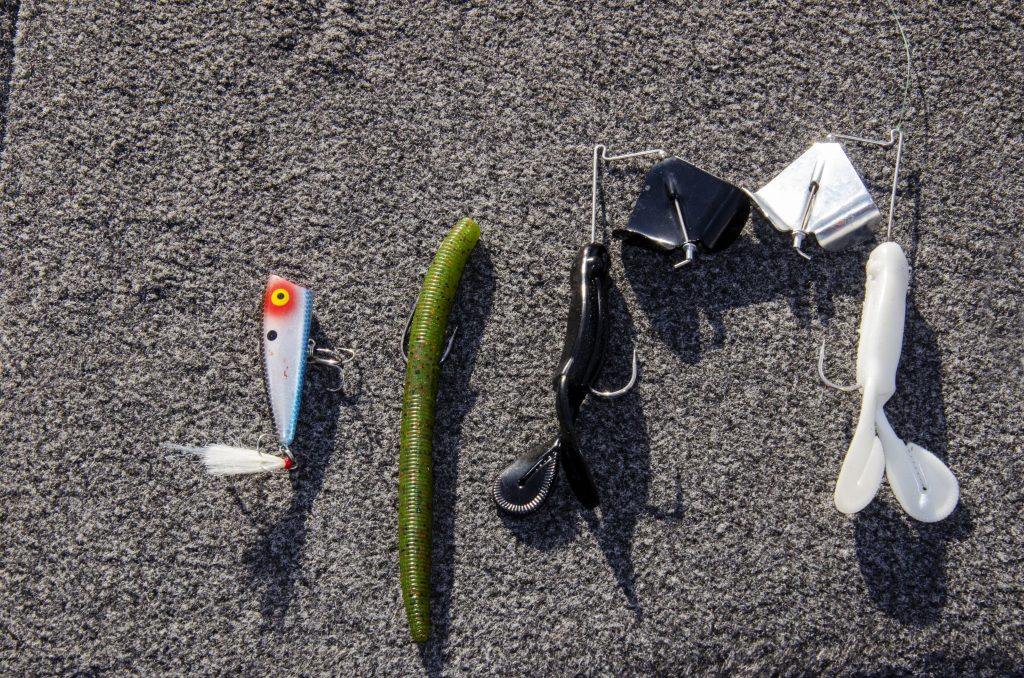
Once Criss thinks he can make an accurate cast to a hole in the grass, he may use a Pop-R, let it sit in the hole and only twitch the bait or cause it to quiver but not move in the hole. He also catches numbers of bass with his follow-up baits that he’s missed with his buzzbait.
“Often if a bass sees that Pop-R sitting in a hole in the grass, quivering, the fish may think it’s stunned and that all it must do is slowly swim-up to that Pop-R and eat it. I’ll use this same tactic to fish the edges of matted grass,” he said.
“The real secret to catching bass on a follow-up bait is how fast you get it to the spot where the bass have blown-up.”
Phillips Criss’s Best Buzzbait Trip
“I’ve had some days in March when my clients and I have caught and released 50-75 bass on a buzzbait,” Criss explained. “Numbers of three to four pound bass and some weighing five pounds and more may be caught. The biggest bass I personally have caught on a buzzbait weighed 10.86 pounds. I caught that bass one year on September 10, and that date’s important since I generally start fishing a buzzbait the last two weeks of February and continue fishing buzzbaits through the first of November. I caught that big bass on the edge of a milfoil patch. If I hadn’t been fishing 65-pound-test braided line, I’d never have caught her. She buried up in the grass as soon as I hooked her. I pulled her up in a big clump of grass three times.
“The last time I pulled the line up, I saw my line in a big clump of grass that looked like it weighed 50 pounds. I spotted a bass’s tail hanging out of that clump and tore the milfoil off my line, until I could see the bass’s mouth, grab it and bring her to the boat. So, although I start fishing the buzzbait when the water temperature reaches 52 degrees, I don’t stop fishing the buzzbait usually until early November,” he concluded.