
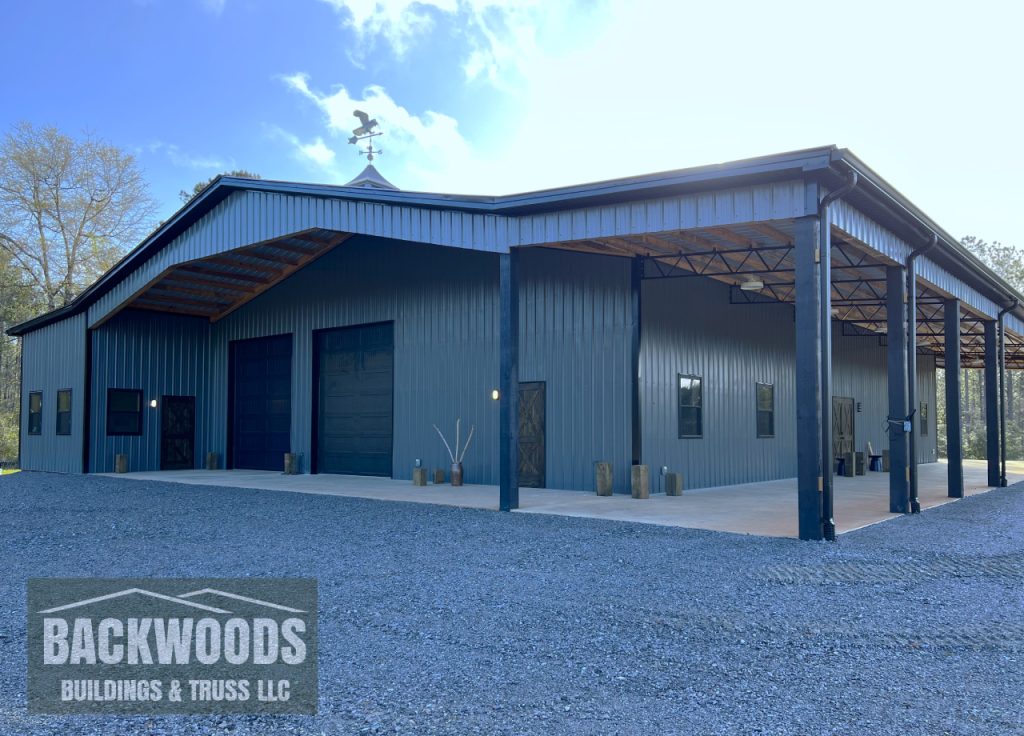
Spend any time driving back roads in the rural South and you’ll see them everywhere. Open-sided sheds sheltering tractors. Horse barns tucked behind tree lines. Half-finished structures that clearly started as a place to park equipment and slowly evolved into something much more. Pole barns have quietly become one of the most flexible tools a landowner can put on the ground, and according to James Craft of Backwoods Buildings & Truss LLC, that flexibility is only growing.
Craft, the general manager of Backwoods Buildings & Truss, has spent more than a decade helping landowners turn ideas into buildings that actually work. “Basically the pole barn can be used in any application now,” he explains. “As long as it’s engineered, it can be used for any application—structural, commercial, residential, or accessory building.”
From Utility Shed to Blank Canvas
For decades, pole barns were purely utilitarian. They existed to keep equipment dry, hay out of the weather, and livestock shaded. That’s changed. Design trends, media exposure, and rising construction costs have all played a role.

“It seems like the HGTV kind of chic infatuation with that whole design has really set it on a trajectory,” Craft says. “People see the pole barn as a cheaper alternative to building, but really it gives more of an open concept and the ability for the DIYer to build their own home.”
That open-ended nature is what makes pole barns so appealing for rural landowners. A structure that starts life as a tractor shed can gradually become a feed room, a workshop, a hangout space at deer camp, or even a full-time residence.
What Actually Makes a Pole Barn a Pole Barn
At the core of that versatility is how pole barns are built. Unlike traditional stick-frame construction, pole barns rely on posts set into the ground to support the roof system, rather than interior load-bearing walls.
“When you build an open pole barn, anything else built underneath there doesn’t need additional support,” Craft explains. “The roof is self-supporting. So when you go to enclose it, none of those walls are load-bearing.”

That structural independence is what allows landowners to reconfigure interior space over time without tearing out walls or reworking the entire building. It’s also what makes pole barns so adaptable for commercial and residential uses.
When a Pole Barn Becomes a Home or Office
Backwoods Buildings has taken that concept all the way to its logical extreme. Craft points to a custom project in Chipley, Florida, that surprises almost everyone who sees it.
“It turned into a super high-end custom home,” he says. “Unless we told you it was a pole barn, you really wouldn’t even know. It’s got granite everywhere, tile showers, Hardy board siding, a wraparound porch…the works”
The same approach applies to commercial spaces. Craft notes that Backwoods is currently building a large office and showroom facility using pole barn construction because it allows for massive open interiors at a lower cost than steel or conventional framing.
Common Misconceptions That Can Get You in Trouble
That flexibility doesn’t mean shortcuts are safe. One of the biggest issues Craft sees is landowners assuming that any pole barn kit can eventually become living space.
“People will buy a run-of-the-mill pole barn kit and think they can turn it into a house as-is,” he says. “That’s one of the biggest misconceptions we see. But you’re putting your family at real risk if it’s not engineered properly.”

Roof decking, metal thickness, truss spacing, and wind-load engineering all matter, especially in hurricane-prone regions. Concrete footings are another area where corners are often cut.
“Unless you have somewhere north of a thousand pounds of concrete per post, your building is at severe risk in high wind zones,” Craft explains. “Throwing one or two bags of concrete in a hole is barely better than packing dirt back around it.”
Plan Bigger Than You Think You Need
If there’s one universal truth about pole barns, it’s that people almost always outgrow them.
“A large percentage of our customers, we’re coming back in six months or a year adding lean-tos or additional bays,” Craft says. “It’s never enough.”
His advice is to think long-term, even when budgets are tight. Building taller or positioning the structure to allow future expansion can save money and headaches later. Pole barns are uniquely suited for phased projects, allowing owners to add square footage over time without making the building look pieced together.
Built for Landowners, Hunters, and Farmers
For outdoor-focused landowners, pole barns remain one of the most practical improvements you can make. Craft sees them used for horse stalls, dog breeding operations, hay storage, tractors, boats, and hunting camp infrastructure.

“You can drive through almost any farm area and see a few pole barns,” he says. “They’re everywhere for a reason.”
While extremely large commercial farm equipment may require red-iron construction, pole barns handle the needs of most private landowners with ease and flexibility.
Thinking Ahead for Power, Plumbing, and Comfort
For anyone considering future living or office space, planning ahead is critical. Craft emphasizes being honest from the very beginning.
“Be honest with your materials dealer about what you want to do later,” he says. “If we know the end goal, we can configure the building so you’re not boxed in down the road.”
He also stresses the importance of professional engineering. “If the budget is so thin that you can’t afford to do it right, you may need to wait,” he adds. “It’s just not worth the risk.”
Paying for It: Financing a Pole Barn the Smart Way
For many landowners, the biggest hurdle isn’t deciding what to build—it’s figuring out how to pay for it. That’s especially true when a project will be built in stages or when today’s equipment shed could become tomorrow’s workshop or living space.
Craft notes that financing often hinges on how professionally a project is planned. “If the customer is a true DIYer and they’re doing everything themselves, they can save a lot of money,” he says. “But if you want financing, engineered plans and a professionally built shell make a big difference.”
That’s where lenders like First South Farm Credit fit naturally into the conversation. Unlike traditional banks that may struggle to categorize rural land improvements, First South Farm Credit specializes in agricultural and recreational properties. Their land improvement loans are designed for projects like pole barns, equipment storage, workshops, and future living space, making them a strong option for landowners investing in long-term functionality.

From a lender’s perspective, a pole barn built with engineered plans, proper site preparation, and quality construction isn’t just a shed. It’s a permanent improvement that adds usability and value to the land. Financing can also make phased projects more realistic, allowing landowners to build the core structure now and finish interior work over time, rather than waiting years to save enough cash to do everything at once.
How Pole Barns Add Real Property Value
Not all pole barns add value equally. Open structures offer utility, but enclosed and well-finished buildings make the biggest difference when it comes to appraisals and resale.
“Outward appearance makes a big difference,” Craft says. “Does it look like it cost fifty thousand to build, or five thousand? That’s what an appraiser or realtor is going to see.”
Quality finishes, doors, windows, and exterior details help a pole barn read as a permanent improvement rather than a temporary shelter.
Not All Pole Barns Are Created Equal
After nearly three decades in business, Craft has seen demand surge, especially after major storms, and with it the rise of inexperienced builders.
“Vet your manufacturer,” he says. “Make sure they’re working with engineers. Cheaper is not always better, and most of the time it’s never better.”
For landowners looking to improve their property, create usable space, and keep future options open, a pole barn remains one of the smartest starting points. Built right and planned well, it’s more than just a building. It’s the foundation for whatever your land needs next.