
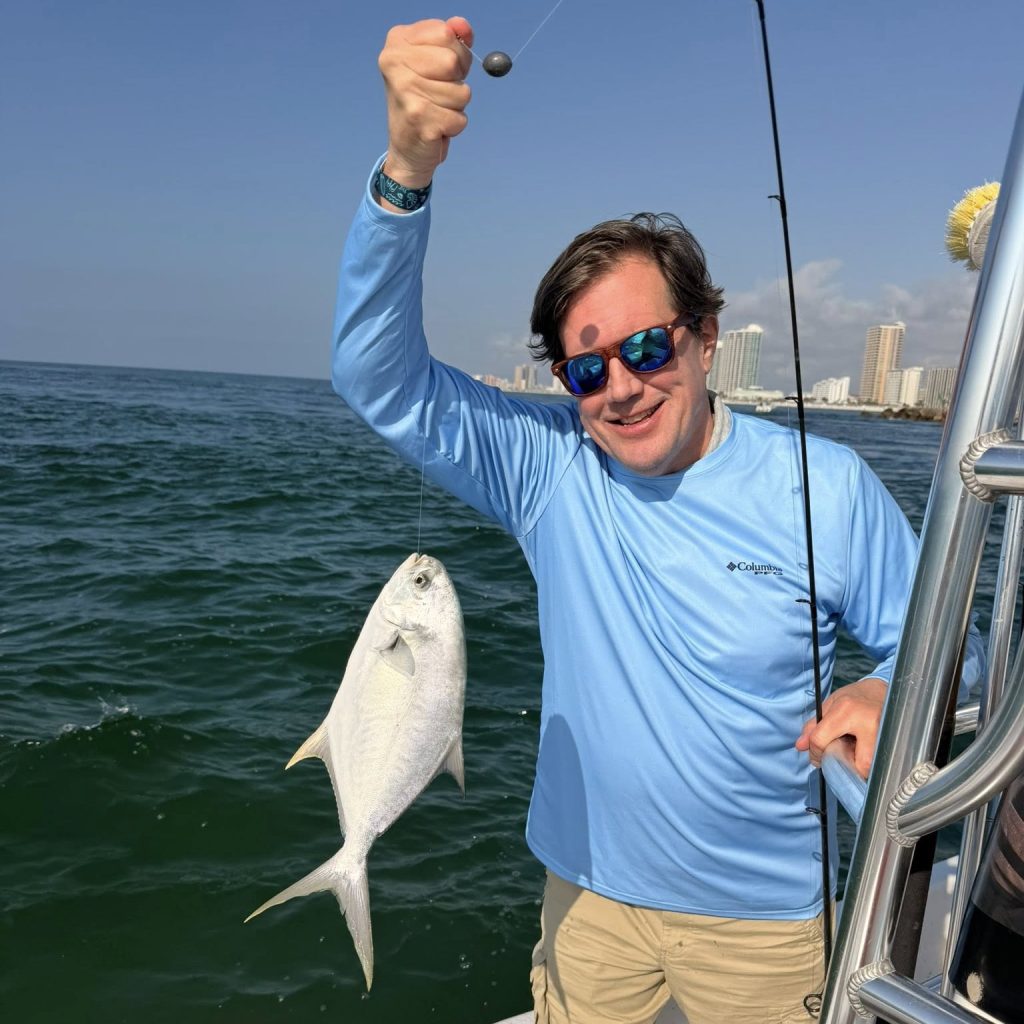
Most Gulf Coast anglers think about pompano as a surf fish first. Sand fleas, pompano rigs, long rods, and beach carts usually come to mind before boats, jetties, and current seams. But around Orange Beach and Perdido Pass, Capt. Ben Knight with Great Southern Fishing Charters has been showing that pompano fishing from a boat can be every bit as productive, and sometimes more controlled, than fishing from the sand.
“This has been kind of the highlight of my charters the last week or two,” Knight said. “Those fish have showed up in full force, and man, it’s been a lot of fun.”
For Knight, pompano are not just something he catches when the bite is right. They are one of his favorite fish, both to target and to eat.
“People ask me all the time, what is your favorite fish to eat, favorite fish to target? And it’s pompano,” Knight said. “It’s my time of the year for it, man. I just absolutely love it.”
Where Capt. Ben Knight Finds Boat Pompano
The key piece of the puzzle is current. Pompano fishing from a boat around the jetties is less about sitting on one piece of structure and more about positioning around moving water. Knight has been focusing on the jetties around Perdido Pass, where moving water pushes bait, creates seams, and gives pompano a place to feed without having to sit directly on the rocks.
“These fish have been like, on the points of the jetty,” Knight said. “They get in these schools, and they like to ride in that current.”
That is an important detail. Boat anglers sometimes make the mistake of fishing too tight to the rocks the whole time. While some fish can be caught close, Knight says many of the better schools are actually off the structure, moving back and forth with the current.

“A lot of times, those fish are not on the rocks themselves,” Knight said. “They’re actually out, schooled up, moving back and forth, up and down the rocks.”
That means boat position matters. On an outgoing tide, Knight will set up down-current and cast up into the moving water. On an incoming tide, especially when clean Gulf water is pushing in, he changes his angle and lets the bait swing naturally around the jetty point.
“If the tide’s going out, I’ll set up down current,” Knight said. “If the tide’s coming in, especially if it’s coming from the east, the sun’s up in the sky, you get a lot of clean water in there. Those fish seem to like that a little bit better.”
Why Incoming Tide Can Be Best
Knight has caught fish on both tides, but he gives the edge to incoming water.
“We’ve been catching them on both the incoming and outgoing tide,” Knight said. “They’ve been biting pretty good, better on the incoming.”
That makes sense around Perdido Pass and similar Gulf Coast passes. Incoming water often brings in cleaner, greener water from the Gulf. For anglers focused on pompano fishing from a boat, that cleaner water can be a major advantage because pompano are visual feeders, and when the water clears up and the sun gets higher, they can feed more confidently.
“They’ve been biting a little bit better as the sun comes up,” Knight said. “Those fish are pretty good visual feeders.”
Because of that, Knight often starts his charters in the back bay early, then shifts toward the jetties once the sun gets up.
“Typically I start my charters back in the back bay in the mornings,” he said. “Then by nine o’clock or so, when the sun gets up high in the sky, I’m ready to ease out to those jetties and catch them.”
For anglers fishing out of a bay boat or center console, that is a good practical plan. Fish the protected water early, then move to the pass once light and water conditions line up.
The Live Shrimp Carolina Rig
Knight’s go-to setup for clients is simple and effective. He fishes live shrimp on a Carolina rig with a light lead, swivel, fluorocarbon leader, and a small hook.
“We’ve been catching them on live shrimp,” Knight said. “As a guide, it’s kind of the easier route for my clients, especially if they aren’t an avid fisherman or not familiar with how to work jigs.”
He typically uses a half-ounce to three-quarter-ounce sinker, depending on the current. The lighter lead helps the bait move naturally and can reduce hang-ups around the rocks.
“A lot of times those lighter leads, when you’re throwing them around the rocks, they don’t tend to get hung up as much,” Knight said. “Now, you will get snagged every now and again, especially if you’re rolling the dice and throwing it in there tight. Sometimes you just got to do what you got to do.”
The shrimp size is another big part of the system. Bigger is not better here.
“The live shrimp is crucial too,” Knight said. “The pompano has a pretty small mouth, and they don’t have teeth, so the bigger shrimp that you would use for speckled trout and redfish typically don’t get bit as well as using a medium or smaller shrimp.”
Knight prefers shrimp around one to one and a half inches long.
“I like to use about an inch long shrimp, maybe an inch and a half, because they have a better opportunity of eating that thing,” he said.
How To Work The Current
The presentation is not a cast-it-out-and-wait deal. Knight wants the bait drifting naturally with the current, moving through the strike zone without dragging straight into every rock.
“We’ll pitch it up current,” he said. “When you get a little bit of bow in that line, as that’s starting to come back to you, just keep up with it.”
That line control is critical. Pompano may hit and run, but they also may swim toward the boat or down-current with the bait. If the angler is not paying attention, the bite can feel like almost nothing.
“A lot of times when those fish bite on the live bait, you’ll feel a pop, pop or two,” Knight said. “Those fish are very erratic. They’ll change direction.”
That is why Knight tells clients to reel fast if something feels different.
“If the line’s coming back to them, I’ll say, hey, you may have a fish on. You just need to reel really fast,” he said. “What happens is that fish is actually swimming down current with it, and the line doesn’t go tight.”
Around the jetties, he is looking for the obvious current features. A seam, a rip, or a pocket of swirling water can all hold fish.
“A lot of times around those jetties, you’ll see some sort of a line where the water is just ripping out, or vice versa, ripping in,” Knight said. “There’s usually somewhat of a pool of swirling water. A lot of times those fish will get into that.”
Hooks, Leaders, And Fluorocarbon
Because pompano have small mouths, Knight keeps his hook size small. He likes little number two Mustad J hooks, the same general style he uses for sheepshead.
“The hook size is important,” Knight said. “They do have a pretty small mouth, so I use those little bitty number two Mustad J hooks.”
Leader size depends on water clarity. On an outgoing tide, the water around Orange Beach often has a little more color. On those days, Knight says 15-pound fluorocarbon works well, and monofilament can also work. When the tide switches and that clean Gulf water pushes in, he gets more careful.
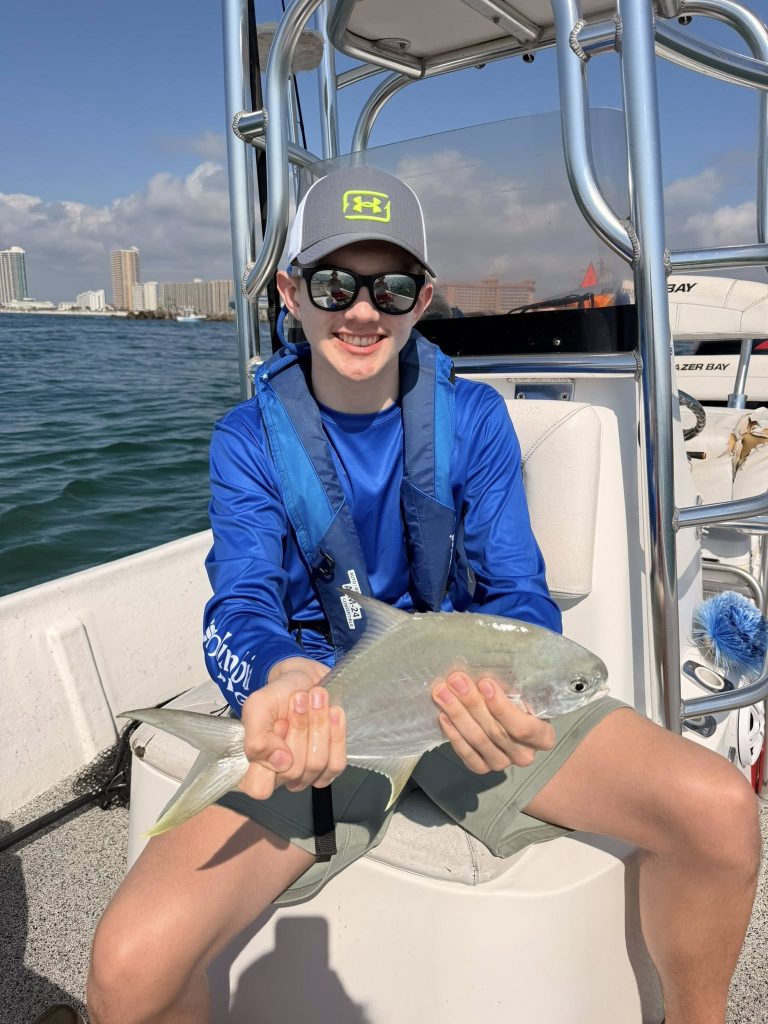
“When that tide switches and we have that beautiful Bohemian water coming in, it’s just gorgeous,” Knight said. “Those fish rely on their vision, and the clearer the water is, the better they can see.”
Knight keeps 20, 15, and 12-pound Yo-Zuri fluorocarbon on the boat. His middle ground is 15-pound.
“The median there for me is 15,” he said. “It’s light enough to get away with it, plus that fluorocarbon is supposed to disappear anyways, but it’s also heavy enough too that if your drag’s set right, and you’ve got whatever’s hooked up that you think is not a pompano digging towards the bottom, you’ve got an opportunity to keep it from chafing off.”
He also likes a longer leader than many anglers might use on a standard Carolina rig.
“When I’m pompano fishing, I’ll actually give it a little bit longer of a leader, maybe a little bit under two feet, roughly two foot leader,” Knight said.
The reason is the current. A shorter leader keeps the bait pinned closer to bottom, but a longer one gives the shrimp room to rise, flutter, and move.
“You want to give that shrimp opportunity to get up off the bottom and move around in that current,” Knight said. “Those fish are moving around in big schools, and they move very quickly.”
When To Switch To Pompano Jigs
Live shrimp is Knight’s best tool for finding fish and keeping clients hooked up. But when the bite is strong and the anglers on the boat can work a lure, he likes to bring out pompano jigs. For anglers interested in pompano fishing from a boat, this is where the bite can get even more fun because the presentation becomes more active and hands-on.
“If I’ve got the right people, and I don’t have a boat full of people, if they’re giving it up on shrimp, I’m like, y’all look, let’s throw some jigs,” Knight said. “And man, you talk about fun.”
His preferred colors are simple: green and pink.
“I like to keep green ones, and I like to keep pink ones,” he said. “If they’re not eating one or the other, we’ll swap back and forth.”
Knight ties his jig setup clean, without a swivel. He splices mono into his braid so anglers can reel the leader up through the rod tip without damaging gear or limiting casting distance.
“I’ll splice me in some mono into my braid where there’s no swivel or anything,” he said. “So you don’t happen to reel the swivel into the rod tip.”
The presentation is similar to the live shrimp approach. Cast up-current, let the jig sink, then pop it and let it fall.
“I’ll cast them out the same way that you would do the live shrimp, same method, throwing it up current,” Knight said. “I’ll let it sink. Give it about five seconds, close the bail over, wait a couple seconds, pick up on it a couple times, pop it a few times, and then stop.”
The fall is where most of the bites happen.
“99% of the time, those pompano eat those jigs on the fall,” Knight said. “That pompano jig will start to flutter down, and you’ll feel one or two pops. Maybe the line will go tight, or it feels like it just stopped, like it hit a rock. And by the time that happens, he’s got it.”
No giant hookset is needed.
“You don’t have to Bill Dance and rip their face off,” Knight said. “I feel that pop a couple times, and he’s got it. I’ll give it one quick pop.”
For anglers who like artificial fishing, this is probably the most fun way to catch them. But Knight is honest about the tradeoff. Shrimp usually produces more bites, especially for clients, while jigs add a little more challenge.
“The live shrimp is a great way to figure out if they’re there,” Knight said. “Once you find them, it gets a little more technical, but people like that. It’s even more rewarding when you catch one.”
Bring Extra Jigs
Pompano jigs work, but the jetties are not forgiving. Add bluefish into the mix, and it is smart to bring extras.
“I definitely would go with at least three or four jigs,” Knight said. “There’s a chance, even throwing around them jetties and letting it sit there and flutter, that you may lose a jig.”
Bluefish have been showing up too, and while they are fun, they can be hard on tackle.
“Every now and again, the bluefish are showing up,” Knight said. “They’ll eat the jig. If you get lucky and get them hooked in the corner of the mouth, you’ll get your jig back. But sometimes, especially since we’re throwing mono, they’ll cut you off.”
Rod And Reel Setup For Boat Pompano
Knight does not overcomplicate the rod and reel side of the equation. He is a Penn guy and fishes Battle series spinning reels in both 2500 and 4000 sizes. For pompano fishing from a boat, especially around current, rocks, and jetties, he wants light tackle that is fun to fish but still gives anglers enough control when a fish runs or digs near structure.
“Pompano fishing, they’re a great fight, they do get somewhat big, but they’re not a very large fish overall,” Knight said. “So the light tackle, the lighter reels, the 2500 I like to use.”
His 2500-size reels are spooled with 12-pound braid. His 4000-size reels, which also get used for sheepshead and redfish, are spooled with 20-pound braid.
“They all work really, really well,” Knight said. “The biggest thing is just what you have at the end, the leader.”
Drag setting matters more than reel size. Knight likes to start loose and tighten up during the fight if needed.
“I always like to start off on my reels actually with my drag somewhat loose,” he said. “I’d rather come back and add pressure to it than get hooked up and it pop us off because the drag was too tight. You can always add more. Sometimes you can’t back it off in time.”
That is a smart way to fish light fluorocarbon around rocks. Pompano are not the only thing that may eat the bait. Flounder, redfish, sheepshead, and other fish can all show up around the same current and structure.
The Bonus Fish Around The Jetties
While pompano are the focus, Knight has also been picking up some solid Gulf flounder while fishing live shrimp around the jetties. That is one of the added benefits of pompano fishing from a boat around current, rocks, and bait-rich structure. The same setup that puts anglers near schools of pompano can also put a good flounder in the net.
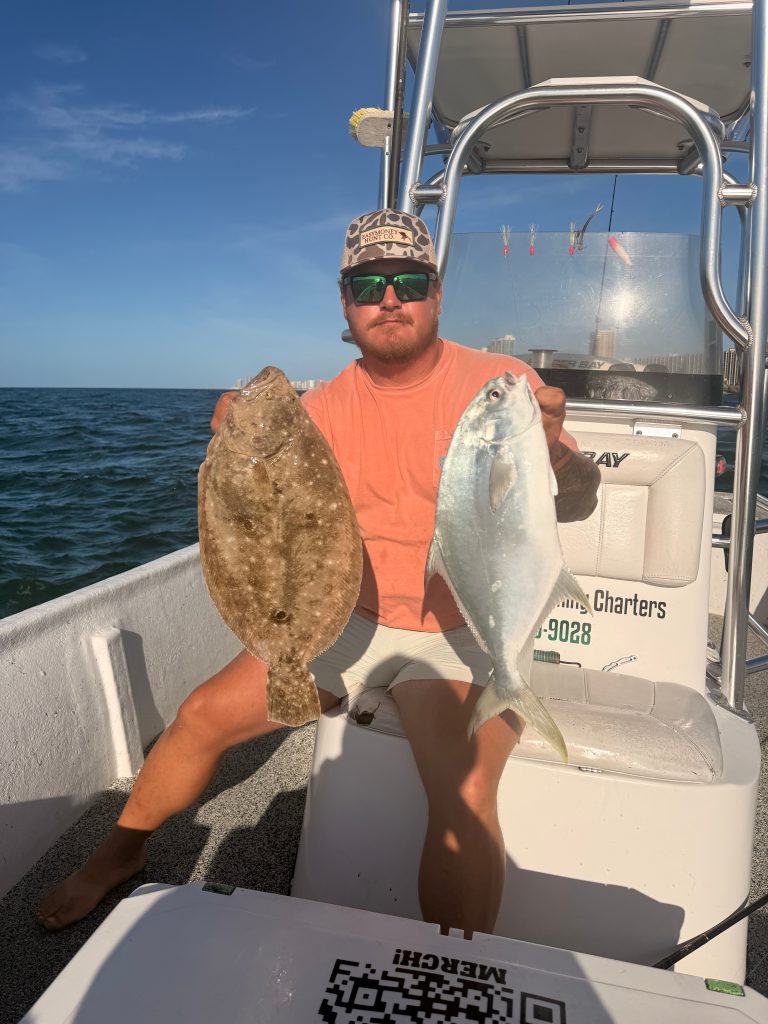
“Those fish are starting to show up,” Knight said. “Especially throwing the live shrimp, we have picked off some Gulfies the last four or five days, and they’ve all been pretty quality size.”
He made it clear he is not targeting flounder heavily during this bite, but he likes seeing them.
“I’m not saying they’re absolute doormats, but they’re definitely fish when you net them that you don’t have to measure,” Knight said. “It’s a nice bycatch.”
That is another reason the 15-pound fluorocarbon makes sense. It is still light enough for clear-water pompano, but it gives anglers a better chance if a flounder digs down near the rocks.
A Bite Worth Taking Advantage Of
The most telling part of Knight’s report was how strongly he described the current pompano bite.
“The last few days, it’s probably been one of the best pompano bites that I’ve seen in a decade,” Knight said.
That is not something a guide says lightly. Pompano fishing from a boat can be extremely productive when the conditions line up, but pompano can also be here today and gone tomorrow, especially around a pass where tide, water color, wind, and bait movement can change quickly. When they line up in big schools and feed aggressively, the window is worth taking advantage of.
“They’ll fire up quick and they’ll shut down quick,” Knight said. “It’s like Krispy Kreme donuts, man. You got to get them while they’re hot.”
That may be the best advice in the whole interview. Have the rigs tied. Have shrimp ready. Have a few pink and green jigs in the box. Once the fish show up, there is no time to be digging through a tackle bag and rethinking the plan.
How Capt. Ben Knight Cooks Pompano
Of course, part of the reason pompano fishing from a boat gets so much attention is what happens after the trip. Knight is clear about his favorite way to cook them.
“Dude, blackened. That is the way,” he said.
He fillets the pompano skin-off, coats the fish heavily with blackening seasoning, and cooks the fillets on aluminum foil over a hot grill. He adds butter around the fish and makes a little foil boat so the butter does not run into the grill.
“I’ll put a piece of aluminum foil on the grill, get it up about 500, 550 degrees,” Knight said. “Then I like to heavily coat my fish in the blackening seasoning.”
Because pompano are firmer than some other inshore fish, Knight likes to flip the fillets halfway through.
“It’s a firmer meat,” he said. “It’s not going to fall apart on you when you go to flip it like snapper would, or flounder. I like to flip it so both sides get somewhat of a crisp on it.”
His cook time is simple too.
“It takes about eight minutes, seven or eight minutes for it to cook all the way through,” Knight said. “Man, you can’t beat it with a stick.”
Final Thoughts
Pompano fishing from a boat is not just surf fishing moved offshore. Around the jetties, it is a current game. The fish may be on the points, in the seams, in the swirl, or suspended just off the rocks. The angler who understands tide direction, water clarity, leader size, bait size, and drift angle is going to catch more fish than the one who simply throws at the rocks and hopes.
Knight’s system is practical. Use live shrimp to find them. Keep the shrimp small. Fish a Carolina rig with a light lead and a longer fluorocarbon leader. Work the current instead of fighting it. When the fish are located and feeding, break out the pompano jigs for a more active bite.
For anglers fishing the Orange Beach and Gulf Shores area, this is a spring pattern worth learning. The surf may get most of the pompano attention, but when the tide is right and those fish are riding the current around the jetties, a boat can put you right in the middle of one of the best bites of the season.