

Few things are as soothing as the sight, sound, and smell of moving water. Whether it’s a gentle summer rain, a babbling mountain brook, or just a shower before bed, something about the steady murmur of water relaxes people. If you’re a pond owner, it’s natural to want to improve the aesthetics of your pond by adding a fountain. But before rushing out and installing one, it’s wise to understand what a fountain will and won’t do for your pond. In this article, we’ll discuss that, along with points to consider to make sure that you get the perfect pond fountain for your private pond.
Understanding Pond Fountains
To get a better understanding of what a pond fountain will and won’t do for your pond, we talked with Norman Latona at Southeastern Pond Management. SE Pond offers a full range of pond development and maintenance services, including ecosystem analysis, management programs, pond construction, liming, fertilizing, fish inventory assessment, removal processes, stocking of forage and game fish, maintenance and more. They’ve been in business since 1989, and have helped thousands of pond owners set up and maintain thriving backyard oases.
According to Norm, the first thing potential pond fountain buyers need to understand is the function of a pond fountain.
“We tell folks that if you want to install a fountain, make sure that you’re doing it for aesthetic effect,” Norm says. “Fountains are decorative water displays. They are designed to move a very small amount of water a great distance to put on a show. All things considered relative to the volume of even a small lake, it’s a very small amount of water; maybe 100 gallons-per-minute at most. That’s not enough water to really make a difference when it comes to aeration. In the summertime, particularly when the lakes stratify and get really hot, you’re just not moving enough water. There’s nothing in the world wrong with pond fountains, but a lot of folks are under the misconception one will take care of oxygenating the water and that’s just not the case.”
Norm continues, “There is equipment that is very efficient at oxygenating the water in terms of aeration, what we’d call a true aerator. But to put it in perspective, a good-size pond fountain that would throw up a lot of water and look beautiful with lights on it would only be about a quarter of a horsepower device. It takes about one horsepower per surface acre, on average, to really properly aerate a pond. So you’re looking at a much larger, much more expensive device to purchase and operate. Since they’re so expensive, we typically only see them used by commercial operations. The average pond may only have, say, 350lbs of fish per acre. But a commercial catfish pond may have eight or ten thousand pounds-per-acre. So they need true aeration and will spend lots and lots of money on it.”
So do fountains have any value beyond aesthetic appeal?
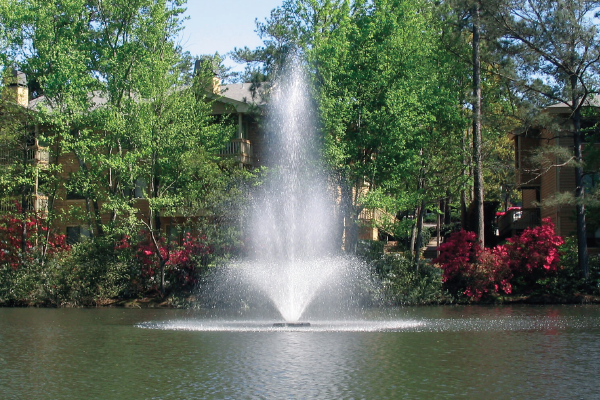
“Fountains primarily provide a pretty display,” says Norm, “but they can be effective at things like keeping the surface tension of the water broken up. Especially in the summertime when it gets really still, you can agitate the surface and break that water tension, and it will make the water look cleaner on top. But again, the function is to make the place look pretty.”
Pond Fountains Vs Water Destratification Systems
According to Norm, a great option for pond managers looking to increase the oxygen supply in their water is a destratification system. These systems may not be as “pretty” as fountains, but they can help keep your water oxygenated without the substantial costs associated with a true, commercial-grade aeration system.
“What we do in cases where folks want to add an “insurance policy” to help ensure that they’re not going to have oxygen problems in their pond is install a destratification system, which is different from an aerator. Sometimes folks get confused about the difference. An aerator sits at the top of the water and moves very high volumes of water, but a destratification system is located at the bottom of the pond. And basically all that it is, is a high volume, low pressure compressor that’s mounted on the shoreline. The compressor produces air, which runs to these airstones that are strategically placed along the bottom of the lake. And they generate millions and millions of tiny bubbles that come up to the surface. Think basically of a giant version of the airstone you had in your aquarium as a kid.”
He continues, “The purpose of these bubbles isn’t to oxygenate the water, but to move it. By moving the water with the air, we can move tremendous volumes of water a very short distance. It’s basically the opposite of a fountain. And what it does is to create an upwell in the pond. If you’ve ever jumped in a summertime pond and it felt like bathwater around your chest but was chilly down at your toes, that’s what’s called temperature stratification. But a pond can also stratify chemically, meaning that there’s not nearly as much oxygen down in that cooler, deeper water as there is at the surface. So by moving that water, we homogenize it; giving it the same temperature and oxygen level throughout the column. This can dramatically increase the amount of oxygen in the overall pond.”
Factors To Consider When Choosing A Pond Fountain
Whether you’re installing a pond fountain, aerator, or destratification system, you’ll want to consult with an expert before you embark on the project to make sure that the system you have is properly sized to your pond and can be properly powered.
Size And Depth Of Pond
So what is the best size fountain for your pond? According to Norm, there’s no set-in-stone answer to that question, since the device is aesthetic and not being relied upon to keep your pond healthy. The biggest question is, “How does it look?”
“As far as size,” says Norm, “it’s really personal preference. Obviously, there are some extremes you want to avoid. You don’t want a tiny little bubbler out in the middle of a big lake that you can barely see. And you don’t want a huge geyser in a small pond that throws water all over you when the wind blows. Other than that, it’s really personal preference. Generally, when we talk with folks about fountains, we try to talk to them in terms of how far away are you going to be looking at this thing. Obviously, if you’ve got something that’s 300ft out in the water, it’s gonna need to be a lot bigger than if it’s 50ft out in the water for you to see and enjoy it.”
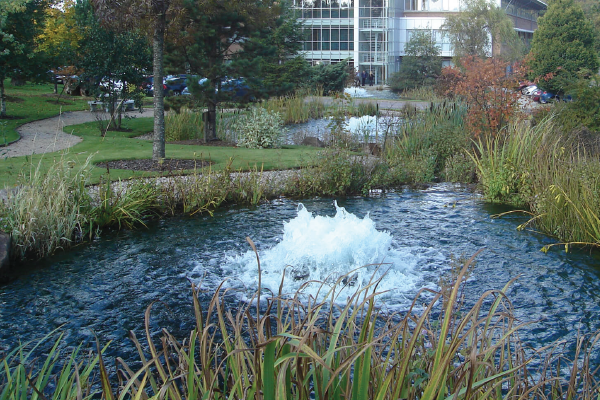
What about destratification systems? Norm says that when you’re installing a destratification system to improve oxygen quality, it’s hard to make a general recommendation without inspecting the pond.
“We install a lot of these each year,” he says, “and basically we come out and take a bunch of measurements of the depth and surface area, and build a custom solution to your pond. Every system is different depending on its shape, depth, and how much water you’re trying to move.”
Power Source
One variable that many pond owners overlook is the money and effort required to power a fountain.
“It’s a significant effort to power a fountain,” he says. “Obviously there are safety concerns, and we would always recommend that whether you use us or not, that you have a certified electrician come out and do everything. You’re running power underwater, and you definitely don’t want any of that power leaking and creating a safety issue. Frankly, for the larger fountains, it can be a significant cost to install one if you have to run power a long distance. It can be the majority of the cost.”
“On the other hand,” Norm continues, “a huge advantage of a destratification system is that you don’t put any electricity in the water. The compressor needs power, but all that goes into the water itself is poly tubing and the airstones. It’s substantially cheaper to power a fountain or true aerator in most instances.”
Final Thoughts On Pond Fountains
In conclusion, the decision to add a fountain to your pond is one that should be made with careful consideration of both aesthetics and functionality. While fountains can undoubtedly enhance the beauty of a pond with their captivating water displays and potential for lighting effects, they are not designed for effective aeration. As we learned from Norman Latona at Southeastern Pond Management, fountains are limited in their ability to oxygenate water, a critical aspect for maintaining a healthy pond ecosystem. For pond owners seeking to improve oxygen levels, a destratification system may be a more practical and efficient choice.
Ultimately, whether you opt for a fountain, aerator, or destratification system, consulting with a pond management expert is crucial. This ensures that your choice is not only visually pleasing but also functionally appropriate for your pond’s unique ecosystem. By making an informed decision, you can enjoy the serene beauty of your pond while also ensuring its health and vitality for years to come.