

It’s hard for me to imagine a day on the water without a good trolling motor. They’re simply indispensable when it’s time to fine-tune your boat position, whether that involves maneuvering around docks and marinas or staying on top of fish.
There have been some big changes in trolling motor and trolling motor battery performance in recent years, and many anglers find themselves looking to upgrade to take advantage of new technology. New units offer cool features such as contour line following abilities, GPS anchoring, brushless motors, and built-in transducers. But these features come at a cost, as does the added performance offered by lithium batteries.
Before you sink good money into a trolling motor, it’s worth taking the time to think through potential problems. Recently we caught up with William Montgomery at Blue Water Ship Stores in Foley, AL, which is associated with Boat Owners Warehouse (BOW), to talk about common pitfalls to avoid when purchasing a new trolling motor.
What Size Trolling Motor Do I Need?
One of the first problems to head off at the pass when shopping for a trolling motor is making sure that you buy a unit that fits your boat and the intended usage. Trolling motors are commonly grouped according to shaft length, thrust ratings, and voltage ratings.
Trolling Motor Shaft Lengths
“When you’re shopping for a trolling motor, you can start the selection process by either looking at the thrust rating or the shaft length,” says William. “Personally, I start with the shaft length. And what you want to do to determine shaft length is to get your boat in the water, and load it just like you were going to go fishing. Get some passengers, fill the fuel tank, pack all of your gear, put ice in the ice chests, just a full load with everything where it will be when the boat’s in use. Then, take a tape measure and measure the height from the bow where you’re going to mount that motor down to the waterline.”
William continues, “Once you have that number, you can go to a trolling motor manufacturer’s website and reference a chart telling you how much they recommend adding to that number so that your shaft gets the prop down in the water where it needs to be. Typically, you’re looking at adding a foot to twenty-four inches. But that can increase depending on what kind of seas you expect to encounter. The rougher the water, the longer your shaft will need to be.”
Having the right length shaft prevents the prop from cavitating or riding up out of the water entirely, which can quickly rob you of large amounts of performance.
Trolling Motor Thrust Ratings
Once you know how long of a shaft you need, the next question is how much thrust your motor needs to be able to maneuver your boat.
“For a ‘down-and-dirty’ rough estimate, you’re going to need about two pounds of thrust for every one hundred pounds of boat,” Williams says. “So if you have a five-thousand pound boat, fully loaded and ready to fish, you’ll need about one hundred pounds of thrust. Again, there are some manufacturer’s charts you can consult, but that’s a quick ballpark. And, when in doubt, always round up to the next size.”
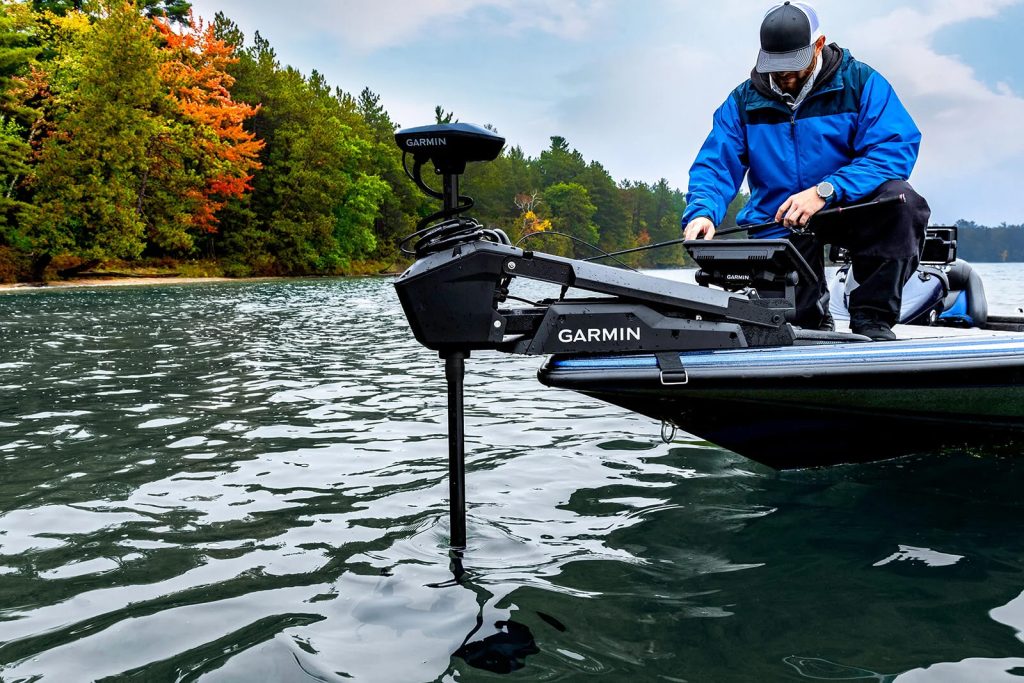
By taking the time to do the math on what your boat weighs and how high your bow will ride above the waterline, you can avoid buying a motor that is underpowered for your vessel.
12v VS 24v VS 36v Trolling Motors
The more thrust a motor puts out, the more energy it has to draw to provide that thrust. Therefore, with bigger trolling motors, 24v and even 36v systems are the norm.
“You’re not going to be able to get a very high thrust rating with a 12v system,” William says. “As a general rule, you can get about thirty to fifty-five pounds of thrust off of a 12v system; seventy to ninety off of a 24v system, and once you get up to one hundred to one-hundred fifteen pounds you’re going to need a 36v system.”
He continues, “It really goes back to your boat weight, ultimately. A lot of guys may say, ‘Oh, I don’t want to have three batteries on my boat,’ but you may not have a choice. If you have a big boat, you need big thrust, and that takes a lot of power to produce.”
Choosing The Best Trolling Motor Battery
This brings us to the second half of the trolling motor equation: the battery. Having the right size trolling motor means very little if you don’t have enough juice to run it. It can be tempting to skimp on batteries, but doing so is a recipe for frustration.
What Size Battery Do I Need For My Trolling Motor?
The answer to this question, according to William, is, “The biggest one you can cram in there!”
“In general, we recommend that everybody use a good, true deep cycle battery. Not a starting battery, not a dual purpose battery, but an actual deep cycle battery. And those are going to start in the group 24 or group 27 size, but we really recommend a big, heavy duty group 31. Especially if you’re going to be tournament fishing or asking that motor to spot-lock you offshore all day.”
Lithium Trolling Motor Batteries VS Traditional Deep Cycles
Big, lead-acid, group 31 deep cycle batteries are mighty heavy, and multiples take up a lot of space on a boat. I was excited to hear in our conversation that it was now possible to buy a single, 24v or 36v lithium battery.
“We’ve started to install a lot of lithium batteries,” Will says. “And it’s pretty cool to be able to have a battery that has roughly the form factor of a single 12v, group 31 battery, but it’s the equivalent of three of those batteries chained together. It takes up a lot less space in a console or locker for sure.”

Boaters who have looked into lithium batteries know that you pay a pretty penny for lithium compared to lead-acid, but Will reminded us in our talk that it’s important to consider the total lifespan of batteries when calculating cost.
“Lead-acid is cheaper than lithium,” he says, “but do the math this way. If you have a 36v trolling motor, you need three batteries. And those batteries will typically need to be replaced after about 3 years. A lithium battery should be good for 10. So in 9 years time, you’ll have purchased 9 deep cycle batteries, and only one lithium battery. And the whole time, you’ve enjoyed having a little bit more storage space and a lot less weight in the boat.”
Do I Need A Saltwater Trolling Motor?
While not everybody needs a saltwater rated trolling motor, according to William, most of his customers end up purchasing one, even if they fish freshwater.
“Depending on your boat,” he says, “a freshwater model may not be an option for you. A lot of manufacturers only make saltwater motors in the bigger sizes. So if you need a long shaft or a lot of thrust, that will be your only choice. But even if you fish more fresh or brackish water than salt, the saltwater models are nice because they come with better corrosion protection than the freshwater models. Anodes, better paint, better sealing; things like that.”
Trolling Motor Accessories And Upgrades
Boaters who are installing new trolling motors may be pleased to find that there are some pretty cool accessories on the market now that weren’t available when they bought their last motor, such as powered quick-disconnect brackets and built-in transducers.
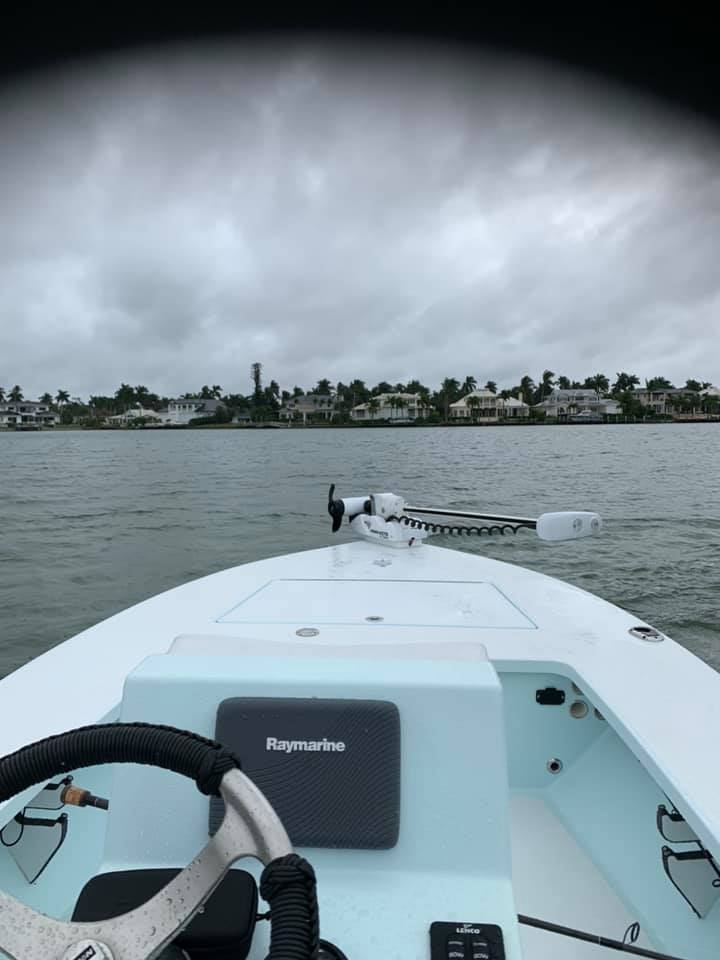
“Something we’ve been installing a lot of are Power Pux,” William says. “And what that is, is a quick-disconnect bracket so that you can take the motor on and off the bow if you need to, but it also is your electric receptacle. So there are no wires on the deck; it’s just a really clean-looking installation. And those cost a little more, but at the minimum I’d recommend a standard quick-disconnect bracket. I can’t remember the last time we installed a motor without one. They’re just really handy if, for example, you’re going to be running a long way and don’t want to beat that motor up in the surf. Or if you’re just going on a pleasure cruise and want a bit more deck space. You just pull a pin, disconnect the power, and take the motor off.”
“Another thing that’s big lately is trolling motors with transducers and wiring built into the shaft and head,” he continues. “That’s another thing that just makes for a really clean install. You can have downscan, side scan, and live scope all built into the head of the trolling motor. It’s pretty neat.”
Trolling Motor Maintenance Tips
Once you’ve picked out the perfect trolling motor for your boat, there are still a few more problems to anticipate in order to make sure you have trouble-free days on the water. According to William, the biggest problems he sees with trolling motors are the result of bad wiring and bad charging practices.
How To Wire Your Trolling Motor
“The biggest thing when you’re wiring up your motor,” he says, “is to make sure that you’re using a heavy enough gauge of wire to handle that amperage. On top of that, make sure you have a good circuit breaker installed to protect the trolling motor and potentially prevent a fire if something goes wrong. Finally, it’s absolutely essential to make sure that those batteries are secured properly. You don’t want them tipping and spilling battery acid, or shorting out.”
How To Charge A Trolling Motor Battery
One everything is wired up correctly, correctly charging your trolling motor batteries is imperative to ensuring that you get the most life out of them and avoid trouble on the water.
“We like to install on-board chargers when we do our installs,” Williams says. “That’s just the simplest way to make sure that folks will actually do the right thing and charge those batteries immediately once they get back to the dock. You don’t want a lead-acid battery to sit empty any longer than necessary, and they will self-discharge over time. An on-board charger lets you just plug an extension cord into the receptacle once you’re done fishing, and it takes care of making sure that your batteries charge correctly and stay topped off.”
Final Thoughts Trolling Motors
In conclusion, choosing the right size motor, powering it with the right battery, and taking the time or spending the money to have it properly installed will prevent a lot of common problems boaters have with trolling motors on their fishing boats. If you’re looking to upgrade your trolling motor and take advantage of the huge improvements that have been brought to market in recent years, be sure to take the time to make sure that motor and batteries will serve your needs on the water for years to come.