
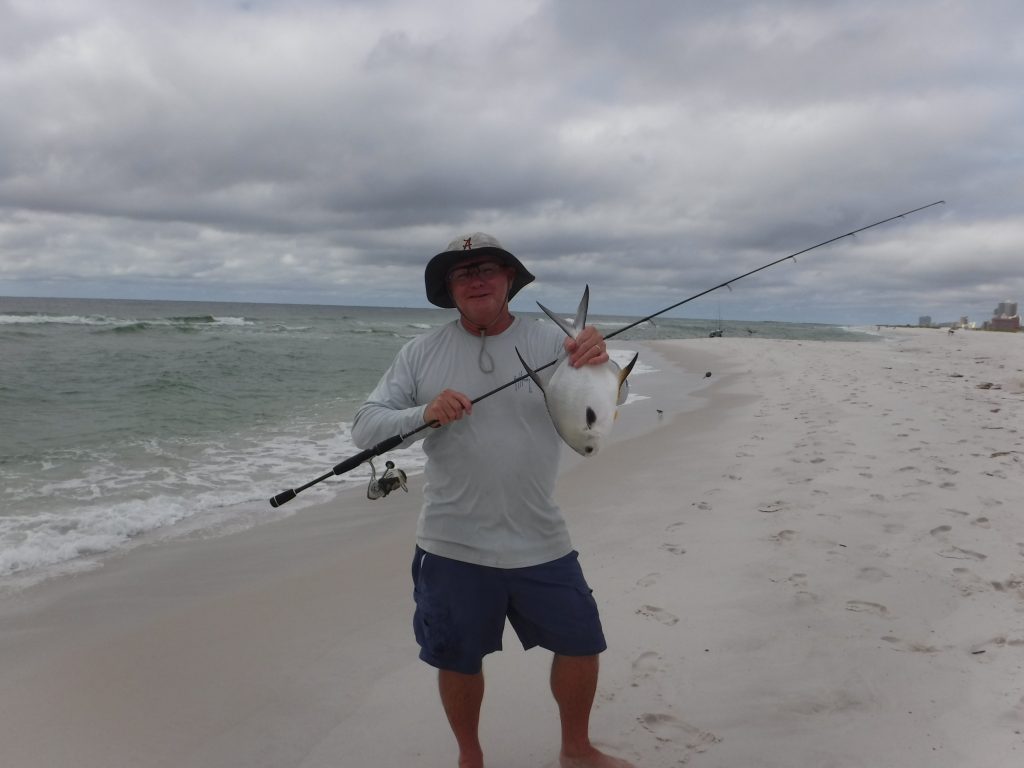
Surf fishing is one of the hottest things happening on the fishing front these days. It seems like everyone who isn’t already set rig fishing from the beach is wanting to try it, or get better at it. There isn’t much more relaxing (or addicting) than sitting on a beach while watching a rod tip (or several) bend slightly from the pressure of passing waves in anticipation it may at any second bend over and the reel start screaming off line. That image is indelibly imprinted in the memory cells of many Emerald Coast surf fishers, old as well as young. Using various surf fishing rigs, such as the fish finder rig, double dropper loop rig, or the high-low rig, enhances the experience and effectiveness of surf fishing. It is an equally great sport for men, women, and children which offers plenty of opportunities to learn more about sport fishing in general, and surf fishing in particular.
Preparation And Planning
Like any other type of fishing, surf fishing is not something we just jump into unprepared, because mother nature’s idiosyncrasies usually have ways of confounding our thoughtless efforts, and too often even outsmarting our best laid plans. The ever changing weather and sea conditions can quickly overcome our expectations, as whenever there is the general lack of our targeted species, or abundance of non-targeted species which can make or break a day. Even experienced beach anglers still call it surf “fishing” and not “catching”. Choosing the right rig and bait to match the conditions and species present is a big step on the road to being more successful and consistent.
First off, if you lack experience at this do some homework to prepare yourself by having at least minimal gear and knowledge. Do a little research online to learn the layout of the beach, or beaches you plan to fish. Check what gear works best for the target species that appeal to you and should be present in the time frame of your visit. Then assemble your working quiver of rods, reels, rigs, lures, and baits. Watch the marine weather forecast as your fishing time gets closer, and have a Plan B or C if the weather is not going to cooperate with your preferred pursuits. Nothing is more frustrating than trying to surf cast into a near gale and raging seas under gunned for the task. Most conditions are fishable IF you have the proper plan and equipment.
The High/Low Or Double Drop Rig
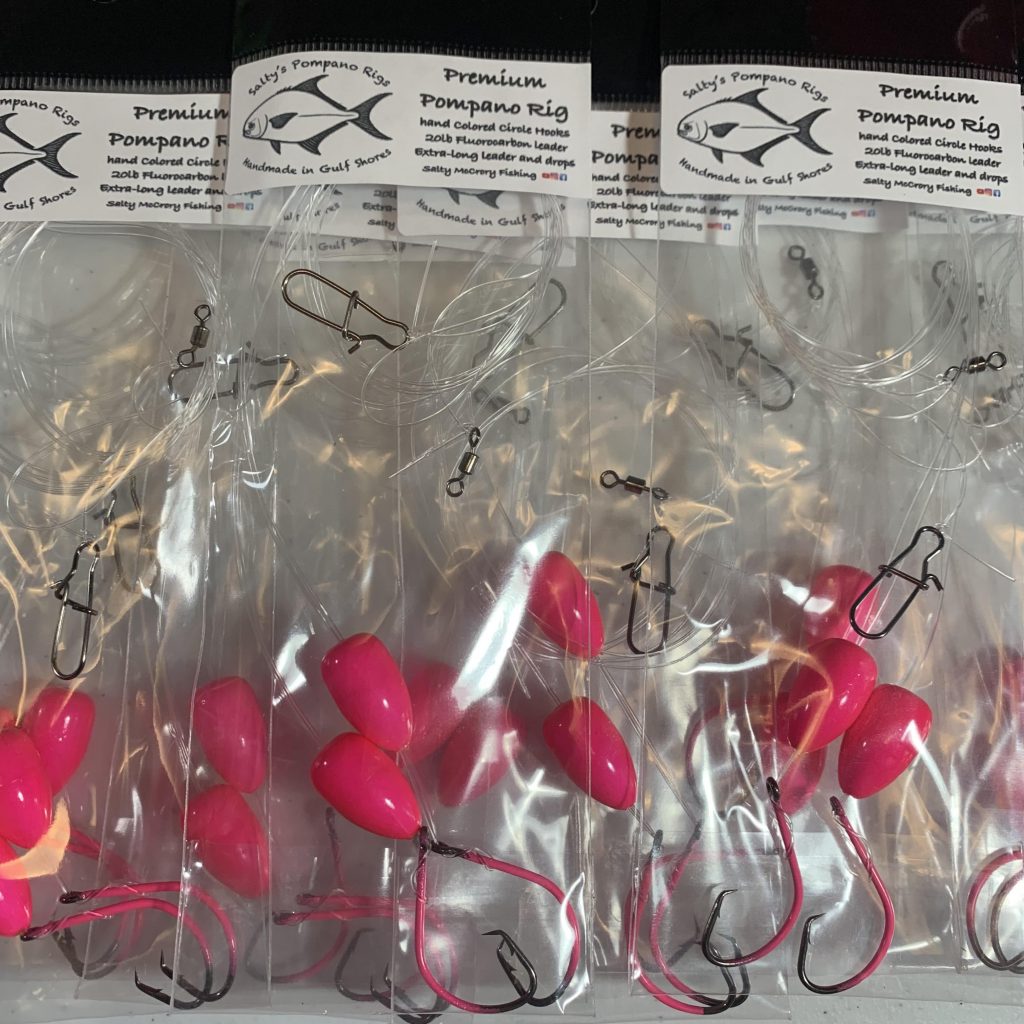
The most popular rig for a variety of conditions is the high/low, mortician, or double drop rig with a weight at the bottom and two offset single hooks branched from the main line. A specialization of this is called a pompano rig when it has beads or floats that act to attract fish (pompano) to the baited hooks. These are available in a wide variety of options at coastal bait & tackle shops differing on the size and style of hooks and color scheme of the attractants used to target the fish and species you want. Most of these are tied by individuals and sold regionally, but several manufacturers, including Fishbites, also produce ready-to-fish surf rigs.
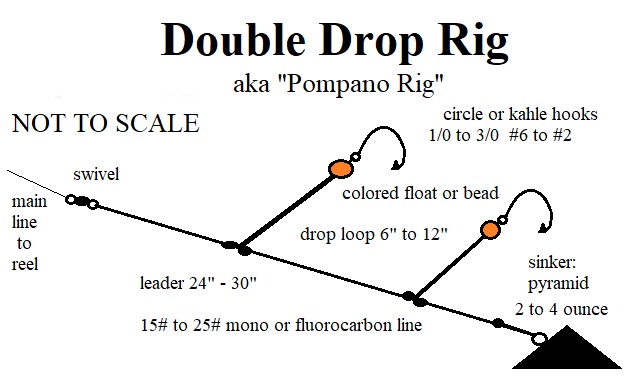
Smaller hooks and weights on these custom made surf fishing rigs are generally targeting whiting and pompano, while larger hooks and weights may be used for bluefish, drum, redfish, rays and small sharks with pieces of fish or crab. The larger/heavier rigs work best to target the bigger species, often in rough water in conjunction with so-called sputnik sinkers that hold bottom better in those conditions. That is why these rigs are usually used on medium heavy or heavy class tackle with 10 to 12 foot rods (or longer), 6000 to 8000 size reels with 300 yards of 20 to 65 pound line.

The idea of this rig is to place one bait near or on the bottom while the other is suspended just above the bottom. This helps fish locate your baits and gives them a choice. The drawbacks include bottom dwellers like crabs and snails may find and eat your bait before the fish do. Plus with two hooks, you go through a lot more bait, another reason a lot of surf anglers choose to supplement their natural bait with pieces of synthetic attractant such as Fishbites. Double drop rigs can be quite productive by combining the two, or simply using synthetics bait strips alone, since the rigs still catch doubles occasionally. These rigs are most often the ones you see set in a sand spike on the beach, patiently awaiting a bite from passing fish.
The Single Drop Rig
A single drop rig is a simpler version of the double drop rig, with just one branch line and a single hook. These are often used in channels or near moderate to heavy surf to make it easier to hold bottom with less weight and resistance in waves or current. They are often tied up on the spot by anglers in the know in order to better target available species under the conditions available. But thoughtful renditions are also available at bait & tackle shops along the coast. The bait presentation may include all natural, synthetic or both whichever is most effective.
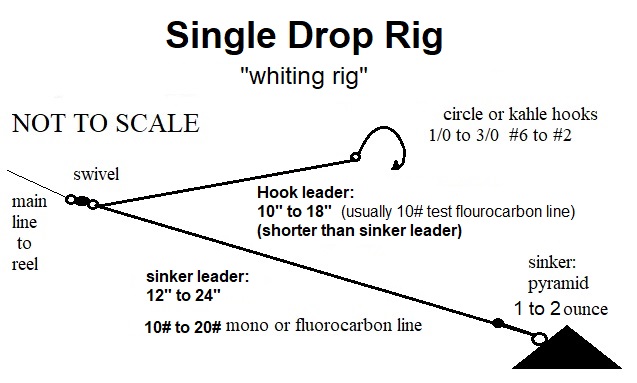
This rig may be placed in a rod holder or sand spike, but is more likely to be closely attended to better monitor any activity while using a single piece of natural bait like shrimp, sand flea, or ghost shrimp. These rigs are mostly used on medium or medium light class tackle like 7 to 9 foot rods with 3000 or 4000 size reels and 10 to 20 pound line. The lighter tackle affords more sensitivity to detect lighter bites from the smaller gamefish in extremely calm conditions when these fish are generally more skittish. Also light tackle is more sporting for these pan fish, but still practical when an occasional redfish or black drum finds the offering. With patience, even these larger fish may be landed on light tackle and even released successfully when handled with care.
The Carolina Rig
The ever popular Carolina rig is a modified Fish Finder rig which uses an egg sinker instead of a sliding snap swivel or sinker slide. All three weight systems employ a leader with a baited single hook (resting on the bottom) on one end, and a swivel on the other that acts as a sinker stop. The weight is free to slide up the main line so a fish taking the bait doesn’t feel any resistance until it gets to the end of the slack in the leader. All the angler has to do is reel the line tight as the fish swims away and give a short jab or two to set the hook firmly in the fish’s mouth. This is why circle hooks and kahle hooks are so effective with these rigs, often producing a very high percentage of hook ups.

Fish Finder rigs are quite versatile for a variety of species from whiting and pompano, up to drum and sharks simply by scaling up or down the size of the terminal rig to match the target species. Again, smaller hooks with small pieces of bait on light (even ultralight) tackle match up well with small mouth species like whiting, croaker, and pompano relatively closer to shore. While larger hooks match up with bigger baits, heavier tackle and large-mouthed species like red and black drum, rays, jack crevalle, and sharks farther from shore. If you scale this rig up for sharks, check current state and federal shark regulations before fishing. Permit rules, approved hooks, species restrictions, and handling requirements can vary by state and season.
Improving Your Surf Fishing Skills
If you are new to the sport of surf fishing, or just want to “up your game”, take a critical look at your terminal tackle and the parameters of the tackle you deliver the baited rig with to determine what you might change to make your surf fishing more successful. The most common mistake by novice surf fishers is trying to use too heavy or large tackle for all species in all conditions. Every good tool box is well stocked with a variety of tools of assorted sizes. Tackle boxes are not much different, in choosing a good basic variety of styles and sizes of all terminal tackle, then matching it with proper sized rods, reels, and line. Experiment with your baits and the presentation of them. Learn to use products like Magic Thread to help keep soft baits on the hook longer so you can catch more fish. Learn how to catch sand fleas, ghost shrimp, or other alternative natural baits. Then practice what, when, where and how to present them to get more bites and land more fish. Never let yourself get complacent into thinking you know it all. Instead strive to use each part of each day to learn a new tactic that can serve you in the future. Keep trying different approaches, changing baits, distances, colors, whatever, until you find what works. Then try to figure out why it worked, or didn’t.
Reading the Surf
Learning to “read the surf” goes a long way to help novice anglers determine the best spots to place their bait, and having an idea what fish they are most likely to encounter there. Look for color changes in the water from darker (deeper) to lighter (shallower). Also where the waves break (sandbar), to where the waves stop rolling (dropoff) so you know the places fish will most likely be looking for food, or avoiding. Take time to study the tides, and how they affect fish movements and feeding patterns in your primary fishing holes. It is far easier to master one area, and apply that knowledge elsewhere than to continually jump around and keep guessing.
The Best Surf Fishing Rigs Take Time
More than a few surf anglers tie up their own beach fishing/surf fishing rigs and some have gotten really good at it. These craftsmen have made it into a science, with their own tying jigs. Some have even turned this into a sideline business by producing and marketing their own lines of surf fishing rigs.
Now it seems like every bait and tackle shop along the coast has displays of the best locally/regionally produced surf fishing rigs for pompano. Each finished pompano rig hanging on a peg in the store represents an investment of time and money by the builder. Plus the store needs to turn a bit of profit too.